Quick wins for a faster PC:
Clear out junk files and repair common Windows errorsFree Scan →Fix the driver behind crashes, sound loss and screen glitchesFind Drivers →Repair Windows errors before they cause bigger problemsFix Now →Elon Musk reportedly said in February 2026 that SpaceX’s near-term emphasis is shifting toward a “self-growing city” on the Moon, while Mars remains a longer-term objective. That is a reported statement—not a formal SpaceX strategy release. The concrete program today is NASA’s Artemis work with SpaceX’s Starship Human Landing System; a privately funded lunar city and a civilization “backup” remain unannounced ambitions.
What Musk reportedly said
A February 13, 2026 TechRepublic report attributed to Musk a plan to focus on building a “self-growing city” on the Moon because lunar missions can fly more often and arrive far sooner than Mars missions. The report described the Moon as a target within less than 10 years, while portraying initial Mars activity as roughly five to seven years away and a Martian city as more than 20 years away.
Those dates should be read as aspirations. The available X material is a secondary summary rather than a clearly authenticated original post (X summary), and no formal SpaceX announcement, funded lunar-city program, published manifest or internal budget establishes a corporate pivot. “Self-growing city” is Musk’s reported description, not a recognized engineering classification.
Why the Moon is a faster strategic target
Short travel and frequent opportunities
A conventional spacecraft can reach the Moon in about three days. Mars missions generally take months and depend on launch windows that occur roughly every 26 months. More frequent lunar opportunities allow hardware to be tested, replaced and resupplied on a much shorter cycle.
The Tool Desk
Outbyte Driver Updater FREEScan for outdated or missing drivers - takes under a minuteDriver Scan →Outbyte PC Repair FREEClear out junk files and repair common Windows errorsFree Scan →#1 Best Overall
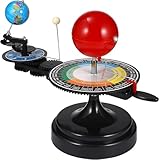
- 【Solar System】: DIY your own sun earth moon orbital rotation model with this creative kit. Seasonal plate that shows the names, order, and dates of the four seasons and the twenty-four solar terms in the traditional Chinese calendar. night, seasons, solar eclipse, lunar eclipse and moon phases .
- 【Usage Scenarios】: Great for Geology & Earth Sciences Teaching, School project also Great gift for your children over 6 years old, it cultivates children's interest in space science. Earth orbiting around the sun, and moon orbiting around the earth showing planetary orbit.
- 【To Demonstrate Seasons and Solar and Lunar Eclipses】: 1)Rotate the Earth to show how the Earth's rotation and orbit around the Sun create seasons; 2)To demonstrate a solar eclipse, move the Moon between the Earth and the Sun, blocking the Sun's light and casting a shadow on the Earth; 3)To demonstrate a lunar eclipse, move the Moon into the Earth's shadow, creating a tint on the Moon.
- 【Easy to Assemble 】: Updated Instruction 1)Wrench the connecting nut to the seasonal plate; 2) Insert the axe to the slot, put the two screws to the corresponding holes, then tighten the screws; 3) Get the “solar system” aligned correctly: Set the handle with the pointer on the summer solstice, adjust the position of the Earth so that the sun shines directly on its Tropic of Cancer; 4)Assemble the gears upper and underneath with the black peg;Put the sun’s metal wire in the hole on the lever.
- 【Size Information】100% brand new and high quality. Size(LxWxH): Approx. 38 x 20 x 28 cm / 15.20 x 7.87 x 11.02 inch.
Near-real-time control
Communication delay with the Moon is only seconds. Mars communications can take several minutes one way, depending on the planets’ positions. Lunar crews and robots can therefore receive instructions, diagnose failures and coordinate emergency responses far more effectively.
A practical test site
The Moon could serve as a nearby proving ground for landing systems, orbital refueling, autonomous construction, power generation, oxygen production, resource extraction, surface mobility and habitat operations. It is a useful stepping stone, but successful lunar demonstrations would not prove that a self-sustaining Mars settlement is ready.
What SpaceX is already doing on the Moon
SpaceX’s lunar role is real through NASA’s Artemis program. NASA is working with the company on Starship as a Human Landing System (HLS), requiring the vehicle to operate as a lunar lander and to rendezvous and dock with Orion in lunar orbit. NASA’s Human Landing System overview describes that role.
NASA’s FY 2026 HLS technical supplement calls for an uncrewed Starship lunar demonstration before crewed landing operations (technical supplement). This contracted work gives SpaceX lunar hardware objectives independent of Musk’s reported city vision. It does not establish that SpaceX has canceled, paused or internally reprioritized Mars development.
Rank #2

- PAINT YOUR OWN MOON LAMP CRAFT KIT: Everything kids need to paint and personalize their own glowing moon lamp in one set. This 20+ piece craft kit includes a paintable moon lamp (5.6" diameter), wooden base, apron, 12 paints, palette, 3 sponge sticks, and 2 brushes for an easy, ready-to-create experience.
- CREATIVE CRAFTS FOR KIDS: Paint stars, galaxies, planets, colorful patterns, or anything they can imagine. In addition to 8 standard paints, the kit is upgraded with 4 metallic paints for even more ways to create. This hands-on arts and crafts for kids ages 8-12 activity encourages creativity through screen-free play and makes a fun painting project for children who love art, DIY crafts, and outer space.
- PAINT BY DAY, GLOW BY NIGHT: The creativity continues after painting. Once finished, their handmade moon becomes a glowing night light for kids' bedrooms, desks, or nightstands. From a fun daytime art project to personalized room decor, kids can proudly display and enjoy something they created themselves.
- REALISTIC 3D LUNAR TEXTURE: Detailed craters and raised ridges recreate the look and feel of the moon while making the painting experience even more engaging. Kids can bring the textured surface to life with color, layer their own details, and turn the blank moon into a unique 3D art project inspired by outer space.
- A FUN GIFT KIDS CAN MAKE & KEEP: A fun craft gift for kids who love painting, space, and DIY projects. Great for birthdays, Christmas, Easter, holidays, or family craft time, this paint your own lamp combines kids crafts, creative play, room decor, and a handmade keepsake they can enjoy long after the activity is finished.
How the announcement fits Artemis
NASA’s current architecture provides a near-term lunar sequence:
| Milestone | What is established |
|---|---|
| Artemis II | NASA says the four-person mission launched April 1, 2026, on a crewed lunar flyby. See the launch announcement and mission page. |
| Artemis III | NASA’s updated plan places a 2027 demonstration involving commercial lunar landers and rendezvous or docking operations. |
| Crewed lunar landing | NASA currently plans crewed landings in 2028 after the demonstration and additional testing. Details are in its Artemis III lander-test update. |
| Longer-term campaign | NASA says it intends to increase mission cadence and build a more enduring lunar presence in its architecture update. |
Artemis is a government-led exploration and infrastructure campaign. Musk’s proposed city is a private vision. The two could share vehicles, technology and destinations, but they are not the same project and NASA’s dates are not a SpaceX settlement schedule.
Moon first does not mean Mars is canceled
The strongest interpretation is sequencing: use the Moon for faster learning and logistics while retaining Mars as the more distant settlement goal. Nothing in the available evidence proves that SpaceX has abandoned Mars or transferred a defined Mars budget to lunar construction.
Mars still has strategic advantages. Its atmosphere can assist aerobraking and some landing concepts, its day is close to Earth’s 24-hour cycle, and accessible water ice exists in some regions. For futurists seeking a large, autonomous settlement, Mars may offer a more plausible long-term environment than the airless Moon.
Rank #3

- HOBBY MODEL KIT – Unassembled model packed in an envelope with easy to follow instructions. Ideal for ages 14 and up.
- NO GLUE OR SOLDER NEEDED – Parts can be easily clipped from the metal sheets. Tweezers are the recommended tool for bending and twisting the connection tabs.
- PREMIUM SERIES ARTEMIS MOON ROCKET - 3.50 Sheet Model with a Challenging difficulty level. Once assembled, dimensions are 3.30 L x 2.88 W x 7.40 H inches. 115 Pieces. 1:522 Scale.
- FROM STEEL SHEETS TO 3D – Pop out the pieces and connect using tabs and holes. Includes illustrated instructions
- HIGHLY DETAILED ETCHED MODEL – Display your 3D model once completed - collect and build them all.
Conversely, a lunar base does not solve the hardest Mars problems: long-duration radiation exposure, closed-loop life support, food production, governance and economic self-sufficiency. “Moon first” is therefore a strategic ordering question, not proof that the Moon is an easier final home.
What a “self-growing” lunar city would require
A settlement would be self-growing only if it could add population and industrial capacity without a proportional increase in Earth-supplied mass. Adding prefabricated modules while importing every critical consumable would be expansion, not self-sufficiency.
- Transport and refueling: repeated launches, orbital propellant transfer, lunar descent, ascent and return operations.
- Power: dependable generation, storage and distribution through long lunar nights, especially outside continuously sunlit terrain.
- Shielding: buried habitats, regolith berms or water stores to reduce radiation exposure.
- Water and oxygen: extraction and purification systems, with site-specific proof that ice is accessible at useful rates and energy costs.
- Construction: autonomous machines able to work in vacuum, dust, darkness and extreme temperatures.
- Food and life support: increasingly closed-loop recycling, crop production, replacement filters, medicine and clothing.
- Industry: machine tools, spare parts, electronics, communications, navigation and repair capability.
- Safety: medical facilities, redundant systems, emergency shelters, rescue plans and reliable links to Earth.
The engineering obstacles are substantial
Transportation complexity
Starship’s lunar architecture requires more than a successful launch. It depends on multiple flights, orbital assembly or refueling, deep-space navigation, a controlled lunar landing, surface operations, ascent and a safe return. NASA’s planned uncrewed demonstration and propellant-transfer work are prerequisites, not optional refinements.
Dust
Lunar regolith is abrasive and electrostatically active. It can damage seals, machinery and optics, contaminate habitats and spacesuits, and threaten human lungs. A settlement must design dust control into every airlock, vehicle and maintenance procedure.
Free tools Windows power users keep installed
One-click scans. No signup required.
Rank #4

- DIY your own sun earth moon orbital planetarium model with this creative kit. This three dimensional model represents the earths changing position with regard to the sun and the moon
- Model equipped with a light that is located inside of the sun to show the effect that sunlight has and the moon
- Great for Geology & Teaching, School project, also Great for your children, it cultivates childrens interest in space science. Earth orbiting around the sun, and moon orbiting showing planetary
- Mounted on a sturdy base, which is labeled with each month of the year, allowing learners to explore the relative positions of the earth both monthly and seasonally
- Sun-earth-moon model can demonstrate the rotation of the Earth, the change of day and night in the same place, the change of day and night at the same time and so on. Let students learn astronomy knowledge by operating this model. Funny educational model for you to choose!
Radiation and temperature
The Moon has no substantial atmosphere or global magnetic field. Habitats need serious shielding, while long darkness periods and severe thermal swings demand highly reliable power storage and thermal control. Polar sites may help with sunlight and ice access, but they bring difficult terrain and uncertain resource economics.
Human health and support
Long-term exposure to low gravity, radiation, isolation and limited medical capability remains poorly understood. A permanent population would need robust health monitoring, emergency treatment and a way to evacuate or shelter people when systems fail.
Independent reader supportYour contribution helps us test, update, and keep practical guides available for everyone.Why “saving civilization” is a much higher bar
A small lunar outpost would be an off-Earth foothold, not a civilization backup. A genuine backup would require a large, genetically and socially viable population; independent food, water and energy systems; industrial production; governance; education; medical capability; and resilience against failures on both the Moon and Earth.
A settlement that depends on regular shipments of oxygen, food, electronics, medicine and replacement parts remains an extension of Earth infrastructure. The Moon is closer than Mars, but its vacuum, radiation, dust and thermal environment make it a hostile place to maintain even a small community.
Best Value

- 【About lights and stand】Sound activated Led lights set and acylic stand are included in the 3D puzzle package. The acrylic stand of the 3D puzzle will be more beautiful if you peel off the film at the surface.
- 【MU Tools】MU 3D puzzles assembling tools are recommended, but not included in the 3D model kits package(you can find tools set in our store). Parts can be easily cut off the sheets. Tweezers or hair clippers are the recommended tool for bending and twisting the connecting tabs. Also you can contact us for broken pieces.
- 【Recommended for Ages 14+】Even though you are a beginner for 3D metal puzzles, there is no problems for you to successfully assemble them with the detailed manual instruction. Great for training and improving teens’ stereopsis vision and manipulative ability. Finished 3D metal model size: 150*100*170mm
- 【Diagram Mannual Book】Even though you are a beginner at 3D metal puzzles, there are no problems for you to successfully assemble them with the detailed manual instruction.
- 【MU Exqusite Package】Unassembled metal model sheets packed in a exquisite color style box with easy to follow instructions. Perfect for being as gift for a Birthday, Valentine's Day, Father's Day, Teacher's Day, Christmas, Thanksgiving, etc
The China factor and the “race” narrative
NASA’s Artemis partnerships frame the lunar campaign around international cooperation, sustained exploration and infrastructure. Lunar south-pole access could have scientific, commercial and strategic value through communications, navigation and resource systems.
Competition language can clarify why governments care about early access, but it can also obscure safety, funding and schedule realities. A national milestone, a commercial delivery and a self-sufficient city are different achievements and should not be treated as interchangeable.
How to tell a rhetoric shift from a real pivot
- Look for direct evidence: an original Musk post, SpaceX statement or formal program document.
- Check resources: disclosed personnel, hardware, procurement or funding assigned beyond existing Artemis obligations.
- Track milestones: lunar cargo, refueling, surface systems and habitation tests beyond NASA’s contracted requirements.
- Demand a manifest: a credible city proposal needs a sequence of missions, cargo capacities and dates.
- Define “city”: distinguish a single habitat, research base, industrial outpost and self-sufficient settlement.
- Test independence: determine whether the plan is privately funded, NASA-supported or dependent on government missions.
What is known—and what is not
| Claim | Evidence level |
|---|---|
| Starship HLS development for Artemis | NASA program documentation and contract work. |
| Uncrewed Starship lunar demonstration | NASA program requirement before crewed landings. |
| Artemis III demonstration in 2027 | NASA’s current architecture. |
| Crewed lunar landing in 2028 | NASA’s current plan, subject to program execution. |
| Self-growing lunar city within 10 years | Reported Musk aspiration; no independently verified SpaceX schedule. |
| Self-sufficient civilization backup | No demonstrated plan, funding or operational definition. |
Bottom line
Musk’s reported Moon-first emphasis is plausible as a change in public rhetoric and aligns with SpaceX’s existing Artemis responsibilities. The Moon offers faster travel, more frequent launch opportunities, lower communications delay and a nearby test site. But the evidence does not show a formal Mars cancellation or an operational lunar-city program. Until SpaceX publishes funded milestones, hardware commitments and a clear definition of self-sufficiency, the city—and the claim that it could save civilization—remains an ambitious vision rather than an established project.
Quick Recap
Product prices and availability are accurate as of the date/time indicated and are subject to change. Any price and availability information displayed on Amazon at the time of purchase will apply.
Do these 3 things before closing this tab:
1Repair Windows errors before they cause bigger problems2Scan for outdated or missing drivers - takes under a minute3Clear out junk files and repair common Windows errors



