Quick wins for a faster PC:
Clear out junk files and repair common Windows errorsFree Scan →Scan for outdated or missing drivers - takes under a minuteDriver Scan →Repair Windows errors before they cause bigger problemsFix Now →On September 26, 2013, eBay brought a data center in South Jordan, Utah, online with 30 Bloom Energy Servers supplying its IT load as the normal power source. The utility grid remained available as backup. The project was a historical redesign of data-center power—not a recent launch, an off-grid facility, or a solar installation.
What eBay brought online
The new building stood beside eBay’s existing Utah data center, which had opened in 2010 and was LEED Gold-certified. Rather than add fuel cells as a supplemental source, eBay made them the principal supply for the new facility’s IT load. Its announcement described the Bloom Energy Servers as the primary on-site power source; the launch report said the utility grid would serve as backup. eBay’s opening announcement and the contemporary launch report establish the date, location, and arrangement.
This “Bloom first” arrangement reversed the usual hierarchy: instead of drawing routine power from the grid and reserving generators and UPS equipment for outages, the Utah design relied on on-site fuel cells for normal operation. It was still connected to the grid, so it was not off-grid or fully independent of utility service. Reporting described a move away from conventional diesel-generator and UPS reliance, but did not publish a complete electrical diagram or inventory. It therefore does not establish that every battery, transfer system, switchgear component, or other protection device was removed.
How the fuel-cell power system worked
Bloom Energy Servers use solid-oxide fuel cells. In a fuel cell, an electrochemical process converts fuel into electricity rather than producing power by burning fuel in a conventional engine or turbine. That enables continuous on-site generation; unlike solar or wind, it is not inherently intermittent. Bloom’s product announcement described an approximate 100-kilowatt server and the technology’s potential to use renewable fuels, but that product description is not a measurement of the output or configuration of eBay’s installed units. Bloom’s technology announcement provides that product context.
Crashes, No Sound, or Screen Glitches?
Random freezes, missing sound and display glitches usually trace back to one bad driver. Find and replace yours safely.Free scan · under a minuteWindows Errors? Fix Them Before They Spread
Repair common Windows errors and clear accumulated junk for a smoother, more stable PC - no reinstall needed.Free scan · no reinstall#1 Best Overall

- Size: The fuel cell measures 24" (L) × 20" (W) × 10" (H), and the inlet/outlet fitting size is 10AN.
- Application: This gas fuel cell is compatible with fuel,diesel, alcohol, methanol, water and ethanol, not fit for E85 gasoline, methanol and ethanol when working with CPE fuel lines.
- Features: The package includes one aluminum fuel cell with a built-in 3–90 ohm level sensor and internal anti-slosh foam.
- Material: The drift fuel cell tank is made of 1060-H24 aluminum alloy, and the cover is made of plastic.
- Note: Anti-slosh foam is built inside the fuel cell tank to improve fuel delivery and prevent flashback explosions. Please check the foam regularly for deterioration.
The fuel reported for eBay’s operating installation was natural gas. eBay’s earlier announcement discussed biogas as a possible renewable-fuel pathway, but that is not evidence that biogas powered the site at launch. A natural-gas fuel cell is not solar-powered, hydrogen-only, or zero-carbon: its electricity depends on a fuel supply, and the full climate impact includes more than emissions at the point of generation.
Capacity, expected generation, and the emissions claim
eBay’s project announcement described a planned 6-megawatt Bloom installation made up of 30 servers. It also estimated that each server would generate about 1.75 million kilowatt-hours annually. Multiplying that estimate by 30 yields about 52.5 million kilowatt-hours per year. These are announced capacity and expected-generation figures, not verified records of the facility’s delivered electricity or the IT load actually served. eBay’s project announcement contains the capacity and annual-generation estimates.
eBay said the new design was expected to produce approximately 49% less CO₂ emissions than its first-phase data center. That is a company expectation for a specific comparison, not a general finding that Bloom fuel cells emit 49% less carbon than every alternative. The available launch reporting does not establish the Utah site’s long-term measured emissions, fuel consumption, power usage effectiveness (PUE), or lifecycle carbon footprint. Those would be needed to assess actual performance, including upstream fuel emissions and equipment impacts.
Why the computing and cooling design mattered
The project paired its power approach with modular, high-density computing and cooling systems. Contemporary reporting described two modules:
Rank #2
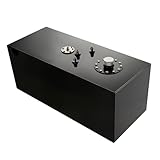
- Size: The fuel cell measures 29.5" (L) × 12" (W) × 12" (H), and the inlet/outlet fitting size is 8AN.
- Application: This gas fuel cell is compatible with fuel,diesel, alcohol, methanol, water and ethanol, not fit for E85 gasoline, methanol and ethanol when working with CPE fuel lines.
- Features: The package includes one aluminum fuel cell with a built-in 3–90 ohm level sensor.
- Material: The drift fuel cell tank is made of 1060-H24 aluminum alloy, and the cover is made of plastic.
- Note: Monitor the fuel level in the tank to alert the vehicle operator to refill it in time.
| Module | Reported configuration | Cooling approach reported |
|---|---|---|
| Dell EPIC | More than 1 MW of IT power capacity across 24 racks, or nearly 50 kW per rack | Fresh-air and evaporative cooling |
| HP EcoPOD | 44 racks and about 1.4 MW of power capacity; a double-wide arrangement joining two 40-foot containers | Could use outside air |
The cooling descriptions apply to the reported modules, not necessarily every system across the campus; they do not establish that the entire facility used no water. Taken together, the fuel cells, modular deployment, rack density, and outside-air or evaporative cooling show that eBay was rethinking more than its generator choice. It was combining power, cooling, and compute design in one infrastructure project. The launch report gives the module specifications and cooling details.
The Ormat waste-heat idea was a follow-on plan
eBay also announced work with Ormat on an off-site system intended to recover waste heat associated with the natural-gas pipeline feeding the fuel cells and convert it into electricity. The launch report said construction could take up to 18 months and that the system was expected eventually to provide up to 5 MW. It was a planned follow-on project, not a confirmed operating component of the data center at launch; the available report does not establish whether it was completed or how it performed.
Independent reader supportYour contribution helps us test, update, and keep practical guides available for everyone.What the architecture could improve—and what it could not prove
Generating electricity close to a data center can reduce dependence on utility delivery and some transmission and distribution losses. A continuous on-site source can also change how operators plan for grid interruptions and standby equipment. eBay presented the arrangement as a way to improve resilience and efficiency, but the launch coverage does not supply uptime results or enough engineering detail to prove that it was more reliable in operation.
Important reliability questions remain unanswered in the published account: how the facility handled simultaneous fuel-cell failures, how quickly it could transfer to utility power, what short-duration ride-through equipment remained, how maintenance outages were managed, and whether interruption of the gas supply could affect multiple units at once. Without a one-line diagram and operating data, no particular redundancy scheme should be inferred. The retained utility connection is a key part of the design, not a detail to omit.
Do these 3 things before closing this tab:
1Fix the driver behind crashes, sound loss and screen glitches2Repair Windows errors before they cause bigger problems3Scan for outdated or missing drivers - takes under a minuteRank #3

- With 13,000 watts of power, the XP13000HXT Tri Fuel generator will keep your whole home running during a storm or power outage, while protecting your family from harmful fumes with CO Alert
- Run your generator on gasoline, propane, or natural gas. With Tri Fuel, we offer the ultimate freedom and flexibility of fuel choice
- Powerful 500cc OHV Engine: At the heart of this generator resides a robust DuroMax engine designed to provide you with the most power.
- The XP13000HXT comes with a push button start, a front facing interface that allows you to change your fuel type in seconds, and a wide variety of outlets including a transfer switch-ready 50 amp outlet
- Push Button Start and Remote Start: Turn on your generator with a simple push of a button, or use the remote to conveniently start your generator from a distance.
The emissions case also depends on the accounting boundary and fuel. Natural-gas operation avoids combustion inside the fuel-cell stack, but that alone does not establish zero emissions or a lower lifecycle footprint. A full assessment would distinguish on-site emissions, upstream fuel emissions, equipment manufacturing and replacement, avoided grid losses, diesel-generator testing or emergency use, and any renewable-gas accounting. The launch report does not provide that full assessment or disclosed project costs, fuel and maintenance expenses, cost per kilowatt-hour, or payback period.
How the Utah project fit eBay’s 2013 infrastructure
The launch report placed the project within a broader efficiency program. At the time, eBay was reported to operate 13 data centers globally, with 52,500 servers and about 31.2 MW of IT load. Its reported total-footprint PUE was 1.5, down from 2.0 in 2008. These are 2013 figures, not current metrics. PUE compares total facility energy with IT equipment energy; the reported improvement provides historical context but does not isolate the Utah facility’s performance.
eBay framed the Utah development as a new architecture that put on-site energy generation into the facility’s design rather than treating sustainability as an add-on. Its official material used pioneering language about the approach. The contemporary reporting supports the specific deployment described here; it does not establish that the project was the first of its kind under every possible definition, or that its design became a universal template.
Quick Recap
Product prices and availability are accurate as of the date/time indicated and are subject to change. Any price and availability information displayed on Amazon at the time of purchase will apply.




