On February 22, 2010, SAS subsidiary DataFlux announced the DataFlux Data Management Platform, combining master data management (MDM), data quality and data integration in one enterprise suite. Internally called Project Unity, it was DataFlux’s answer to a market in which IBM and Informatica were expanding through acquisitions. The announcement was a strategic bid to simplify how organizations managed data—not evidence that DataFlux displaced those competitors. The platform’s longer-term story is also one of change: SAS later integrated the DataFlux portfolio, ending its role as a separately licensed product line.
Why master data management mattered in 2010
Master data is the shared information an organization relies on across systems: customers, products, suppliers and locations, for example. When the same customer appears under different spellings or identifiers in billing, customer relationship management (CRM) and reporting systems, teams can make decisions from conflicting records. Mergers and acquisitions make the problem harder by bringing together overlapping databases, definitions and processes.


MDM is more than deduplication. Organizations need to decide which records represent the same entity, which source is authoritative for each field, who owns the data, how changes are approved, and how trusted records reach the systems that use them. That work depends on data quality and integration: teams must find, profile, standardize and connect source data before a dependable master record can be maintained. The 2010 launch coverage described this market context and DataFlux’s offering in Computerworld’s report.
Why the competitive stakes were rising
The “giants” framing came from contemporary coverage of an increasingly consolidated MDM market. Informatica had acquired Siperian, while IBM was moving to acquire Initiate Systems. Both developments signaled that major enterprise vendors were strengthening their MDM positions.
What’s actually slowing this PC down?
Pick the symptom - the matching free tool is one click away.
#1 Best Overall
DataFlux, then a SAS subsidiary, took a different route in its pitch: it combined data-quality, data-integration and MDM capabilities associated with DataFlux and SAS rather than centering the announcement on an acquisition. These companies overlapped, but they were not interchangeable. Their product architectures, existing customer bases, services and broader portfolios differed. The announcement established DataFlux’s competitive positioning, not a market-share victory over IBM or Informatica.
What DataFlux announced
The DataFlux Data Management Platform, known internally as Project Unity, was presented as a common environment for IT data-management teams, data stewards and business analysts. Its purpose was to let teams design, test, monitor and reuse data-management processes across projects. DataFlux described the platform as a combined approach to MDM, data quality and integration; EDN’s launch coverage also reported the unified-platform pitch.
It was not simply a database or customer registry. SAS documentation for the platform describes a component-based environment: Studio for building and managing data-management work, Server for deploying jobs and services, and supporting repositories and connections. The SAS platform overview outlines that architecture. A representative workflow was:
- Discover and profile source data to understand its structure and quality.
- Define business rules and metadata, including terms and standards that teams can share.
- Standardize and transform records, applying repeatable cleansing rules.
- Connect disparate systems through batch, real-time or virtual integration methods.
- Match and merge records to create or maintain customer, product or other master data.
- Monitor data quality and compliance, then deploy jobs or real-time services through DataFlux Data Management Server.
The intent was to reuse rules and other assets instead of recreating them for each project, while enabling business stewards and technical staff to collaborate. The SAS Studio overview details capabilities spanning data quality, integration, MDM, governance, metadata and enrichment.
Crashes, No Sound, or Screen Glitches?
Random freezes, missing sound and display glitches usually trace back to one bad driver. Find and replace yours safely.Free scan · under a minutePC Slower Than It Used to Be?
A free scan shows the junk files, broken settings and background clutter dragging Windows down - then fixes them in one click.Free scan · Windows 10 & 11What convergence could—and could not—solve
The central differentiator was convergence: data quality, integration and MDM were brought together in a more unified interface and operating model. In organizations where those functions had been bought as separate tools, a shared environment could reduce product-boundary friction, make rules easier to reuse and give business and IT teams a common place to work. It also offered a single primary vendor relationship.
That was a strategic advantage, not proof of universal technical superiority. A unified suite may be broader than a buyer needs, overlap with tools already deployed or increase dependence on one vendor. Nor does one platform remove the work of connecting to existing databases, applications and processes. Data stewards may contribute to rule design, but deployment, data modeling, security and operations still require specialist skills. MDM outcomes also depend on governance, ownership and implementation discipline, not just software.
Rank #3
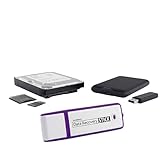
- The Data Recovery Stick requires no technical skills — simply plug it into your Windows computer, click Start, and the software automatically begins scanning and recovering lost files within minutes. Compatible with Windows Vista, 7, 8, 10, & 11, it's designed to be a reliable first step when accidental deletion occurs.
- Recover photos (JPG, BMP, PNG, TIFF), Microsoft Office documents (Word, Excel, PowerPoint, Publisher, Access), Open Office files, MP3 music files, PDFs, RTF documents, AutoCAD files, and HTML web pages. Whether it's personal memories or critical business files, the Data Recovery Stick covers the file types that matter most.
- Works with hard drives, USB drives, SD cards, memory sticks, and other common storage formats that use FAT or NTFS file systems — making it a single solution for hard drive recovery, USB drive recovery, SD card recovery, and more. Note: a media reader is required for micro SD cards and some mass storage devices.
- No Installation Required - The Data Recovery Stick runs entirely from the USB drive with no software installation on your computer — helping prevent new data from overwriting the files you're trying to recover. This also makes it ideal for use across multiple computers or in emergency situations where installation isn't practical.
- Use the Data Recovery Stick on as many computers as often as needed — simply clear the recovered data between uses to free up storage space. Software updates keep the tool compatible with newer systems and devices, backed by 25+ years of data software expertise from Paraben Consumer Software.
The rip-and-replace problem
Many potential buyers already had an investment in integration, data-quality or MDM software. Replacing it all at once could disrupt operational workflows and multiply migration work. DataFlux acknowledged that customers might not want a wholesale replacement and presented integration with existing systems and gradual migration as alternatives. That was the vendor’s stated approach, not independent evidence that every migration would be straightforward.
For an organization assessing that strategy, the practical questions were whether the platform could coexist with its current IBM, Informatica, SAS, CRM, ERP and warehouse systems; whether it could be introduced one data domain at a time; and whether its existing rules and processes could be retained or had to be rebuilt. Customer and product data also have different matching, survivorship, hierarchy and governance requirements. A common platform does not eliminate that domain-specific modeling.
Quick wins for a faster PC:
Clear out junk files and repair common Windows errorsFree Scan →Scan for outdated or missing drivers - takes under a minuteDriver Scan →Repair Windows errors before they cause bigger problemsFix Now →Historical price was only one part of the economics
Computerworld reported a 2010 starting price of about $100,000–$150,000 for the platform. That is historical launch-era pricing, not a current quote, and it does not establish that DataFlux was cheaper than competing products. The same coverage cautioned that a complete MDM implementation could cost much more, potentially reaching seven figures.
The distinction matters because implementation costs extend beyond software licensing: data remediation, integration, stewardship, infrastructure, change management and ongoing operations all affect total cost. The platform was enterprise software, not a modern self-service SaaS offering. Buyers would have needed to evaluate deployment and administration requirements as well as the scope of the license.
Independent reader supportYour contribution helps us test, update, and keep practical guides available for everyone.What happened to DataFlux after the launch
DataFlux should be understood today as a former SAS subsidiary and a product lineage, not an independent modern platform vendor. SAS says that DataFlux products were incorporated into broader SAS offerings; some were renamed and others replaced, and they were no longer licensed separately as standalone offerings. Its account of the transition is in the SAS Help Center’s DataFlux overview.
The product history is not a simple story of every component vanishing. As of August 18, 2026, SAS documentation still listed DataFlux-branded Studio and Server components in supported or legacy product lines, including Data Management Server 2.10 hot fixes. The Server support page and 2.10 hot-fix listing provide component-level references. Support status must be checked for the exact product, release and operating system; a listed legacy component does not mean the former DataFlux suite remains a separately licensed, unified product portfolio.
Do these 3 things before closing this tab:
1Repair Windows errors before they cause bigger problems2Fix the driver behind crashes, sound loss and screen glitches3Clear out junk files and repair common Windows errorsBest Value

- FAST AND EFFICIENT TRANSFER OPTIONS - Seamlessly migrate your PC with Laplink’s PCmover, including download instructions for PCmover and SafeErase to securely wipe old data, plus an optional Ultra High Speed Thunderbolt Transfer Cable (both PCs must have Thunderbolt 3 or 4 ports). Now with Wi-Fi Direct for faster connections. One license allows unlimited transfers between one source and one destination; additional licenses are needed for more PCs.
- AI-ASSISTED TRANSFER INSIGHTS - PCmover’s AI Assistant generates a clear summary of transferable items, lets you ask questions, make adjustments, and recommends the best options for your migration. Enjoy a personalized, interactive setup experience that guides you step-by-step.
- COMPATIBLE WITH THUNDERBOLT 3 & 4: This is a Thunderbolt 4 cable that utilizes USB Type-C connectors, offering powerful compatibility for Thunderbolt 4 and Thunderbolt 3 ports. Please note: To maximize the full speed of Thunderbolt 4, both computers must have Thunderbolt 4 ports. Both PCs must have either Thunderbolt 3 or 4.
- COMPLETE SELECTIVITY FOR CUSTOMIZED TRANSFERS - Enjoy full control with PCmover’s selectivity feature. Choose specific applications, files, folders, and settings to transfer for a tailored experience. With the option to "undo" changes, PCmover makes it easy to fine-tune your migration to fit your preferences.
- SEAMLESS COMPATIBILITY ACROSS WINDOWS VERSIONS - Easily transfer data between Windows XP, Vista, 7, 8, 8.1, 10, and Windows 11. PCmover’s comprehensive compatibility ensures reliability across platforms, so your data arrives exactly as it should.
Version details also should not be projected back onto the 2010 announcement. For example, SAS documentation for DataFlux Data Management Studio 2.9 specifies Java 8 and says DataFlux Web Studio was unavailable in that release; those are release-specific details, not launch-era requirements. See the Studio 2.9 “What’s New” page. SAS also states that support for the NCOA, CASS, SERP and non-Loqate geocoding data packs ended on July 31, 2023, as set out in its Data Management Server documentation.
What the launch ultimately meant
DataFlux’s 2010 move was notable because it framed MDM as part of a broader data-management operating model: profiling and improving data, integrating sources, and managing trusted master records together. That was a distinct strategic response to rivals expanding through acquisitions. Its promise was fewer seams between capabilities and more reusable work; its limits were the familiar ones of enterprise platforms—existing-stack overlap, migration effort, implementation cost and dependence on sound governance.
The evidence supports describing the announcement and its strategy, not claiming that it revolutionized the market or beat IBM and Informatica. In retrospect, the more durable development was SAS’s integration of DataFlux into its own portfolio, rather than the emergence of DataFlux as a lasting independent challenger.
Quick Recap
Product prices and availability are accurate as of the date/time indicated and are subject to change. Any price and availability information displayed on Amazon at the time of purchase will apply.
Recommended Free Tools




