The Tool Desk
Outbyte PC Repair FREEClear out junk files and repair common Windows errorsFree Scan →Outbyte Driver Updater FREEFix the driver behind crashes, sound loss and screen glitchesFind Drivers →A transition services agreement (TSA) is a temporary contract for services a seller continues providing after a business is separated, helping it keep operating while the buyer arranges an independent solution. It is a continuity bridge, not the separation plan itself: each service needs a defined scope, an owner, and an intended exit route.
What is a transition services agreement?
In a carve-out, the business being sold may rely on its parent for people, systems, contracts, data, or facilities. If those shared capabilities cannot be separated by closing, a TSA can allow specified services to continue afterward. Deloitte describes this role as particularly relevant when the carved-out business does not yet have standalone infrastructure.
The agreement buys time to preserve operations while the buyer transfers work, builds capability, engages a provider, or decides a service is no longer needed. It does not by itself separate shared systems, assign lasting ownership, or create a plan for operating independently. Those decisions require coordinated separation work alongside the contract.
What can a TSA cover?
The service catalog depends on the business and its actual dependencies; no category is automatically required. Examples in carve-out guidance include:
#1 Best Overall

- QUALITY INVOICES: Adams Order books provide a professional invoice or customer receipt; a great way to create and maintain a professional image for small businesses and service providers
- 50 TWO-PART CARBONLESS FORMS: Customers get the perforated white top copy; retain the canary and pink copies for your records
- WRAP-AROUND COVER: Fold the back cover between sets to keep invoices neat and legible
- ROOM FOR CUSTOMIZATION: A blank space at top leaves room for your company stamp; a big savings over custom-printed forms
- CONSECUTIVELY NUMBERED: Large 6-digit numbers in the upper right hand corner help you thumb through orders quickly
- IT separation and operational support;
- HR and payroll;
- finance and accounting;
- legal administration;
- facilities;
- procurement and third-party vendor management; and
- other day-to-day business services needed for continuity.
ICAEW’s sell-side carve-out guidance distinguishes the agreement’s legal terms from its operational schedules. The schedules should make clear what the provider will actually do and where the service begins and ends. “IT support,” for example, is not a useful scope on its own unless the parties specify the activities and boundaries it covers.
Legal terms and operational schedules
| Part of the TSA | What it should address |
|---|---|
| Legal terms | Payment, governance, performance obligations, third-party consents, cost liability, confidentiality, termination, dispute resolution, and related contractual provisions. |
| Operational schedules | Service scope and delivery, commercial structure, applicable service levels, and services excluded from scope. |
For each service, connect the schedule to the actual Day One operating need: what continues, what changes at closing, and what is expressly outside the provider’s responsibility. A generic catalog can leave both sides unclear about the work required to maintain continuity.
Rank #2

- 2-part billing form
- Carbonless with white original and canary duplicate
- Book size: 8 1/2 x 8 1/4 inches
- Detached size: 8 1/2 x 7 3/4 inches
- Convenient spiral bound booklet
How do you decide what belongs in the TSA?
Begin with the target’s dependencies, not a standard list of services. Identify which shared people, systems, contracts, data, and facilities the business uses, then assess each dependency against the planned operating model. ICAEW’s guidance on carve-out planning emphasizes early, cross-functional Day One discussions to support continuity and a clear separation route.
KPMG’s Separation in practice (April 2026) recommends using a TSA for service gaps that cannot reasonably be discontinued, replicated, outsourced, or transferred by Day One. Its practical implication is to avoid including work merely because the seller currently performs it: establish why continuity is needed and what would have to happen for the service to end.
Rank #3
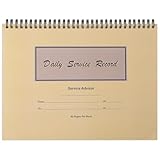
- Record Book: the package includes 1 daily service record book with 80 sheets, offering ample space to meet daily logging needs; It's a practical tool for tracking appointments, managing tasks, and enhancing customer service efficiency
- Ideal Size: measuring 8.5 x 11 inches, this activity log notepad balances portability and capacity; With 80 pages, it's ideal for daily use in the automotive industry, serving as a reliable service record management tool for consistent tracking
- Nice Quality: crafted from quality paper, the activity log book features reliable coil binding for easy page turning and tear-out; Its structured layout provides ample space for detailed entries, supporting effective schedule planning
- Friendly Design: designed for convenience, the daily log book's coil binding allows effortless sheet removal whenever needed; The intuitive layout ensures quick access to logging sections, making daily activity recording simple and efficient
- Versatile Usage: the service log book is a helper for the automotive industry or individuals to record scheduled maintenance, the shop can use it to register the maintenance needs of different customers, individuals can use it to keep track of flat rate hours
Compare the available routes
| Route | When it may fit | What to weigh |
|---|---|---|
| Transfer to the buyer | The buyer can take on the work or relevant capability. | Continuity risk, implementation time, cost, seller dependence, and fit with the buyer’s operating model. |
| Build standalone capability | The business needs its own people, processes, or systems. | Time and resources to establish the capability, and whether the transition can be completed without disrupting operations. |
| Outsource | A third-party provider can perform the service. | Provider readiness, timing, cost, and the dependencies that must be resolved to hand over the work. |
| Discontinue | The service is not needed in the intended operating model. | Whether any business activity still relies on it and how to stop it without losing a necessary capability. |
These are alternatives to assess service by service, not a universal ranking. KPMG supports considering transfer, replication, outsourcing, or discontinuation, while the cited guidance does not establish a standard cost comparison or a single best route.
How do you avoid operational dependency?
Design the exit while defining the service. KPMG’s “start with the end in mind” approach means that each scheduled service should have an intended destination and identifiable conditions that must be met before it can end. The separation plan and TSA should then be managed together against that operating plan.
Rank #4

- Income And Expense Log Book: This Income and Expense Record Book(8.5" x 10.5") is a necessary item for any small business owner or entrepreneur. It is an essential part of any business - helping you understand your overall earnings to determine if you are profitable.
- Daily Tracking and Weekly Overview: let our log tell you if you are profitable today! There are two pages per week to help you you track your income and expenses. At the end of each day or week, you can note whether you made a profit or a loss for the day.
- Clear P&L Statement For Your Business: This income and expense book makes it easy to see your expenses and how they fluctuate from time to time. This makes it easy for you to decide where you can cut back on expenses and assess your total annual net profit.
- Main Features: Expense Review + Income Review + Weekly Pages + Summary of The Year + Twin-Wire Binding + Waterproof Cover + Rounded corner design + Thicker paper
- Effective Organization: This budget book has a twin-wire binding and you can easily lay it flat at 180°. This effective design can help you work better and bring you great convenience in the process of using.
- Map dependencies before signing. Bring the relevant business, operational, technology, finance, HR, and legal leads together to identify shared capabilities and Day One needs. Decide whether each dependency can be transferred, built, outsourced, or removed in time.
- Limit the TSA to real gaps. For every proposed service, record why it cannot be safely transferred, replicated, outsourced, or discontinued by closing. Define the scope, delivery expectations, charges, governance, and applicable service levels in the agreement and schedules.
- Assign an exit route to each service. Identify who will own the work after transition and what dependencies need resolving. A service should not remain on the schedule just because no one has yet decided who takes responsibility for it.
- Track the operating plan alongside the contract. Review progress against the actions needed to reach the intended independent model. This helps keep the TSA a temporary bridge rather than a substitute for decisions about future ownership of work and systems.
How long should a TSA last?
There is no universally appropriate duration in the cited guidance. Deloitte advises that scope and duration should reflect realistic stand-up needs, while also noting that a seller may favor shorter obligations. ICAEW’s guidance on where carve-outs can go wrong (June 2026) also identifies scope, duration, and cost as important planning considerations.
Set the term service by service around the time needed to complete the chosen exit route and the dependencies that must be resolved. A term that is too short may leave a continuity gap; prolonged reliance can add cost and operational burden and delay the move to independent capability. The right balance depends on the transaction’s actual separation work, not a market-wide benchmark.
Do these 3 things before closing this tab:
1Clear out junk files and repair common Windows errors2Scan for outdated or missing drivers - takes under a minute3Repair Windows errors before they cause bigger problemsBest Value

- PROFESSIONAL FORMAT: Comprehensive job invoice template with dedicated sections for materials, labor, and miscellaneous charges for detailed work documentation
- CARBONLESS DESIGN: 50 sets of 2-part carbonless receipt book ensure clear copies for both business and customer records
- STANDARD SIZE: Measures 7.5 x 11 inches , perfectly sized for standard filing systems and document storage
- PRACTICAL FEATURES: Includes perforated lines for easy separation and a sturdy backing board for writing support
- DETAILED SECTIONS: Contains fields for job location, customer information, work description, and itemized pricing calculations
What should the parties focus on when negotiating?
Prioritize the parts of the agreement that connect contractual obligations to the separation plan:
- Service scope and exclusions: Specify activities, boundaries, and what the provider does not have to deliver.
- Service levels and delivery: Set expectations suited to the service and the target’s continuity needs.
- Charges and cost liability: Clarify payment and who bears relevant costs.
- Governance: Set out how service delivery and unresolved issues will be managed.
- Third-party consents: Identify where a service depends on consent from an outside party.
- Confidentiality and performance obligations: Address the relevant duties in the contract.
- Termination, extension mechanics, and disputes: Make the applicable process clear, including how disagreements are handled.
The legal effect of these provisions and the parties’ negotiating positions depend on the transaction documents and applicable jurisdiction. This general overview is not deal-specific legal advice; transaction counsel and operational leads should review the agreement and separation plan together.
Quick Recap
Product prices and availability are accurate as of the date/time indicated and are subject to change. Any price and availability information displayed on Amazon at the time of purchase will apply.




