Quick wins for a faster PC:
Scan for outdated or missing drivers - takes under a minuteDriver Scan →Clear out junk files and repair common Windows errorsFree Scan →Broadcom’s October 2025 AI Ethernet expansion paired two different products: Tomahawk 6–Davisson, a co-packaged-optics (CPO) switch Broadcom rates at 102.4 Tbps, and Thor Ultra, an 800G AI network interface card (NIC). Together they illustrate Broadcom’s effort to supply more of the networking stack used in large AI clusters. By August 2026, that effort also encompassed scale-up and data-center interconnect switches, optical components, retimers, cables and PCIe products. The announcements describe a broad platform strategy—not a turnkey system whose performance or availability is guaranteed by any one chip.
What Broadcom announced
The October 2025 news was a portfolio expansion, not a single product launch. Tomahawk 6–Davisson addresses switching and optical connectivity; Thor Ultra connects a host or accelerator platform to the network. Broadcom’s case for Ethernet is that it can serve large AI fabrics while giving operators access to an open, multi-vendor ecosystem. Whether it delivers the required performance in a particular cluster depends on the complete system: endpoints, switches, software, optics, topology and operations.
The distinction matters for buyers and investors alike. A switch’s aggregate bandwidth is not an application benchmark, and a NIC’s advertised rate does not establish usable throughput for a given workload. The 2025 announcement and product details were reported by EE Times.
Where the products fit in an AI network
AI clusters use networks at different scales. Scale-up links closely coupled accelerators, often within a rack or pod, where latency and collective communication are important. Scale-out connects many accelerator nodes across a data-center fabric. Scale-across connects facilities or geographically distributed clusters. Broadcom’s product portfolio maps to several of these layers:
#1 Best Overall

- 2.5 Gbps PCIe Network Card: With the 2.5G Base-T Technology, TX201 delivers high-speeds of up to 2.5 Gbps, which is 2.5x faster than typical Gigabit adapters. Performance varies by conditions, distance to devices, and obstacles such as walls
- Versatile Compatibility – The Ethernet Network Adapter is backwards compatible with multiple data rates(2.5 Gbps, 1 Gbps, 100 Mbps Base-T connectivity). The 2.5G Ethernet port automatically negotiates between higher and lower speed connection.
- QoS: Quality of Service technology delivers prioritized performance for gamers and ensures to avoid network congestion for PC gaming
- Wake on LAN – Remotely power on or off your computer with WOL, helps to manage your devices more easily
- Low-Profile and Full-Height Brackets: In addition to the standard bracket, a low-profile bracket is provided for mini tower computer cases
| Network function | Broadcom product or technology | Role |
|---|---|---|
| Scale-up switching | Tomahawk Ultra | Switching for AI and HPC accelerator fabrics |
| Scale-out switching | Tomahawk 6 | High-capacity Ethernet switching |
| Optical switching links | Tomahawk 6–Davisson and optical components | CPO and associated optical connectivity |
| Host or XPU network interface | Thor Ultra | 800G Ethernet NIC |
| Multi-facility fabrics | Jericho 4 | Data-center interconnect and distributed AI networking |
| Electrical reach and signal integrity | Agera retimers and active electrical cables (AECs) | Support high-speed electrical links |
| Host-to-accelerator expansion | PCIe Gen6 switches and retimers | PCIe connectivity within systems |
Tomahawk 6–Davisson: switching and co-packaged optics
Broadcom describes TH6-Davisson as its third-generation CPO Ethernet switch, with 102.4 Tbps of switching capacity, 200G per optical lane and a reported configuration of 512 logical ports. The company’s comparison with the preceding 51.2T, 100G-per-lane generation describes a doubling of those headline figures. They are vendor specifications, not independent measurements of application performance. Broadcom’s claim that the product doubles the bandwidth of any CPO switch then available was reported by EE Times and should likewise be treated as a company claim.
CPO places optical engines close to the switching ASIC within a package ecosystem. Shortening the electrical path between switch silicon and optics can help address power, density and signal-integrity challenges as bandwidth rises. Broadcom says the design is intended to reduce optical power and link-flap risk while improving link reliability. Those are intended benefits, not a guarantee that every deployed system will use less power or have fewer failures: results depend on the complete switch, optics, cooling, cabling and network design.
What CPO changes for operators
Conventional pluggable optics can be replaced at the front panel. CPO moves more of the optical integration into the switch package, which can make service and replacement more complex. It also raises manufacturing, thermal-management and qualification considerations. CPO is therefore a design trade-off, not an automatic upgrade for every data center. Operators should assess the replacement workflow, cooling design, interoperability and support model alongside density and power goals.
Rank #2
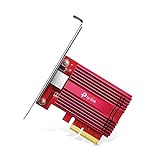
- 10 Gbps PCIe Network Card: With the latest 10GBase-T Technology, TX401 delivers extreme speeds of up to 10 Gbps, which is 10× faster than typical Gigabit adapters, guaranteeing smooth data transmissions for both internet access and local data transmissions[1]
- Versatile Compatibility: With extreme speed and ultra-low latency, 10GBase-T is backwards compatible with multiple data rates (10 Gbps, 5 Gbps, 2.5 Gbps, 1 Gbps, 100 Mbps), automatically negotiating between higher and lower speed connections
- QoS: Quality of Service technology delivers prioritized performance for gamers and ensures to avoid network congestion for PC gaming
- Free CAT6A Ethernet Cable: To maximize TX401's performance, a 1.5 m CAT6A Ethernet Cable is included—rated for up to 10 Gbps while a regular cable is only rated for 1 Gbps
- Low-Profile and Full-Height Brackets: In addition to the standard bracket, a low-profile bracket is provided for mini tower computer cases
At OFC 2026, Broadcom said Tomahawk 6 was shipping in production volume and positioned TH6-Davisson within its AI scale-up, scale-out and scale-across portfolio. That status statement does not establish that every OEM system using Davisson is broadly available. The distinction between a component shipping and a qualified, supported finished system is important. Broadcom’s OFC 2026 portfolio material also discusses CPO and near-packaged optics (NPO), including multi-vendor optical interoperability.
Do these 3 things before closing this tab:
1Repair Windows errors before they cause bigger problems2Scan for outdated or missing drivers - takes under a minute3Clear out junk files and repair common Windows errorsThor Ultra: an 800G AI Ethernet NIC
Thor Ultra is the host-side counterpart to the switches: an 800G AI Ethernet NIC intended for very large XPU clusters. Broadcom called it the first 800G AI Ethernet NIC and says it can support a single 800G flow, rather than relying only on the aggregation of two 400G interfaces. Both claims are attributable to Broadcom; they do not show that an application will sustain 800G under all conditions. The October 2025 coverage described the NIC as sampling, which is not the same as broad production availability.
Broadcom says Thor Ultra uses capabilities associated with the Ultra Ethernet Consortium (UEC), including packet-level multipathing, out-of-order packet delivery, selective retransmission and programmable congestion control at sender and receiver. These mechanisms target problems that matter in large AI fabrics: distributing traffic across paths, making progress despite congestion and recovering from packet loss without requiring every packet to be retransmitted in the same way.
Rank #3

- Ultra-Fast: 10/100/1000Mbps PCIe Adapter upgrade your Ethernet speed to Gigabit
- Automation: Wake-on-LAN supporting Auto-Negotiation and Auto MDI/MDIX
- Supports: IEEE802.3x Flow Control for Full-duplex Mode and backpressure for Half-duplex Mode; 4k Bytes Port: 1x 10/100/1000Mbps RJ45 Network Media
- Compatibility: Windows 11, 10, 8.1, 8, 7, Vista, XP
- Dual Bracket: Low profile and standard profile bracket inside works with both mini and standard size PCs.
UEC-related features do not make a network plug-and-play or guarantee interoperability. The NIC must work with compatible switches, firmware, drivers, host interfaces and XPU software; the topology and congestion configuration also matter. Even a NIC operating at its rated link speed can be limited by PCIe bandwidth, accelerator memory behavior, collective software or traffic patterns.
Tomahawk Ultra and Jericho 4 serve different scales
Tomahawk Ultra for scale-up
Tomahawk Ultra is separate from Tomahawk 6–Davisson. Broadcom announced it in July 2025 for AI and HPC scale-up, specifying 51.2 Tbps throughput, 250 ns switch latency at full throughput, line-rate switching for 64-byte packets and up to 77 billion packets per second. The feature set includes Link Layer Retry, Credit-Based Flow Control, in-network collective operations and topology-aware routing; Broadcom also says it is compatible with the public Scale-Up Ethernet specification and pin-compatible with Tomahawk 5.
Broadcom says its Scale-Up Ethernet architecture can deliver sub-400 ns XPU-to-XPU communication with Tomahawk Ultra. This is a platform claim tied to the specified architecture, not a universal end-to-end latency for applications. Broadcom said the switch was “shipping now” on July 15, 2025; that does not mean every OEM configuration is available through every channel. See the Tomahawk Ultra announcement.
Rank #4

- The network adapter comes with low-profile bracket and full height bracket.8 cm low-profile bracket suitable for 2U chassis,the 12 cm full height bracket suitable for 3U common chassis
- PCl Express PCle v1.1(2.5GT/s)X1,easily compatible with slot PCI-E X1,X2,X4,X8,X16 ,pay attention:isn't compatible with PCI slot.
- I/O virtualization (IOV) support for VMware NetQueue and Microsoft VMQ
- Automatic Detection and Correction of Pair Swaps, Pair Skew and Pair Polarity
- Network Operating Systems (NOS) Software Support: Windows* 2000; Windows* Server 2003; Windows* Server 2008; Windows Professional XP* SP3; Windows Vista* SP1; Windows 7; Linux* RHEL 4.6; Linux* Kernel version 2.6.24; Linux* Kernel version 2.4.36.2; RHEL* 5.1; SLES* 9 SP4; SLES* 10 SP1; FreeBSD* 7.0; DOS*; DOSODI*; SCO OpenServer 6/Unixware* 7.1.x; Novell Netware* 6.5; Xen*; FreeBSD* 5.x or later; ESX* 3.x* support (for VMware).
Jericho 4 for distributed fabrics
Jericho 4 targets connectivity across large distributed AI facilities rather than the same scale-up role as Tomahawk Ultra. Broadcom says it is designed to interconnect more than 1 million XPUs, support congestion-free RoCE and provide 3.2 Tbps HyperPort for secure, lossless fabrics. These are architecture and capability claims; they are not evidence that a named customer is operating a production deployment at that scale. “Lossless” describes intended network behavior under defined mechanisms and conditions, not immunity to link errors, buffer exhaustion, misconfiguration, software faults or endpoint failures. Details appear in Broadcom’s Jericho 4 announcement.
Why Broadcom is extending into optics and system connectivity
Switch capacity alone does not move data between racks or facilities. High-speed optical and electrical links, host expansion and signal conditioning are part of the same system problem. Broadcom’s OFC 2026 portfolio material presented components across those connections, including:
- Taurus, described by Broadcom as a 400G-per-lane optical DSP, alongside 400G EML and photodiode components.
- Optical modules targeting 1.6T and future 3.2T designs.
- 200G-per-lane Ethernet retimers and AECs, with reach up to 6 meters claimed for listed AECs. The reach is product-specific and deployment-dependent.
- PCIe Gen6 switches and retimers, 3.5D XPU technology, and CPO and VCSEL-based NPO.
- Participation in the Optical Compute Interconnect Multi-Source Agreement.
This breadth is strategically significant because a vendor supplying more of the connectivity chain can influence the design from XPU packaging to inter-rack links. It does not mean each part is a generally purchasable, finished system. Broadcom’s stated roadmap toward 200T-class switching and future 204.8T platforms is a roadmap, not a current shipping specification.
PC Slower Than It Used to Be?
A free scan shows the junk files, broken settings and background clutter dragging Windows down - then fixes them in one click.Free scan · Windows 10 & 11Outdated Drivers Are Slowing You Down
One free scan finds every outdated or missing driver and matches the right update for your exact hardware.Free scan · exact hardware matchBest Value
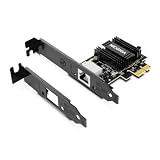
- ⭐【Next-Gen 10Gbe Performance】:Adopting the latest Realtek RTL8127 controller, this 10Gb PCIe network card delivers blazing-fast speeds up to 10Gbps. It provides extreme stability for local data transmission and internet access, effectively preventing packet loss. Perfect for NAS storage, home labs, gaming, and 4K video editing. Supports Wake-on-LAN (WOL).
- ⭐【Multi-Gig Auto-Negotiation】:Seamlessly backward compatible with 10Gbps, 5Gbps, 2.5Gbps, 1Gbps, and 100Mbps. It automatically negotiates the optimal speed to match your routers, switches, or NAS systems. Supports standard Cat6a/Cat7 or high-quality Cat6 cabling for cost-effective 10GbE network upgrades.
- ⭐【PCIe 4.0 x1 for Compact Systems】:Features a high-bandwidth PCIe 4.0 x1 interface that easily converts a standard x1 slot into a 10G RJ45 Ethernet port. Universally fits into PCIe x1, x4, x8, and x16 slots without occupying your GPU's lanes, making it ideal for Mini PCs, ITX builds, and compact workstations (Note: Not for PCI slots).
- ⭐【Broad OS & Advanced Linux Support】:Fully compatible with Windows 11/10 and Windows Server 2019/2022. Native plug-and-play for modern Linux distributions with Kernel 6.x and above (Ubuntu, Debian, Fedora), while older kernels (5.x) can be easily driven via Realtek official source code. Ready for mainstream virtualization and DIY NAS platforms.
- ⭐【Cool Running & Easy Installation】:Thanks to the ultra-efficient Realtek RTL8127 chipset, this 10G NIC consumes minimal power and generates significantly less heat than older 10G chips, ensuring non-stop stability. Includes both standard full-height and low-profile brackets to perfectly fit into slim or full-size desktop towers.
Ethernet versus a more integrated AI fabric
The practical choice is not simply whether Ethernet is “open” or a proprietary fabric is “faster.” Ethernet can offer a wider choice of silicon, system vendors and network designs, and may fit organizations already operating Ethernet at scale. But openness at the standards level does not remove the work of validating implementations, tuning congestion management, monitoring the fabric and coordinating NIC, switch and software behavior.
A more vertically integrated fabric may reduce some integration choices and provide a tighter vendor-controlled stack, while narrowing vendor flexibility. Neither architecture is universally better: the right comparison is the complete system under the organization’s workload, scale, operations model and support requirements. Buyers should compare observed application throughput and tail latency, failure recovery, telemetry, software maturity, serviceability and total cost—not headline switch bandwidth alone.
Product status: shipping, sampling and roadmap are not interchangeable
| Product or capability | Status supported by the cited material | What that status does not establish |
|---|---|---|
| Tomahawk Ultra | Broadcom said “shipping now” on July 15, 2025. | Availability of every finished OEM system or universal channel access. |
| Thor Ultra | Described as sampling in October 2025 coverage. | Broad production availability or plug-and-play compatibility. |
| Tomahawk 6 | Broadcom’s OFC 2026 material said it was shipping in production volume. | That TH6-Davisson systems are broadly available from all OEMs. |
| TH6-Davisson | Presented in Broadcom’s portfolio and OFC 2026 material. | A generally purchasable complete system or independently validated performance. |
| Taurus, future optical modules, 200T-class and 204.8T targets | Announced or described as part of the OFC 2026 portfolio and roadmap. | General availability or shipment as a finished, qualified product. |
Product status comes from Broadcom’s dated OFC 2026 material, its Tomahawk Ultra release and the October 2025 Thor Ultra coverage. Buyers should confirm current system, firmware and support availability directly with the relevant OEM or integrator.
What a buyer should validate before choosing a platform
These products are enterprise infrastructure components, generally sourced through OEMs, system builders, hyperscalers or integrators rather than ordinary retail checkout. No public per-chip pricing is established in the cited material. A useful commercial comparison should include the completed system and its operating costs, not just the switching silicon.
Free tools Windows power users keep installed
One-click scans. No signup required.
- Workload and topology: Define cluster size and whether the demanding traffic is scale-up, scale-out or scale-across. Model oversubscription and collective communication.
- End-to-end compatibility: Confirm XPU, server, PCIe, NIC, switch, firmware, driver and collective-library support for the intended configuration.
- Measured behavior: Test application throughput, tail latency, congestion response and recovery with representative traffic; do not infer them from aggregate bandwidth.
- Optical and electrical links: Compare pluggable optics with CPO or NPO for power, density, reach, qualification and replacement procedures. Validate AECs and optical components with the chosen platform.
- Operations: Review telemetry, congestion controls, observability, failure handling, software maturity and the team’s ability to tune and operate the fabric.
- Economics and support: Include chassis, NICs, optics, cables, power, cooling, network software, engineering validation, support contracts and spare/replacement plans in total cost of ownership.
Organizations with mature networking teams and very large cluster needs may value Broadcom’s breadth and merchant-silicon ecosystem. Smaller enterprises seeking a supported, turnkey AI cluster—or teams without experience operating RDMA and high-performance Ethernet—should weigh integration and ongoing operations heavily. CPO’s service model may also be a poor fit where front-panel field replacement is a priority, while conventional pluggable networking may be sufficient for more modest workloads.
Why the expansion matters
Broadcom is positioning Ethernet as a complete AI connectivity stack, from accelerator-facing NICs and scale-up switches through optical links and multi-facility routing. That strategy can give large buyers more component and OEM choices, but the decisive test is system-level validation: interoperable hardware and software, predictable congestion behavior, manageable service processes and acceptable total cost. The announcements establish the ambition and product map; they do not by themselves establish a universally superior fabric or a production deployment at every advertised scale.
Quick Recap
Product prices and availability are accurate as of the date/time indicated and are subject to change. Any price and availability information displayed on Amazon at the time of purchase will apply.




