Do these 3 things before closing this tab:
1Clear out junk files and repair common Windows errors2Scan for outdated or missing drivers - takes under a minute3Repair Windows errors before they cause bigger problemsBell did not announce that it was ending fibre construction across Canada. In February 2025, CEO Mirko Bibic said the company would scale back its earlier expansion plans after the CRTC required large incumbent phone companies to offer competitors wholesale access to fibre networks. Bell said it no longer expected to meet its previous goal of extending fibre to 8.3 million more homes by the end of 2025. The dispute is about who can sell service over Bell-funded infrastructure—and whether the rules make future builds less attractive.
What Bell said about its fibre expansion
On Bell’s February 2025 earnings call, CEO Mirko Bibic objected to building fibre that could help Telus sell competing Internet service. Bell said it would reduce 2025 capital spending and no longer expected to meet its earlier target of extending fibre to 8.3 million additional homes by the end of that year, according to MobileSyrup’s report.
The 8.3-million figure describes homes Bell planned to extend fibre to; it is not a count of new paying subscribers. Bell’s announcement concerned a reduction or reconsideration of planned expansion, not a verified nationwide halt to fibre construction. The public information cited here does not establish which specific projects were delayed or cancelled, or Bell’s revised expansion target.
What the CRTC required
In Telecom Regulatory Policy CRTC 2024-180, the CRTC required Bell, Telus and SaskTel to make workable aggregated wholesale access to fibre-to-the-premises (FTTP) available to competitors by February 13, 2025.
#1 Best Overall
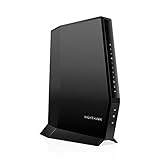
- MAXIMIZE YOUR CABLE INTERNET AND WHOLE-HOME WIFI: A cable modem and WiFi router in one device unlocks the full potential of your home internet with faster downloads, smoother WiFi for gaming and video calls, and reliable coverage in every room.
- APPROVED FOR YOUR PROVIDER AND PLAN: Works with Xfinity internet plans up to 800Mbps, Spectrum up to 1Gbps, and Cox up to 1Gbps. Not compatible with Verizon, AT&T, CenturyLink, DirecTV, DISH, or bundled voice plans. ISP activation required after setup.
- MULTI-GIG DOCSIS 3.1 SPEEDS: Get Gigabit+ cable download speeds on today's fastest plans, with headroom for the upgrades ahead. Real-world speeds depend on your plan and ISP network.
- WIFI 6 COVERAGE FOR THE WHOLE HOME: Stay connected in every room with dual-band AX2700 WiFi 6 covering up to 2,000 sq ft and capacity for 25+ connected devices. Real-world coverage depends on home size, layout, and building materials.
- WIRED CONNECTIONS FOR YOUR FASTEST DEVICES: Four Gigabit Ethernet ports keep gaming consoles, desktops, and streaming devices hardwired for the lowest latency and the most stable connection in your home.
- FTTP or FTTH: fibre-to-the-premises or fibre-to-the-home—fibre connections reaching homes or other customer premises.
- Wholesale access: another provider pays to use parts of an incumbent’s network and sells Internet service to the customer under its own retail relationship. It is not free access.
- Aggregated access: the wholesale provider connects through a limited number of network interconnection points rather than building a separate last-mile network to every customer.
- ILEC: an incumbent local exchange carrier. Bell, Telus and SaskTel are the companies covered by this fibre-access mandate.
The policy’s stated aim was to increase consumer choice and affordability while preserving incentives to invest. It set a national implementation deadline, but the deadline did not mean that every competitor would instantly offer service at every address where fibre exists.
Where Telus can use Bell’s network
The rule is not a blanket permission for Telus to sell service on Bell fibre everywhere. The CRTC’s Decision 2025-39 bars an incumbent and its affiliates from using the mandated service within their own traditional serving territory or an affiliate’s territory, while permitting access outside those territories.
That geography makes Telus especially relevant to Bell’s objection: Telus’s traditional wireline footprint is primarily in British Columbia and Alberta, while Bell has a major fibre presence in Ontario, Quebec, Atlantic Canada and Manitoba. Subject to the framework’s conditions and commercial implementation, Telus could use Bell’s network in parts of Ontario and Quebec; Bell could potentially use Telus’s network in Western Canada. This is a regulated, geography-limited wholesale arrangement, not a requirement that the two companies jointly operate one network.
The CRTC hearing record shows that Telus had already used wholesale arrangements to offer home Internet in Ontario and Quebec. The broader dispute is also about whether large incumbents and their affiliates should benefit from a framework associated with helping smaller competitors. In the February 2024 hearing, Cogeco argued that large providers were using wholesale arrangements to reinforce their market position; those were arguments in a regulatory proceeding, not a finding that the framework produced that result. The hearing transcript records the competing views.
Free tools Windows power users keep installed
One-click scans. No signup required.
Rank #2

- ⚠️ CABLE INTERNET ONLY - NOT COMPATIBLE WITH: Fiber (Verizon FiOS, AT&T), DSL, Satellite, or Fixed Wireless. ONLY works with cable providers like Xfinity, Spectrum, Cox. Verify your internet type BEFORE purchase.
- 🚫 NO WiFi INCLUDED - ROUTER REQUIRED: This is a modem ONLY. You MUST buy a separate WiFi router to get wireless internet. Without a router, only ONE device can connect via Ethernet cable. This does NOT replace your current WiFi router.
- 🔌 CABLE INTERNET REQUIRED: Works EXCLUSIVELY with cable internet service (DOCSIS) from providers like Xfinity, Spectrum, or Cox. Will NOT work with fiber (Verizon FiOS, AT&T), DSL, satellite, or fixed wireless internet. Contact your ISP to confirm compatibility BEFORE purchasing.
- 🚀 MULTI-GIG PERFORMANCE: Supports internet plans up to 2.5 Gbps with 2.5 Gbps Ethernet port. Designed for plans 1 Gbps and faster from certified providers: Xfinity (up to 2.33 Gbps), Spectrum (1 Gbps), Cox (2 Gbps). Verify your plan speed and provider compatibility.
- 💡 SETUP REQUIREMENTS: You need: (1) Cable internet service, (2) Separate WiFi router with 2.5 Gbps port for full speeds, (3) ISP activation. This modem cannot create WiFi networks or connect multiple devices without additional equipment.
Why Bell says the rule changes its investment calculation
Bell’s argument is that it pays to build the fibre, then must compete with a provider that can pay regulated wholesale charges to use that same network. In Bell’s view, that can reduce the return on a new build and weaken the case for expanding into marginal areas. That is Bell’s stated economic position; the announcement alone does not prove that wholesale access caused a measurable nationwide decline in investment.
The CRTC acknowledged that wholesale access could affect investment in some circumstances, but concluded that safeguards could address the risk. One key safeguard is a five-year “head start”: fibre deployed by Bell, Telus or SaskTel after August 13, 2024 generally does not become eligible for wholesale access until August 13, 2029, under Policy 2024-180.
The exemption helps explain the policy trade-off, but it does not settle Bell’s objection. Bell may disagree with access to its existing network, consider five years too short for infrastructure with a longer investment horizon, or believe that other parts of the framework still reduce expected returns. Those are possible explanations, not established details of Bell’s internal investment model. The public record cited here does not identify the exact projects behind Bell’s revised plans or isolate wholesale access from other capital-allocation factors.
Wholesale charges are not residential Internet prices
The CRTC set interim wholesale charges in Order 2024-261. For Bell Aliant, the listed aggregated FTTP access charge was $68.94 for the 3 Mbps to 1,500 Mbps speed band and $78.03 for the 1,501 Mbps to 3,000 Mbps band; capacity-based billing was $64.24 per 100 Mbps. These are specific interim wholesale rates, not monthly consumer plan prices.
What’s actually slowing this PC down?
Pick the symptom - the matching free tool is one click away.
Rank #3

- ⚠️ CABLE INTERNET ONLY - This modem works ONLY with cable internet providers (Xfinity, Spectrum, Cox). NOT compatible with fiber internet services including AT&T Fiber, Verizon Fios, Frontier Fiber, Google Fiber, or CenturyLink Fiber. Check with your ISP to confirm you have cable (coaxial) service before purchasing.
- 📞 DATA ONLY - NO PHONE SERVICE - This modem does NOT support telephone or voice service of any kind. If your internet plan includes phone service or you need VoIP calling, you must purchase a separate voice-capable modem or VoIP adapter. This device handles internet data only.”
- 🚀 MULTI-GIG PERFORMANCE: Supports internet plans up to 2.5 Gbps with 2.5 Gbps Ethernet port. Designed for plans 1 Gbps and faster from certified CABLE providers: Xfinity (up to 2 Gbps), Spectrum (1 Gbps), Cox (2 Gbps). NOT compatible with fiber internet services. Verify your plan speed and provider compatibility.
- 🔌 MODEM ONLY - NO WIFI INCLUDED - This device is a cable modem with ONE Ethernet port only. It does NOT provide WiFi or wireless connectivity. You MUST connect your own separate WiFi router to this modem to create a wireless network. This is not an all-in-one gateway or combo unit.
- ⚡ DOCSIS 3.1 TECHNOLOGY: Latest cable standard with 32x8 channel bonding for reliable multi-gig speeds. Backward compatible with DOCSIS 3.0 networks. Eliminates monthly modem rental fees (typically $14-20/month). For CABLE internet only - verify compatibility with your cable provider.
A reseller’s total costs can also involve capacity, transport, interconnection, support and equipment, as well as its own operating costs and margin. The wholesale figures therefore cannot be compared directly with an advertised retail price or treated as a prediction of what customers will pay. The framework also continues to evolve: the CRTC later approved Bell’s wholesale 8-Gbps tier on an interim basis in Order 2025-334, following Bell’s introduction of corresponding retail speed tiers in 2025.
Independent reader supportYour contribution helps us test, update, and keep practical guides available for everyone.How the rules developed through 2026
- August 2024: The CRTC issued Policy 2024-180, setting the wholesale-access framework, the February 13, 2025 implementation deadline and the five-year head-start rule for qualifying new fibre.
- February 13, 2025: The access deadline arrived. Telus sought a four-month extension for British Columbia and Alberta; the CRTC rejected the request in Decision 2025-37, saying Telus could implement a workable solution by the deadline.
- 2026: The CRTC denied Bell’s later application challenging its compliance obligations and found that Bell was meeting the requirements of Policy 2024-180 in Decision 2026-53. That decision left the wholesale obligation in force; it did not require Bell to restore its previous 8.3-million-home target.
What the change could mean for Internet customers
At eligible addresses, wholesale access can make it possible for more providers to sell service over an incumbent’s fibre rather than build a duplicate last-mile network. That could bring new plan choices, bundles or promotional prices. It does not guarantee lower bills: retail prices also depend on the provider’s costs, promotions, customer acquisition, bundling and competitive conditions.
Fibre in a neighbourhood also does not guarantee that a particular reseller can serve a specific home. Availability depends on address-level network access and the reseller’s offering. Plans using the same underlying network can differ in speed tiers, installation, equipment, support and terms; an independent provider may not offer every speed or feature sold directly by the network owner.
Rural and remote deployment presents a separate challenge. Low customer density, construction costs, permits, poles, backhaul and maintenance can matter more than wholesale rules alone. Wholesale fibre access does not itself build a network where one does not exist. The CRTC hearing record also discussed alternatives such as fixed wireless and low-Earth-orbit satellite service in remote areas.
Quick wins for a faster PC:
Fix the driver behind crashes, sound loss and screen glitchesFind Drivers →Clear out junk files and repair common Windows errorsFree Scan →Scan for outdated or missing drivers - takes under a minuteDriver Scan →What remains unproven
- The number and location of Bell fibre projects delayed or cancelled after the announcement.
- Bell’s replacement target for fibre expansion.
- The nationwide effect, if any, of the wholesale policy on capital investment.
- Whether wholesale competition will materially lower retail prices.
- How extensively Bell and Telus will use each other’s networks outside their traditional territories.
Bell’s warning is evidence of how the company says the policy affects its plans. It is not, by itself, a controlled test of the policy’s broader investment effects or proof that consumers will see a particular price change.
Quick Recap
Product prices and availability are accurate as of the date/time indicated and are subject to change. Any price and availability information displayed on Amazon at the time of purchase will apply.




