Recommended Free Tools
AT&T is a good internet provider only after you identify which AT&T product your address can actually order. If AT&T Fiber is available, it is generally a top-tier choice: its plans offer symmetrical upload and download speeds, unlimited data, no annual contract, and low latency. AT&T Internet Air can be a useful replacement for slow DSL, satellite, or weak cable service, but its speed and latency vary with signal strength, tower capacity, gateway placement, and congestion. Legacy AT&T Internet, IPBB, and DSL service should usually be treated as a last resort when a faster wired alternative exists.
This review uses AT&T’s publicly available pricing and performance information as of August 10, 2026. Prices, promotions, availability, and wireless-bundle eligibility can change, so the exact address result and Broadband Facts label should control before you order.
As an Amazon Associate I earn from qualifying purchases.
AT&T internet options at a glance
The phrase AT&T Internet describes several materially different technologies. Comparing them under one overall rating can lead to an expensive mistake, particularly if an address qualifies only for older copper service or fixed wireless.
The Tool Desk
Outbyte Driver Updater FREEScan for outdated or missing drivers - takes under a minuteDriver Scan →Outbyte PC Repair FREEClear out junk files and repair common Windows errorsFree Scan →| AT&T product | Advertised download/upload | Typical latency | Data and contract | Current public price shown | Best fit | Main drawback |
|---|---|---|---|---|---|---|
| AT&T Fiber | 300/300 Mbps to 5,000/5,000 Mbps | About 10–12 ms median to the closest AT&T access point | Unlimited data; no annual contract; standard equipment included | $35–$95 per month depending on tier and offer, before taxes and fees | Most households, especially those needing strong uploads and consistent performance | Not available at every address; promotions and installation terms vary |
| AT&T Internet Air | Typical 90–300 Mbps down and 8–30 Mbps up | About 35–65 ms to the closest AT&T access point | Unlimited data; no annual contract; no overage fees | $55 per month with AutoPay and paperless billing, or as little as $35 for some eligible AT&T wireless customers | Homes without good wired broadband | Performance can change with signal, tower traffic, placement, and network management |
| Legacy Internet/IPBB/DSL | Roughly 10–100 Mbps tiers with substantially slower uploads, depending on address | Varies by line and network | Plan-specific | Address-specific | Customers with no practical faster alternative | Asymmetrical speeds, aging copper infrastructure, and limited upgrade potential |
Quick verdict: Order AT&T Fiber when it is available at a competitive total price. Consider Internet Air only after checking the signal and testing performance at busy times. Be cautious about legacy copper service if cable, independent fiber, municipal broadband, or another fixed-wireless provider is available.
#1 Best Overall
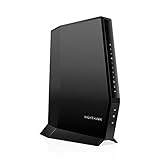
- MAXIMIZE YOUR CABLE INTERNET AND WHOLE-HOME WIFI: A cable modem and WiFi router in one device unlocks the full potential of your home internet with faster downloads, smoother WiFi for gaming and video calls, and reliable coverage in every room.
- APPROVED FOR YOUR PROVIDER AND PLAN: Works with Xfinity internet plans up to 800Mbps, Spectrum up to 1Gbps, and Cox up to 1Gbps. Not compatible with Verizon, AT&T, CenturyLink, DirecTV, DISH, or bundled voice plans. ISP activation required after setup.
- MULTI-GIG DOCSIS 3.1 SPEEDS: Get Gigabit+ cable download speeds on today's fastest plans, with headroom for the upgrades ahead. Real-world speeds depend on your plan and ISP network.
- WIFI 6 COVERAGE FOR THE WHOLE HOME: Stay connected in every room with dual-band AX2700 WiFi 6 covering up to 2,000 sq ft and capacity for 25+ connected devices. Real-world coverage depends on home size, layout, and building materials.
- WIRED CONNECTIONS FOR YOUR FASTEST DEVICES: Four Gigabit Ethernet ports keep gaming consoles, desktops, and streaming devices hardwired for the lowest latency and the most stable connection in your home.
AT&T Fiber plans and pricing
AT&T’s current public fiber page displays five primary consumer speed tiers. The following prices are the offers shown in the research period and are before taxes and fees. The displayed price can depend on the service address, new-customer status, AutoPay, paperless billing, wireless bundling, and the promotion active at checkout.
| Plan | Advertised speed | Public price shown | Standard/base price shown | Important terms and qualifications |
|---|---|---|---|---|
| Internet 300 | 300 Mbps down / 300 Mbps up | $35 per month | $60 per month | Displayed offer reflects current promotional and/or AutoPay and paperless-billing discounts; verify the offer duration at checkout |
| Internet 500 | 500/500 Mbps | $50 per month | $75 per month | Address and promotion dependent; verify the post-promotion price and billing requirements |
| Internet 1000 | Up to 1 Gbps symmetrical | $50 per month | $90 per month | The current page advertises a first-year offer and a $200 reward card with qualifying 1 GIG or higher orders |
| Internet 2000 | 2 Gbps symmetrical | $93 promotional price shown in indexed AT&T material | $155 per month | The tier was not exposed consistently on the current retail-page crawl; recheck the exact offer and availability before relying on these figures |
| Internet 5000 | 5 Gbps symmetrical | $95 per month | $135 per month | Limited availability; All-Fi Pro is included; a limited-time Ray-Ban Meta glasses promotion was advertised for qualifying 5 GIG customers |
See AT&T’s current Fiber plans and promotions page for the live offer. Promotional pricing is not the same as a permanent price lock. A low introductory price can become much more expensive when the promotion ends, even though the service has no annual contract.
How to budget for the real price
For a household budget, record four separate numbers instead of relying on the large promotional price:
- Monthly service price: the amount shown after any AutoPay, paperless-billing, new-customer, or wireless-bundle discount.
- Post-promotion price: the standard or base price shown in the offer terms. For the displayed 300 Mbps and 500 Mbps offers, the difference is $25 per month. For the displayed 1 GIG and 5 GIG offers, the difference is $40 per month. The 2 GIG figures shown in indexed material differ by $62 per month.
- One-time charges: AT&T’s promotional terms say an installation fee of up to $99 may apply, although self-installation or no-cost installation may be offered for some addresses.
- Taxes and surcharges: taxes and fees are extra. AT&T’s wording about no hidden fees does not eliminate taxes, possible installation charges, state cost-recovery surcharges, or a later promotional-price change.
For example, if a $35 Fiber offer later becomes $60, the service portion of the bill rises by $300 over a full year. If a $50 1 GIG offer later becomes $90, the increase is $480 over a full year. These calculations assume the prices shown at checkout and do not include taxes or fees.
The advertised $200 reward card can materially reduce first-year cost, but it is not the same as a permanently lower monthly bill. Check the redemption deadline, eligibility, and delivery terms. AT&T has also advertised a limited-time Ray-Ban Meta glasses promotion for some 5 GIG orders; treat promotional merchandise as a bonus rather than a reason to choose a plan whose recurring price does not fit your budget.
Which Fiber tier is the sensible value?
Internet 300 is enough for many small and medium households. Internet 500 gives more headroom for simultaneous users and large downloads. The displayed 1 GIG offer deserves a close comparison because it was shown at the same promotional price as Internet 500, but its standard price is higher. That does not automatically make 1 GIG the best choice: the relevant comparison is the post-promotion price, the household’s actual needs, and whether the home network can use the additional capacity.
Two- and five-gigabit service is mainly justified by many simultaneous heavy users, frequent large file transfers, multi-gigabit wired networking, a high-end home lab, or content-production workloads. A typical phone, television, or laptop connected over Wi-Fi will rarely use the full advertised rate.
Do these 3 things before closing this tab:
1Scan for outdated or missing drivers - takes under a minute2Repair Windows errors before they cause bigger problems3Fix the driver behind crashes, sound loss and screen glitchesAT&T Internet Air review
Internet Air is AT&T’s fixed-wireless home broadband service using the company’s cellular network. It includes an AT&T All-Fi Hub and is designed for self-setup rather than a traditional wired installation. It is not simply fiber delivered over the air, and it should not be evaluated as a fiber replacement when the comparison is speed consistency, upload capacity, or latency.
Price and terms
- The current public product page lists $55 per month with AutoPay and paperless billing, plus taxes and fees.
- AT&T lists unlimited data, no annual contract, and no overage fees.
- The current product page says there is no price increase at 12 months.
- The included All-Fi Hub and $0 self-setup reduce upfront equipment and installation costs.
- AT&T announced on July 29, 2026 that eligible customers combining Internet Air with AT&T wireless could receive home internet for as little as $35 per month. The exact wireless-plan eligibility must be checked at checkout.
The $35 wireless-bundle figure is not a universal Internet Air price. A household should calculate the cost of the wireless plan and home internet together. A bundle discount is a saving only if the wireless service is already wanted and its total cost is competitive with alternatives.
AT&T also announced in April 2026 that qualifying households using one of 18 federal need-based assistance programs could receive $25 off Internet Air through Access from AT&T. Confirm that the discount remains open to new applicants and that your specific qualifying program is accepted by reviewing the current Access from AT&T announcement and enrollment terms.
How fast is Internet Air in practice?
AT&T describes typical Internet Air performance as 90–300 Mbps download, 8–30 Mbps upload, and 35–65 ms latency to the closest AT&T access point. Those figures are ranges, not a promise that every address will remain within them throughout the day.
Results depend on the distance and line of sight to the cell site, indoor signal attenuation, terrain, trees and buildings, radio-frequency interference, tower capacity, the number of customers sharing the site, local network design, gateway placement, and Wi-Fi conditions inside the home. A strong speed test at noon does not establish that the service will perform equally during the evening.
One independent dataset illustrates the uncertainty without predicting every customer’s result. CableTV.com said it analyzed more than 9,000 AT&T Internet Air speed tests from its HighSpeedInternet.com partner data. In its analysis, 33.5% of evaluated AT&T tests reached or exceeded the advertised speed range used in the study, compared with 35.9% for Verizon and 47.5% for T-Mobile. The test population and methodology may not represent every market or address, so the useful conclusion is variability—not that a particular household will receive a specific percentage of advertised speed. The same review reported average latency of 42.5 ms in its partner dataset.
The important unlimited-data qualification
Unlimited data means AT&T does not advertise a monthly data cap, overage fee, or ordinary allotment that runs out. It does not mean that network management is impossible. AT&T’s network-practices disclosure says that, in rare congestion cases, Internet Air speeds may be reduced to as low as 512 Kbps for a minimum of 30 minutes when usage contributes to network congestion.
This is different from a normal monthly data cap: the plan does not charge an overage after a stated number of gigabytes. It is also a material distinction from an unqualified promise of unlimited, unvarying performance. If Internet Air is your only connection for business-critical remote work, large backups, or competitive gaming, this policy and the local tower conditions deserve particular attention.
Who should consider Air?
Internet Air makes the most sense when fiber is unavailable, existing DSL is unusably slow, and cable, satellite, or another fixed-wireless service is worse or more expensive. It can support ordinary browsing, streaming, video calls, smart-home devices, and moderate work-from-home use when the address has a strong signal and the tower has sufficient capacity.
Be cautious if the home has weak indoor cellular service, several people upload large files at once, competitive gaming requires stable low latency, evening performance falls sharply, or a wired provider is available at a similar price. The word 5G describes the radio technology, not fiber-like consistency.
Rank #2

- CABLE INTERNET AND WIFI MADE FOR YOUR HOME: This two-in-one cable modem and WiFi router puts every setting in your hands, from your WiFi names and passwords to how your network runs, so it works the way your household needs.
- APPROVED FOR YOUR PROVIDER AND PLAN: Works with Xfinity internet plans up to 800Mbps and Cox plans up to 500Mbps. Not compatible with Verizon, AT&T, CenturyLink, DirecTV, DISH, or bundled voice plans. ISP activation required after setup.
- GET THE FULL SPEED OF PLANS UP TO 800 MBPS: DOCSIS 3.0 delivers plenty of speed for HD and 4K streaming, online gaming, and video calls across your home. Actual speeds vary by plan and provider.
- AC1900 WIFI COVERAGE FOR THE WHOLE HOME: Stay connected in every room with dual-band AC1900 WiFi covering up to 1,800 sq ft and Beamforming+ for stronger signal to mobile devices. Real-world coverage depends on home size, layout, and building materials.
- WIRED CONNECTIONS FOR YOUR FASTEST DEVICES: Four Gigabit Ethernet ports keep gaming consoles, desktops, and streaming devices hardwired for the lowest latency and the most stable connection in your home.
Legacy AT&T Internet, IPBB, and DSL
Some AT&T addresses still qualify for older wired service that may be described as AT&T Internet, IPBB, DSL, or another legacy name. These plans are not equivalent to Fiber. AT&T’s published performance disclosures show IPBB tiers of roughly 10–100 Mbps with much slower uploads than the symmetrical Fiber tiers.
That asymmetry matters. A connection that downloads quickly enough for one stream may still struggle with cloud backups, livestreaming, sending large work files, and several simultaneous video calls. Copper line length, neighborhood equipment, wiring condition, and network congestion can also affect the result.
What’s actually slowing this PC down?
Pick the symptom - the matching free tool is one click away.
AT&T’s 2025 annual report said the company was actively exiting legacy copper and reported 2.8 million legacy consumer internet connections as of December 31, 2025. That does not mean every remaining IPBB customer will lose service on a particular date, but it is a reason to consider upgrade potential and long-term value before signing up for a legacy plan.
If legacy AT&T is the only practical wired choice, compare its actual upload speed and total monthly price with fixed wireless, cable, satellite, or a local broadband provider. If a faster alternative is available at a similar price, legacy AT&T should usually not be the first choice.
AT&T speed and reliability
Fiber’s published performance
AT&T publishes performance measurements for its Fiber tiers. The figures below are AT&T-reported actual download and upload results, not a guarantee for every device or speed test:
| Tier | Expected service | AT&T-reported actual download | AT&T-reported actual upload | Reported median latency |
|---|---|---|---|---|
| Internet 300 | 300/300 Mbps | 396.1 Mbps | 385.4 Mbps | 10.3 ms |
| Internet 500 | 500/500 Mbps | 657.6 Mbps | 643.4 Mbps | 11.5 ms |
| Internet 1000 | 1 Gbps/1 Gbps | 999.6 Mbps | 946.9 Mbps | 10.7 ms |
| Internet 2000 | 2 Gbps/2 Gbps | 2,457.6 Mbps | 2,414.7 Mbps | 11.2 ms |
| Internet 5000 | 5 Gbps/5 Gbps | 4,955.0 Mbps | 5,046.3 Mbps | 10.4 ms |
AT&T’s latency figures are median measurements to the closest AT&T internet access point. Latency to a particular game server, VPN endpoint, video-conferencing service, website, or cloud platform can be higher because the traffic must travel beyond AT&T’s access point. Even so, Fiber’s approximately 10–12 ms access-network latency and symmetrical upload capacity are strong advantages for interactive and upload-heavy use.
AT&T also markets Fiber reliability at 99.9% on its consumer materials. That is a marketing claim, not a business-grade contractual uptime service-level agreement. Actual reliability can still be affected by local construction, power failures, damaged fiber, gateway problems, and broader outages.
Why a multi-gigabit plan may not produce multi-gigabit Wi-Fi
Internet speed, gateway capability, Wi-Fi speed, and device speed are separate limits. AT&T says its expected 1 GIG and 2 GIG performance assumes equipment such as a BGW320 gateway, Fiber Jack, SFP ONT, and a 5-Gbps Ethernet LAN connection. A device or router with a 1-Gbps Ethernet port will generally top out near 940 Mbps after Ethernet and IP overhead. On 5 GIG, a single device using the gateway’s 5-Gbps Ethernet port is limited to approximately 4.7 Gbps by overhead.
Wi-Fi can be slower because of the client device, Wi-Fi generation, distance, interference, channel conditions, walls, floors, and home construction. A phone over Wi-Fi is not a valid test of whether a 5 GIG fiber connection is delivering its full wired capacity.
For a meaningful Fiber test, connect a modern computer directly to an appropriately fast Ethernet port, use a suitable cable, stop competing downloads, and check the gateway and client port speeds. For ordinary household use, good Wi-Fi coverage may be more valuable than upgrading from 500 Mbps to 5 Gbps.
Free tools Windows power users keep installed
One-click scans. No signup required.
Air’s performance is more location-sensitive
Fiber performance is primarily determined by the wired access network and the home’s equipment. Air adds a radio link between the home gateway and the cell site. Moving the hub, changing its orientation, or placing it near a window can make a meaningful difference, but the customer cannot control tower loading or local interference.
When evaluating Air, measure download, upload, and latency at morning, afternoon, evening, and on a weekend. Test the activities that matter to your household rather than relying on one peak download result. A stable 100 Mbps connection with acceptable uploads may be more useful than a connection that briefly reaches 300 Mbps but becomes inconsistent during the hours your family works and streams.
Availability: check the exact address, not the state
AT&T’s public Fiber coverage map lists consumer Fiber availability in Alabama, Arizona, Arkansas, California, Florida, Georgia, Illinois, Indiana, Kansas, Kentucky, Louisiana, Michigan, Mississippi, Missouri, Nevada, North Carolina, Ohio, Oklahoma, Pennsylvania, South Carolina, Tennessee, Texas, and Wisconsin. That state list is useful for orientation, but it is not an ordering guarantee.
There is also a transition issue. In February 2026, AT&T announced that its acquisition of Lumen’s mass-market fiber business expanded the AT&T Fiber footprint to 32 states, adding more than 1 million fiber subscribers and more than 4 million fiber locations across 11 states. AT&T’s corporate announcement and its consumer state-level map do not line up cleanly. The consumer map may not yet reflect every acquired or transitioned market, and acquired areas may have different product names, ordering systems, plans, or transition schedules.
Quick wins for a faster PC:
Scan for outdated or missing drivers - takes under a minuteDriver Scan →Clear out junk files and repair common Windows errorsFree Scan →Fix the driver behind crashes, sound loss and screen glitchesFind Drivers →Fiber locations passed is not the same as your home being orderable. A neighborhood can be near a fiber build while a particular house lacks a serviceable drop, port, building wiring, or apartment authorization. AT&T notes that a neighbor may qualify while a nearby address does not, particularly at the edge of a footprint.
Address-check procedure
- Open AT&T’s address availability checker.
- Enter the complete street address, including apartment or unit number, city, state, and ZIP code.
- Read the technology name carefully. Confirm that the result specifically says AT&T Fiber, rather than only AT&T Internet or Internet Air.
- Record every available speed tier, the promotional price, the standard price, the AutoPay and paperless-billing requirement, and any wireless-bundle condition.
- Open the Broadband Facts label for the exact offer. Use it to verify monthly charges, typical speeds, latency, data policies, and other required disclosures.
- Ask AT&T whether the address is fiber-served, fiber-ready, or merely close to a fiber build if the result conflicts with a neighbor’s service or a real-estate listing.
- Use the FCC National Broadband Map as a secondary cross-check, not as a live AT&T ordering system.
The FCC map displays provider-reported availability, technology, and advertised speeds at individual locations. It does not show actual performance, affordability, or adoption. If the map appears wrong, the FCC explains how to submit an availability challenge, but AT&T’s address checker and written order offer determine what can be ordered immediately.
Installation, equipment, and Wi-Fi costs
Fiber installation
Fiber installation may require a technician even when the home already has AT&T service because Fiber uses different lines and equipment. AT&T estimates a typical installation at four to six hours, although the appointment can take longer or require additional work.
Rank #3

- input voltage:100 -240V
- SAVE MONTHLY RENTAL FEES: Model C7000 replaces your cable modem and WiFi router saving you up to $150/yr in equipment rental fees. System Requirements Cable broadband Internet service, Check your cable Internet service provider web site for data speed tier compatibility, Not compatible with Cable bundled voice services.
- BUILT FOR FAST SPEED: Best for cable provider plans up to 800 Mbps speed
- FAST Wi Fi PERFORMANCE: Get up to 1800 sq ft wireless coverage and 30 devices connected
- VERSATILE CONNECTIONS: 4 Gigabit Ethernet ports give you fast wired connections to your computer,, game box, and other devices. One USB port for storage devices.
Possible complications include a new fiber drop, exterior routing, drilling through an outside wall, Fiber Jack placement, gateway placement, landlord or HOA approval, property-access issues, conduit that cannot be reused, and construction or permitting delays. An online self-install offer does not necessarily mean no construction is needed; it only describes the installation method AT&T is offering for that address and order.
Crashes, No Sound, or Screen Glitches?
Random freezes, missing sound and display glitches usually trace back to one bad driver. Find and replace yours safely.Free scan · under a minutePC Slower Than It Used to Be?
A free scan shows the junk files, broken settings and background clutter dragging Windows down - then fixes them in one click.Free scan · Windows 10 & 11Internet Air installation
Air is simpler to set up. AT&T provides an All-Fi Hub, describes the service as plug-in self-setup, and uses the Smart Home Manager app to guide setup and help locate a suitable position. There is no standard technician installation charge for the advertised self-setup, but verify the order terms if the address requires anything different.
Gateway and Wi-Fi options
Standard AT&T Fiber plans include AT&T equipment without a recurring equipment fee. AT&T offers All-Fi Pro for $25 per month plus taxes on eligible lower-tier plans. According to the current Fiber page, All-Fi Pro is included with 2 GIG and 5 GIG plans. It includes Wi-Fi 7 technology, an equipment-upgrade program, advanced ActiveArmor security, and extended Wi-Fi coverage features. Eligibility and included features should be confirmed for the exact tier.
AT&T’s All-Fi and Smart Home Manager tools can provide parental controls, device-level usage tracking, screen-time management, and other network controls. Some features require a compatible gateway and app, while advanced security or coverage features may be limited to All-Fi Pro or particular gateway models.
Before paying $25 per month for upgraded Wi-Fi, consider whether the problem is the internet connection or coverage inside the house. A gateway in a poor location, thick walls, an old client device, or a weak mesh arrangement can make a fast Fiber plan feel slow. All-Fi Pro may be useful for households that value the included security and coverage support, but it is not automatically necessary to use a 300 or 500 Mbps connection.
Contracts, data policies, backup, and service credits
No contract and unlimited data
AT&T advertises both Fiber and Internet Air with unlimited data, no annual contract, no overage fees, and included standard equipment. Fiber has no data caps according to AT&T’s plan materials. These are meaningful budgeting advantages over plans with usage allowances or contract termination penalties.
No annual contract does not mean the promotional price is permanent. It also does not eliminate taxes, installation charges, state cost-recovery surcharges, or the possibility that the provider changes an older plan. Always save the order confirmation and Broadband Facts label.
Possible legacy-plan price change
A July 2026 Android Central report, based on internal documents, said AT&T might raise some customers on legacy Fiber and Internet Air plans by $5 per month beginning August 16, 2026. The report was not confirmed on the public AT&T pricing pages reviewed for this article. Treat it as unconfirmed until an AT&T bill notice, customer communication, or official terms establish whether it applies to your plan.
AT&T Guarantee
AT&T’s current Guarantee covers Fiber and Internet Air. For a qualifying network interruption lasting 20 minutes or more, AT&T says the customer receives a credit for a full day of service. The guarantee has restrictions and exclusions, and it should be understood as a service-credit policy rather than a blanket uptime guarantee.
Quick wins for a faster PC:
Scan for outdated or missing drivers - takes under a minuteDriver Scan →Repair Windows errors before they cause bigger problemsFix Now →The guarantee also advertises technical-support assistance within five minutes or a callback option, same-day or next-day Fiber technician availability in qualifying situations, and outage credits. Check the current terms for eligibility, exclusions, and the process for requesting or redeeming a credit. A service credit is not a substitute for a separate business-grade service-level agreement.
Internet Backup
Qualifying customers with AT&T Fiber and AT&T wireless can use wireless data as a backup during a Fiber outage. This requires compatible service and setup. It is useful continuity protection for a household that already has AT&T wireless, but it is not the same as a separate wired backup connection or business-grade failover. Confirm the wireless-plan requirements before assigning a financial value to the feature.
Customer satisfaction and independent evidence
Different studies measure different parts of the customer experience, and none should be turned into a universal promise about an individual address.
- ACSI: AT&T announced that AT&T Fiber ranked highest among fiber providers in the 2026 ACSI study for the fourth consecutive year. This is AT&T’s announcement of an external award, so it is best interpreted as evidence from that study’s sample and methodology—not proof that every installation, bill, outage, or support interaction will be excellent.
- J.D. Power: The 2026 U.S. Telecom Digital Experience Study ranked AT&T second among internet service providers for digital experience, with a score of 675, behind T-Mobile. This measures websites and apps; it does not measure installation quality, outage resolution, field service, billing, or overall network reliability.
- Opensignal: AT&T’s summary of 2026 fixed-broadband research reported 107 category wins for AT&T Fiber across speed, reliability, video, and consistency in 26 metro areas. The geography, technology, evaluation period, and category definitions matter. The result is not a nationwide guarantee.
- Independent Air testing: CableTV.com’s partner speed-test analysis found variable Internet Air performance and an average latency of 42.5 ms. It is useful evidence that fixed-wireless results vary, but it does not predict the result at every tower or home.
These results support a split conclusion: AT&T Fiber has strong evidence behind its performance and digital experience, while Internet Air requires more address-specific caution. Local installation quality and outage history can still matter more to a particular household than a national or multi-market ranking.
Who should get AT&T?
Small household
For one or two people who browse, stream, use video calls, and have ordinary smart-home needs, 300 Mbps Fiber is usually ample. Air can also work if Fiber is unavailable and the address has a strong signal. Do not pay for 2 or 5 GIG merely because the number is larger; use the difference for a better coverage setup or keep it in the household budget.
Large family or busy household
Fiber 500 Mbps or 1 GIG provides useful headroom when multiple people stream, attend video calls, download games, use cloud services, and operate smart-home devices at the same time. The symmetrical upload speed is particularly helpful when several devices send data simultaneously.
Remote worker
Fiber is the safer choice when work depends on stable video calls, VPN access, cloud applications, and frequent uploads. Air may be adequate, but test it during working hours and the evening before making it the only connection. If a failed connection would cost income or disrupt an important obligation, consider keeping a mobile backup or using AT&T’s Internet Backup only after verifying eligibility and setup.
Gamer
Fiber’s low access-network latency and consistency are better suited to competitive gaming. Air can support casual gaming, but its 35–65 ms provider-reported latency range is only a starting point; latency to the actual game server may be higher, and radio congestion can add variation. The critical comparison is stable latency and jitter, not only maximum download speed.
The Tool Desk
Outbyte Driver Updater FREEScan for outdated or missing drivers - takes under a minuteDriver Scan →Outbyte PC Repair FREERepair Windows errors before they cause bigger problemsFix Now →Rank #4

- DUAL-BAND WIFI 6 ROUTER: Wi-Fi 6(802.11ax) technology achieves faster speeds, greater capacity and reduced network congestion compared to the previous gen. All WiFi routers require a separate modem. Dual-Band WiFi routers do not support the 6 GHz band.
- AX1800: Enjoy smoother and more stable streaming, gaming, downloading with 1.8 Gbps total bandwidth (up to 1200 Mbps on 5 GHz and up to 574 Mbps on 2.4 GHz). Performance varies by conditions, distance to devices, and obstacles such as walls.
- CONNECT MORE DEVICES: Wi-Fi 6 technology communicates more data to more devices simultaneously using revolutionary OFDMA technology
- EXTENSIVE COVERAGE: Achieve the strong, reliable WiFi coverage with Archer AX1800 as it focuses signal strength to your devices far away using Beamforming technology, 4 high-gain antennas and an advanced front-end module (FEM) chipset
- OUR CYBERSECURITY COMMITMENT: TP-Link is a signatory of the U.S. Cybersecurity and Infrastructure Security Agency’s (CISA) Secure-by-Design pledge. This device is designed, built, and maintained, with advanced security as a core requirement.
Content creator or heavy uploader
Choose Fiber when available. Its symmetrical upload tiers are materially better for livestreaming, cloud backups, sending large video files, and remote production. Air’s typical 8–30 Mbps upload range can be workable for moderate tasks but may become a bottleneck for large or simultaneous uploads. Legacy IPBB is usually the weakest fit for this use.
Rural or suburban household
Do not infer service from AT&T’s state presence or a nearby fiber line. Check the exact address. If Fiber is unavailable, test Internet Air against satellite, cable, local fixed wireless, and any independent provider. Air may be a major improvement over DSL, but only the actual signal and busy-hour performance can establish whether it is a good value.
Existing AT&T wireless customer
The bundle can be financially attractive if you already want the qualifying wireless plan. AT&T has advertised Internet Air for as little as $35 per month for eligible wireless customers. Compare the combined bill with separate wireless and home-internet alternatives, verify eligibility, and check whether losing or changing the wireless plan would remove the discount. Do not count a bundle as a saving if it causes you to pay for more wireless service than you need.
Low-income household
Check Access from AT&T if your household participates in one of the eligible federal need-based assistance programs. AT&T announced a $25 monthly Internet Air discount for qualifying customers, but enrollment availability and qualifying programs should be verified before relying on the reduced price in a budget.
Recommended Free Tools
Customer offered only legacy DSL or IPBB
Compare the exact speed, particularly upload speed, against cable, fixed wireless, satellite, municipal broadband, and local fiber. If legacy AT&T is the only stable wired service, it may still be practical, but its declining copper platform and limited upgrade potential make it a weak long-term value when a faster alternative is reasonably priced.
How much speed does a household need?
| Approximate tier | Reasonable use case | What to consider |
|---|---|---|
| 100 Mbps | Basic browsing, streaming, light work from home, and a small number of devices | May become restrictive with several simultaneous users or large downloads |
| 300 Mbps | General-purpose service for many small and medium households | Often a strong value if the post-promotion price remains affordable |
| 500 Mbps | Multiple simultaneous users, large downloads, gaming, and heavier smart-home use | Useful headroom without requiring multi-gig home networking |
| 1 Gbps | Large households, frequent large downloads, multiple 4K streams, and content creation | Requires suitable Ethernet, Wi-Fi, and client hardware to realize its potential |
| 2–5 Gbps | Many heavy users, multi-gigabit local networking, home labs, or unusually demanding file-transfer workloads | Most ordinary Wi-Fi devices will not use the full rate |
These are practical editorial guidelines, not AT&T guarantees. Bandwidth is shared among devices, and latency, upload capacity, Wi-Fi coverage, and consistency can matter more than headline download speed.
AT&T Fiber versus the alternatives
There is no useful nationwide winner without checking the local offers. Compare the technology, post-promotion price, upload speed, installation requirements, outage history, and equipment costs at your address.
| Comparison | When AT&T may be preferable | When the alternative may be preferable |
|---|---|---|
| AT&T Fiber vs. Google Fiber or local fiber | AT&T offers Fiber at your address with competitive pricing, strong upload speeds, no cap, and acceptable installation terms | The other fiber provider has a lower long-term price, better availability inside the building, simpler installation, or a stronger local service record |
| AT&T Fiber vs. cable | You need symmetrical uploads, low latency, no data cap, or consistent capacity for several users | Local cable has a substantially lower long-term price or faster installation and your household does not need much upload capacity |
| Internet Air vs. T-Mobile or Verizon 5G Home | AT&T’s address check shows stronger signal, better busy-hour results, a lower eligible bundle price, or more favorable terms | The competing fixed-wireless service performs more consistently at the home or has better local pricing and return terms |
| Internet Air vs. satellite | AT&T’s signal is strong and the household wants a lower-latency option than a satellite connection can provide in the local comparison | Air has weak indoor signal or severe tower congestion and satellite is the only reliable option at the property |
| Legacy AT&T vs. cable or fixed wireless | Legacy service is the only stable, affordable connection available | A faster alternative offers materially better upload speed and capacity at a similar total price |
For every alternative, use the provider’s exact address checker and current Broadband Facts label. National reputations cannot account for a particular apartment building, neighborhood node, tower, or copper line.
Free tools Windows power users keep installed
One-click scans. No signup required.
A practical buying and testing checklist
Before ordering
- Check the full address, including the unit number.
- Write down the technology: Fiber, Internet Air, IPBB, DSL, or another label.
- Record advertised download and upload speeds separately.
- Save the promotional price, standard price, promotion duration, AutoPay and paperless-billing conditions, and wireless-bundle requirements.
- Review the Broadband Facts label for the exact offer.
- Ask about installation, construction, property access, landlord or HOA approval, and the potential $99 installation charge.
- Confirm whether standard equipment is included and whether All-Fi Pro is optional or included.
- Calculate the 12- and 24-month cost without treating a reward card as recurring savings.
- Ask for the current terms on cancellation, returns, outage credits, and any equipment return requirement.
If you choose Internet Air
- Place the All-Fi Hub near a window or another location with the strongest available signal, while still considering practical Wi-Fi coverage.
- Use the Smart Home Manager app and the gateway’s indicators to identify a suitable position.
- Test over Ethernet when possible so the result measures the Air connection rather than weak in-home Wi-Fi.
- Measure download, upload, and latency at different times, especially during the evening and on weekends.
- Try a video call, VPN session, game, cloud backup, or other activity that matters to your household.
- Keep an existing connection until the Air service has passed the tests, if your budget and the provider’s terms allow overlap.
- Review the current return or cancellation terms before ordering; do not assume every fixed-wireless offer includes the same trial period.
If your Fiber speed test looks low
- Test with a wired computer and an Ethernet port that supports the speed you purchased.
- Check whether the computer, router, switch, and cable are limited to 1 Gbps or less.
- Test near the gateway before diagnosing the Fiber line.
- Pause other downloads and disconnect competing high-bandwidth devices.
- Compare multiple tests and devices rather than relying on one Wi-Fi result.
- Contact AT&T if a properly configured wired test remains materially below the expected service.
Final verdict: is AT&T internet worth it?
AT&T Fiber is worth serious consideration whenever it is available at the exact address and its post-promotion price is competitive. The combination of symmetrical speeds, low latency, unlimited data, no annual contract, and included standard equipment makes it one of the strongest residential options in AT&T’s footprint. A 300 or 500 Mbps plan is enough for many households; multi-gigabit plans make sense only when the household and network equipment can use them.
Internet Air is a conditional recommendation. It can be a substantial improvement over slow DSL, satellite, or poor cable service, particularly for an AT&T wireless customer who qualifies for the lower bundle price. But its 90–300 Mbps download range, 8–30 Mbps upload range, 35–65 ms access latency, and possible congestion management make it materially different from Fiber. Test signal and busy-hour performance before making it the only home connection.
Legacy AT&T copper or IPBB service is the weakest option when a faster wired alternative exists. Its asymmetrical performance and declining strategic status make it difficult to recommend for heavy uploading, remote work, large households, or long-term value. Check the exact address, calculate the full cost after promotions, and choose the technology—not merely the AT&T brand—that best fits the household.
Frequently Asked Questions
Is AT&T Fiber better than AT&T Internet Air?
Usually, yes. AT&T Fiber offers symmetrical 300 Mbps to 5 Gbps tiers and provider-reported median access latency of about 10–12 ms. Internet Air typically offers 90–300 Mbps download, 8–30 Mbps upload, and 35–65 ms latency, with greater variation from signal and tower conditions. Air can still be the better practical choice when Fiber is unavailable or existing wired service is poor.
Crashes, No Sound, or Screen Glitches?
Random freezes, missing sound and display glitches usually trace back to one bad driver. Find and replace yours safely.Free scan · under a minuteWindows Errors? Fix Them Before They Spread
Repair common Windows errors and clear accumulated junk for a smoother, more stable PC - no reinstall needed.Free scan · no reinstallDoes AT&T Internet Air have unlimited data?
AT&T advertises unlimited data and no overage fees for Internet Air. However, AT&T’s network-practices disclosure says speeds may be reduced as low as 512 Kbps for at least 30 minutes in rare congestion situations when usage contributes to congestion. Unlimited data does not mean completely unmanaged performance.
How do I know whether AT&T Fiber is available at my home?
Use AT&T’s address checker with the complete street address and apartment or unit number. Confirm that the result specifically says AT&T Fiber and review the offered speed, price, and Broadband Facts label. A state-level coverage list, nearby fiber line, or neighbor’s service does not guarantee that your address is orderable.
Is AT&T’s $35 Internet Air price available to everyone?
No. AT&T has announced Internet Air pricing as low as $35 per month for eligible customers who combine it with AT&T wireless. The exact wireless-plan and customer eligibility rules must be verified at checkout. The general public price listed on AT&T’s product page is $55 per month with AutoPay and paperless billing, before taxes and fees.
Will a 5 GIG AT&T Fiber plan give every device 5 Gbps?
No. The device, Ethernet port, cable, router, Wi-Fi generation, signal conditions, and gateway all limit the result. AT&T says a 1-Gbps Ethernet device generally tops out around 940 Mbps after overhead, while a single device on a 5-Gbps port reaches approximately 4.7 Gbps after overhead. Ordinary phones and laptops over Wi-Fi will usually measure less.
What’s actually slowing this PC down?
Pick the symptom - the matching free tool is one click away.
Does AT&T Fiber have a contract or data cap?
AT&T advertises Fiber with no annual contract and unlimited data, with no standard data cap or overage fee. Taxes, installation charges, promotional-price changes, and state cost-recovery surcharges can still affect the bill. Review the exact order terms rather than treating the promotional price as permanent.
The Bottom Line
Choose AT&T Fiber if your exact address qualifies and the long-term price fits your budget. Consider Internet Air when wired alternatives are unavailable, but test its signal and busy-hour performance before relying on it. Treat legacy AT&T IPBB or DSL as a fallback rather than an automatic value, and never use AT&T’s state-level footprint as proof that your specific home can order Fiber.
Quick Recap
Product prices and availability are accurate as of the date/time indicated and are subject to change. Any price and availability information displayed on Amazon at the time of purchase will apply.




