Recommended Free Tools
AMD completed its acquisition of server technology company SeaMicro on March 23, 2012, after announcing the deal on February 29. AMD said it wanted to combine its processors with SeaMicro’s energy-efficient server fabric and system design for cloud data centers. The transaction was described as worth about $334 million in AMD’s announcement, while AMD’s later financial filing reported $312 million in total consideration, excluding cash acquired.
Did AMD complete the SeaMicro acquisition?
Yes. AMD announced a definitive agreement to acquire SeaMicro on February 29, 2012, and said the acquisition closed on March 23, 2012. At closing, AMD said SeaMicro would become its Data Center Server Solutions business. AMD’s closing announcement confirms the completion date.
How much did AMD pay for SeaMicro?
The figures differ because AMD’s announcement and its later accounting filing describe the transaction differently. AMD initially valued the deal at approximately $334 million, including approximately $281 million to be paid in cash. In its 2012 Form 10-Q, AMD reported total consideration of $312 million, excluding $19 million of cash acquired. The filing itemized that consideration as $293 million in cash and $19 million in fair value for replacement equity awards, and separately reported $6 million in transaction costs. These figures should be attributed to their respective documents rather than treated as interchangeable measures. AMD’s February 2012 announcement and its 2012 Form 10-Q provide the two presentations.
Why did AMD buy SeaMicro?
AMD said the acquisition would combine its processor technology with SeaMicro’s fabric technology and system-level design. Its stated aim was to give original-equipment-manufacturer customers serving cloud-focused data centers more server building blocks and processor choices. AMD identified dynamic web content, social networking, search, and video as target workloads.
Quick wins for a faster PC:
Fix the driver behind crashes, sound loss and screen glitchesFind Drivers →Repair Windows errors before they cause bigger problemsFix Now →Scan for outdated or missing drivers - takes under a minuteDriver Scan →#1 Best Overall
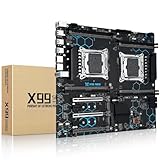
- Intel Dual CPU Sockets: This C612 chipset server motherboard is designed with dual CPU sockets, which can support Xeon E5 V3/V4 series processors. (Note: Core i7 not support Dual-CPU mode, if only one CPU is installed, please install it in the left slot)
- DDR4 Memory Slots: The memory slots of the LGA 2011-v3 motherboard is designed with 8-channel, which can support DDR4, DDR4 ECC, DDR4 RECC RAM. It supports effective frequencies is 2133/2400MHz, and the maximum capacity is 256GB. (Note: When use E5 v4 CPU, can not support Desktop DDR4 RAM)
- PCIe 3.0 Protocol: Equipped with 2 PCIe 3.0 X16 graphics card slots (with steel case), and 1 PCIe 3.0 X8, 2 PCIe 2.0 X1. The transfer rate can reach 15.754 GB/s. Equipped with 2 M.2 hard disk slots, which can achieve fast reading even if multiple programs are running
- Stable Power Supply: The X99 Dual CPU motherboard use 24+8+8pin standard power supply interface, 8-phase power supply. Precise modularization provides good heat dissipation and makes the program run more stably
- Strong Expandability: The X99 gaming motherboard is equipped with multiple expansion interfaces to ensure that the motherboard has more room for improvement, include 4*USB 3.0 ports, 2*USB 2.0 ports, 8*SATA 3.0 ports, 2*network ports
That rationale describes AMD’s strategy at the time of the announcement, not proof that the expected benefits were later realized. AMD also said it planned to offer systems based on AMD Opteron processors and SeaMicro technology in the second half of 2012, while remaining committed to its traditional server business. Those were forward-looking plans in the 2012 announcement, not confirmation of later product availability.
What did SeaMicro’s server technology do?
AMD’s filing describes SeaMicro’s technology in connection with its SM10000 server offering: an array of independent, ultra-low-power processors that integrated computing, switching, server management, and load balancing. AMD positioned the design for scale-out infrastructure such as cloud data centers. In the announcement, AMD executive Lisa Su called SeaMicro’s fabric technology “one of the crown jewels of the Cloud.”
Rank #2

- Ready for Advanced AI PC: Designed for the future of AI computing, with the power and connectivity needed for demanding AI applications
- Intel? LGA 4710-2 socket: Ready for Intel Xeon 600 Processors for Workstation
- CPU and memory overclocking: The performance of ECC R-DIMM DDR5 memory (2DPC) is further enhanced by the exclusive NitroPath DRAM technology
- Ultrafast connectivity: 7 PCIe 5.0 x16 slots, Realtek 10Gb LAN and Intel? 2.5Gb LAN, 4 M.2, 2 SlimSAS, and USB4? and USB 20Gbps Type-C
- Server-grade IPMI remote management: Hardware and software-level with ASUS IPMI expansion card support, plus a real-time monitoring and management software – ASUS Control Center Express
What did AMD claim about efficiency and bandwidth?
AMD said systems using SeaMicro technology typically used one-quarter the power and one-sixth the floor space of traditional servers delivering the same compute performance, and offered up to 12 times the bandwidth per core. These were AMD’s own configuration-specific comparisons, not independent benchmark results or universal performance ratios.
| Claim | Configuration AMD compared | Qualification |
|---|---|---|
| One-quarter the power | 51 traditional two-socket 1U rack servers: 13,581 total watts; versus 512 single-socket SeaMicro servers in one 10U chassis: 2,499 total watts. | AMD specified a standard web-server workload at 100% utilization and the same compute performance. |
| One-sixth the floor space | 60 traditional 1U servers versus one 10U chassis. | This was AMD’s stated space comparison; it should not be generalized to every server deployment. |
| Up to 12 times the bandwidth per core | A traditional 12-core, dual-socket system with 2 Gbps aggregate network bandwidth versus a four-core SeaMicro server with up to eight 1-Gigabit NICs per socket. | The figure reflects AMD’s stated comparison and its specific network configurations. |
AMD presented these figures in its February 29, 2012 announcement. They describe the systems AMD selected for comparison and should not be read as guaranteed savings or bandwidth gains for other workloads or configurations.
What’s actually slowing this PC down?
Pick the symptom - the matching free tool is one click away.
Quick Recap
Rank #3

- AMD socket sTR5 supports up to 96-core CPUs: Ready for AMD Ryzen Threadripper PRO 7000 WX-Series Processors.
- Ultrafast connectivity:Seven PCIe 5.0 x16 slots, dual 10 Gb LAN ports, four M.2 slots, two rear USB4 40Gbps Type-C and SlimSAS NVMe support.
- CPU and memory overclocking: Support for up to 2TB ECC R-DIMM DDR5 memory modules (1DPC)
- Robust power and thermal design: 32 power stages with two 8-pin power connectors for the CPU, massive VRM cooling, chipset and M.2 heatsinks with active fans, and M.2 thermal pad.
- PCIe Q-release Slim: Remove the graphics card by directly pulling it up, instead of pressing a PCIe latch.
Product prices and availability are accurate as of the date/time indicated and are subject to change. Any price and availability information displayed on Amazon at the time of purchase will apply.




