A useful business accounting spreadsheet separates sales, expenses, owner transactions, loans, and transfers; links each entry to supporting records; and summarizes activity for a defined period using a consistent accounting method. The example below is an adaptable bookkeeping aid—not an IRS form, an IRS-approved template, or a substitute for tax and accounting requirements that apply to your business.
For U.S. federal recordkeeping, the IRS says, “You can choose any recordkeeping system suited to your business that clearly shows your income and expenses.” The IRS does not prescribe one spreadsheet layout for every business.


Build the workbook around a transaction log
Start with one row per transaction, based on an invoice, receipt, deposit record, paid bill, or other supporting document. Give every entry enough detail that you can explain what happened, when it happened, who paid or received money, how you classified it, and where its evidence is stored. The IRS describes a journal as “a book where you record each business transaction shown on your supporting documents.”
| Column | What to record |
|---|---|
| Transaction date | The date the sale, purchase, transfer, contribution, or other activity occurred. |
| Earned or incurred date | For accrual records, the date income was earned or an expense was incurred, if different from the payment date. |
| Paid or received date | When money actually changed hands, if different from the transaction date. |
| Description | A clear explanation of the transaction and its business purpose. |
| Customer or vendor | The source of income or the person or business paid. |
| Category | A consistent account or category appropriate to the business. |
| Classification | Sales income, expense, transfer, owner contribution, owner withdrawal, loan proceeds, loan payment, or another suitable non-sales category. |
| Amount | The transaction amount. Use a consistent sign convention and do not mix income and expenses without a clear classification. |
| Payment method or account | The bank account, card, cash, or other channel used. |
| Document reference | An invoice number, receipt filename, deposit reference, or location of the supporting record. |
| Reconciliation status | Whether the transaction has been compared with the relevant bank or card statement. |
| Notes | Additional context needed to understand the entry later. |
This is a practical design, not an official IRS-required column list. Keep gross receipts identifiable and do not count every deposit as a sale: an owner contribution, loan, or transfer is a different kind of cash movement from customer revenue. The IRS advises businesses to identify sources of receipts and distinguish business from nonbusiness receipts.
Crashes, No Sound, or Screen Glitches?
Random freezes, missing sound and display glitches usually trace back to one bad driver. Find and replace yours safely.Free scan · under a minutePC Slower Than It Used to Be?
A free scan shows the junk files, broken settings and background clutter dragging Windows down - then fixes them in one click.Free scan · Windows 10 & 11#1 Best Overall

- Income And Expense Log Book: This Income and Expense Record Book(8.5" x 10.5") is a necessary item for any small business owner or entrepreneur. It is an essential part of any business - helping you understand your overall earnings to determine if you are profitable.
- Daily Tracking and Weekly Overview: let our log tell you if you are profitable today! There are two pages per week to help you you track your income and expenses. At the end of each day or week, you can note whether you made a profit or a loss for the day.
- Clear P&L Statement For Your Business: This income and expense book makes it easy to see your expenses and how they fluctuate from time to time. This makes it easy for you to decide where you can cut back on expenses and assess your total annual net profit.
- Main Features: Expense Review + Income Review + Weekly Pages + Summary of The Year + Twin-Wire Binding + Waterproof Cover + Rounded corner design + Thicker paper
- Effective Organization: This budget book has a twin-wire binding and you can easily lay it flat at 180°. This effective design can help you work better and bring you great convenience in the process of using.
Organize the workbook into useful sheets
Transactions
Use the transaction log as the source for summaries. Avoid typing the same transaction separately into multiple totals, which can create mismatches. Keep dates, categories, and classifications consistent so the workbook can be filtered and reviewed.
Categories
Maintain a short list of income and expense categories that fits the business, and use it consistently. A business with inventory should distinguish inventory purchases from ordinary operating costs; a service business may need a different structure. No single chart of accounts is right for every trade.
Monthly summary
Summarize income and expenses by month and category, and calculate a management net-income figure for the chosen reporting period. Label the accounting method used and the period covered. A simple cash-based system may summarize daily and monthly cash receipts and monthly cash disbursements, but that summary is not automatically a tax return or a complete set of financial statements.
Reconciliation
Compare transactions in the workbook with statements for the business bank account and other accounts used for business. Track outstanding checks, deposits in transit, bank fees, and errors until the difference is explained. A bank statement confirms a payment or deposit occurred, but it does not by itself establish that an expense is deductible; retain the invoice or receipt that shows what was purchased and why.
Recommended Free Tools
Assets and payroll, when relevant
Businesses with depreciable property or employees may need separate asset and payroll records. Include those only when they apply, and check the required treatment for the business. The IRS examples include records such as depreciation worksheets and employee compensation records, but a simple income-and-expense log does not replace them.
Choose and label the accounting method
Cash and accrual methods can put the same transaction in different periods. The method affects the dates used in summaries, so label it plainly and apply it consistently. The SBA gives a simple example: for a sale made in January and paid in February, accrual accounting records the sale in January, while cash accounting records it in February.
| Method | General timing | Practical trade-off |
|---|---|---|
| Cash | Generally reports income when received and deducts or capitalizes expenses when paid. | Often easier to follow and offers a direct view of cash movement, but can make a month look different from the period when work was done or costs were incurred. |
| Accrual | Generally reports income when earned and expenses when incurred, whether or not payment has occurred. | Can show activity closer to when it occurs, but requires tracking unpaid invoices and bills as well as payment dates. |
These are broad descriptions, not a determination of which method your business may use. IRS rules can depend on the business and its circumstances. For example, inventory necessary to account for income generally affects the accounting method used for purchases and sales, although the IRS describes an exception for certain small-business taxpayers. Check current IRS requirements before choosing or changing a method.
Know when a spreadsheet is not enough
A single-entry income-and-expense spreadsheet can be a simple starting point. The IRS describes single-entry bookkeeping as based on the income statement and illustrates summaries of cash receipts. It is less suited to showing a full picture of what the business owns and owes.
Best Value
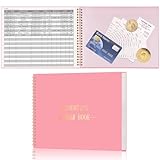
- Easy To Track Your Finances: HAUTOCO accounting ledger book keeps you on top of your expenses and income! Help you keep your money organized, spend well, and set and achieve financial goals
- Premium Material: The accounting ledger book has a total of 120 pages and 3,000 lines of entries. It is made of 100gsm thick paper to reduce ink leakage; it is equipped with a waterproof and sturdy PP cover to protect the inner pages
- Practicality: The expense tracker notebook measures 10.1 x 7.8'', and the large size gives you enough space to record each of your transactions; there are 2 PE large pockets at the back of the account book to store important tickets and loose items
- Manage Your Finances Effectively: Undated accounting books with number, date, description, account, payment or deposit amount, and total balance. You will be able to easily analyze your financial activities and quickly prepare accurate financial statements
- Ideal For Small Business or Personal Use: An accounting log journal can track your business or personal financial status. With a clear record of transactions, you can find unnecessary expenses or fraudulent charges
| Approach | What it tracks | Best understood as |
|---|---|---|
| Single-entry | Income and expenses, often organized around cash receipts and disbursements. | A simpler recordkeeping approach for some small businesses; it may not provide a complete balance sheet or built-in balancing check. |
| Double-entry | Each transaction has debit and credit entries; total debits should equal total credits. It can track income, expenses, assets, liabilities, and net worth. | A more complete accounting structure with an internal balancing control, but one that requires more setup and accounting knowledge. |
An income statement reports results over a period. A balance sheet reports assets, liabilities, and equity at a particular date. A transaction log or monthly net-income total is not, on its own, either a complete set of statements or a double-entry ledger.
Consider a more structured bookkeeping system or qualified accounting help when the business has inventory, employees, significant receivables or payables, multiple businesses, or reporting needs that a basic log cannot handle. IRS Publication 583 includes an illustrative example for a sole proprietor with a small auto body shop, part-time help, no inventory held for sale, and cash accounting; the IRS explicitly cautions that the sample is not a recommendation for every business.
Independent reader supportYour contribution helps us test, update, and keep practical guides available for everyone.Keep records that support the entries
Retain the source records that substantiate what the spreadsheet summarizes: sales slips, paid bills, invoices, receipts, deposit slips, canceled checks, and other relevant documents. Organize them so each entry can be traced back to its evidence. An electronic workbook does not reduce these obligations. IRS guidance says electronic records must be complete and accurate, kept in a legible and retrievable form, and accessible for examination.
- Use stable filenames or references that connect spreadsheet rows to supporting documents.
- Back up the workbook and source records, and make sure you can retrieve and reproduce them in readable form.
- Reconcile business accounts regularly; IRS Publication 583 advises monthly reconciliation.
- Keep personal and business transactions distinguishable, especially when an account contains both.
- Do not build generic tax-deduction conclusions or fixed tax rates into the workbook; tax treatment depends on the facts and applicable rules.
There is no single retention period that safely applies to every business record. IRS Publication 583 explains that the period depends on the return and record involved and separately says employment tax records must be kept at least four years. Check current IRS retention guidance for the specific records and circumstances that apply to your business.
Set up a reliable routine
- Choose the scope. Decide which business, accounts, reporting period, and accounting method the workbook covers.
- Enter transactions from source documents. Record each transaction promptly and classify non-sales deposits separately from gross receipts.
- Attach traceable references. Store invoices, receipts, and other evidence so the reference in the log leads to the underlying record.
- Review categories and dates. Check for missing entries, inconsistent categories, duplicate rows, and differences between transaction dates and payment dates where relevant.
- Reconcile to statements. Compare the workbook with bank and card statements, document timing differences, and investigate unexplained amounts.
- Review summaries before relying on them. Confirm that the period and accounting method are labeled and that totals represent the categories they claim to summarize.
The workbook is most useful when it makes the records understandable and verifiable—not merely when its totals add up.
Quick Recap
Product prices and availability are accurate as of the date/time indicated and are subject to change. Any price and availability information displayed on Amazon at the time of purchase will apply.




