Do these 3 things before closing this tab:
1Repair Windows errors before they cause bigger problems2Fix the driver behind crashes, sound loss and screen glitches3Clear out junk files and repair common Windows errorsMarket-data platforms deliver information such as quotes, trades, indices and, on some feeds, order-book events to trading systems and users. What you receive—and how quickly and reliably it arrives—depends on the feed, venue coverage, connection and service tier. A real-time quote can help inform a decision, but it does not guarantee an execution at that price or make a strategy profitable.
What real-time market data contains
Market data is information about trading activity and instruments. An exchange feed generally distributes events produced by that venue, such as trade reports and bid and offer information. Depending on the product, a platform may combine data from multiple venues, show only selected fields, or provide a more detailed stream of individual order events.
Quotes, trades and order-book depth
- Quotes show prices and, depending on the feed, displayed quantities available to buy or sell. A best bid and offer view shows the best displayed prices represented in that feed.
- Trades report transactions, including their prices and other fields supported by the service.
- Order-book depth adds displayed orders or aggregate quantities at prices beyond the best bid and offer. A feed may aggregate or “net” activity, or expose visible orders individually; the exact content depends on the product.
- Indices and reference data can accompany trading information. Coverage and fields vary by provider and instrument.
“Level 1” and “Level 2” are common shorthand for data tiers, not a guarantee that every provider includes identical fields. In general, Level 1 refers to top-of-book information, while Level 2 adds depth at multiple price levels. Check the particular product’s definition: an exchange may distinguish consolidated depth from un-netted or order-by-order data. Deutsche Börse, for example, describes CEF Core as consolidated Level 1/2 information and CEF Ultra+ as un-netted pre-trade information, with order-by-order options for visible orders (Deutsche Börse real-time data feeds).
How trading platforms receive and deliver data
A trading platform needs a source of market data, a route for receiving it, and software capable of decoding and presenting or processing the messages. Users may access data through a broker or licensed vendor, or an institution may connect to an exchange’s feed directly. Exchanges describe routes that include dedicated network connections, colocation, leased lines, VPNs and cloud or standardized API access. The right route depends on the feed, user, location and intended use.
Quick wins for a faster PC:
Repair Windows errors before they cause bigger problemsFix Now →Scan for outdated or missing drivers - takes under a minuteDriver Scan →Clear out junk files and repair common Windows errorsFree Scan →#1 Best Overall

- E-Ink Screen: High-quality E-Ink display for easy, glare-free reading of stocks, crypto, commodities, and more. The screen ensures clear visibility without eye strain.
- WiFi Connected: Connects to WiFi for real-time updates on stocks, crypto, commodities, options, ETFs, and electricity prices. Stay informed with live data directly on the device.
- Stock Alerts: Receive instant notifications for stock and crypto price changes, including pre- and after-market prices, helping you stay on top of market fluctuations.
- Stackable Design: Stackable and customizable for any office or gaming setup. TickrMeter is a stylish accessory that enhances any workspace.
- Real-Time Stock Ticker: Monitor stocks, crypto, and other financial data in real-time. Perfect for market enthusiasts, it’s the ultimate tool to keep track of your investments.
Direct exchange feeds
A direct feed carries data from a particular exchange or venue. It can be appropriate when a firm needs that venue’s specific content, depth or event stream. It does not automatically provide a consolidated view of the wider market: coverage is tied to the service and instruments it includes. A firm also needs to check connectivity, protocol, feed handling and data-use rights.
Vendors and consolidated feeds
A data vendor can provide access to one or more sources, potentially simplifying delivery for customers who do not want to connect separately to each venue. Consolidation and coverage are product-specific, so confirm which venues and instruments are included and how their data is represented. The London Stock Exchange says customers can receive real-time data directly or through licensed vendors (LSE Real Time Data).
Connectivity and APIs
Some services use multicast and binary protocols, while others offer WebSocket streams or standardized API protocols. These are not interchangeable from an operational perspective: the receiving system must support the chosen protocol, handle the message rate and maintain accurate timing. Deutsche Börse lists leased lines, colocation or VPN access for different services and a cloud-stream WebSocket endpoint; CME describes dedicated network or data-centre connections and standardized API protocols among its access routes. These are provider-described options, not assurances of availability for every product or location (Deutsche Börse; CME Group Data and Analytics).
Rank #2

- STOCK & CRYPTO MARKET DATA – Track both US stocks (SPY, TSLA, NVDA) and crypto pairs (BTC, ETH, DOGE, MATIC, XRP) with real-time candlestick charts, price indicators, and trading volume visualization.
- CUSTOMIZABLE & EASY SETUP – Simple WiFi connection with user-friendly portal for asset selection. Adjust timeframes (1m–1mo), languages, time zones, and 4 brightness levels to fit your trading style.
- MONITOR UP TO 25 ASSETS – Pre-loaded with top stocks and crypto pairs but fully customizable to track your personal portfolio. Instantly updates crypto prices and refreshes stock data every 10 seconds.
- PORTABLE & PERSONAL – Remembers your settings even when unplugged. Choose optional standard or extended battery for portability, so you can monitor the market during travel or meetings.
- PERFECT GIFT– Available in black, natural wood, red, rainbow, glow, and gold. Perfect gift for investors, stock traders, crypto bros, or market enthusiasts who want real-time price data at a glance.
Examples of exchange-described feeds
| Provider and product | Provider-described content or features | Access or scope detail |
|---|---|---|
| Deutsche Börse CEF Core and CEF Ultra+ | CEF Core: consolidated Level 1/2 information. CEF Ultra+: un-netted pre-trade information, with order-by-order options for visible orders. | Different services have different access routes, including leased lines, colocation, VPN and a cloud-stream WebSocket endpoint. See Deutsche Börse’s feed descriptions. |
| LSEG Group Ticker Plant | Consolidated feed for LSE and Turquoise cash venues, TRADEcho and FTSE indices; listed features include multicast, a binary protocol, dual-feed design and Level 1/2 data. | These are provider descriptions; exact product scope and access should be verified with LSEG. See Group Ticker Plant. |
| London Metal Exchange LMEsource | Provider describes a high-throughput, low-latency multicast feed with electronic and non-electronic market data. Listed electronic features include order-by-order events, indicative opening prices, combined orders and trades, and reference data. | See LMEsource for the provider’s product description. |
| CME Group data and analytics | Provider describes streaming and historical data products. | Access routes include dedicated network or data-centre connections and standardized API protocols. Verify the relevant product’s instruments, protocols, permissions and geographic availability at CME Group Data and Analytics. |
Those feature lists describe what providers say their products offer; they are not independent performance tests or evidence that one feed is faster than another in a trader’s environment.
Why latency and resilience matter
Latency is the time taken for information to travel through some defined part of a system. A provider’s feed-delivery figure may describe only one segment, not the full journey from an exchange event to a decision or order at a trader’s system. Real-world end-to-end timing also depends on location, network path, message processing, clock accuracy and the receiving application. Provider claims such as “low latency” or “lowest latency” should not be compared as if measured with the same method and conditions.
For automated strategies, a delay in receiving or processing events may matter because the strategy acts on changing information; high message rates can also challenge systems that cannot keep up with a full stream. Deutsche Börse positions Ultra+ and order-by-order products for algorithmic trading, but this is a use case, not a reason every investor needs the deepest or fastest available feed. For a person checking prices before placing occasional orders, detailed event streams may add complexity without answering a practical need.
Rank #3
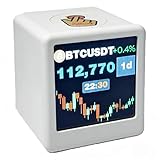
- Next-Gen System Upgrade — Backed by CoinGecko, it monitors real-time prices for over 2000 leading cryptocurrencies and the entire U.S. stock market. Designed with cutting-edge technology, it delivers a sleek, futuristic experience that puts global markets at your fingertips. Now enhanced with real-time gold price tracking for a more complete view of the markets.
- Smart Dynamic Display — More than markets, this display offers weather updates, a digital clock, and a customizable photo album for daily essentials. With GIF animations and photo albums, it blends vital info with personalized, vibrant visuals.
- Gifts A Man Can't Refuse: Tech-savvy and versatile, it’s an ideal present for crypto enthusiasts, stock traders, or anyone who loves smart gadgets—combining practicality with a premium touch.,And it's small,1.4X1.25 inch,Even during work, it won't attract the boss's attention。Additionally, we will give away a Collector's Edition Bitcoin Coin
- Pro-Tech Gadget——Designed for crypto enthusiasts and financial followers. This smart display features seamless 2.4GHz Wi-Fi connectivity for real-time streaming of Bitcoin (BTC), altcoins, and global stock market data. While no coding is required, users will access our dedicated web portal via a QR code to personalize tickers and layouts. Please ensure a compatible Wi-Fi environment and follow our comprehensive video guide for a professional-grade setup.
- Dual Market Coverage — Instantly switch between crypto (e.g., BTC, ETH, BNB, XRP, ADA) and U.S. stock data on one device. No need for multiple apps or platforms—get a unified view of the financial world in real time. Now also supports real-time gold price tracking for broader market coverage.
Resilience matters alongside speed. A dual-feed design, redundant sites, recovery behavior and operational support can affect whether a system continues receiving usable data during a disruption. A fast feed that drops events or is difficult to restore may be less useful than a slightly slower service with continuity that meets the user’s needs. Ask providers how failover works and what happens to the stream during recovery; public product descriptions do not establish how every customer’s full system will perform.
Real-time information can help traders monitor conditions and inform order decisions. The London Stock Exchange says, “Delivering data in a timely manner also leads to a greater level of market transparency.” It also describes its real-time data as including order-book depth, prices and sizes (LSE Real Time Data). These are provider statements about the role of its data. A quote or displayed order is an observation, not a promise that an order will fill, that the quoted price will remain available, or that a trade will be profitable.
Outdated Drivers Are Slowing You Down
One free scan finds every outdated or missing driver and matches the right update for your exact hardware.Free scan · exact hardware matchWindows Errors? Fix Them Before They Spread
Repair common Windows errors and clear accumulated junk for a smoother, more stable PC - no reinstall needed.Free scan · no reinstallHow to compare market-data platforms
Compare the service against the job it must do, rather than choosing on a single “fastest” label. Ask providers to define the timing metric and measurement point behind latency claims; figures measured at different points or under different conditions are not directly comparable.
Rank #4

- STOCK & CRYPTO MARKET DATA – Track both US stocks (SPY, TSLA, NVDA) and crypto pairs (BTC, ETH, DOGE, MATIC, XRP) with real-time candlestick charts, price indicators, and trading volume visualization.
- CUSTOMIZABLE & EASY SETUP – Simple WiFi connection with user-friendly portal for asset selection. Adjust timeframes (1m–1mo), languages, time zones, and 4 brightness levels to fit your trading style.
- MONITOR UP TO 25 ASSETS – Pre-loaded with top stocks and crypto pairs but fully customizable to track your personal portfolio. Instantly updates crypto prices and refreshes stock data every 10 seconds.
- PORTABLE & PERSONAL – Remembers your settings even when unplugged. Choose optional standard or extended battery for portability, so you can monitor the market during travel or meetings.
- PERFECT GIFT– Available in black, natural wood, red, rainbow, glow, and gold. Perfect gift for investors, stock traders, crypto bros, or market enthusiasts who want real-time price data at a glance.
- Content and depth: Does the service include trades, best bid and offer, multiple depth levels, consolidated data or order-by-order events? Are orders aggregated or shown individually?
- Venue and instrument coverage: Which exchanges, asset classes, instruments and related indices are included? Does “consolidated” mean the venues relevant to your use case?
- Latency and determinism: What timestamp and start/end points define the provider’s figure? Is it a typical, average, maximum or otherwise specified measurement, and under what conditions?
- Resilience and continuity: Are there dual feeds, redundant sites, documented failover and recovery behavior, and support when data is interrupted?
- Connectivity and processing: Is access direct, through a vendor, over multicast, a leased line, colocation, VPN, WebSocket or API? Can your system decode the format and handle the message rate?
- Rights and costs: What do the contract and venue rules permit for display, non-display use, redistribution and reporting? Who is classified as the user, and which venue fees apply? These terms are contract-specific and cannot be inferred from a public product feature list.
Do you need a direct exchange feed?
Not necessarily. A direct feed is worth evaluating when you need a venue’s specific events or depth, need to control the connection and processing path, or operate a strategy for which feed characteristics are material. A broker or licensed vendor may be a more suitable route when its coverage and delivery meet your needs and you prefer not to manage separate venue connections.
Before choosing, write down the instruments and venues you actually use, the information your decisions require, and whether you need display-only data or data for automated/non-display processing. Then confirm the exact feed contents, access method, latency definition, continuity arrangements and contractual permissions for your account and location. Public provider pages do not settle current prices, licensing terms or geographic availability; request current product and contract documentation for those details.
Regulatory transmission rules are not user latency promises
European rules provide an important example of why timing figures need context. MiFIR Article 22a requires covered trading venues and approved publication arrangements (APAs) to transmit specified information to the consolidated-tape data centre “as close to real time as technically possible,” using harmonised formats and a high-quality protocol. The rule concerns contributors’ transmission to that data centre, not a guarantee about when a retail user receives data (ESMA MiFIR Article 22a).
Best Value
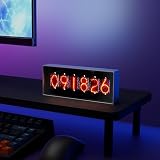
- Real-Time Data Display – Shows live cryptocurrency (Bitcoin), stock market trends, time, weather, and temperature updates at a glance.
- Custom Image & Video Upload – Supports personalized image uploads and up to 30-second video playback for a unique visual experience.
- Smart App Control – Easily manage content, switch display modes, and update information through dedicated control software.
- Clear & Dynamic Visuals – Bright, easy-to-read display delivers clear information and enhances your desk, office, or gaming setup.
- Modern Tech Decor – Combines practical information display with a sleek, modern design, perfect for home offices and tech enthusiasts.
For covered shares and ETFs, Commission Delegated Regulation (EU) 2025/1155 specifies that certain pre-trade input data is due no later than 50 milliseconds after the order timestamp and certain on-venue post-trade data no later than 50 milliseconds after the transaction timestamp, each with a daily 95% confidence interval. These are contributor-to-consolidated-tape transmission requirements, not universal market-feed standards or retail trading targets; applicability and any amendments should be checked before relying on the regulation for legal decisions (Commission Delegated Regulation (EU) 2025/1155).
Why old latency figures should not be treated as current benchmarks
Historical U.S. figures illustrate how much the measurement period and market-data system matter. NYSE’s exchange-authored explainer reports the following average Securities Information Processor (SIP) latency measurements:
| Measure | Q1 2010 average | February 2018 average |
|---|---|---|
| Quote latency, Tape A and Tape B securities | 4.04 milliseconds (NYSE, measurement period Q1 2010) | 0.09 milliseconds (NYSE, measurement period February 2018) |
| Quote latency, Tape C securities | 5.42 milliseconds (NYSE, measurement period Q1 2010) | 0.017 milliseconds (NYSE, measurement period February 2018) |
| Trade-reporting latency, Tape A and Tape B | 6.46 milliseconds (NYSE, measurement period Q1 2010) | 0.15 milliseconds (NYSE, measurement period February 2018) |
| Trade-reporting latency, Tape C | 6.06 milliseconds (NYSE, measurement period Q1 2010) | 0.017 milliseconds (NYSE, measurement period February 2018) |
These are dated U.S. SIP averages published by NYSE, not current measurements of exchange direct feeds, vendors or end-to-end trading systems. They should not be compared with European contributor reporting deadlines or provider marketing claims as though all measure the same thing. See NYSE’s “Understanding the Market for U.S. Equity Market Data” for the stated periods and figures.
Quick Recap
Product prices and availability are accurate as of the date/time indicated and are subject to change. Any price and availability information displayed on Amazon at the time of purchase will apply.
Free tools Windows power users keep installed
One-click scans. No signup required.




