Free tools Windows power users keep installed
One-click scans. No signup required.
Solar panels can reduce the electricity you buy from your utility and the emissions associated with grid power, but neither result has a universal figure. Your outcome depends on how much your system produces, how much of that power your household uses, what the utility pays or credits for exports, and the system’s full cost and financing terms.
How solar panels can lower an electricity bill
A solar PV system generates electricity at your home. When household demand coincides with solar production, you can use that electricity instead of buying it from the utility. If production exceeds demand, surplus electricity may flow to the grid. The value of that exported power depends on your utility’s rules.
The U.S. Department of Energy (DOE) says it is nearly impossible to calculate a universal average for solar savings because households differ in size, electricity use, and location. System output, purchase or lease terms, utility rates, and export compensation also affect the result. As DOE puts it, “The amount of money you can save with solar depends upon how much electricity you consume, the size of your solar energy system, if you choose to buy or lease your system, and how much power it is able to generate given the direction your roof faces and how much sunlight hits it.” Source: U.S. Department of Energy, Homeowner’s Guide to Solar.
DOE’s published examples illustrate why outcomes vary; they are scenarios, not typical results or forecasts. Its August 1, 2024 California homeowner example describes about $200 per month in electricity-bill savings and payback in less than five years. An Ohio lease example from the same date describes $600 in net annual savings after a fixed monthly panel payment and avoided electricity costs. Neither figure should be treated as a prediction for another household. DOE examples and guidance.
#1 Best Overall

- 【200W N-Type 16BB High Efficiency】Built with advanced N-type monocrystalline cells and 16BB busbar technology, the Callsun 200 watt solar panel delivers up to 25.6% conversion efficiency. N-type cells provide excellent power generation and reliability, while the 16BB design helps reduce hot spots and microcrack risks for dependable long-term performance.
- 【400W Series Connection for Portable Power Stations】Pair two Callsun 200W panels in series to reach 400W total power, 47.48V Vmp and 54.62V Voc while maintaining 8.43A operating current. This configuration is well suited for many portable power stations with 60V-class solar input limits, helping maximize solar charging within supported voltage and current ranges.
- 【Boost Energy with Bifacial Technology】The Callsun 200W bifacial solar panel features a transparent backsheet that captures sunlight from both the front and rear sides. By utilizing direct, reflected and diffuse light, the bifacial design can generate additional energy from the rear side under suitable installation conditions, helping maximize overall solar output.
- 【TwinCell Anti-Shading Design】The Callsun 200W solar panel features a dual-module parallel design that divides the panel into two independently operating sections. When one section is partially shaded by trees, buildings or other obstacles, the other section can continue generating power. This design helps reduce the impact of partial shading and maintain more consistent energy production.
- 【Compact Design for RVs, Vans & Off-Grid Use】Each panel measures 51.3 × 30.3 × 1.4 inches and weighs 23.8 lbs, delivering strong power output in a compact footprint. This 200W solar panel is ideal for Class B vans, RVs, marine applications, rooftops and other space-conscious off-grid solar systems. Pre-drilled mounting holes make installation with compatible mounting hardware straightforward.
What determines whether solar makes financial sense?
Roof suitability and system production
Shade, roof area, shape, slope, and age affect how much electricity a rooftop system can generate and whether installation is practical. DOE says south-facing roofs with slopes of 15–40 degrees typically perform best, but other roof types may also be suitable. A roof that may need replacement soon can add a significant cost or affect installation timing.
For an initial estimate, NREL’s PVWatts calculator models the energy production and cost of energy for grid-connected photovoltaic systems. Use it as a starting point, then request an estimate based on a site assessment and your actual roof. A calculator result is not a custom installer quote or a guarantee of production. NREL PVWatts.
Rank #2

- [Higher Efficiency, More Power Output] With Grade A+ large monocrystalline solar cells, this panel achieves a remarkable 23% conversion rate, outperforming conventional options. It generates up to 500Wh of electricity per day with 5 hours of direct sunlight. Unleash the potential of solar energy with our high-performance panel.
- [10BB Cells] Utilizing 10BB solar cells, these solar panels offer superior efficiency and performance, ensuring reliable energy production.
- [Durable and Weather-Resistant] Built with black corrosion-resistant aluminum frame, the 100W solar panels withstand strong winds of 2100Pa and snow loads of 5100Pa. The IP65 junction box and IP67 connectors provide exceptional waterproof protection, making them ideal for outdoor use.
- [Easy Installation and Versatile Use] JJN 100 Watt Solar Panel features pre-drilled mounting holes, which enable straightforward installation and transport, suitable for a range of applications from residential rooftops to off-grid systems in RVs and boats.
- [Reliable after-sales Service] As a professional solar panel manufacturer, we provide an extra-long transferable power output warranty of 30 years. Whenever you encounter any problems, JJN Solar will provide you with professional and prompt customer service.
Your electricity use and utility rate
Review bills to establish how much electricity you use and the rates you pay. A system’s annual generation alone does not tell you the bill savings: timing matters, too. Electricity you use directly can avoid a utility purchase, while surplus electricity is subject to the utility’s export-credit rules.
How the system is paid for
Compare cash purchase, loan, lease, and power-purchase-agreement (PPA) proposals when available. DOE notes that buying outright can have a lower total cost than a loan, lease, or PPA, but the right choice depends on the household and the specific offer. Look beyond a quoted monthly payment: review total cost, financing charges, any payment escalator, projected generation, and the assumptions behind estimated savings and payback.
Rank #3
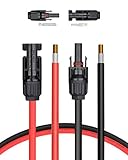
- UPGRADE 2.0 SOLAR CABLE: Increase a free pair of separate solar connectors. One pair (1 piece black + 1 piece red) 20 Feet 10AWG Solar Extension Cable. BougeRV promises an 18-month technical support for the solar extension cable.
- MINIMIZE POWER LOSS: Made with tin-coated pure cooper, the tinned-coated pure cooper cable has good electrical conductivity, compared with bare copper wire, its corrosion resistance and oxidation performance are stronger, also can greatly extend the service life of cables. Compared with 14AWG and 12AWG cables, using a 10AWG solar extension cable can minimize power loss in your solar panel system.
- HIGH SECURITY: BougeRV solar cable is certified by TÜV and UL. The dual sheath is made with XLPE insulation, which ensures it can work stably from -40℉ to 194℉, while PVC wire can only handle 158℉ at maximum. BougeRV solar cable wire is UV resistant, which makes the cable much better for running in outdoor solar arrays.
- IP67 WATERPROOF & DUSTPROOF: An IP67 waterproof ring on the male solar connector provides a tight seal against water and dust, preventing corrosion. The built‑in lock ensures a secure hold, and the PV cable is suitable for outdoor use in temperatures from -40℉ to 194℉
- QUICK AND EASY CONNECTION: One end has the connectors installed, and the other end is bare wire in case you need to hook up to a controller. Come with an extra connector for extended installation. This solar extension cable can help you to position your solar panels anywhere with ease and flexibility. The solar connector is plug-and-play. Press fingers to either side of the built-in lock on the male connector can connect and disconnect the connector easily, without using other tools.
Why export credits can change the calculation
Ask your utility whether net metering or another export-credit arrangement is available, who qualifies, what rate applies, and how credits appear on bills. Electricity sent to the grid may not be credited at the same rate you pay when buying electricity. That difference can materially affect the economics, especially when a system regularly produces more than the home is using.
Before accepting a proposal, confirm that its savings estimate uses the utility’s actual rules and your eligibility—not an assumed retail-rate credit. Ask how the estimate treats electricity used at home versus exported, and whether system size or customer eligibility limits apply. DOE guidance on solar savings.
Rank #4

- 🏞️【Compact 5V Solar Power for DIY Projects】This 5-pack of 1W 5V 200mA mini solar panels helps power small lights, toys, STEM models, and low-current electronics in direct sunlight.
- 🏞️【Ready-to-Connect Wire Clip Design】Included wire clips make it easier to attach the panels to simple circuits for testing, classroom builds, or quick DIY setups without soldering.
- 🏞️【Small Size for Flexible Builds】Each 89.5 x 89.5 mm small solar panel fits compact crafts, garden light repairs, model cars, and project boxes where space is limited.
- 🏞️【Built for Low-Power Solar Experiments】These solar cells are suitable for learning series or parallel layouts, comparing output, and building simple 5V solar panel projects.
- 🏞️【Match Before You Connect】Designed for low-current devices, each 1W solar panel should be used with the proper circuit, polarity, and sunlight conditions for better project results.
How solar can reduce a household’s carbon footprint
Solar generation can displace some electricity that would otherwise come from the grid, reducing emissions associated with electricity use. The amount depends on where the home is and when solar power is generated. There is no single national household carbon-reduction number that applies reliably to every system.
The U.S. Environmental Protection Agency (EPA) uses separate emissions factors for avoided and consumed electricity and cautions that national-average factors may not accurately represent a region. For a more relevant estimate, use regional electricity emissions factors or tools where available rather than applying one national figure to every household. EPA eGRID.
Best Value

- 𝐏𝐫𝐞𝐦𝐢𝐮𝐦 𝐐𝐮𝐚𝐥𝐢𝐭𝐲: .Pjerjzn solar panel disconnector switch are newly upgraded with connectors that do not differentiate between male and female wires for quick installation. Made of premium quality material, thickened purple copper coil, wider operating handle, Transparent cover for easy checking of operational status, waterproof sealing silicone ring, IP65 waterproof and dustproof.
- 𝐏𝐫𝐨𝐭𝐞𝐜𝐭𝐢𝐨𝐧 𝐅𝐮𝐧𝐜𝐭𝐢𝐨𝐧: Solar disconnector switch has over voltage, overload and lightning protection functions, and can communicate over long distances to extend the working life of the solar system.IP65 Waterproof allow indoor and outdoor installation with built in DC switchgear for effective protection in harsh weather and environmental use.
- 𝐄𝐚𝐬𝐲 𝐈𝐧𝐬𝐭𝐚𝐥𝐥𝐚𝐭𝐢𝐨𝐧: Solar dc disconnect, installed between solar panel and solar inverter, can realize faster and safer installation, plug and play. Circuit breaker is easy and convenient to assemble and disassemble, easily connected by two waterproof connectors on the top and bottom, with pre-drilled holes on the back and internal 35mm guide rails.
- 𝐖𝐢𝐝𝐞𝐥𝐲 𝐔𝐬𝐞𝐝: Suitable for photovoltaic solar panel grid connected system and solar off grid system solar power generation system, home, RV, etc. With IP65 waterproof grade, it can be used for outdoor rain protection.
- 𝐒𝐩𝐞𝐜𝐢𝐚𝐥𝐭𝐢𝐞𝐬 𝐚𝐧𝐝 𝐬𝐞𝐫𝐯𝐢𝐜𝐞𝐬: If there is any problem with the product you received, please feel free to look for the platform or our customer support centre, we will provide you with excellent service. You can feel confident in choosing our circuit breakers for your electrical protection needs. Package includes 1x disconnect switches circuit breaker, 2x screws, 4x terminals, 2x solar connector, 1x spanner wrench and 1x product manual.
How to estimate your own savings and emissions impact
- Establish your baseline: Review utility bills for electricity use and applicable rates.
- Assess the roof: Check shade, condition, usable area, orientation, slope, and likely replacement needs.
- Estimate production: Enter your location and system assumptions in NREL PVWatts, then seek a custom site-based estimate.
- Confirm export treatment: Ask the utility about eligibility, credit rates, and how exported power is billed.
- Compare complete proposals: Evaluate total cost and financing terms alongside projected generation, self-consumed and exported power, annual savings, and payback assumptions.
- Estimate regional emissions effects: Use relevant regional emissions factors rather than a national household average.
- Check incentives: Verify current federal, state, local, and utility rules before including any incentive in your calculation.
Payback is one way to compare a proposal’s cost with estimated savings, not a guaranteed date. The estimate depends on assumptions about production, electricity prices, export credits, financing, and system costs; compare those assumptions rather than relying on the headline number alone.
What if rooftop solar is not an option?
Community solar may give renters and households with unsuitable roofs another way to participate. Instead of installing panels at home, a customer subscribes to a shared solar project and may receive bill credits. Availability and subscription terms vary by location, so confirm how credits are calculated, what the subscription costs, and how to leave the arrangement. DOE Community Solar Basics.
Account for panel life and current incentives
DOE reports that most rooftop systems maintain at least 80% of their initial power output for at least 25 years, with output diminishing slightly over time. This is general guidance, not a warranty for a particular product or system. Review the specific equipment and workmanship warranties in any proposal. DOE homeowner guidance.
For U.S. households, IRS guidance says the residential clean energy credit is unavailable for expenditures made after December 31, 2025. Older consumer information may describe earlier federal-credit rules, so do not assume those rules still apply to a new expense. Check current IRS guidance along with state, local, and utility incentives before counting any credit or rebate toward the project’s cost. IRS Residential Clean Energy Credit.
Quick Recap
Product prices and availability are accurate as of the date/time indicated and are subject to change. Any price and availability information displayed on Amazon at the time of purchase will apply.




