Quick wins for a faster PC:
Repair Windows errors before they cause bigger problemsFix Now →Fix the driver behind crashes, sound loss and screen glitchesFind Drivers →Credit card processing does not have one universal rate. A merchant’s cost can combine interchange, card-network assessments, a processor’s markup, and account or service charges. The total depends on the payment mix, how transactions are accepted and processed, and the merchant’s agreement. To compare offers, use your own transaction data and include every recurring or conditional fee—not just the advertised percentage.
What are credit card processing fees?
They are the costs a business incurs to accept and process card payments. A statement may bundle several costs into one rate or list them separately, so ask what a quoted rate includes. The main layers are interchange, network assessments, and the processor or acquirer’s markup; separate account and service charges may also apply.
Interchange
Interchange is generally a transfer between the financial institution that accepts the transaction for the merchant (the acquirer) and the cardholder’s issuing bank. Networks establish interchange schedules, with rates that vary by card product, transaction type, merchant category, and qualification criteria. It is not necessarily a fee that the merchant pays directly to the network.
Visa states in its U.S. schedule: “Merchants do not pay interchange reimbursement fees; merchants pay ‘merchant discount’ to their financial institution.” That statement appears in Visa’s Visa USA Interchange Reimbursement Fees, dated April 18, 2026. The schedule applies to Visa financial transactions within the 50 U.S. states and the District of Columbia; it is an interchange schedule, not a complete merchant processing quote.
The Tool Desk
Outbyte Driver Updater FREEFix the driver behind crashes, sound loss and screen glitchesFind Drivers →Outbyte PC Repair FREEClear out junk files and repair common Windows errorsFree Scan →#1 Best Overall

- With Square Terminal, you can ring up sales, accept payments, and print receipts, all with one device. Use it at the counter or ring up customers anywhere in your store.
- Accept all major credit and debit cards and pay one low rate with no hidden fees and no long-term contracts.
- Process chip cards in just two seconds.
- Get your money as soon as the next business day.
- Use it cordlessly with the built-in battery, designed to last all day.
Network assessments
Card networks may charge separate assessments for network services. These are distinct from interchange and from the processor’s markup. Whether they appear as separate statement lines depends on the provider’s pricing and billing.
Processor or acquirer markup
The markup pays the provider for processing and related services. The amount and the way it is presented vary by provider and agreement. Mastercard likewise describes interchange as one component of the merchant discount rate that acquirers establish and merchants pay for acceptance services. Its merchant interchange information notes that qualification can depend on factors including merchant category, authorization-to-clearing timing, transaction data, and merchant volume.
Rank #2

- Get your money as soon as the next business day.
- Get set up quickly with no long-term commitments. Download the Square Point of Sale app for free, create an account, and start taking payments anywhere.
- Run your business all in one place with the free Square Point of Sale app. Track your sales, manage inventory, accept tips, send receipts digitally, and more.
- Works with Apple devices with a Lightning connector.
Why do processing rates vary?
Two businesses can process the same dollar volume and receive different costs because their payments and agreements differ. Network schedules may distinguish consumer, rewards, commercial, debit, and other cards, as well as in-person, keyed, and card-not-present transactions. Qualification can also depend on authorization and clearing procedures and the data submitted with a transaction.
Mastercard’s page separates U.S. domestic and interregional rates and says schedules are typically updated semiannually; it cautions that its webpage may not always reflect the official rates. Confirm the applicable current schedule with the acquirer. Visa’s April 18, 2026 U.S. schedule also contains distinct programs and transaction contexts. A rate in either network’s table is not the merchant’s all-in price.
Rank #3
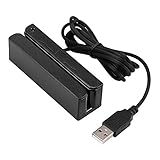
- MSR90 is a USB emulation keyboard interface that not need any driver or software,USB simply plug and play
- Reads up to 3 tracks of information,can reads ISO7811, AAMVA, CA DMV and most other card data formats
- Threaded inserts for mounting. LED indicator, green light is on when connecting,green light blinks when cards swiped
- Bi-directional swipe reading, superior reading of high jitter, scratched, and worn magstripe cards, reliable for over 1,000,000 card swipes
- Configuration software makes configuration changes easy,works with: Windows OS and Mac OS
Payment channel and business risk can matter, too. Provider-authored guidance says card-present transactions can cost less than online or keyed transactions because of differences in fraud risk, and that industry category, chargebacks, fraud levels, and processing volume may affect pricing. The actual result depends on the merchant agreement; see Stripe’s guide to credit card processing fees.
What are the main pricing models?
| Model | How it is structured | What to weigh |
|---|---|---|
| Flat-rate or blended | A single percentage, often plus a fixed amount per transaction, regardless of card type or network. | Simple to predict and reconcile, but can cost more on transactions with lower underlying network costs. |
| Interchange-plus | Interchange and assessments pass through, with a separately stated processor markup. | Shows components more clearly; whether it costs less depends on your payment mix, markup, and other fees. |
| Tiered | Transactions are assigned to provider-defined categories, such as qualified and nonqualified, each with its own rate. | Request every tier rate and the qualification rules. A low qualified rate alone may not describe what routine transactions cost. |
There is no model that is always cheapest. Compare the estimated cost for the same representative payments under each offer, including the fixed amount per transaction and separate charges. Stripe’s interchange-plus pricing guide describes that model as generally more cost-efficient for businesses with consistent volume. That is general provider guidance, not a guarantee for an individual merchant.
Rank #4
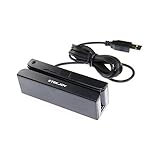
- USB interface, keyboard emulation, no need to install software to read, configuration software for changing settings available.
- Read data from all 3 tracks, high and low coercivity cards, ISO7811, AAMVA, CA DMV and most magnetic card data formats.
- Work on Windows, Mac and other USB capable systems. Work with TXT, notepad, Word, Excel, POS systems and son on.
- Compact size, with 145cm USB cord, two 3mm-diameter screw holes for fixing at the bottom, a LED indicator light
- Perfect for POS, Banking, Loyalty, Access Control, ID verification and other applications.
Which additional fees should you check?
A quoted transaction rate may not include every charge, and a possible fee is not proof that every provider charges it. Request the current fee schedule and check the written agreement for applicable items such as:
- Monthly, account, statement, or minimum-monthly fees.
- Payment gateway charges, including recurring or per-transaction charges.
- Hardware setup, purchase, or rental charges.
- Chargeback or dispute fees.
- Setup costs and early-termination charges under a term agreement.
- Cross-border, currency-conversion, or channel-specific charges when relevant.
Ask the provider to identify which charges are recurring, which apply only in certain circumstances, and which are already included in the quoted rate.
Recommended Free Tools
Best Value

- Pay one transparent rate per swipe for Visa, Mastercard, Discover and American Express.
- Works in conjunction with most downloadable Square point-of-sale apps on your device. Customers can pay, tip and sign directly on your device. Track payments in cash, gift cards and more. Also lets you send receipts via e-mail or text message, makes it easy to apply discounts, keeps a data and sales history log and more.
- Accepts magstripe credit card payments, including those from Visa, Mastercard, Discover and American Express (fees apply).
- App sends deposits to your bank account within 1 to 2 business days, or enjoy instant deposits (fees apply).
How should you compare processor offers?
Use the same assumptions for every provider, based on recent processing statements where possible. Estimate total monthly cost, not just the percentage rate:
- Gather a representative payment profile. Record monthly card volume, transaction count, average ticket, card mix, the share of in-person, online, and keyed payments, domestic versus foreign cards, and the frequency of refunds or disputes.
- Request written offers using that profile. Ask each provider to estimate the all-in monthly cost and effective rate, and to list every recurring or conditional charge.
- Apply the pricing rules to your mix. Include percentage charges, per-transaction amounts, account fees, and relevant conditional charges. For interchange-plus, inspect the markup and other account costs. For tiered pricing, get every tier’s price and qualification criteria.
- Compare the agreement and service fit. Review contract length, termination terms, settlement and account structure, integration support, chargeback tools, and suitability for your industry. These considerations are also covered in Stripe’s guide to choosing a payment processor.
Ask providers to base their written estimates on actual recent statements. Without that like-for-like calculation, a lower advertised rate or a change in pricing model does not establish that switching will save money.
How current are published rates?
Network schedules and processor prices can change. Always identify the geography and effective date for a quoted schedule, then verify it with the network or your acquirer. A network interchange table explains one part of the cost; the merchant’s agreement determines the provider’s pricing and any additional charges. For a provider’s current offer, rely on its written quote and contract rather than treating an educational guide as a binding price.
Quick Recap
Product prices and availability are accurate as of the date/time indicated and are subject to change. Any price and availability information displayed on Amazon at the time of purchase will apply.




