What’s actually slowing this PC down?
Pick the symptom - the matching free tool is one click away.
Crypto mining is the process proof-of-work blockchains use to select who may add the next block, protect the transaction history, and issue protocol rewards. A miner uses specialized hardware to make enormous numbers of hash calculations, searching for a result below the network’s current target.
Mining is not a feature of every cryptocurrency. Bitcoin still uses proof of work, while Ethereum Mainnet switched to proof of stake on September 15, 2022. For an individual, mining is both a technical operation and a business decision: electricity, equipment, cooling, network difficulty, coin prices, pool fees, taxes, and downtime all determine whether the operation makes money.
How crypto mining works
Mining applies to proof-of-work (PoW) blockchains. The basic process is:
- Users broadcast transactions to the peer-to-peer network.
- Nodes and mining software collect eligible transactions, commonly from a mempool.
- A miner assembles a candidate block and adds a destination for the block reward.
- The mining hardware repeatedly hashes the block header, changing values such as the nonce, until it finds a hash below the network’s target.
- The miner broadcasts a successful block.
- Other nodes independently verify the transactions, proof of work, reward, and other consensus rules.
- If the block is valid, it becomes part of the chain that nodes recognize as having the greatest cumulative proof of work.
The mining calculation is not a useful calculation such as weather modeling or medical research. It is deliberately repetitive trial and error. The difficulty comes from the huge number of attempts required, not from solving a complicated equation with a clever shortcut.
#1 Best Overall

- ⚡ Efficient Home ASIC Miner – Up to 1.1 TH/s hashrate with just 18W power consumption (15 J/TH), perfect for home or small office use.
- 🇪🇺 Made in Europe – Designed and manufactured in Europe with premium components for reliability and long-term performance.
- 🔧 BM1370 ASIC Chip (Antminer S21 Pro) – Same chip used in the Antminer S21 Pro for professional-grade mining power in a compact, open-source form.
- 📡 Wi-Fi & USB-C Connectivity – No monitor or keyboard required – configure and monitor easily via web interface
- 🎁 Complete Kit Included – Delivered fully assembled with EU/UK/US 5V 6A power supply, premium fan, 3D-printed stand, and OLED display.
Bitcoin’s mining documentation describes the process in detail: Bitcoin Developer Guide.
What is inside a Bitcoin block?
A Bitcoin miner does not hash every transaction separately as its main mining task. It builds a block and hashes the block’s header. The serialized Bitcoin block header is 80 bytes and includes several important fields:
| Field | Purpose |
|---|---|
| Previous block hash | Connects the proposed block to the existing chain. |
| Merkle root | Summarizes the transactions included in the block. |
| Timestamp | Records the miner’s claimed block time, subject to network rules. |
nBits |
Encodes the current Bitcoin difficulty target. |
| Nonce | A value miners can change while searching for a valid hash. |
Mining software usually obtains a block template from a node or a pool. A Bitcoin miner operating with its own node may use the getblocktemplate interface. The software then repeatedly changes the nonce and, when necessary, other header data such as the coinbase transaction, producing a new Merkle root and a fresh sequence of hash attempts.
What does “solving” a mining block mean?
Each hash behaves like an unpredictable number. The miner succeeds when the resulting value is numerically lower than the network’s target. Lowering the target makes acceptable results rarer and raises the average work required to find a block.
There is no guaranteed number of hashes that produces a block. A miner could find a valid result on its first attempt, although that outcome is extraordinarily unlikely at network scale. It could also run for a long time without finding one. The probability of success depends on the miner’s share of the network’s total hash rate and the current difficulty.
Bitcoin adjusts difficulty so that blocks are produced at an average rate of roughly one every 10 minutes, even when miners add or remove substantial computing power. More total hash rate generally causes difficulty to rise at a later adjustment; it does not permanently make blocks arrive faster.
How miners are paid
A Bitcoin block reward has two components:
- Block subsidy: newly issued bitcoin created under the protocol’s monetary schedule.
- Transaction fees: fees attached to transactions included in the block.
Bitcoin’s subsidy began at 50 BTC and is cut in half every 210,000 blocks, approximately once every four years. The April 2024 halving at block 840,000 reduced the subsidy from 6.25 BTC to 3.125 BTC per block. That 3.125 BTC subsidy remains in place until the next scheduled halving at block 1,050,000, assuming the consensus schedule continues.
Rank #2

- Genuine New Canaan Avalon Q Miner with full manufacturer warranty. Trust a reliable seller – no used or refurbished units
- Maximize profits with 90TH/s hash rate at just 18.6J/TH – one of the most energy-efficient ASIC miners for home or business mining
- Ready to mine right out of the box! Includes a 110V-240V power cord for seamless setup in any standard outlet
- Designed for home-friendly mining with advanced noise reduction – mine Bitcoin without disturbing your household
- Note: All products we offer are brand new and in pristine condition. Returns are accepted. If the return is not due to a verified product failure, a restocking fee will be deducted from your refund to cover handling and logistics costs.
The subsidy is not a guaranteed payment for operating a machine. A solo miner receives a reward only after finding a valid block. In a pool, the miner normally receives payments under the pool’s rules for contributed work, while the pool handles the much less frequent event of finding a network block.
Fees can make a block’s total reward higher than its subsidy. Conversely, a block with low-fee transactions may pay little beyond the subsidy. The market value of the reward also changes with the bitcoin price.
Solo mining versus pool mining
Solo mining
A solo miner chooses transactions, builds blocks, and attempts to find a block independently. If successful, the miner receives the full subsidy and transaction fees, subject to the coinbase maturity rule.
The disadvantage is extreme payout variance. A small operation may have enough theoretical hash rate to find a block eventually but still wait an unpredictable amount of time. During that period, it continues paying for electricity and equipment without regular mining revenue.
Pool mining
A mining pool coordinates many miners. The pool gives participants work using a pool target that is easier to meet than the actual Bitcoin network target. Miners submit results called shares.
Quick wins for a faster PC:
Clear out junk files and repair common Windows errorsFree Scan →Scan for outdated or missing drivers - takes under a minuteDriver Scan →Repair Windows errors before they cause bigger problemsFix Now →A share usually does not represent a valid Bitcoin block. It is evidence that the miner completed a measurable amount of work. If one submitted share also meets the real network target, the pool submits the block and distributes the proceeds according to its payout system.
| Approach | Potential advantage | Main drawback |
|---|---|---|
| Solo mining | Keep the full block reward if you find a block. | Very unpredictable income and a long possible wait between blocks. |
| Pool mining | More regular payments based on contributed work. | Pool fees, payout rules, rejected shares, and counterparty or operational risk. |
Pool payouts are not identical. Check the pool’s current fee, minimum withdrawal amount, payout method, treatment of transaction fees, supported coin, address requirements, and downtime policy before connecting equipment.
Rank #3

- 6 TH/s Hashrate at 100W – 4× BM1370 ASIC chips deliver ~16 J/TH efficiency for compact 24/7 home Bitcoin mining.
- Ultra-Quiet Operation – Premium low-noise fan keeps the miner whisper-silent, ideal for living rooms, bedrooms, and home offices.
- Plug & Play or DIY – AxeOS open-source firmware with 2.4G Wi-Fi or Ethernet for easy solo mining or pool connection.
- Real-Time Monitoring – Built-in 1.9" T-Display shows hashrate, temperature, power draw, and diagnostics directly on the device.
- Complete Kit Included – NerdQaxe++ miner, premium 12.4V / 10A power supply, and sturdy metal stand. Made in Europe with high-quality components.
What equipment is needed?
Bitcoin mining is now performed economically with application-specific integrated circuits (ASICs) designed for the SHA-256 algorithm. In Bitcoin’s early years, ordinary CPUs could mine; later, GPUs and other hardware became important. That history does not make a laptop a practical Bitcoin mining machine today.
A general-purpose computer can technically calculate hashes, but it is not competitive with a Bitcoin ASIC. Running one continuously can create excessive heat, noise, electricity use, and hardware wear while producing negligible revenue.
“GPU mining” is not a synonym for all crypto mining. Hardware usefulness depends on the specific proof-of-work algorithm and network. Some networks may support GPUs or CPUs, while Bitcoin’s competitive mining market is centered on ASICs.
An ASIC also needs more than a power outlet. A realistic setup may require:
- a suitable electrical circuit and correctly rated power supply;
- continuous ventilation or cooling;
- noise control, since mining equipment can be loud;
- network connectivity and stable mining software;
- fire and heat safety measures; and
- a wallet address compatible with the selected coin and pool.
An ASIC converts nearly all of its consumed electricity into heat. Electrical capacity, ventilation, and fire protection are operating requirements, not optional upgrades.
How to evaluate whether mining is profitable
Mining revenue is a moving estimate rather than a fixed paycheck. Before buying equipment, calculate expected revenue and all-in costs under several price and difficulty scenarios.
| Revenue or cost factor | Why it matters |
|---|---|
| Hash rate | Determines the machine’s share of the network’s mining work. |
| Energy efficiency | More efficient machines use fewer kilowatt-hours per unit of hash rate. |
| Electricity price | Often the largest ongoing operating cost. |
| Coin price | Changes the fiat value of coins earned. |
| Network difficulty and total hash rate | Change the expected amount of coin earned by a given machine. |
| Block subsidy and transaction fees | Determine the reward available to miners. |
| Pool fee and payout policy | Reduce or affect the amount and timing of payments. |
| Downtime, repairs, and rejected shares | Reduce productive hashing time and revenue. |
| Cooling, rent, taxes, and hardware depreciation | Can turn apparent gross revenue into a loss. |
A simple electricity estimate is:
daily electricity cost = machine power in kilowatts × 24 × electricity price per kWh
Rank #4

- SUPERIOR HASHING POWER: Unlock 13.8 TH/s of mining performance with the updated Rev 3.1 architecture. Engineered for SHA-256 algorithm efficiency, this unit provides a powerful and consistent hashrate for Bitcoin and compatible cryptocurrency mining.
- ULTRA-LOW ENERGY CONSUMPTION: Experience the perfect balance of performance and efficiency. Running at a remarkably low 230W, this miner maximizes your output while keeping your electricity costs manageable, making it the ideal choice for 24/7 sustainable home mining.
- WHISPER-QUIET LIQUID COOLING: Designed specifically for home environments, our advanced integrated hydro-cooling system dissipates heat effectively while maintaining near-silent operation. Enjoy high-performance mining without the noise disturbance typical of industrial-grade equipment.
- PLUG-AND-PLAY SETUP: Get started in minutes with our user-friendly, open-source interface. The device features integrated Wi-Fi connectivity and an intuitive dashboard, allowing both beginners and experienced enthusiasts to manage their mining pool settings with ease.
- COMPACT & ROBUST DESIGN: Built with durability in mind, the Rev 3.1 features a sleek, space-saving form factor that fits perfectly on any desk or shelf. It includes a high-quality power supply unit (PSU) and is ready for immediate deployment in your home or office.
For example, a 3.5-kilowatt machine running continuously uses about 84 kWh per day. At $0.10 per kWh, its electricity cost is approximately $8.40 per day before pool fees, cooling, repairs, taxes, and equipment depreciation. This is only a cost illustration, not a profitability forecast.
Mining calculators can estimate expected coin production, but their output changes as difficulty, fees, prices, and network hash rate change. Treat a calculator result as a snapshot. Test a lower coin price, higher difficulty, electricity interruptions, equipment downtime, and the cost of replacing the machine.
What happens when two miners find a block?
Two valid blocks can be broadcast at nearly the same time. Different nodes may briefly see different tips of the chain. As another block is added, the network generally follows the branch with the greatest cumulative proof of work. The competing block becomes stale, sometimes called an orphan in casual usage.
Do these 3 things before closing this tab:
1Repair Windows errors before they cause bigger problems2Scan for outdated or missing drivers - takes under a minute3Clear out junk files and repair common Windows errorsThe miner that produced the stale block may receive no usable block reward, despite having performed valid work. Pool systems also deal with stale or rejected shares. Shares may be rejected because they arrived too late, contained invalid work, used incorrect Stratum settings, or were affected by network latency or unstable mining software.
Bitcoin coinbase rewards have an additional delay: a coinbase transaction cannot be spent until it has received 100 additional blocks. This rule helps prevent a miner from immediately spending a reward from a block that later loses a short-lived fork.
Independent reader supportYour contribution helps us test, update, and keep practical guides available for everyone.What mining does for a blockchain
Proof-of-work mining helps a network:
- order competing blocks;
- make historical rewriting expensive;
- make large-scale censorship or double-spending attacks require substantial control of mining power; and
- issue new coins according to predetermined consensus rules.
Mining does not give miners unlimited control. Full nodes independently verify blocks. They reject a block with invalid transactions or an excessive coinbase reward, and miners cannot spend coins without the required private keys.
A miner or group controlling a majority of a PoW network’s hash power may be able to reorganize recent blocks, censor transactions, or carry out some double-spend attacks. That control still does not allow the group to create arbitrary valid coins or spend funds for which it lacks private keys.
Free tools Windows power users keep installed
One-click scans. No signup required.
Best Value
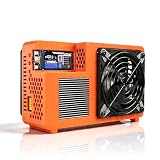
- Professional ASIC Miner for Home: Powered by four advanced BM1370 ASIC chips, this Bitcoin miner delivers a strong 8.0TH/s hashrate with only 170W power consumption. Perfect for solo miner and lottery miner seeking efficient mining at home.
- Two Fans Cooling and Quiet and Home-Friendly: Featuring a two-fan cooling system,this home miner provides superior heat dissipation while maintaining low noise levels.Optimized airflow ensures stable,quiet operation,making this bitcoin miner machine suitable for living rooms,studies,or small home mining environments.
- Plug-and-Play Bitcoin Miner Kit:This all-in-one bitcoin miner kit supports true plug-and-play operation and runs fully independently.With built-in 2.4G Wi-Fi, it connects easily to your network and starts mining crypto currency within minutes—no external controller required.
- Wide Compatibility for Crypto Currency Miners: The bitcoin miner machine (btc miner) supports BTC (Bitcoin) and other SHA-256 coins (BCH, BSV, NMC, XEC, PPC, FB), making it a versatile choice for crypto currency miners. As a complete bitcoin miner kit, it lets you switch coins freely to maximize earnings without extra equipment.
- Beginner-Friendly Nerdminer Design: Built on an open-source Bitaxe platform, this nerdminer features a simple web-based interface for easy setup and monitoring. Whether you are new to mining or upgrading your setup, it is an excellent choice for anyone exploring BTC solo miner solutions.
Mining is not staking
Mining and staking are different consensus mechanisms.
| Mining | Staking |
|---|---|
| Uses proof-of-work computations and hashing hardware. | Uses validators that lock up or commit assets under the network’s rules. |
| Operating costs center on electricity, equipment, cooling, and maintenance. | Risks and requirements center on capital, validator software, uptime, and possible penalties. |
| Used by Bitcoin and other PoW networks. | Used by Ethereum Mainnet after The Merge on September 15, 2022. |
Running a wallet or a full node does not automatically mean you are mining. A wallet manages private keys. A full node verifies and relays blockchain data. Mining requires compatible hardware and mining software in addition to any node or wallet setup.
Tax and practical considerations
In the United States, the IRS treats digital assets as property. Mining rewards may need to be reported as income, and a later sale or exchange may create a separate capital gain or loss. The correct treatment depends on facts such as the activity’s scale, expenses, business status, and how rewards are received.
Use current IRS guidance, including its digital assets guidance and virtual-currency FAQs, and consult a tax professional when the amounts are material. Keep records of payout dates, coin amounts, fair-market values, pool fees, electricity, repairs, equipment purchases, and sales.
Recommended Free Tools
Common crypto-mining misconceptions
| Claim | What is actually true |
|---|---|
| “Running a wallet mines crypto.” | A wallet manages keys; mining requires compatible hardware and software. |
| “A laptop can profitably mine Bitcoin.” | Competitive Bitcoin mining uses specialized ASICs. |
| “Ethereum mining still works.” | Ethereum Mainnet mining ended when the network moved to proof of stake in 2022. |
| “Miners solve useful equations.” | They repeatedly hash data while searching for a result below a target. |
| “Every pool share earns a block reward.” | Most shares only measure contributed work; one must also meet the network target to produce a block. |
| “Miners approve transactions on their own.” | Miners choose transactions for candidate blocks, but nodes enforce consensus rules. |
| “Cloud mining is guaranteed passive income.” | No mining arrangement guarantees profit, and cloud contracts add counterparty and fee risk. |
FAQ
Can I mine Bitcoin with a regular computer?
A regular computer can technically calculate hashes, but it is not economically competitive with Bitcoin ASICs. It may consume more electricity than the value it produces and can generate substantial heat and hardware wear.
How often does a Bitcoin miner get paid?
A solo miner is paid only when it finds a valid block, so payments can be highly unpredictable. Pool miners generally receive smaller, more regular payouts under the pool’s specific reward method and withdrawal rules.
Is crypto mining profitable?
It can be profitable under some combinations of hardware efficiency, electricity price, coin price, difficulty, fees, and uptime, but profitability is not guaranteed. Calculate electricity, cooling, repairs, depreciation, taxes, and pool fees rather than comparing revenue alone.
Is mining the same as staking?
No. Mining uses proof-of-work computation and specialized hardware. Staking uses validators that commit or lock assets under a proof-of-stake network’s rules. Ethereum Mainnet uses staking, not mining, since September 15, 2022.
PC Slower Than It Used to Be?
A free scan shows the junk files, broken settings and background clutter dragging Windows down - then fixes them in one click.Free scan · Windows 10 & 11Outdated Drivers Are Slowing You Down
One free scan finds every outdated or missing driver and matches the right update for your exact hardware.Free scan · exact hardware matchThe Bottom Line
Crypto mining is a competitive proof-of-work process: miners assemble candidate blocks, repeatedly hash their headers, and broadcast a block when they find a result below the network target. Nodes verify the result and the transactions before accepting it.
For personal-finance purposes, the key point is that mining is not free crypto. A machine’s result depends on electricity, hardware efficiency, difficulty, coin prices, fees, downtime, taxes, and payout variance. Bitcoin mining generally requires ASIC hardware and careful cost modeling; running a wallet or laptop is not a realistic substitute.
Quick Recap
Product prices and availability are accurate as of the date/time indicated and are subject to change. Any price and availability information displayed on Amazon at the time of purchase will apply.




