Start with the U.S. Bureau of Economic Analysis (BEA) Regional Price Parities (RPPs) for a same-year baseline, then compare housing and your household’s other major costs in the specific places you’re considering. Finally, weigh those expenses against realistic local or remote-work income and after-tax pay. An RPP is a regional average price level—not a forecast of your bills or a verdict on whether you can afford a move.
Start with a same-year regional price baseline
BEA defines Regional Price Parities as measures of price-level differences across states and metropolitan areas for a given year, expressed as a percentage of the national price level. In practical terms, 100 is the national average: an RPP of 110 means the area’s average price level is 10% above the national level for that year. An RPP of 90 is 10% below it, but it does not mean your personal bills will be exactly 10% lower.
The latest state estimates available as of BEA’s February 19, 2026 release are for 2024. The following figures illustrate the spread; they are not a ranking of the best places to move.
| State | 2024 all-items RPP |
|---|---|
| California | 110.7 |
| Hawaii | 110.0 |
| New Jersey | 108.8 |
| Arkansas | 86.9 |
| Mississippi | 87.0 |
| Iowa | 87.8 |
| Oklahoma | 87.8 |
Check BEA’s Regional Price Parities by State and Metro Area page for current tables. Compare the same year for both candidate locations. If the page has a metro or local-area estimate for the places you’re considering, use it to refine the state comparison; a state average can hide substantial differences among cities, suburbs, and rural areas.
#1 Best Overall

- EXTRA-LARGE FIXED DISPLAY: The 4-inch, extra-large LCD screen features a fixed display that displays crisp digits to prevent reading errors.
- DUAL POWER SOURCE: Operates on dual power (solar with battery backup) and requires 1 LR44 battery (included) to deliver continuous power for your business calculations.
- COST-SELL-MARGIN KEYS: Features dedicated cost-sell-margin keys that allow quick profit margin calculations, alongside a grand total key, double-zero key, and more.
- ACCURATE DATA ENTRY: Durable keys are comfortably spaced for accurate data entry, while a backspace key allows fast, simple corrections for time-saving use.
- TRUSTED BY WORKPLACES FOR DECADES: Sharp has been a dependable name in office calculation for generations — practical tools built around the way people actually work.
Look beyond the all-items index
The all-items RPP combines broad consumer categories using expenditure weights. It offers a consistent starting point, but it cannot represent every household’s spending pattern. BEA says housing rents are often the main driver of differences in overall RPPs. In 2024, the housing-rent RPP was 154.3 in California and 54.2 in West Virginia. Those figures compare relative rent price levels, not monthly rent amounts or quotes for particular homes.
Build a comparison around the costs that matter to your household:
Rank #2
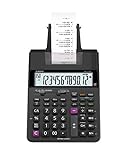
- FAST TWO-COLOR PRINTING – Prints at 2.0 lines per second with dual-color output (black/red) for easy distinction between positive and negative values.
- CHECK, CORRECT & RE-PRINT – Review and correct up to 150 steps before printing; use re-print and after-print functions for efficient documentation.
- TAX & BUSINESS FUNCTIONS – Includes cost/sell/margin, mark-up/mark-down, tax calculation keys, and currency exchange for quick financial operations.
- BIG DISPLAY & EASY INPUT – Features a 12-digit LCD and large, clearly spaced plastic keys for comfortable, accurate data entry.
- UPGRADED DESIGN – New version of the HR-100TM, ideal for taxes, bookkeeping, and accounting with clock/calendar printouts, subtotal & grand total, and percent functions.
- Housing: Compare suitable rentals or likely ownership costs in the neighborhoods you would actually consider. Account for home size and type, insurance, property-related costs, and availability—not just a statewide average.
- Utilities and household expenses: Estimate likely utility bills, food, and other recurring spending using current local information where possible.
- Transportation: Include commute distance and mode, vehicle costs, and any transit expenses that fit your likely routine.
- Health, childcare, and education: Add the services your household is likely to use. Costs can vary with individual needs and choices.
- Other major spending: Include any recurring category that materially affects your budget rather than assuming the average household’s basket matches yours.
BEA’s methodology combines price information from federal sources, including Bureau of Labor Statistics Consumer Price Index data, Census American Community Survey housing data, and BEA personal consumption expenditure data. The agency cautions that CPI was not designed to compare places; uneven or sparse samples can make some estimates volatile. Selected extreme regional price levels for volatile CPI items, especially medical and education services, may be replaced with national price levels. Treat the index as a baseline, then validate high-impact expenses with current local options and estimates.
Compare income and taxes separately
A lower regional price level does not by itself mean a move improves your finances. Estimate what you could realistically earn in the destination, including whether your current salary would continue under the terms of a remote-work arrangement. Then compare expected take-home pay after taxes and relevant deductions, and account for benefits that affect your household budget.
Rank #3

- ENTER DIMENSIONS JUST LIKE YOU SAY THEM: Input measurements directly in feet, inches, building fractions, decimals, yards and meters, including square areas and cubic volumes; one key instantly converts your measurements into all standard Imperial or metric math dimensions that work best for you and the project you are working on
- DEDICATED BUILDING FUNCTION KEYS: Make determining your project needs easy; just input project measurements, select material type like wallpaper, paint or tile; then calculate the quantity needed and total costs to avoid surprises at the homecenter checkout
- ACCURATE MATERIAL ESTIMATION: Helps you estimate material quantities and costs for your projects, ensuring you never buy too much or too little material; simplifies your home improvement and decorating jobs and cuts down on the number of trips to the hardware store
- PRECISE PAINT CALCULATIONS: Calculate exactly how much paint you need to ensure you finish the job without finding yourself with a half-painted room at night with a wet paint roller, and avoid storing or disposing of excess paint
- 11 BUILT-IN TILE SIZES: Make it easy to estimate the quantity needed to complete your project; simply calculate your square footage, then determine the tile required based on tile size and compare tile usage and costs by size; comes complete with hard cover, easy-to-follow user's guide, long-life battery and 1-year warranty
BEA’s real personal income statistics are regional, price-adjusted measures; they are not an estimate of your salary, paycheck, or state tax bill. Use them as regional context, not as a substitute for estimating your own income and taxes. The BEA’s 2024 state release also reports real personal consumption expenditure growth—5.3% for Massachusetts and 2.9% nationally. Those are inflation-adjusted consumption growth figures, not changes in an individual household’s cost of living.
Keep moving expenses out of the monthly comparison
Moving expenses are one-time transition costs, not recurring regional price levels measured by RPP. Make a separate list for mover or rental-truck charges, travel, storage, deposits, and any overlap between leases or housing payments. Get estimates tied to your route, moving date, and service level; those details affect what you will actually pay.
Rank #4

- PRINTING CALCULATOR LOGIC: Operates on printing calculator logic instead of a standard desktop calculator, giving business users a familiar, streamlined way to process calculations.
- PAPERLESS SCROLLING DISPLAY: A 12-digit display works together with a 5-line scrolling LCD that stores up to 300 entries, keeping recent calculations organized without added paper waste.
- COST, SELL AND MARGIN KEYS: Dedicated cost, sell, and margin keys handle quick profit calculations, alongside decimal, rounding, percent, sign change, backspace, and grand total functions.
- COMPACT, PORTABLE BUILD: A cordless design and compact enclosure make it simple to move this calculator from one workspace to the next without searching for an outlet.
- TRUSTED BY WORKPLACES FOR DECADES: Sharp has been a dependable name in office calculation for generations — practical tools built around the way people actually work.
Build a side-by-side monthly scenario
- Pick comparable locations and dates. Record the same-year state RPP for each option, then add a metro or local estimate when BEA provides one for the destination.
- Use the index as context, not a budget. Note each all-items RPP and remember that it describes average relative price levels, not personal affordability or inflation over time.
- Estimate your household’s recurring costs. Price likely housing, utilities, food, transportation, medical care, childcare or education where relevant, and other important expenses. Use a low and high estimate for uncertain items.
- Estimate destination take-home pay. Use realistic earnings and work arrangements, then account for taxes, deductions, and benefits separately from the RPP.
- Compare monthly totals and transition costs. Set estimated recurring expenses against after-tax income. Show moving costs in a separate one-time total so they do not distort the ongoing comparison.
- Write down assumptions and dates. Record which neighborhoods, housing choices, commute, and cost estimates you used so you can revise the comparison as plans change.
RPP measures geographic price-level differences for a given year; inflation measures changes in prices over time. They are not interchangeable. BEA’s methodology and additional information explain the index and its limits in more detail: RPP methodology and additional information on BEA’s state release. The product page lists December 10, 2026 as the next state real PCE, real personal income, and RPP release date; check BEA for updated estimates after that date.
Quick Recap
Best Value

- WORKS IN UNITS THAT WORK FOR YOU -- enter dimensions directly in feet, inches, fractions, yards and meters including square and cubic formats and then instantly convert to any standard building unit you prefer for consistent solutions that makes sense to you
- SET A PROJECT’S MATERIAL REQUIREMENTS to define and use stored values for estimating, including custom tile size, grout gaps, board widths, fence post spacing, paint coverage and more so you can quickly determine your material requirements and costs
- BUILT-IN FUNCTION KEYS help you easily find the number of boards or posts based on standard board lengths and stored measurements, so you get the fencing or decking material quantities you need to finish the job without costly overages or underages
- FIGURE OUT FLOORING REQUIREMENTS with built-in standard carpet roll lengths, linoleum square and roll sizes, custom tile sizes with various grout widths to quickly calculate coverage area and square yards you need based on an entered or calculated floor area
- Works directly in yards, feet, inches, fractions and meters – including square and cubic formats. No need to convert to decimals.
Product prices and availability are accurate as of the date/time indicated and are subject to change. Any price and availability information displayed on Amazon at the time of purchase will apply.
Do these 3 things before closing this tab:
1Clear out junk files and repair common Windows errors2Fix the driver behind crashes, sound loss and screen glitches3Repair Windows errors before they cause bigger problems



