Windows Errors? Fix Them Before They Spread
Repair common Windows errors and clear accumulated junk for a smoother, more stable PC - no reinstall needed.Free scan · no reinstallOutdated Drivers Are Slowing You Down
One free scan finds every outdated or missing driver and matches the right update for your exact hardware.Free scan · exact hardware matchSet an affordable total advertising budget first, then divide it among platforms according to the qualified results each can deliver—not a universal percentage. Google Ads and Microsoft Advertising handle budget pacing differently, and neither platform’s campaign settings automatically enforce one spending limit across your accounts. Plan for that variation, track actual spend centrally, and reallocate only when comparable business results support the change.
1. Set a total budget your business can afford
Choose a budget for a defined period, such as a month, based on available cash and the cost your business can sustain if campaigns do not produce the expected return. Treat the total as a portfolio guardrail: it applies across the advertising accounts and platforms you intend to use, rather than being the sum of amounts you hope each platform will spend.
Keep any money intended for experimentation or changes in demand distinct from the amount committed to ongoing campaigns. There is no source-backed reserve percentage that fits every advertiser; choose an amount that matches your cash-flow constraints and priorities.
Account for variable daily spend
A daily budget setting may represent an average rather than a hard limit on each individual day. If your business cannot absorb a day above the amount entered in a platform, do not assume that setting alone provides a strict daily cap. Check the rules for the specific platform and campaign type, and reconcile actual spend against your overall limit.
#1 Best Overall
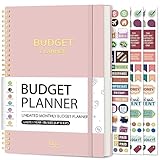
- Effective Budget Planning - Take control of your finances with the budget account book. This comprehensive planner allows you to plan and track your income, expenses, savings, and financial goals in one convenient place. With its intuitive layout and easy-to-use sections, you can stay organized and make informed decisions to achieve financial success.
- User-Friendly Layout - The budget planner features a user-friendly layout designed for easy navigation and organization. Each month, you'll find dedicated budget pages where you can set financial goals, track your income, and plan your expenses. Additional sections include debt trackers, savings goals, bill payment trackers, and more, making it simple to stay on top of your finances.
- Undated Monthly Calendar & Bonus Stickers - Featuring undated calendar each month, you'll have ample space to mark paydays, bills due, appointments, and important dates. Say goodbye to difficult writing spaces. Plus, we've included 3 cute sticker sheets that allow you to personalize your financial organizer and make budgeting more fun. Dates are not pre-printed and are completed by the user.
- Reliable and Convenient Design - Our monthly budget planner is designed for your convenience and built to last. The elastic band keeps everything securely in place, and the dual-sided pocket provides extra storage. Experience a budget planner that combines practicality and durability.
- Master Budgeting with Ease - Our financial planner includes a complete guidebook that provides valuable insights and instructions for optimal usage. From setting financial goals to tracking expenses, this guidebook offers step-by-step guidance and practical tips. Whether you're new to budgeting or an experienced user, this resource will help you make the most of your budget planner, empowering you to achieve financial success.
2. Decide what outcome the budget must buy
Before splitting funds, define the conversion or qualified business result that makes advertising worthwhile. It might be a completed purchase, a qualified lead, or another outcome your business can verify. Use the same business definition when comparing platforms; platform-reported conversion totals are not automatically equivalent or directly comparable.
For each campaign, record spend and the resulting qualified outcomes over the same period. Where possible, assess the quality or value of those outcomes as well as their cost. Clicks and platform-reported conversions can help diagnose campaigns, but they do not by themselves show which channel is producing more valuable business.
Rank #2
3. Build an initial split from your own evidence
There is no established starting percentage that applies to every advertiser. Use the evidence and limits specific to your business to make a provisional allocation:
- Demand and coverage: Check whether each platform can reach the relevant audience and geography and whether there is useful search demand for your offer.
- Outcome economics: Compare the cost per qualified outcome and the quality or value of those outcomes, rather than choosing based only on clicks or raw conversion totals.
- Available headroom: Determine whether a campaign is actually constrained by its budget. If demand or eligibility is the constraint, adding budget may not create more useful results.
- Campaign constraints: Account for campaign type, targeting, and any platform-specific budget controls when deciding how much to make available.
If you have no useful history, label your first split as a test allocation—not an industry benchmark. Set it using your own affordability limits, priorities, and the amount you are willing to learn from. Official platform guidance does not establish a universal minimum test budget or test duration.
Rank #3

- Effective Budget Planning - Take control of your finances with the budget account book. This comprehensive planner allows you to plan and track your income, expenses, savings, and financial goals in one convenient place. With its intuitive layout and easy-to-use sections, you can stay organized and make informed decisions to achieve financial success.
- User-Friendly Layout - The budget planner features a user-friendly layout designed for easy navigation and organization. Each month, you'll find dedicated budget pages where you can set financial goals, track your income, and plan your expenses. Additional sections include debt trackers, savings goals, bill payment trackers, and more, making it simple to stay on top of your finances.
- Undated Monthly Calendar & Bonus Stickers - Featuring undated calendar each month, you'll have ample space to mark paydays, bills due, appointments, and important dates. Say goodbye to difficult writing spaces. Plus, we've included 3 cute sticker sheets that allow you to personalize your financial organizer and make budgeting more fun. Dates are not pre-printed and are completed by the user.
- Reliable and Convenient Design - Our monthly budget planner is designed for your convenience and built to last. The elastic band keeps everything securely in place, and the dual-sided pocket provides extra storage. Experience a budget planner that combines practicality and durability.
- Master Budgeting with Ease - Our financial planner includes a complete guidebook that provides valuable insights and instructions for optimal usage. From setting financial goals to tracking expenses, this guidebook offers step-by-step guidance and practical tips. Whether you're new to budgeting or an experienced user, this resource will help you make the most of your budget planner, empowering you to achieve financial success.
4. Set budgets using each platform’s rules
Budget controls and pacing differ by platform and campaign type. Check the current campaign setup in your account before relying on a particular control.
| Platform | Documented budget controls and pacing | What to account for |
|---|---|---|
| Google Ads | For most campaigns using average daily budgets, Google Ads Help (checked 2026) documents a daily spending limit of 2× the average daily budget and a monthly spending limit of 30.4× that budget. In Google’s example, a $10 average daily budget produces a $20 daily limit and a $304 monthly limit. Google says it may spend more on higher-opportunity days and less on lower-opportunity days. It also documents shared budgets and campaign total budgets. | These are Google-specific rules, not a portfolio-wide cap or a cross-platform planning benchmark. Check whether a shared budget or campaign total budget is available and appropriate for your campaign. |
| Microsoft Advertising | Microsoft Advertising documents daily standard and shared standard options. Its help page describes shared budgets as flexible budgets used across multiple campaigns. A lifetime budget is available for Audience campaigns. Microsoft’s API guidance says the service calculates a monthly budget limit from a daily budget using the number of days in the month. | Lifetime budgets are not documented as universal across campaign types. Check the current campaign setup and account interface for the settings and limits that apply to your campaigns. |
| LinkedIn Campaign Manager | LinkedIn provides daily, lifetime, and combined daily-plus-lifetime budgets at campaign and/or ad-set level, depending on configuration. LinkedIn Help, updated 2026, says actual daily spend may be up to 50% above the daily budget on a given day in the described setup. | LinkedIn is included only as an example of platform-specific pacing; it is not a search platform recommendation. |
Google identifies Performance Planner as a tool that can help optimize budgets across existing campaigns. It is a platform tool, not a cross-platform spending control.
Rank #4

- 🌙 MANAGE YOUR MONEY EFFECTIVELY - This budget planner will help to learn to achieve your financial goals, take to earn more money & take to cut your expenses for managing your money effectively. You can change some of your bad spending habits after a year of budgeting, so that you can better manage your money and spend it on some essential thing.
- 🌙 GOOD MONTHLY PLAN/BUDGET/REVIEW & EXPENSE TRACKER - Our budget planner with undated monthly planner has a well layout and can be started at any time. Monthly plan & budget pages have goals, upcoming purchase/bills, income, savings items with planned/actual/difference budget sheets all in a visually appealing 2-page layout. Expense tracker pages help you set up goals. At the end of the month, review what happened, spot bad spending habits, think about how you can improve.
- 🌙 EFFECTIVE ORGANIZATION - This budget book with twin-wire binding for easy lay-flat 360°, inner pocket for putting in some small cards & elastic closure for keeping the budget planner without falling off. These effective designs can make the accounting book better play its own role and bring you great convenience in the process of using it.
- 🌙 PRACTICAL & ELEGANT TOOLS FOR PERSONAL FINANCE -Golden Stem Green Leaves Budget planner starts with 2 pages for setting your financial goals. There are 2 pages for writing your day budget planning each month, 2 pages for monthly spend plan & budget plan, 4 pages for tracking exspense, followed by 1 idea & note page. At last, there are 4 pages for saving/debt tracker, 2 pages for holiday budgeting, 2 pages for bill tracker, 2 pages for an annual summary to track all year.
- 🌙 PREMIUM THICK PAPER - This bill organizer features 12-month archival-quality pages made from thick paper, which can prevent planner from damages of light and air then ensure long-lasting performance from one year to the next of this budget planner. The premium white papers in this undated finance planner are environmentally friendly and adequately protects your eyes.
5. Keep the portfolio within its limit
Separate campaign budgets do not, by themselves, guarantee that total spend across multiple accounts stays within your business’s chosen limit. Maintain a central view that records actual spend from each platform over the same period, then sum it against the portfolio budget.
Use the same date range and currency when reconciling platform reports. A platform’s configured budget is a control or pacing input, not a substitute for checking what the business actually spent.
Recommended Free Tools
Best Value

- 【SPACIOUS 7.2" × 10" BUDGET PLANNER】Roomy pages provide generous writing space for income, bills, everyday purchases, savings, debt payments and financial notes. Larger than many compact A5 planners, this monthly budget planner combines the flexibility of a budget notebook with the organized structure of a budget book, so you can record more details without squeezing information into small boxes.
- 【COMPLETE 12-MONTH BUDGETING SYSTEM】Plan, track and review your finances in one convenient place. Each monthly section includes a calendar, financial goals, income planning, bill tracking, category budgets, daily expense tracking and a monthly budget review—making this budgeting planner a practical tool for managing money from the beginning to the end of every month.
- 【COMPARE BUDGETED VS. ACTUAL SPENDING】See where your money was planned to go and where it was actually spent. Dedicated Budgeted and Actual columns help you monitor housing, groceries, transportation, health care and personal expenses. This expense tracker notebook makes it easier to identify overspending, adjust category limits and make more informed financial decisions.
- 【BILLS, SAVINGS, DEBTS & EXPENSES IN ONE PLACE】This all-in-one financial planner includes a monthly bill organizer, savings tracker, debt tracker, check register and dedicated holiday budget, gift and spending sections. Use it as a bill planner and organizer to track card and cash purchases, payment due dates, outstanding balances and savings progress without relying on multiple notebooks or loose papers.
- 【UNDATED, DURABLE & EASY TO USE】The undated 12-month layout allows this paycheck budget planner to start with any month or pay cycle without wasting unused pages. A sturdy hardcover, metal corner protectors and twin-wire binding provide a stable, lay-flat writing surface. The inner pocket stores receipts and documents, while three sticker sheets help mark bills, due dates, savings goals and priorities.
6. Reallocate based on comparable evidence
Review performance over a consistent window and compare each platform against the outcome you defined. Before shifting money, check whether a campaign is budget-constrained, whether results are qualified, and whether there is enough evidence to distinguish a meaningful change from ordinary variation.
- Reconcile spend: Compare actual platform spend with the central portfolio total for the same period.
- Compare business outcomes: Use the same qualified-result definition and review outcome quality or value, not only platform-attributed conversion counts.
- Check for headroom: Confirm that the campaign can use additional budget and that demand or eligibility is not the real constraint.
- Make a measured change: Adjust the provisional allocation in line with your evidence and affordability limits, then continue tracking the revised mix.
The official platform help pages do not prescribe a universal review window, minimum budget, or method for correcting attribution differences between platforms. Avoid treating a short-lived fluctuation as proof that a channel deserves a lasting budget change.
Quick Recap
Product prices and availability are accurate as of the date/time indicated and are subject to change. Any price and availability information displayed on Amazon at the time of purchase will apply.




