Recommended Free Tools
The Strategic Petroleum Reserve (SPR) is a federally owned stockpile of crude oil held in underground salt caverns on the Texas and Louisiana Gulf Coasts. It is an emergency buffer for major petroleum supply disruptions—not a supply of ready-to-use gasoline. The U.S. Department of Energy (DOE) reports that the reserve held 294.1 million barrels on August 20, 2026, against 714 million barrels of authorized capacity.
What is the Strategic Petroleum Reserve?
The DOE owns and operates four sites along the Gulf Coast: Bayou Choctaw, Big Hill, Bryan Mound and West Hackberry. Oil is stored in caverns created in natural salt domes, not in above-ground tanks. The region was chosen in part for its proximity to refineries and distribution links. DOE’s SPR Quick Facts describes the reserve as a federally managed network of four sites.
The reserve was created after the 1973–74 oil embargo. Congress established it through the Energy Policy and Conservation Act (EPCA) of 1975, and the first oil arrived in 1977. Its purpose is to help the country respond to major petroleum supply disruptions and strengthen energy security. DOE’s history of the SPR records those milestones.
How does the U.S. use the SPR?
Emergency drawdowns
Under EPCA, a president may authorize an emergency drawdown when the statutory conditions are met, including a severe energy supply interruption or a significant reduction in supply that is likely to cause a major adverse impact on the national economy. After a presidential direction, DOE arranges competitive sales of released crude. Buyers then take delivery through the reserve’s connections and the commercial distribution system.
The Tool Desk
Outbyte Driver Updater FREEScan for outdated or missing drivers - takes under a minuteDriver Scan →Outbyte PC Repair FREERepair Windows errors before they cause bigger problemsFix Now →#1 Best Overall

- These are hobby grade products securely packed for protection in shipping
- Please handle with care when removing from package or breakage could occur
DOE says oil can enter the market within 13 days after a presidential decision. That is a stated time to begin delivery, not a promise that fuel will reach every refinery, become gasoline or diesel, and arrive at retail stations within that period. DOE’s SPR FAQs explain the release process.
Exchanges and other releases
The Energy Secretary can authorize certain limited releases, including exchanges to address temporary supply disruptions. In an exchange, a recipient generally returns oil later, often with an additional quantity as a premium. DOE also conducts test sales to assess readiness, and Congress can direct sales for specified purposes. A decline in SPR inventory therefore does not, by itself, mean that an emergency drawdown took place.
Rank #2

- A wide 575,000-gallon tank
- A stairway molded to fit the tank body
- Berm crossover stairways
- Realistic decals
- Modular retention berms which can be used to combine multiple tanks into a complete scene
How much oil is in the SPR, and how quickly can it be released?
DOE lists authorized storage capacity of 714 million barrels. Its latest inventory table located here is dated August 20, 2026, and reports 294.1 million barrels in total. Inventory is the amount held on that date; capacity is the authorized storage limit. The figures are not interchangeable, and the inventory is not an October 2026 snapshot. DOE’s site inventory table gives the following breakdown:
| SPR site | Inventory on August 20, 2026 |
|---|---|
| Bayou Choctaw | 32.0 million barrels |
| Big Hill | 89.1 million barrels |
| Bryan Mound | 142.5 million barrels |
| West Hackberry | 30.5 million barrels |
| Total | 294.1 million barrels |
DOE reports a maximum nominal drawdown capability of 4.4 million barrels per day. This is a maximum release rate, not ordinary daily output or a guarantee that this volume can be sustained indefinitely. The 13-day figure measures time until oil can begin entering the market after presidential direction; it is separate from both the amount in storage and the maximum release rate.
Free tools Windows power users keep installed
One-click scans. No signup required.
Rank #3

- New in manufacturer packaging.
- Realistic Detail.
- Robust materials.
- Original packaging.
- Scale Miniature for For Model Trains and Dioramas.
DOE separately reported 411 million barrels in the reserve on December 31, 2025, equivalent to approximately 125 days of U.S. crude-oil net imports using the import measure for that date. That dated estimate should not be carried forward as a current figure. The International Energy Agency’s 90-day obligation concerns net-import protection across public and private stocks; it does not mean the SPR alone must contain 90 days of oil.
What kind of oil is stored—and why not gasoline?
The SPR stores crude oil, which refineries process into products such as gasoline and diesel. A release therefore adds crude to the supply chain; it does not deliver finished fuel directly to drivers. Refinery capacity, crude compatibility, transportation and distribution all stand between a reserve sale and fuel at a pump.
Rank #4

- 【Durability】 Train Building Kit is crafted from pp, ensuring long term use and resistance to wear during frequent handling or display
- 【Versatile】Great for dioramas, sand table models, and train scene displays; the HO Scale Water Tank Kit is ideal for hobbyists and collectors alike
- 【Compact】Assembly Measuring 8cm in length, 4cm in width, and 7.5cm in height, the HO Scale Model Kit fits seamlessly into various model railway setups without taking up excessive space
- 【Realistic】Designed in HO scale 1:87, this miniature water tank model accurately replicates railway scene architecture for authentic train layouts
- 【Complete】Includes 1 miniature water tank model assembly per package, ready to integrate into your HO scale railway environment
DOE classifies crude by sulfur content: sweet crude has no more than 0.5 percent sulfur by weight, while sour crude has more than 0.5 percent but less than 2.0 percent. Refiners differ in the grades they can process, so the type of crude released matters when matching supply to refinery needs.
DOE says crude is less costly to acquire, store and transport than refined products, does not degrade over time in the same way refined products do, and gives flexibility to meet changing refinery needs. Those are the agency’s reasons for storing crude rather than finished fuels; they do not mean an SPR release can instantly resolve a local gasoline shortage. DOE’s FAQs provide its explanation.
Best Value
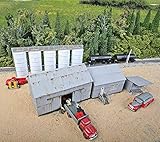
- Narrow design fits easily between or along tracks - perfect for shelf layout
- Separate office and warehouse buildings
- Parts for five tanks, plus piping and other details
- Printed signs
- Molded in 5 colors and clear plastic
When has the SPR been used?
Not every release has the same legal authority or purpose. Major examples illustrate the difference between emergency drawdowns, exchanges and congressionally directed sales. DOE’s release history distinguishes categories of SPR activity.
| Year | Use | Reported amount and context |
|---|---|---|
| 1991 | Emergency drawdown during the Persian Gulf War | President George H. W. Bush authorized the first emergency drawdown; DOE sold 17.3 million barrels. |
| 2005 | Response to Hurricane Katrina’s damage to Gulf production and infrastructure | The U.S. sold or exchanged 20.8 million barrels. |
| 2022 | Coordinated emergency release announced by the U.S. and International Energy Agency partners after Russia’s invasion of Ukraine | DOE records 180.0 million barrels in the operational sale category. Separate congressionally mandated sales also occurred, so not all inventory reductions that year were part of the emergency release. |
| 2023 | Congressionally mandated sales | DOE reports 26 million barrels delivered. |
How the current capacity compares with the reserve’s peak
The SPR’s highest recorded inventory was 726.6 million barrels on December 27, 2009, according to DOE’s historical account. That peak inventory is distinct from today’s 714-million-barrel authorized capacity: the first is a historical quantity held at one time, while the second is the current authorized storage limit. Older DOE pages may cite historical or design-capacity figures that differ from the current quick-facts figure. DOE’s history documents the peak.
Quick Recap
Product prices and availability are accurate as of the date/time indicated and are subject to change. Any price and availability information displayed on Amazon at the time of purchase will apply.




