Mexico’s current banknotes are the G-family commemorative 20-peso note plus 50-, 100-, 200-, 500-, and 1,000-peso notes. They are not all made of paper: the 20-, 50-, and 100-peso notes use polymer, while the 200-, 500-, and 1,000-peso notes use cotton paper. Some older F-family notes also remain valid, so an unfamiliar or older-looking bill is not automatically worthless.
What currency does Mexico use?
Mexico’s currency is the Mexican peso, divided into 100 centavos. Banco de México lists six current banknote denominations: a commemorative 20 pesos, followed by 50, 100, 200, 500, and 1,000 pesos. Coins circulate alongside them, including 5, 10, 20, and 50 centavos and 1-, 2-, 5-, and 10-peso coins, as well as a current-design 20-peso coin.

“Current” describes the G-family set Banco de México manufactures and lists for circulation; it does not mean every earlier design has been withdrawn.
Current Mexican banknotes at a glance
| Denomination | Family/status | Material | Length × height | Front theme | Reverse theme |
|---|---|---|---|---|---|
| 20 pesos (commemorative) | G-family special issue | Polymer | 120 × 65 mm | Commemorative Independence imagery | Mangrove ecosystem |
| 50 pesos | G-family current | Polymer | 125 × 65 mm | Ancient Mexico; Tenochtitlan imagery associated with a Diego Rivera mural | Xochimilco rivers-and-lakes ecosystem, including an ajolote and cornfield |
| 100 pesos | G-family current | Polymer | 132 × 65 mm | Historical-period imagery | Mexican ecosystem |
| 200 pesos | G-family current | Cotton paper | 139 × 65 mm | Historical-period imagery | Mexican ecosystem |
| 500 pesos | G-family current | Cotton paper | 146 × 65 mm | Historical-period imagery | Mexican ecosystem |
| 1,000 pesos | G-family current | Cotton paper | 153 × 65 mm | Francisco I. Madero, Hermila Galindo, and Carmen Serdán with a locomotive | Calakmul rainforest, including a jaguar and trees |
The dimensions and materials are descriptive specifications from Banco de México; they are not, by themselves, an authentication test.
Free tools Windows power users keep installed
One-click scans. No signup required.
#1 Best Overall
How the G-family designs tell Mexico’s story
The G-family links a historical period on the front of a note with an ecosystem on its reverse. The historical subjects span Ancient Mexico, Colonial Mexico, the War of Independence and Reform, the Restoration of the Republic, the Mexican Revolution, and contemporary Mexico. The pairing makes the notes useful as compact visual introductions to both Mexican history and biodiversity.
The 50-peso note: Tenochtitlan and Xochimilco
The 50-peso front uses imagery of Tenochtitlan associated with a Diego Rivera mural. Its reverse moves to Xochimilco’s rivers-and-lakes ecosystem, showing an ajolote and a cornfield. This polymer note is 125 mm long and is one of the easiest G-family examples to recognize by its strong historical-versus-ecosystem contrast.
The 1,000-peso note: Revolution and Calakmul
The 1,000-peso front depicts Francisco I. Madero, Hermila Galindo, and Carmen Serdán alongside a locomotive. The reverse depicts the Calakmul rainforest, with a jaguar and trees. At 153 mm, it is the longest note in the current set.
Rank #2
The commemorative 20-peso note
The special G-family 20-peso note commemorates the bicentennial of Independence. Its reverse uses a mangrove ecosystem. It is a polymer note measuring 120 mm in length, shorter than the regular 50-peso note.
Polymer versus cotton-paper notes
Material is one of the clearest physical differences among current bills:
- Polymer: commemorative 20 pesos, 50 pesos, and 100 pesos.
- Cotton paper: 200 pesos, 500 pesos, and 1,000 pesos.
A transparent window is possible on applicable polymer designs, while cotton-paper notes use a different combination of embedded and printed security elements. Do not assume that a feature found on one denomination must appear on another.
Rank #3
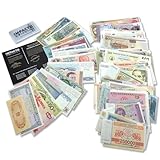
- 100 Banknotes from the World: Human history has a tangled path, and there are items that support us in researching the events in the past. Take these 100 various banknotes to get to know their stories carefully.
- Foundation of Your Collection: 100 banknotes will be a good starting point for numismatic enthusiasts to set up their collection. Collection of banknotes will suffice you and promote your thrill and interest in researching the stories of the currencies.
- Increasing Value: As time passes, these banknotes increase in value as they resemble the countries and governments that are not here anymore. Make a solid investment into your collection and benefit from it as the years pass by.
- Authenticity Certificate: Every collection has been carefully inspected by a member of the American Numismatic Association and has a Certificate of Authenticity inside. Please notice that bills in a collection are diverse and may vary in quality.
- What a Gift Idea: Walk no further if you wish to make history gifts to your numismatic friend, a birthday gift, anniversary offering, or wedding present. Our historical gifts currency collection can also serve as an educational basis for children in schools or at home.
Are older Mexican peso bills still valid?
Some older F-family notes remain valid for transactions. Banco de México’s official list identifies particular 50-, 100-, 200-, and 500-peso F-family designs, including commemorative notes, that continue to be valid. The central bank states: “The following denominations by type of banknote continue to be valid for transactions.” That statement introduces a specific list, not a blanket rule for every historical Mexican banknote.
The F family began in 2006 in Banco de México’s account, while G-family issuance began with the 500-peso note in 2017 and continued with later releases. These dates describe series milestones; they are not a complete withdrawal timetable.
How to check a particular older note
- Identify the denomination and the design family, using the note’s imagery and security layout.
- Compare it with Banco de México’s “Other designs” validity list.
- If the design is not clearly listed, ask a bank or consult Banco de México rather than assuming it is accepted or worthless.
An older appearance alone does not establish invalidity, and validity does not establish collector value.
Rank #4

- Important 40+ Year Old Mexican Banknote in Gem Crisp Uncirculated Condition!
Security and accessibility features to examine
Banco de México recommends using several relevant features and consulting the guide for the exact denomination and family. No single check guarantees authenticity.
Features found on applicable notes
- Raised printing: tactile relief appears on selected text, figures, and other design elements.
- Transparent-window details: used on applicable polymer notes.
- Color-shifting denomination numerals: multicolor numbers change appearance as the note is tilted, where provided.
- Dynamic threads: included on the G-family 200-, 500-, and 1,000-peso notes.
- Fluorescence: selected elements react under ultraviolet light.
Tactile marks for identification
On the G-family 200-, 500-, and 1,000-peso notes, raised lines at the upper left and right edges identify denominations by count: two lines on 200 pesos, three on 500 pesos, and four on 1,000 pesos. Other raised printing also helps people identify and handle the notes.
Folio numbers: a limited check
For certain F-family notes and the G-family 200-, 500-, and 1,000-peso notes, the obverse has two folio numbers. Banco de México advises: “Check that both folio numbers are the same; otherwise, the piece may have been altered and would therefore have no value.” This instruction applies only to the note types covered by that guidance, not to every Mexican banknote.
Recommended Free Tools
Best Value

- ✅ A LIMITED EDITION - Get a coin bag with 5 rare, collectible coins from the United Mexican States. Each pack may have different combinations of coins, from 2 centavos to 2 pesos.
- ✅ VALUABLE PIECES OF MEXICAN HISTORY - Our coins collection includes real pieces issued in 1970 and onwards. You’ll love the story and culture carried by these small works of metal art.
- ✅ WORTHY INVESTMENT - We offer foreign coins that are not legal tender. This means there aren’t many circulating, and they’re bound to increase in value. Invest in the past for your future.
- ✅ NO EXTREMELY WORN PIECES - Our old coins for collectors include circulated pieces with the least sign of wear. Please note that the oldest coins may show more scratches and oxidation.
- ✅ TREASURED GIFT ITEMS - This coin collection is packed in specially labeled bags complete with national attributes and decorations. The sealed package makes it an attractive birthday or wedding gift.
A practical inspection sequence
- Feel: run a finger over raised printing and, where applicable, the tactile edge marks.
- Look: inspect windows, threads, print quality, and denomination details appropriate to that note.
- Tilt: check any color-shifting or moving elements described for the denomination.
- Compare: use Banco de México’s denomination-specific guide and compare with a note known to be genuine.
- Escalate uncertainty: do not rely on one feature or on an informal internet image when accepting a doubtful note.
Mexican coins in the same currency system
Coins complement the banknotes, and their identification relies on denomination, size, edge, color, and shape. The post-2020 commemorative 20-peso coin design is twelve-sided, bimetallic, and 30 mm in diameter. A commemorative coin does not mean it is the only 20-peso form; Banco de México lists both current-design and commemorative issues.
Should you keep a commemorative note?
Banco de México describes the limited number of commemorative notes as an invitation for the public to keep them because of their design and quality. That is an official observation about their appeal, not a claim about rarity, resale prices, or investment returns. If you collect them, an album or archival sleeves can reduce handling and wear; ordinary spending money does not require special storage.
Quick Recap
Product prices and availability are accurate as of the date/time indicated and are subject to change. Any price and availability information displayed on Amazon at the time of purchase will apply.




