Analog Devices completed its acquisition of Maxim Integrated on August 26, 2021. The roughly $20 billion transaction was an all-stock merger—not a cash takeover—in which Maxim shareholders received 0.6300 shares of Analog Devices common stock for each Maxim share. Maxim stopped trading as an independent Nasdaq-listed company after the closing.
The headline $20 billion figure described the deal’s announcement-era market value. Analog Devices later reported approximately $28.0 billion of accounting consideration, largely reflecting the value of stock issued at closing. Those figures use different valuation methods and should not be treated as contradictory purchase prices.
The deal in one minute
| Item | Details |
|---|---|
| Announcement | July 13, 2020 |
| Closing | August 26, 2021 |
| Structure | All-stock merger |
| Exchange ratio | 0.6300 Analog Devices share for each Maxim share |
| Expected ownership at announcement | Approximately 69% for existing ADI shareholders and 31% for former Maxim shareholders |
| Final major regulatory approval | China’s State Administration for Market Regulation, announced August 23, 2021 |
| Maxim’s public-company status | Maxim common stock ceased trading on Nasdaq after completion |
The merger subsidiary Magneto Corp. merged into Maxim, with Maxim surviving as a wholly owned subsidiary of Analog Devices. Former Maxim CEO Tunç Doluca and former Avago executive Mercedes Johnson joined ADI’s board at closing. ADI’s closing announcement and its Form 8-K describe the completion mechanics.
What Maxim shareholders received
Maxim shareholders did not receive a fixed cash payment. Instead, each Maxim share was exchanged for 0.6300 shares of ADI common stock. Cash was paid only in lieu of fractional ADI shares where applicable, and Maxim equity awards were converted into ADI-denominated awards under the merger terms.
#1 Best Overall
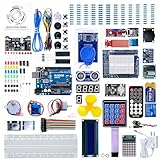
- 30+ Guided Electronics Projects: Start with LEDs and build toward LCD1602 displays, RFID access, motion detection, distance sensing, motor control and environmental monitoring for STEM learning, coding clubs, classrooms and hobby projects
- 200+ Components Across 63 Types: Includes an ELEGOO UNO R3 controller, LCD1602, RC522 RFID, RTC, HC-SR501 PIR sensor, ultrasonic sensor, DHT11, GY-521, MAX7219, keypad, joystick, relay, SG90 servo, stepper motor, breadboard and more
- Begin Without Soldering: Pre-soldered modules, a solderless breadboard, organized storage case and small-parts box reduce setup time and help beginners move from lesson to lesson while keeping LEDs, ICs, wires and sensors easy to find
- Learn, Modify and Create: Program the ELEGOO UNO R3 board with Arduino IDE using the included PDF tutorial and example code, then adjust sensor thresholds, timing, display text and motor behavior to turn guided lessons into original projects
- Flexible Power and Project Setup: Includes a 9 V, 1 A power supply, breadboard power module, 9 V battery and USB cable to support controller, breadboard and module experiments without sourcing basic setup accessories separately
That structure gave former Maxim investors continued exposure to the combined company, but it also meant that the value of their consideration moved with ADI’s share price. A stock-for-stock merger can preserve potential upside if the buyer performs well, while offering less price certainty than a cash acquisition.
The anticipated ownership split was roughly 69% for existing ADI investors and 31% for former Maxim investors. In practical terms, Maxim shareholders became significant shareholders of ADI rather than being bought out for cash.
Why Analog Devices wanted Maxim
Analog Devices was already a major supplier of precision analog, signal-processing and mixed-signal technology, with strong exposure to industrial, communications and healthcare applications. Maxim added substantial capabilities in power management and specialized mixed-signal products, along with important positions in automotive, data-center, industrial and consumer electronics.
The strategic logic was broader than simply adding revenue. Power-management components sit alongside processors, sensors, communication chips and other signal-chain devices in many electronic systems. Combining the portfolios could give ADI more opportunities to supply complete subsystems rather than individual components.
Free tools Windows power users keep installed
One-click scans. No signup required.
Rank #2

- Powerful ESP-32 Board: Unlock the world of Internet of Things (IoT) and advanced electronics with the heart of this kit: the ESP-32 board. It features a powerful dual-core processor, integrated Wi-Fi and Bluetooth 4.2, making it perfect for building connected, smart devices that communicate with your phone or the cloud. It's fully compatible with the Arduino IDE for easy programming.
- Super Starter Kit: This kit contains over 35 different modules and electronic components, including sensors, displays, motors, and input devices. From LEDs and buttons to an OLED screen, servo motor, and keypad, you have everything needed to explore a vast range of projects in one box.
- Step by Step Online Tutorial: Jump right in with our detailed, beginner-friendly tutorial. Access 30+ projects with complete code, clear circuit diagrams, and step-by-step instructions. Learn the fundamentals of electronics, coding, and how to utilize the ESP-32's unique capabilities without any prior experience.
- Hands-on Learning for All Skill Levels: Perfect for students, makers, engineers, and hobbyists. Start with basic circuits and coding, then progress to intermediate and advanced IoT applications. Build practical projects like weather stations, smart home controllers, remote-controlled devices, and interactive gadgets. The skills you learn are the foundation for real-world innovation.
- Quality & Great Support: Elegoo is committed to quality. We provide a clear, detailed tutorial guide, refined code, and a well-organized component kit. All modules are carefully selected for reliability and ease of use. Our dedicated technical support team and active online community are ready to help you succeed in your learning journey.
- Power management: regulators, power-management ICs, battery-management and charging products, sequencing solutions and power-conversion technology.
- Automotive: electronics for battery management, vehicle connectivity, display power and driver-assistance-related systems.
- Data centers: power-management solutions supporting processors and accelerators.
- Industrial: long-life-cycle products spanning power, sensing, control and connectivity.
- Consumer devices: technologies used in areas such as wearables, hearables, fast charging, gaming and portable power.
At closing, ADI said the combined company would have more than 10,000 engineers, pro-forma trailing revenue above $9 billion and pro-forma trailing free cash flow above $3 billion. These were company-stated pro-forma figures describing the expected scale of the combined business, not a guarantee of future results. ADI’s original transaction announcement provides the company’s strategic rationale and forecasts.
Why the deal is called both $20 billion and $28 billion
The most commonly reported figure was approximately $20 billion. That was an announcement-era market valuation for an all-stock transaction whose ultimate equity value depended on ADI’s share price and the number of shares issued.
After the acquisition, ADI’s purchase-accounting disclosures reported approximately $28.0 billion in total consideration. That accounting figure reflected the fair value of ADI stock issued at the acquisition date along with other acquisition-related consideration. It is not simply a revised cash price for the same deal.
These concepts are different:
- Announcement valuation: a market-based estimate when the transaction was announced.
- Exchange-ratio value: the value implied by 0.6300 ADI share for each Maxim share.
- Closing-date accounting consideration: the value recorded under acquisition-accounting rules when the transaction closed.
- Enterprise value: a broader valuation measure that can include debt and other adjustments.
Accordingly, it is accurate to say that the deal was announced and widely characterized as roughly a $20 billion transaction, while ADI later reported approximately $28 billion of accounting consideration based on the value of stock and other consideration at closing. ADI’s acquisition disclosure explains the later accounting treatment.
Do these 3 things before closing this tab:
1Repair Windows errors before they cause bigger problems2Scan for outdated or missing drivers - takes under a minute3Clear out junk files and repair common Windows errorsRank #3

- 35+ Guided Electronics Projects: Progress from LEDs and buttons to RFID access, real-time clocks, motion and distance sensing, environmental monitoring, motor control and interactive displays for STEM learning, coding clubs and maker projects
- More I/O and Memory for Larger Builds: The MEGA 2560 R3 provides 54 digital I/O pins, including 15 PWM outputs, 16 analog inputs, 4 hardware serial ports and 256 KB flash for projects that combine more sensors, controls and displays
- 200+ Components for Prototyping: Includes LCD1602, RC522 RFID, RTC, DHT11, HC-SR501 PIR, ultrasonic and water-level sensors, GY-521, MAX7219, keypad, joystick, rotary encoder, relay, SG90 servo, stepper motor, DC motor, breadboard and more
- Learn, Modify and Create: Follow 35+ guided lessons with example code, then adjust sensor thresholds, timing, display text, motor behavior and control logic to turn structured exercises into access systems, monitors, alarms and interactive projects
- Organized for Repeatable Learning: Pre-soldered modules, a solderless breadboard, storage case and small-parts box reduce setup time and keep sensors, LEDs, ICs, wires and other components easy to find between projects
The regulatory path took more than a year
The transaction was announced on July 13, 2020, but it did not close immediately. Shareholder approval and antitrust clearances in the United States and other jurisdictions remained necessary.
China’s State Administration for Market Regulation granted the final major clearance announced in the dossier on August 23, 2021. ADI and Maxim then said all required regulatory approvals had been received and expected to complete the merger around August 26. The closing occurred on that date—roughly 13 months after the announcement.
The timeline mattered because large semiconductor mergers can attract scrutiny over product overlap, supplier choice and the effect of greater concentration in specialized chip markets. The SEC filing on the China clearance records that final stage of the approval process.
What changed for customers and the semiconductor market
For customers, the combined portfolio offered a broader source for analog, mixed-signal, power, sensing and connectivity components. A larger supplier can potentially coordinate more products around a customer’s design, increase engineering support and use greater manufacturing and distribution scale.
Rank #4

- This kit Includes 1818pcs of the most important and useful electronic components. Would be a great gift for a family member or friend who tinkers with electronics.
- 820PCS 1/4W 1% Tolerance Metal Film Resistor; 300PCS Ceramic Capacitors (50V); 120 PCS Aluminum Electrolytic Capacitor; 180PCS TO-92 Transistor; 200PCS 3mm/5mm LED; 100 PCS Diode; 4PCS Prototype PCBs; 13PCS 3296W adjustable potentiometer; 65PCS RM063 adjustable resistance; 16PCS Voltage Regulators.
- 100% compatible for Arduino UNO, MEGA, Raspberry Pi, PLC, Microcontroller.
- All of electronics components are well packed and assorted in a re-use storage case, convenient to carry and use.
- The product undergoes rigorous inspection before leaving the factory. If you are not satisfied with the product, please feel free to contact us.
ADI’s current portfolio continues to include power-management products and Maxim-originated capabilities, although corporate ownership does not mean every legacy product remains unchanged. Product families can be consolidated, redesigned or discontinued as a company rationalizes its portfolio. Engineers evaluating a specific Maxim part should check its current status directly in ADI’s power-management IC portfolio and the relevant product documentation rather than assuming that an old Maxim-branded part is still available.
The trade-off is reduced supplier diversity in some categories. Customers may welcome a broader one-stop supplier, but they can also face fewer independent sources for particular components, changes to product road maps or qualification work when products are integrated.
Independent reader supportYour contribution helps us test, update, and keep practical guides available for everyone.What happened after closing?
ADI initially presented the acquisition as financially attractive. In September 2021, management said it expected the deal to be neutral to adjusted earnings in fiscal 2022 and accretive within 12 months of closing—six months earlier than its initial expectation. Those statements were management forecasts, not audited guarantees of realized performance.
Later filings show that integration involved meaningful costs. ADI reported special charges associated with Maxim integration and broader organizational actions, including severance, facility-footprint consolidation and write-offs of acquired intellectual property. Its fiscal 2025 annual report continued to describe cumulative integration and restructuring charges tied to these efforts.
What’s actually slowing this PC down?
Pick the symptom - the matching free tool is one click away.
Best Value

- TURN CODE INTO REAL-WORLD RESULTS — Follow 22+ guided lessons to make LEDs blink, read temperature and distance, move servo and stepper motors, control an LCD and respond to joystick or IR input; ideal for a family weekend build, homeschool unit, coding club or STEM classroom
- MORE PROJECT VARIETY IN ONE ORGANIZED KIT — Includes the UNO R3 controller, LCD1602 with pre-soldered header, breadboard power module, ultrasonic and DHT11 sensors, joystick, IR receiver and remote, SG90 servo, stepper motor, relay, DC motor, fan blade, displays, LEDs, buttons, resistors and jumper wires
- START WITHOUT SOLDERING — Plug-in modules, a solderless breadboard and the pre-soldered LCD help beginners focus on wiring, code and testing; the illustrated component list makes it easier to find each part and move from one lesson to the next
- LEARN THE LOGIC, THEN CREATE YOUR OWN — Use Arduino IDE and the included example code to understand digital input and output, analog sensing, timing, motor control and display functions, then change thresholds, speeds and sequences for alarms, environmental monitors, reaction games and motion projects
- CLEAR SETUP SUPPORT FOR FIRST-TIME BUILDERS — Download the latest tutorial and code, select the UNO board and correct computer port, check component polarity and breadboard rows, and keep power-module input at 9V or below; younger learners should work with an experienced adult
ADI’s original announcement also projected $275 million of cost synergies by the end of the second year. That was a target, not a result that should be presented as automatically achieved. The ultimate investment case depends on whether the combined company converts the broader product portfolio and cost opportunities into durable revenue, cash flow and returns that justify the price paid.
What happened to Maxim?
Maxim no longer exists as an independent public company. Its shares stopped trading after the merger, and its technology, products and operations became part of Analog Devices.
That does not mean the Maxim name or every Maxim product disappeared overnight. Semiconductor products often remain in the market under established part numbers while ownership, documentation, sales channels and development responsibilities transition. The correct distinction is that Maxim’s independent corporate listing ended, while Maxim-originated technology continued to be integrated into ADI’s broader product portfolio.
How investors should assess the transaction
- Separate the deal price from the accounting value. Use the roughly $20 billion figure for the announcement-era description and the approximately $28 billion figure for ADI’s later reported accounting consideration.
- Account for the stock structure. Former Maxim shareholders received ADI shares, so their realized value depended on ADI’s market performance rather than a guaranteed cash amount.
- Measure strategic benefits against costs. More products, engineers and end-market exposure can be valuable, but restructuring charges, product rationalization and acquired-IP write-offs reduce the near-term benefit.
- Define success before judging it. Relevant measures include revenue growth, free-cash-flow generation, operating margins, return on invested capital, customer retention and the treatment of integration costs—not a single headline synergy number.
The transaction clearly changed ADI’s scale and portfolio, particularly in power management and mixed-signal applications. Whether it created sufficient long-term shareholder value is a financial-performance question that cannot be answered solely by the closing announcement or by the original management projections.
Quick Recap
Product prices and availability are accurate as of the date/time indicated and are subject to change. Any price and availability information displayed on Amazon at the time of purchase will apply.




