What’s actually slowing this PC down?
Pick the symptom - the matching free tool is one click away.
The Middle East conflict has added pressure to U.S. farm budgets by disrupting energy and shipping markets, pushing up fuel costs and raising risks to fertilizer prices and availability. The effects are uneven: what an individual farmer pays depends on when inputs were bought, the crop being grown, local supply and how long shipping disruption lasts. Figures reported in March 2026 describe the early planting-season shock, not a current national estimate of farm losses.
How does the conflict reach U.S. farm budgets?
The main pathway runs through energy and trade. Disruption to Middle East energy flows and shipping can raise crude oil, refined fuel and natural-gas costs. Natural gas is a key input in nitrogen fertilizer production; higher energy, freight and insurance costs can also make fertilizer more expensive to produce and deliver.
The United States produces and imports fertilizer, so international prices can affect U.S. buyers even when a farm’s shipment does not pass through the Strait of Hormuz. The Fertilizer Institute summarized that exposure this way: “Supply disruptions in one part of the world can ripple across the trade routes and affect availability and price in other regions.” It also noted: “While the U.S. is both a fertilizer producer and importer, those same global supply dynamics play a role in determining input costs for American farmers.”
The region’s direct agricultural role is smaller than its energy-market role. The OECD’s 2026 assessment says the Middle East accounts for 0.4% of global agricultural production and 3% of global agricultural trade, while playing a major role in energy markets. That distinction helps explain why a conflict can affect farm costs far beyond the region without implying that Middle Eastern agriculture supplies a large share of U.S. food.
Do these 3 things before closing this tab:
1Clear out junk files and repair common Windows errors2Scan for outdated or missing drivers - takes under a minute3Repair Windows errors before they cause bigger problems#1 Best Overall

- 【EXCELLENT MATERIAL AND DESIGN】-This heavy duty gloves is made of 100% split cowhide leather and soft lining with cotton fibers, which makes it have High abrasion, puncture resistant, high temperature resistant, cut resistance, high flexibility and comfort. The reinforced palm provides extra protection. The adjustable wrist can prevent dirty small things from entering the gloves. When your hands sweat, you don't have to worry about it dyeing your hands. I think you can imagine all this
- 【WIDE RANGE OF APPLICATIONS】-This husky gloves can be used in many works: garden work, welding, construction, farm, ranch, barn, Truck driving, florist, landscaping, electrician, demolition, woodworking, driving, grinding, wood cutting, yard garage shed and warehouse work,etc. You can also use it to BBQ, DIY, use the chainsaw and lawn mowers, moving rock, handle the burning fireplace and wood stove, handling wood, barbed wire, iron, etc. 2XLarge, XLarge, Large, Medium, Small,XSmall 6 Sizes
- 【EXCELLENT THORN PROOF AND WEAR RESISTANCE】-You can use it when weed pulling, using weed wacker, digging, sowing, mixing fertilizer, landscape, potting, pushing the lawn mower or wheelbarrow, pruning, etc. You don't have to worry about being hurt by plants with thorns, such as rose, cactus, wild thistle, poison ivy and oak, bougainvillea thorn, blackberry bushes, palm trees, citrus trees, miniature conifers, Stinging Nettle plants, thorny weeds, many barberry plants, other prickly vegetation.
- 【PERFECT GIFT】-Coffee grey is simpler and more fashionable than conventional colors. The professional leather processing technology makes the gloves meet the environmental requirements. The safety work gloves are suitable for: gardener, carpenter, forestry workers, welder, electrician, trucker, driver, manual workers, blacksmith, ironworker, builder, farmer. This is the first choice for yourself or friends, whether mens or womens.
- 【SATISFACTION GUARANTEE】-We back up our claim that this glove is the best on the market. You can rest easy with your purchase. If there is any issue or advice for our products, please email us, we will offer satisfactory service for you.NOTE:The size of this product is measured manually and there may be a slight error. Please be aware of this.
Why does the Strait of Hormuz matter to U.S. farmers?
The Strait of Hormuz is a major route for energy and fertilizer-related trade. Restrictions or uncertainty around shipping can delay cargoes and raise shipping costs, while traders may reprice commodities globally. Lesly McNitt, vice president of public policy for the National Corn Growers Association, said: “When these fertilizers can’t be transported through the Strait of Hormuz, there are real implications for availability and price, and there’s a global market impact.”
In March 2026, McNitt also said: “Now the conflict in the Middle East has further complicated access to critical fertilizers.” Her remarks were reported as U.S. farmers were preparing for planting; they describe the concerns of that period, not a guarantee that every farm faced a physical shortage.
Rank #2

- Sold as 1 Pair.
- Reliable and comfortable. Suitable for construction, shop work, equipment operation and rigging.
- Double-stitched reinforcements on palm, saddle and fingers.
- Padded inner palm.
- Rubberized knuckle protection.
Market conditions changed over the following months. The U.S. Energy Information Administration (EIA) said Strait disruptions contributed to higher, more volatile crude prices through much of the second quarter of 2026. After a June 17 U.S.–Iran memorandum sought to resume traffic, Brent prices generally declined; prices rose again in early Q3 after renewed military strikes and uncertainty about the agreement. For Q2, EIA reported Brent front-month futures ranged from $72 per barrel on June 26 to $118 per barrel on April 29. The average daily Brent price swing in April and May was $4 per barrel, compared with $1 in the same months of 2025. These are international crude-market measures, not prices paid by farms. (EIA’s Q2 oil-market review)
How are fertilizer costs affected?
Fertilizer exposure differs by nutrient. Nitrogen depends heavily on natural gas in production, making it particularly sensitive to energy prices. Phosphate has a different supply chain and sourcing profile. In March 2026 reporting, the National Corn Growers Association said the United States typically imports about 40% of phosphate products from Saudi Arabia. That is the association’s statement as reported at the time, not a current official import-share estimate.
The Tool Desk
Outbyte Driver Updater FREEScan for outdated or missing drivers - takes under a minuteDriver Scan →Outbyte PC Repair FREEClear out junk files and repair common Windows errorsFree Scan →Rank #3

- Flexible & Breathable Spandex Back: Stretchable spandex back keeps your hands cool and comfortable on the job.
- Touch Screen Fingertips: Touch screen mechanics gloves capable of your phone or tablet without having to take the gloves off.
- Knuckles Protection: Foam padding knuckles reduces impact to the top of your hand
- Padded Palm: Padded work gloves for men with foam padding reduce shock and vibration from hand tool use.
- Perfect for light-duty work: Lightweight & flexible mens utility gloves for yard work, gardening, and home improvement.
| Input | Main exposure described in the sources | What a farmer may experience |
|---|---|---|
| Nitrogen fertilizer | Natural gas is a key production input; U.S. buyers remain exposed to global pricing even with domestic production. | Energy-market changes may affect replacement costs and delivered prices. The timing of a farmer’s purchase determines how soon the change reaches the budget. |
| Phosphate fertilizer | The NCGA said in March 2026 that the United States typically imports about 40% of phosphate products from Saudi Arabia. | Shipping disruption can affect access and price; the cited figure does not establish a current shortage or the exposure of any particular farm. |
One farm-level figure illustrates why individual numbers should not be treated as national averages. Matt Frostic, a Michigan farmer and NCGA first vice president, estimated that nitrogen fertilizer coming into U.S. ports would add about $90 per acre to his production cost, according to March 2026 reporting. That was his estimate, not a measured nationwide impact.
The same report cited USDA projections of $917 per acre for average corn production costs in 2026 and around $890 per acre in 2025. Those are overall production-cost figures, not estimates of costs caused by the conflict.
Rank #4

- MULTI-PACK - 2 Pairs of work gloves included
- 100% SPLIT COWHIDE PALM - High abrasion & puncture resistance creates a durable work glove that lasts
- LEATHER FEATURES - Palm, fingertips and knuckles are covered & protected by hardy split cowhide genuine leather
- CUFF - Wrist protection provided by heavy duty safety cuff
- IDEAL FOR - All-Purpose, DIY Projects, Tool Use, Landscaping, Demolition, Construction, Fencing, Equipment Operation, Gardening and More!
What happened to diesel prices?
Fuel is another direct pressure, particularly for field work and transporting crops and inputs. EIA reported that the U.S. average retail diesel price was $5.40 per gallon on March 30, 2026, its highest level in real terms in more than two years. This is a national benchmark for that date, not the price every farmer paid or a current October price. EIA linked the rise to crude oil and refined-product market disruption. (EIA’s March 2026 fuel-price report)
Diesel and fertilizer do not reach each farm budget in the same way. Fuel is used repeatedly through the season, so a price increase can affect purchases as they occur. Fertilizer is often bought ahead of application, and farmers who prepaid or secured prices may be less exposed to immediate increases than those who had not. Some farmers reported they could not lock in prices because of financial constraints. Storage capacity, supplier terms and purchase timing all shape the actual effect.
Best Value
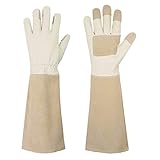
- Breathable Gardening Gloves– Pigskin provides the best breathability of all leather gloves due to the hides porous texture, dry soft after getting wet, keep your hands cool and comfortable. Best gardening gifts for gardener.
- Strength & Durability: Natural premium pigskin leather palm and back ensure wear resistance & puncture resistance, rose pruning gloves keep your hands safe and blood-free from scratches.
- Elbow-length Gauntlet Cuff: Extended synthetic leather cuff protects hands & forearms from cuts and scratches, good coverage to just below the elbow, long gauntlet gloves allowing you to be free from your rose painlessly.
- Reinforced Protection: Puncture resistant padded palm and fingertips, reinforced protection to your hands and gloves. Flexibility design making it much easier to using garden tools.
- Soft, Lightweight and Puncture Resistant: This thorn proof gardening glove is ideal for: trimming roses, pruning holly bushes, berry bushes and other prickly shrubs, trimming cactus, garden clearance work.
Will higher input costs mean lower farm profits?
Higher costs can narrow margins if crop prices do not rise enough to offset them, but input prices alone cannot establish whether a farm will lose money. A Purdue agricultural economics brief identifies three central variables: conflict duration, crop-price response and the timing of input purchases. Its answer to the profitability question is: “The honest answer to ‘what does this mean for farm profitability?’ is: it depends heavily on three things — how long the conflict and Strait closure last, how much commodity prices respond to tightened supply, and when individual farmers purchased their inputs.” (Purdue Agricultural Economics brief)
- Input purchase timing: Prepaid or contracted fertilizer and fuel can buffer a farm from immediate spot-price increases, while purchases still to be made may cost more.
- Crop prices and crop mix: Higher crop prices could offset some expense, but the result varies by crop and by how much a farm can sell at the higher price.
- Length of disruption: A short shipping shock and a prolonged disruption create different procurement and budget risks.
- Farm finances and local conditions: Cash flow, supplier access, inventories and the ability to store inputs influence how much pressure an individual operation faces.
USDA’s Economic Research Service says energy-related inputs—gasoline, diesel, electricity and fertilizer—make up over 30 percent of nonfarm-origin farm expenses. This is broad structural context about farm expenses, not an estimate of conflict-related costs in 2026. USDA ERS also explains natural gas’s role in nitrogen fertilizer production. (USDA ERS on farm businesses)
What do the later market figures show—and what do they not show?
The OECD’s 2026 assessment reports that Brent spot prices rose from around $67 per barrel in early February to above $100 in early March, peaking at $138 on April 7. It also reports European natural-gas prices rose by more than 50% and Asian spot LNG prices by nearly 90% since the conflict began. Those are international market movements, not U.S. farm input prices; their relevance is the potential transmission through production, shipping and energy costs. (OECD’s 2026 assessment)
Policy measures also addressed transport rather than farm profitability directly. The Congressional Research Service describes temporary shipping and trucking measures intended to facilitate fertilizer transport, but the cited material does not establish how much they changed prices paid by farmers. (Congressional Research Service overview)
Windows Errors? Fix Them Before They Spread
Repair common Windows errors and clear accumulated junk for a smoother, more stable PC - no reinstall needed.Free scan · no reinstallOutdated Drivers Are Slowing You Down
One free scan finds every outdated or missing driver and matches the right update for your exact hardware.Free scan · exact hardware matchAs of October 8, 2026, the sources cited here do not establish a definitive national estimate of cumulative farm net-income losses caused by the conflict. The available figures describe market conditions, broad expense patterns, or attributed estimates from specific people and organizations. They do not show that all U.S. farms, regions or crops experienced the same outcome.
Quick Recap
Product prices and availability are accurate as of the date/time indicated and are subject to change. Any price and availability information displayed on Amazon at the time of purchase will apply.




