Five companies with documented U.S. optical-fiber or cable manufacturing activity are Corning, AFL, Prysmian, Lightera, and CommScope’s Cable Exchange business. They are a useful shortlist, not a verified ranking: the available sources do not establish comparable market shares, output, product quality, or revenue. The right supplier depends on the cable’s application and specifications—and, if domestic origin matters, on where the specific product is made.
How this list is organized
The companies below are listed alphabetically. Selection is based on documented U.S. manufacturing activity, relevant cable products, and applications such as broadband, enterprise networks, and data centers—not a measured assessment of who is largest or best. A company may make optical fiber, finished cable, or both, and may manufacture in multiple countries. A U.S. footprint does not establish the origin of every product it sells.
Five notable manufacturers
AFL
AFL identifies itself as a manufacturer, engineer, and installer of fiber-optic products and equipment, with headquarters in Duncan, South Carolina. Its listed cable manufacturing locations include Duncan and North Grafton, Massachusetts, as well as facilities outside the United States. Its portfolio includes optical ground wire (OPGW), all-dielectric self-supporting (ADSS), enterprise and premise cable, and harsh-environment cable. AFL says its cable products are made to order to customer specifications. See AFL’s cable information and company profile.
CommScope / Cable Exchange
CommScope’s Cable Exchange business says it manufactures fiber and copper cables, trunks, and related products for data centers and enterprise applications at U.S. manufacturing centers in Santa Ana, California, and Pineville, North Carolina. Those locations describe Cable Exchange’s operations; they should not be assumed to apply to every CommScope cable product. Read about Cable Exchange.
What’s actually slowing this PC down?
Pick the symptom - the matching free tool is one click away.
#1 Best Overall

- Optical digital audio cable: Perfect for equipment with a TOSLINK interface (OPT In / OPT Out or S/PDIF In / S/PDIF Out). TOSLINK connector to TOSLINK connector (F05 connector)
- Versatile: Ideal for transmitting crystal-clear digital audio from your TV, video game console (PS3/PS4/Xbox One), DVD/Blu-ray player, or TV streaming box to a soundbar, amplifier/amp, stereo/Hi-Fi system, D/A converter, and more
- High-End: This metal-free fiber optic audio cable, featuring a fully flexible PVC jacket, is entirely immune to electrical interference. Each cable undergoes multi-stage testing during manufacturing to ensure maximum product quality and durability
- 24K gold-plated connectors: Corrosion resistant gold plating keeps connectors clean. And because these cables are fiber optic, they provide 100 % signal transmission with 0 % loss
- No risk: 36 months manufacturer warranty
Corning
Corning’s 2025 annual report describes optical fiber, cable, and connectivity products for advanced communications networks, including fiber-to-the-home and data-center applications. In June 2026, the company announced a multibillion-dollar agreement to supply optical fiber, cable, and connectivity for Amazon’s U.S. data-center infrastructure. That announcement is evidence of a specific supply agreement, not an independently verified ranking or general measure of capacity. Corning also joined a March 2026 statement on U.S. fiber and cable manufacturing and BEAD supply. Read Corning’s FY2025 annual report and its Amazon agreement announcement.
Lightera
A March 16, 2026 joint statement by AFL, Corning, Lightera, and Prysmian says each company makes optical fiber, optical cable, or both in the United States. It also says the four companies committed to the National Telecommunications and Information Administration (NTIA) to provide Build America, Buy America (BABA)-compliant supply for the duration of the Broadband Equity, Access, and Deployment (BEAD) Program. The statement does not specify Lightera’s facilities or distinguish its U.S. fiber output from its cable output, so buyers should confirm product-specific details directly. Read the companies’ joint statement.
Rank #2
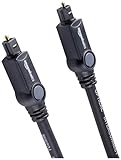
- Please REMOVE the end protective caps before using the cable.
- IN THE BOX: 6-foot digital optical audio Toslink cable.
- CLEAR AUDIO: Multi-channel, fiber-optic digital audio output; corrosion resistant gold-plated connectors and buffer tubing for optimal signal transfer.
- DURABLE: Lightweight, flexible cable with a rugged PVC exterior and removable rubber tips that protect the cable when not plugged in; remove before using.
- CONNECTS DEVICES: Quickly connects a sound bar, CD player, Blu-Ray player, game console, or other device to an audio system or TV.
Prysmian North America
Prysmian identifies its optical-fiber and cabling plant in Claremont, North Carolina, as a site where fiber cores and cladding are produced. Its U.S.-made examples also include cable made in Lexington, South Carolina. Examples in its product materials include aerial self-supporting and loose-tube cable. A 2024 company release lists Claremont, Lexington, and Jackson, Tennessee, as U.S. facilities for compliant fiber solutions and describes investment in Jackson and Claremont. See Prysmian’s optical-fiber cable information and its 2024 U.S. investment announcement.
What U.S. manufacturing and BABA compliance mean
“Made in the United States” can refer to different stages: producing optical fiber, drawing fiber from preform, or finishing the fiber into cable. For a project with federal funding, a supplier’s U.S. presence alone is not proof that a particular product meets the applicable country-of-origin rules. Prysmian’s account of BABA describes U.S. preform, fiber-drawing, and cable-finishing requirements. Buyers should confirm the exact product’s manufacturing locations and obtain current documentation for the program and contract involved. Read Prysmian’s explanation of BABA requirements.
Free tools Windows power users keep installed
One-click scans. No signup required.
Rank #3

- 【Extra-Long 10ft Cable for Flexible Setup】iVANKY 10ft optical audio cable provides just the right length to connect your devices comfortably - no more struggling with cables that are too short. Enjoy the same pristine, lossless audio quality while having the freedom to arrange your home theater, gaming system, or audio components exactly how you want
- 【Ultra-Clear Audio Quality with Japan Toray Original Fiber Core】iVANKY optical audio cable uses Japan Toray Original Fiber Core to deliver zero-distortion, lossless audio. This toslink cable is compatible with uncompressed PCM audio and compressed 5.1 to 7.1 surround sound systems, including Dolby Digital Plus, DTS-HD High Resolution, and LPCM. This digital optical audio cable ensures a wide dynamic range for an immersive listening experience
- 【Universal Device Compatibility】This optical cable for soundbar and home theaters connects seamlessly to a wide range of devices with standard Toslink (s/PDIF, Optical) ports, such as TVs, Soundbar, Speaker, Receiver, PS4, Xbox, Blu-Ray players, and more. It’s perfect for anyone looking to enhance their audio setup with a fiber optic cable that works flawlessly across multiple devices
- 【24K Gold-plated Connectors & Superior Durability】 Unlike conventional PVC jackets, iVANKY optical cable features a high-quality nylon braided jacket that withstands over 16,000 bends, making it highly durable and resistant to breakage. The aluminum shell and 24K gold-plated connectors prevent tarnishing and maintain conductivity over time, ensuring long-lasting performance
- 【Precision Design】The precisely designed cuboid connectors of this digital optical audio cable make installation easy and secure. The flexible and lightweight nylon material ensures hassle-free handling. Additionally, removable rubber caps protect the connectors from dust and oxidation when not in use. CL3-rated, this cable is also designed for in-wall installation, providing flexibility for your setup
The four-company March 2026 statement estimates that U.S. fiber and cable manufacturers collectively produce approximately 135 million fiber-kilometers annually and that peak BEAD-related demand would use less than 5% of total domestic capacity. These are figures from an industry statement published by Corning and authored by representatives of AFL, Prysmian, Lightera, and Corning—not independent audited findings. The U.S. Department of Commerce/NTIA’s 2025 Quadrennial Supply Chain Review describes BEAD as a $42.5 billion program. Read the 2025 review.
Independent reader supportYour contribution helps us test, update, and keep practical guides available for everyone.How to choose cable and compare suppliers
Start with the network design, then compare products against its requirements. A manufacturer’s broad catalog does not tell you whether a particular cable is suitable for your installation.
Rank #4

- Optical digital audio cable: Perfect for equipment with a TOSLINK interface (OPT In / OPT Out or S/PDIF In / S/PDIF Out). TOSLINK connector to TOSLINK connector (F05 connector)
- Versatile: Ideal for transmitting crystal-clear digital audio from your TV, video game console (PS3/PS4/Xbox One), DVD/Blu-ray player, or TV streaming box to a soundbar, amplifier/amp, stereo/Hi-Fi system, D/A converter, and more
- High-End: This metal-free fiber optic audio cable, featuring a fully flexible PVC jacket, is entirely immune to electrical interference. Each cable undergoes multi-stage testing during manufacturing to ensure maximum product quality and durability
- 24K gold-plated connectors: Corrosion resistant gold plating keeps connectors clean. And because these cables are fiber optic, they provide 100 % signal transmission with 0 % loss
- No risk: 36 months manufacturer warranty
Match construction to the installation
- Aerial or overhead: Check whether the route calls for ADSS, OPGW, or another construction, and confirm the cable is designed for the installation conditions.
- Buried or duct: Identify the required outside-plant construction and verify protection against water and other site-specific hazards.
- Indoor or enterprise: Confirm the cable’s intended indoor use and any required fire or smoke rating.
- Data-center trunks: Verify fiber count, termination approach, connector compatibility, and fit with the planned pathway and equipment.
- Harsh environments: Specify the environmental conditions and confirm that the manufacturer’s data sheet addresses them.
Compare the actual product specifications
For each candidate cable, review fiber count and type, bend characteristics, armor or messenger requirements, water blocking, fire and smoke ratings where applicable, and connector or termination compatibility. The companies’ cited materials do not provide a like-for-like specification comparison across all five, so use the data sheet for the exact product rather than assuming that similar product names mean equivalent performance.
Verify origin and procurement fit
Ask where the specific cable is manufactured and, if relevant, request current documentation for the governing domestic-content rules. Also compare availability, lead time, custom-specification support, service, and compatibility with the planned network. The cited sources describe some different supply channels and made-to-order capability, but do not provide comparable prices, lead times, or service scores.
Best Value

- 【Rugged Outdoor-Grade TPU Jacket】This armored fiber optic cable features a thick industrial TPU jacket with excellent tensile strength, UV resistance, abrasion protection, and waterproof performance. Built for long-term reliability in harsh environments like snowfields, deserts, mountain ridges, tunnels, coastal zones, rooftops, factories, roadside trenches, and construction sites. Supports direct burial, conduit routing, or overhead use. Available in 5m to 300m lengths for residential and commercial deployments.
- 【Dual Armored Construction for Protection】Built with a stainless steel spiral armor tube and inner fiberglass yarns, this outdoor fiber cable provides double-layer mechanical protection against crushing, rodent chewing, sharp bending, and pulling stress. With an outer diameter of 5.0mm, it offers significantly more resistance to physical damage than standard 3.0mm fiber cables, making it ideal for direct burial, industrial campuses, outdoor conduits, and environments with heavy foot or vehicle traffic. Engineered for long-term durability in harsh conditions.
- 【Pre-Installed Pulling Eye for Easy Deployment】The cable comes pre-terminated with a swivel pulling eye kit on one end, allowing for efficient and safe pulling through conduits, ducts, bridge trays, risers, telecom manholes, and underground raceways. It eliminates the risk of fiber damage during long-distance installations. The pulling eye cover is removable and reusable, making it ideal for multi-phase construction, structured cabling, building backbone links, outdoor trench routing, industrial campuses, and FTTH deployments across large properties.
- 【OM3/OM4 High-Speed Transmission up to 100Gbps】This armored fiber optic cable uses 50/125μm multimode fiber to support high-speed Ethernet connectivity. At 850nm wavelength, OM3 supports 10Gbps up to 300m, 40Gbps up to 100m, and 100Gbps up to 70m; OM4 extends these distances to 400m, 150m, and 100m respectively. Ideal for data center backbones, enterprise LANs, telecom rooms, FTTH deployments, server farms, campus networks, SAN/NAS storage interconnects, broadcast studios, control systems, surveillance backhauls, and other high-density, high-bandwidth fiber optic infrastructure.
- 【Space-Saving Uniboot & Broad Device Compatibility】LC uniboot connectors reduce cable clutter and enable quick polarity reversal—ideal for dense patching environments. This cable supports 1G/10G/25G/40G/100G SFP/SFP+/XFP/QSFP+ modules, and integrates smoothly with Ethernet switches, routers, firewalls, ONU/OLT terminals, media converters, patch panels, NICs, NVR systems, fiber mux/demux units, and industrial control equipment. Compatible with Cisco, Ubiquiti, Mikrotik, Juniper, HPE, Arista, TP-Link, Netgear, Intel, Fortinet, Zyxel, Mellanox, Supermicro, Huawei, ZTE, Brocade, D-Link, and others.
Is one manufacturer the best?
The available information does not establish a neutral winner. These companies serve different applications, and the sources do not provide independent, comparable market-share data, audited production-capacity comparisons, or like-for-like product testing. The most defensible choice is the supplier whose specific cable meets the installation, performance, origin, and procurement requirements of your project.
Quick Recap
Product prices and availability are accurate as of the date/time indicated and are subject to change. Any price and availability information displayed on Amazon at the time of purchase will apply.




