In 2025, the biggest data-center construction stories were about more than buildings: AI projects tied together campuses, power supply, transmission, cooling, chips, financing and cloud demand. The year’s defining announcements included OpenAI’s multiyear Stargate program, Amazon’s regional megacampuses, Meta’s pursuit of firm nuclear power and Microsoft’s purpose-built AI facilities. Their headline figures describe plans and commitments—not a tally of capacity completed in 2025.
How to judge which projects mattered most
There is no single fair ranking of the year’s largest projects. A multiyear investment program is not directly comparable with a campus announcement, and a power figure may mean planned data-center capacity, contracted generation or something else. The useful questions are how much capital and power a project represents, what is actually being built, how specifically it serves AI, and whether it changes the infrastructure or development equation for a region.
Project status matters just as much as size. An announcement or site selection is not the same as permitting, construction, a grid connection, commissioning or an operational data center. The figures below are attributed to the companies or agency that announced them; where a source does not define a power metric as IT load or total facility demand, it is left in the source’s terms.
Stargate made AI infrastructure a megaproject
OpenAI, SoftBank, Oracle and partners announced Stargate in January 2025 as an intended $500 billion investment in U.S. AI infrastructure over four years. The initial partners also included Arm, Microsoft and NVIDIA. Abilene, Texas, was identified as the flagship location. In September, OpenAI said the program had nearly 7 GW of planned capacity and more than $400 billion in investment over three years, including Abilene and new sites in Texas, New Mexico, Ohio and elsewhere. Those are program ambitions and planned capacity, not a report of what was built or energized during 2025.
#1 Best Overall

- Ventilation Fan: Designed to quietly ASUS GT/RT- AC5300 , cool Xboxs, CPU/ GPU, Playtations, Rokus, TVs, receivers, mondems, routers, DVRs, window fans ,network appliances, DIY aquarium cooling and other audio video electronics
- Variable Speed Control: 110V - 220V Fan power supply with speed control function, turn the knob to adjust the speed, 4V - 12V adjustable fan speed,and can turn off the fan . | Input: 100V - 240V 50/60Hz | Output: DC 3-12V 200-2000ma
- DIY Vertical Window Fan: Can both vertical and horizontal, provide efficient cooling and ventilation. Mining rigs rely on the cooling power of fans for optimal operation.Double Metal Protective, the fan is equipped with double metal protective net
- Easy to Install: Draw out air in refrigerators, provide ventilation in greenhouses, prevent amplifier overheating, and vent hot air from living room consoles like PS4. Y cable connects 2 fans, two fans can be 42cm/16.5 in far away from each other
- Dual Ball Bearing: 240mm x 240mm x 25mm / 9.45in(L) x 4.72in(W) x 1in(H) in in total. | Rated Voltage :12V | Rated Current: 0.93A at full speed | Airflow: (82CFM)x4 at 12V | Speed: 2500 RPMx4
Stargate’s importance is its integrated structure: AI demand, cloud infrastructure, capital, chips, power and construction are being assembled as parts of one program. That makes delivery dependent not just on erecting data halls but on coordinating the supporting systems and supply chains. OpenAI’s announcements do not make every selected site equivalent in status, nor do they establish that the full proposed capacity has secured power or entered service.
Amazon’s regional campuses tied construction to local infrastructure
Northern Indiana
Amazon announced an additional $15 billion investment in Northern Indiana and said it would add 2.4 GW of regional data-center capacity, on top of an earlier $11 billion St. Joseph County investment. The company also cited 1,100 new high-skilled jobs, broader construction and supply-chain employment, an energy agreement with NIPSCO and workforce-development programs. The capacity figure is planned regional capacity; the announcement does not establish that it was all under construction or operational in 2025. Amazon’s announcement frames the effort as a regional buildout rather than a single isolated facility.
Northwest Louisiana
Amazon announced $12 billion for data-center campuses spanning Caddo and Bossier parishes. It projected 540 full-time data-center jobs and 1,710 additional positions, and said it would invest up to $400 million in local water infrastructure. Amazon also said it would pay the full cost of new energy infrastructure and utility upgrades serving the campuses; STACK Infrastructure was named as development and construction partner. Those are company commitments and employment projections, not independently verified outcomes. The pledge to cover serving infrastructure costs makes Louisiana a useful example in the debate over who pays for the grid and water systems required by a large campus. Amazon’s Louisiana announcement.
Rank #2
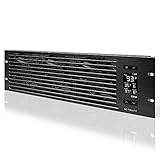
- An intelligent fan system designed for cooling audio video, DJ, server, network, and IT equipment racks.
- Protects rack-mount equipment from overheating, performance issues, and shortened lifespans.
- Programmable thermostat controller with automated speed control, alarm warnings, and backup memory.
- Premium anodized aluminum construction with CNC-machined detailing for a professional appearance.
- Size: 3U Rack Space | Design: Intake | Airflow: 60 to 300 CFM | Noise: 12 to 38 dBA | Bearings: Dual Ball
Meta linked AI campus design with firm power
A long-term nuclear supply agreement
Meta announced a 20-year agreement with Constellation tied to continued operation of the Clinton Clean Energy Center in Illinois. The stated 1,121 MW of emissions-free nuclear power is to begin in 2027. This is a power-supply agreement, not construction of a new reactor, and it does not mean that generation is physically dedicated to a particular data center. Its significance is strategic: securing firm power has become part of planning for AI infrastructure, alongside renewable-energy procurement. Meta’s announcement.
What’s actually slowing this PC down?
Pick the symptom - the matching free tool is one click away.
Beaver Dam, Wisconsin
In November, Meta announced its 30th data center worldwide at Beaver Dam, with investment exceeding $1 billion and more than 1,000 skilled-trade workers expected at peak construction. Meta said the AI-focused facility would use dry cooling and have no operational cooling-water demand. The company also described nearly $200 million in related energy infrastructure, including substations, transmission lines and network upgrades. These are site-specific company claims; dry cooling does not eliminate the facility’s need for power or establish zero total environmental impact. Meta’s Beaver Dam announcement.
Microsoft’s Fairwater showed the shift to AI-native facilities
Microsoft presented its Fairwater facility in Mount Pleasant, Wisconsin, as its largest and most sophisticated AI factory, and said similar facilities were under construction elsewhere in the United States. The company characterized Fairwater as the “world’s most powerful AI datacenter”; that is Microsoft’s description, not an independently established industry ranking. Its announcement points to investments of tens of billions of dollars and hundreds of thousands of AI chips across the facilities. Microsoft’s Fairwater account.
Rank #3

- [Adjustable] Adjustable temperature control helps ensure optimal performance for your rackmount such as network, server, music, and AV cabinets
- [Quiet and powerful] Equipped with three powerful 4” (120mm) noise control ball bearing fans capable of pumping 225 CFM of air, preventing overheating of expensive equipment
- [Optimal Airflow] This three fan cooling system will provide excellent cooling with its high-performance fans, which keep the hot air stream away from your setup with its top exhaust cool air system.
- [Compact Design] Device is standardized to mount to any 19" server rack or cabinet while taking only a single unit (1U) of space and has a wide variety of applications.
- [Programmable] Equipped with a programmable thermostat sensor controller for better temperature monitoring that will trigger fans based on your parameter configuration.
AI clusters change the design problem. Accelerator-heavy computing requires high-density racks, large-scale networking, specialized power distribution and cooling suited to the heat those systems produce. Facilities also need infrastructure to store and process the data generated by AI workloads. These requirements can mean different layouts and commissioning priorities from conventional cloud halls; the precise cooling method and power design vary by project, so they should not be inferred from the AI label alone.
Federal siting put land and energy in the same conversation
On April 3, 2025, the U.S. Department of Energy identified 16 federal sites as potential locations for data-center and AI infrastructure. DOE pointed to existing energy infrastructure and the possibility of expediting development, including new generation such as nuclear. Identification is not approval, permitting, financing or construction. Still, the initiative reflects a practical constraint: commercially suitable land is of limited use if power and the path to connect it cannot arrive on the project’s schedule. DOE’s announcement.
International projects broadened the year’s buildout
The largest headlines clustered in the United States, but 2025’s expansion was international as well. The figures below have different scopes and should not be added into a single construction total.
Rank #4

- Adjustable temperature control helps ensure optimal performance for rackmount such as network, server, music, and AV cabinets
- Noise controlled fans makes the cooling system useful for a quiet office or business space
- Compact design mounts to any 19" inch cabinet and takes up only 1 unit of space
- Simple and easy to use LCD display allows user to control temperature
- Air pumped through to the top exhaust system of the fan
| Market and announcement | Stated commitment | What the figure covers |
|---|---|---|
| Taiwan: AWS launched the Asia Pacific (Taipei) Region | More than $5 billion planned | AWS said this covers construction, connection, operation and maintenance of data centers in Taiwan; it is not solely 2025 construction spending. AWS announcement. |
| Poland: Microsoft cloud and AI infrastructure | PLN 2.8 billion by June 2026 | Microsoft described expansion of existing campuses along with skilling and cybersecurity. The amount is not a data-center construction-only total. Microsoft announcement. |
| Denmark: Microsoft plans a western Denmark region | At least $3 billion in Danish data-center capacity investment from 2023–2027 | The stated total excludes the later western-Denmark expansion, so it should not be treated as the complete cost of that plan. Microsoft announcement. |
| United Kingdom: Amazon’s broader investment plan | £40 billion | A UK-wide plan that includes previously announced data-center investment, but covers more than data-center construction. Amazon announcement. |
| 14 APEC economies outside the U.S.: Amazon cloud and AI investment | More than $40 billion from 2025–2028 | A regional cloud and AI infrastructure commitment, not a measure of data-center construction in 2025 alone. Amazon announcement. |
Google also remained part of the wider hyperscale expansion and energy-procurement story. Available project reporting supports treating it as part of the broader buildout, but does not establish a sufficiently specific first-party 2025 announcement for a defensible “largest Google project” ranking. Construction Dive’s 2025 project overview provides secondary context.
Independent reader supportYour contribution helps us test, update, and keep practical guides available for everyone.The bottleneck moved beyond concrete
AI demand can move faster than the systems needed to serve it. A building may be ready before its utility connection, and chips may arrive before a campus has enough commissioned capacity to use them. Transformers, switchgear, generators, high-voltage interconnection, cooling equipment, construction labor, permits and financing can all affect the sequence. A campus can also come online in phases: “operational” may mean a first building is serving workloads, not that the full announced buildout is complete.
Power commitments also need careful reading. A customer may fund new substations or utility upgrades, contract for generation, or match electricity use with renewable purchases; those arrangements are not interchangeable. Amazon said it would cover new energy infrastructure and utility upgrades serving its Louisiana campuses, while Meta described direct infrastructure spending at Beaver Dam. Those company-specific statements do not establish who pays for every project’s grid work.
Do these 3 things before closing this tab:
1Scan for outdated or missing drivers - takes under a minute2Repair Windows errors before they cause bigger problems3Fix the driver behind crashes, sound loss and screen glitchesBest Value
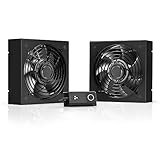
- A quiet fan kit designed for standard 19” racks, to be mounted on the roof or to replace existing fans.
- Features a speed controller utilizing PWM which can control the fan's speed without generating noise.
- Compatible with CLOUDPLATE series rack fans and can be linked to share the same programming.
- Heavy-Duty steel construction with spiral fan guards, mounting hardware, and power adapter.
- Size: Standard 120mm Rack Fans | Fans: 2 | Airflow 200 CFM | Noise: 26 dBA | Bearings: Dual Ball
Cooling has no universal answer either. Evaporative, dry, direct-to-chip liquid and closed-loop systems have different water and energy implications, shaped by climate and facility design. Meta’s Beaver Dam claim concerns operational cooling-water demand at that facility; it should not be generalized to other AI campuses or to construction and other water uses.
Local employment and investment announcements likewise need context. Peak construction workers are not permanent operating staff, and projected jobs or economic benefits are forecasts. For a local project, the practical questions include utility and road upgrades, water availability, noise, backup-generator emissions, land use, tax arrangements, housing and labor supply, and whether residents bear any infrastructure costs. The company announcements cited here do not resolve those questions for every community.
Quick Recap
What to watch after the announcements
- Whether selected sites move through permits, financing, site work, building construction and energization—not just press releases.
- Whether grid connections and generation can be delivered on the same schedule as data halls and AI hardware.
- How often campuses secure firm power, and how those contracts relate to physical supply and renewable-energy claims.
- Whether AI-specific cooling and high-density electrical designs become standard across new builds.
- How local permitting, water constraints, community concerns and skilled-trade availability affect delivery.
- Whether planned capacity is ultimately built and used as AI demand and investment commitments evolve.
Product prices and availability are accurate as of the date/time indicated and are subject to change. Any price and availability information displayed on Amazon at the time of purchase will apply.




