Free tools Windows power users keep installed
One-click scans. No signup required.
For tax year 2025 federal returns filed in 2026: the most valuable tax deduction is not always an expense you can discover. Most taxpayers first choose between the standard deduction and itemizing, while certain deductions—such as HSA contributions, traditional IRA contributions, student-loan interest, qualified tips and overtime—can be claimed separately without itemizing.
“Write-off” is informal tax language. A deduction reduces taxable income; it generally does not reduce your tax bill dollar for dollar. A $1,000 deduction might reduce federal income tax by roughly $1,000 multiplied by your marginal tax rate, subject to the rules and limitations that apply. A tax credit, by contrast, directly reduces tax and may be refundable.
As an Amazon Associate I earn from qualifying purchases.
This guide covers U.S. federal income-tax rules for 2025. State tax rules differ. Dollar limits, income thresholds and eligibility requirements should be checked against the current IRS forms and instructions before filing.
How tax write-offs work for 2025
Individual deductions fall into several different categories. They do not all work the same way or go on the same form:
#1 Best Overall

- Yearly Tax Organizer: includes 2 spiral bound tax organizer designed to help you collect, sort, and store important tax records throughout the year, keeping receipts, income records, bills, and other paperwork in one easy to manage place
- Large Size for Everyday Documents: cover measures about 13 x 9.65 inches, with inside pages about 9.65 x 6.5 inches; The spacious pocket design provides room for receipts, statements, records, and tax-related papers without taking up too much desk or shelf space
- 12 Monthly Pockets for Easy Sorting: the tax record organizer features 12 pockets, making it simple to separate documents by month or category; Useful for organizing medical expenses, charitable donations, prescriptions, invoices, income folders, and monthly bill receipts
- Spiral Bound for Convenient Access: the secure spiral binding lets pages turn smoothly, so you can quickly add, remove, or review documents whenever needed; A practical design that helps simplify filing and reduce last-minute stress during tax season
- Widely Applied: this annual tax organizer is suitable for managing annual taxes, tracking receipts and preparing for audits all year round, making your tax preparation more systematic and manageable, and it is very suitable for annual tax returns, document storage and filing, professional tax services and tax agencies
- Standard deduction: a fixed amount based mainly on filing status.
- Itemized deductions: eligible personal expenses reported on Schedule A, such as state and local taxes, mortgage interest, charitable gifts and qualifying medical expenses.
- Adjustments to income: deductions such as HSA contributions, traditional IRA contributions, student-loan interest and educator expenses. These generally do not require itemizing.
- Schedule 1-A deductions: four new 2025 deductions for qualified tips, qualified overtime, qualifying passenger-vehicle loan interest and eligible seniors. These are available whether you use the standard deduction or itemize, subject to the applicable rules.
- Business deductions: expenses that reduce income from a genuine trade or business, usually on Schedule C, E or F.
You generally cannot claim the standard deduction and Schedule A itemized deductions at the same time. That does not mean you lose adjustments to income, Schedule 1-A deductions or legitimate business deductions when using the standard deduction.
For a general explanation of the distinction, see the IRS overview of individual credits and deductions.
The 2025 standard deduction
| Filing status | 2025 standard deduction |
|---|---|
| Single | $15,750 |
| Married filing separately | $15,750 |
| Head of household | $23,625 |
| Married filing jointly | $31,500 |
| Qualifying surviving spouse | $31,500 |
These are the principal 2025 amounts from IRS Publication 501. Taxpayers age 65 or older or blind may qualify for an additional standard-deduction amount. A married taxpayer filing separately generally cannot use the standard deduction if the spouse itemizes. A taxpayer who can be claimed as someone else’s dependent has a restricted standard deduction.
The practical test is simple: compare your standard deduction with the total of your allowable Schedule A deductions. You do not itemize merely because you have a mortgage, paid state taxes or made charitable donations.
Quick guide: which deductions require itemizing?
| Deduction | Itemizing required? | Usual 2025 location | Important limit or record |
|---|---|---|---|
| Standard deduction | No; it is the alternative to itemizing | Form 1040 calculation | Depends on filing status, age, blindness and dependency |
| Age or blindness amount | No, if using the standard deduction | Form 1040 or Form 1040-SR indicators | Generally $1,600; up to $2,000 in the specified unmarried situation |
| Enhanced senior deduction | No | Schedule 1-A, Part V | Up to $6,000 per qualifying person, subject to income limits |
| SALT | Yes | Schedule A | Generally capped at $40,000 for 2025, with phaseout rules |
| Mortgage interest | Yes | Schedule A | Usually subject to acquisition-debt limits |
| Charitable contributions | Yes for 2025 | Schedule A | Keep receipts and acknowledgments; percentage limits may apply |
| Medical and dental expenses | Yes | Schedule A | Only unreimbursed expenses above 7.5% of AGI |
| HSA contributions | No | Form 8889 and Schedule 1 | $4,300 self-only or $8,550 family contribution limit |
| Traditional IRA contributions | No | Schedule 1 | $7,000, or $8,000 at age 50 or older, subject to compensation and income rules |
| Student-loan interest | No | Schedule 1 | Up to $2,500, subject to income and eligibility rules |
| Educator expenses | No | Schedule 1 | Up to $300 per eligible educator |
| Qualified tips | No | Schedule 1-A, Part II | Up to $25,000 per return, with occupation and income limits |
| Qualified overtime | No | Schedule 1-A, Part III | Up to $12,500, or $25,000 for joint filers |
| Passenger-vehicle loan interest | No | Schedule 1-A, Part IV | Up to $10,000 for qualifying loans and vehicles |
| Self-employed and business expenses | No | Schedule C, E or F; sometimes Schedule 1 | Must be connected with a genuine business and properly documented |
Forms and line numbers can change. Use the current IRS revision linked from the About Form 1040 page rather than relying on an old line number.
The 15 common 2025 tax write-offs
1. The standard deduction
The standard deduction is the default deduction available to most taxpayers. It is not an expense and does not require receipts. For 2025, it is $15,750 for single and married-filing-separately taxpayers, $23,625 for heads of household and $31,500 for married couples filing jointly or qualifying surviving spouses.
Who may claim it: Most taxpayers who do not itemize. Special restrictions apply to dependents, married taxpayers filing separately and certain taxpayers who must itemize.
Windows Errors? Fix Them Before They Spread
Repair common Windows errors and clear accumulated junk for a smoother, more stable PC - no reinstall needed.Free scan · no reinstallCrashes, No Sound, or Screen Glitches?
Random freezes, missing sound and display glitches usually trace back to one bad driver. Find and replace yours safely.Free scan · under a minuteItemizing required: No. In fact, the standard deduction is the alternative to itemizing.
Where reported: It is part of the Form 1040 calculation. Age and blindness information is entered on Form 1040 or Form 1040-SR as applicable.
Example: If you are single and your allowable Schedule A deductions total $11,000, the $15,750 standard deduction is generally larger, so itemizing would not improve your federal deduction.
2. Additional deductions for older or blind taxpayers
There are two separate 2025 deductions to keep apart.
Additional standard deduction for age or blindness: A taxpayer who is 65 or older or blind may generally add $1,600 to the standard deduction. The amount generally increases to $2,000 for an unmarried taxpayer who is not a surviving spouse and is both age 65 or older and blind. The exact amount depends on filing status and the number of qualifying conditions. This additional amount matters when you use the standard deduction; it is not an extra Schedule A deduction when you itemize. See IRS Topic 551 for the applicable table.
Enhanced senior deduction: For 2025 through 2028, a taxpayer age 65 or older may qualify for a separate deduction of up to $6,000 per person. A married couple could therefore claim up to $12,000 if both spouses qualify. It is available to itemizers and non-itemizers, is claimed on Schedule 1-A, Part V, requires the applicable valid Social Security number and phases out above modified AGI of $75,000 for single filers or $150,000 for joint filers. Do not confuse this new deduction with the existing age-based additional standard deduction. The IRS discusses the senior provisions in its Working Families Tax Cuts guidance and Publication 554.
Records: Keep the taxpayer’s and spouse’s identifying information and documents supporting age and filing status. The IRS form itself generally calculates the applicable amount.
3. State and local taxes, or SALT
If you itemize, you may generally deduct qualifying state and local income taxes or elect to deduct general sales taxes, plus qualifying real-property taxes and value-based personal-property taxes. You cannot deduct both state and local income taxes and general sales taxes on Schedule A.
The Tool Desk
Outbyte Driver Updater FREEFix the driver behind crashes, sound loss and screen glitchesFind Drivers →Outbyte PC Repair FREEClear out junk files and repair common Windows errorsFree Scan →For 2025, the combined SALT limit is generally $40,000, or $20,000 for married taxpayers filing separately. For most taxpayers, the cap is reduced when modified AGI exceeds $500,000, or $250,000 for married filing separately. The reduction is generally 30% of the excess income, subject to a statutory floor of $10,000, or $5,000 for married filing separately. The 2025 Schedule A instructions contain the calculation.
What does not qualify: Federal income tax, Social Security and Medicare taxes, homeowners association dues, most transfer taxes, and taxes for local improvements are not personal SALT deductions. A tax directly attributable to a trade or business may belong on a business schedule instead.
Where reported: Schedule A.
Records: Keep property-tax bills, state and local tax payment records, state income-tax documentation and the sales-tax worksheet or supporting records if you make the sales-tax election.
Example: A taxpayer with $18,000 of deductible property and state income taxes does not automatically receive an $18,000 federal deduction if another limitation applies. The taxpayer must apply the 2025 SALT cap and compare the result with the standard deduction.
Quick wins for a faster PC:
Repair Windows errors before they cause bigger problemsFix Now →Fix the driver behind crashes, sound loss and screen glitchesFind Drivers →Clear out junk files and repair common Windows errorsFree Scan →4. Mortgage interest
Itemizers may generally deduct qualified mortgage interest paid on a main home or second home. The debt must generally be secured by the residence and used to buy, build or substantially improve the home.
For acquisition debt incurred after December 15, 2017, the limit is generally based on $750,000 of qualifying debt for single and joint filers, or $375,000 for married filing separately. Certain older qualifying acquisition debt may use the prior $1 million and $500,000 limits. IRS Publication 936 explains the debt and residence rules.
What does not generally qualify: Mortgage principal, homeowners insurance, HOA dues, ordinary repairs, utilities and interest on home-equity debt used for personal purposes. Points and refinancing transactions may require a separate calculation.
Where reported: Schedule A, generally using Form 1098 and lender records.
Records: Keep Form 1098, closing documents, loan statements and records showing how home-equity or refinanced proceeds were used.
Example: Interest on a loan used to add a room to your home may qualify if the loan is secured by the home and other requirements are met. Interest on a home-equity loan used to pay credit-card bills generally does not qualify as home-mortgage interest.
Rank #2
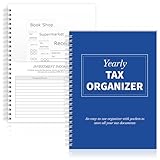
- Yearly Tax Organizer: includes 1 spiral bound tax organizer designed to help you collect, sort, and store important tax records throughout the year, keeping receipts, income records, bills, and other paperwork in one easy to manage place
- Spiral Binding: with spiral security binding, you can sort and access your monthly tax documents all year round; Help simplify tax time
- Durable: our tax document organizer is made of paper, which is very durable and convenient for you to use frequently in your daily work
- Large Capacity: this tax document organizer has 12 pockets, which makes it convenient for you to sort and file receipts and records and store them in a centralized manner; With this document organizer, you can organize various documents such as medical expenses, prescription drugs, charitable donations, etc. throughout the year, and face tax season confidently and efficiently
- Widely Applied: this annual tax organizer is suitable for managing annual taxes, tracking receipts and preparing for audits all year round, making your tax preparation more systematic and manageable, and it is very suitable for annual tax returns, document storage and filing, professional tax services and tax agencies
5. Charitable contributions
For 2025, charitable contributions are generally deductible only if you itemize. The recipient must be a qualified organization; gifts to individuals, political candidates and political organizations are not deductible charitable contributions.
If you receive goods or services in exchange for a donation, only the amount above the fair-market value of what you received is generally deductible. For many cash contributions to qualifying organizations, the deduction is generally subject to a 60%-of-AGI limit, although different percentage limits apply to certain property and organizations. Unused contributions may be carried forward under the applicable rules. See IRS Publication 526 and IRS Topic 506.
Do these 3 things before closing this tab:
1Repair Windows errors before they cause bigger problems2Scan for outdated or missing drivers - takes under a minute3Clear out junk files and repair common Windows errorsDocumentation rules:
- Keep a bank record or receipt for every cash contribution.
- A contribution of $250 or more generally requires a contemporaneous written acknowledgment from the charity. The acknowledgment should describe the contribution and state whether you received goods or services.
- Noncash contributions over $500 generally require Form 8283.
- Noncash contributions over $5,000 generally require a qualified appraisal and Form 8283, Section B, subject to exceptions.
Where reported: Schedule A.
Important 2026 distinction: A new rule allows non-itemizers to deduct up to $1,000 of qualifying cash donations, or $2,000 for joint filers, beginning in 2026. Itemizers also face a new 0.5%-of-AGI charitable-contribution floor beginning in 2026. Neither provision applies to charitable contributions made in 2025. See IRS Publication 505 for 2026.
6. Unreimbursed medical and dental expenses
An itemizer may deduct qualifying medical and dental expenses paid for the taxpayer, spouse and qualifying dependents, but only the portion that exceeds 7.5% of adjusted gross income. Insurance reimbursements, employer-plan payments and other reimbursements must be excluded.
Potentially qualifying costs can include doctors, dentists, hospitals, prescription drugs, certain long-term-care costs, medical equipment and transportation primarily for medical care. Ordinary personal items such as toothbrushes and toothpaste do not qualify. IRS Publication 502 lists eligible and ineligible expenses.
Where reported: Schedule A.
Records: Keep invoices, receipts, insurance statements, reimbursement information and transportation records showing the medical purpose.
Example: If your AGI is $80,000, the first $6,000 of otherwise qualifying medical expenses generally produces no Schedule A medical deduction because of the 7.5% floor. Only qualifying unreimbursed expenses above that threshold count.
Do not count the same cost twice: An expense paid or reimbursed from an HSA generally cannot also be included as a Schedule A medical expense. Self-employed health-insurance premiums have their own deduction and should not be added again here.
7. Health Savings Account contributions
Eligible taxpayers may deduct contributions to an HSA through Form 8889. This is a separate adjustment to income, so itemizing is not required.
For 2025, the HSA contribution limits are:
- $4,300 for self-only coverage.
- $8,550 for family coverage.
For 2025, an HSA-qualified high-deductible health plan generally must have a deductible of at least $1,650 for self-only coverage or $3,300 for family coverage. Its out-of-pocket limit generally cannot exceed $8,300 for self-only coverage or $16,600 for family coverage. These figures come from IRS Revenue Procedure 2024-25.
Recommended Free Tools
To contribute, you generally must have eligible HDHP coverage, no disqualifying additional coverage, no Medicare enrollment and no status as another taxpayer’s dependent. Employer contributions count toward the annual limit. Contributions made through payroll may already be excluded from wages, so do not claim the same contribution again as an individual deduction. See the 2025 Form 8889 instructions.
Where reported: Form 8889, flowing to Schedule 1 and Form 1040.
Records: Keep HSA contribution statements, employer contribution information, Form 5498-SA when received and receipts for medical distributions. Qualified HSA withdrawals used for eligible medical expenses are generally tax-free, but the expense itself cannot be deducted again.
8. Deductible traditional IRA contributions
For 2025, the combined contribution limit for traditional and Roth IRAs is $7,000, or $8,000 for taxpayers age 50 or older, limited by taxable compensation. Roth IRA contributions are not deductible. A traditional IRA contribution may be deductible, partly deductible or nondeductible.
What’s actually slowing this PC down?
Pick the symptom - the matching free tool is one click away.
The deduction depends on whether you or your spouse were covered by a workplace retirement plan and on modified AGI. For example, for 2025 the phaseout for a covered taxpayer filing single or head of household is $79,000 to $89,000. For married filing jointly when the contributing taxpayer is covered, it is $126,000 to $146,000. Different limits apply when only the spouse is covered and for other filing statuses. The 2025 IRS Publication 590-A tables control.
Where reported: Schedule 1.
Records: Keep the IRA custodian’s contribution confirmation and documentation showing whether the contribution was designated for 2025. A contribution made by the tax-return due date may generally be designated for the prior tax year, but you must tell the financial institution which year applies.
Example: A $7,000 traditional IRA contribution is not automatically a $7,000 deduction. The result depends on compensation, filing status, workplace-plan coverage and modified AGI.
9. Student-loan interest
A qualifying taxpayer may deduct the lesser of $2,500 or the amount of qualifying student-loan interest actually paid during 2025. This is an adjustment to income, so you do not need to itemize.
Quick wins for a faster PC:
Repair Windows errors before they cause bigger problemsFix Now →Fix the driver behind crashes, sound loss and screen glitchesFind Drivers →The deduction is phased out at higher modified AGI levels and is unavailable to married taxpayers filing separately. You generally must be legally obligated to pay the interest. Loan principal, ordinary origination costs and interest paid by someone who is not legally obligated generally do not qualify. Interest paid by an employer under an educational-assistance program may also be ineligible for an additional employee deduction. See IRS Topic 456 and Publication 970.
Where reported: Schedule 1.
Records: Form 1098-E is useful, but retain lender statements showing the amount of interest actually paid and any information about refinancing, cancellation or employer assistance.
Example: If you paid $1,800 of qualifying interest and meet the income and legal-obligation requirements, your potential deduction is limited to $1,800, not the full $2,500 maximum.
10. Educator expenses
Eligible K–12 teachers, instructors, counselors, principals and aides who worked at least 900 hours during the school year may deduct up to $300 of eligible unreimbursed classroom expenses for 2025. Two married educators filing jointly may claim up to $600 total, but neither spouse may claim more than $300.
Do these 3 things before closing this tab:
1Scan for outdated or missing drivers - takes under a minute2Repair Windows errors before they cause bigger problems3Fix the driver behind crashes, sound loss and screen glitchesQualifying costs may include classroom books, supplies, computers, software, equipment and professional-development expenses. The educator must pay the cost, and it cannot be reimbursed by an employer, grant or another source.
Where reported: Schedule 1.
Records: Keep receipts, proof of payment, records of reimbursement and documentation of the 900-hour requirement.
Critical employee warning: The educator deduction is a specific exception. Ordinary unreimbursed employee expenses—such as a home office, commuting, work clothes, laptop or general supplies—are generally not federally deductible for 2025. Narrow exceptions also exist for certain reservists, fee-basis government officials, performing artists and employees with impairment-related work expenses.
Rank #3

- Great way to organize and store vital tax records
- Instruction sheet/checklist and preprinted labels included
- 12 pockets plus one large pocket in back provides ample storage
- Protective flap and elastic cord closure
- Contains 10% recycled content, 10% post-consumer material
11. Qualified tips
For 2025 through 2028, eligible employees and self-employed individuals may deduct qualified tips received in occupations identified by the IRS as customarily and regularly receiving tips. The maximum is $25,000 per return. The deduction phases out above modified AGI of $150,000 for single filers or $300,000 for joint filers.
The Tool Desk
Outbyte Driver Updater FREEScan for outdated or missing drivers - takes under a minuteDriver Scan →Outbyte PC Repair FREERepair Windows errors before they cause bigger problemsFix Now →Qualified tips generally must be voluntary cash or charged tips, including shared tips, and must be reported on a W-2, qualifying 1099, another permitted statement or Form 4137. A married taxpayer generally must file jointly, and the applicable Social Security number requirement must be met.
Where reported: Schedule 1-A, Part II—not Schedule C.
Records: Keep W-2s, 1099s, Form 4137 when applicable, pay stubs, tip-pool records and employer statements. For 2025, tax forms may not separately identify every qualified tip, so pay records may be important. The IRS qualified-tips guidance and Schedule 1-A instructions provide the current rules.
Example: A tipped worker cannot automatically deduct every dollar shown as tips. The occupation, nature and reporting of the tips, filing status and modified AGI all matter.
12. Qualified overtime compensation
For 2025 through 2028, eligible taxpayers may deduct qualified overtime compensation up to:
- $12,500 for most individual returns.
- $25,000 for married couples filing jointly.
The deduction phases out above modified AGI of $150,000 for single filers or $300,000 for joint filers.
Qualified overtime is generally the premium portion required under the Fair Labor Standards Act—not the employee’s entire overtime paycheck. For example, with time-and-a-half pay, the qualifying amount is generally the additional half-time premium, not all wages paid for the overtime hours. State overtime rules or an employer’s voluntary overtime premium do not necessarily create qualified overtime for this deduction.
Where reported: Schedule 1-A, Part III.
Records: Keep W-2s, pay stubs, payroll breakdowns, employer statements and records showing the regular and premium portions of overtime. Do not deduct the same wages as a business expense or treat all overtime wages as tax-free. See the IRS overtime FAQs.
13. Interest on a qualifying passenger-vehicle loan
For tax years 2025 through 2028, a taxpayer may deduct up to $10,000 per year of qualifying passenger-vehicle loan interest, whether using the standard deduction or itemizing. Income limitations apply.
The loan and vehicle generally must meet all of these conditions:
- The loan was incurred after December 31, 2024.
- It finances a vehicle purchased for personal use.
- The loan is secured by a first lien on the vehicle.
- The vehicle is new, meaning its original use begins with you.
- The vehicle’s final assembly occurred in the United States.
Used vehicles, older loans and interest connected with qualifying business use require separate treatment. Do not assume that an auto loan secured by the vehicle qualifies merely because it is a car loan.
Where reported: Schedule 1-A, Part IV.
Records: Keep the loan agreement, lender interest statement, purchase documents, vehicle identification information and evidence of final U.S. assembly when provided. The IRS car-loan-interest guidance explains the vehicle and loan tests.
Double-counting warning: Interest attributable to business use should not be claimed both as a business expense and under the personal Schedule 1-A deduction.
14. Self-employed health-insurance premiums
A self-employed taxpayer may be able to deduct premiums for medical, dental and vision insurance, as well as qualifying long-term-care insurance, for the taxpayer, spouse, dependents and a child under age 27 even if the child is not a dependent.
The deduction is limited by earned income from the relevant business. It generally cannot be claimed for months when the taxpayer was eligible for subsidized employer coverage, including coverage through a spouse’s employer. More-than-2% S-corporation shareholders have special rules involving the plan, W-2 reporting and how the premiums are handled.
Where reported: Form 7206 and Schedule 1—not Schedule C as an ordinary business expense. See the 2025 Form 7206 instructions.
Outdated Drivers Are Slowing You Down
One free scan finds every outdated or missing driver and matches the right update for your exact hardware.Free scan · exact hardware matchWindows Errors? Fix Them Before They Spread
Repair common Windows errors and clear accumulated junk for a smoother, more stable PC - no reinstall needed.Free scan · no reinstallRecords: Keep premium invoices, proof of payment, coverage dates, employer-coverage information and business-income records.
Do not count the same premiums twice: Premiums used for this deduction should not also be included in Schedule A medical expenses. HSA-paid amounts also cannot be used again as a medical deduction.
15. Self-employed business expenses
Business owners and independent contractors have a different deduction system from W-2 employees. A sole proprietor generally reports ordinary and necessary business expenses on Schedule C. Partnership, S-corporation, rental and farming activities may instead use Schedule E or Schedule F, depending on the activity and entity.
A business expense must be directly connected with a genuine trade or business and must be ordinary and necessary for that activity. A hobby, occasional personal activity or pursuit operated without a profit motive does not automatically create Schedule C deductions. Use the guidance in IRS Publication 334 and the 2025 Schedule C instructions.
What’s actually slowing this PC down?
Pick the symptom - the matching free tool is one click away.
Ordinary operating costs
Potential categories include advertising, business software, supplies, rent, contract labor, insurance, legal and professional fees, utilities and business taxes. Only the business portion qualifies for a mixed-use item. Personal legal work, fines, penalties and personal purchases cannot be relabeled as business expenses.
Tax-preparation fees are generally deductible only to the extent attributable to the business portion of the return. Keep invoices that separate business and personal services.
Home-office expenses
A self-employed taxpayer may qualify when part of the home is used regularly and exclusively for business and generally serves as the principal place of business or a qualifying location for administrative or management activities. A desk in a room that is also used for personal purposes ordinarily does not meet the exclusive-use test.
The simplified method is $5 per square foot, limited to 300 square feet, for a maximum deduction of $1,500. The regular method allocates actual expenses and may include depreciation. It requires more records and can create depreciation-recapture considerations when the property is later sold.
Rank #4

- All-In-One Monthly Organizer: Keep all your important documents in one place with Sooez Accordion File Organizer. 13 pockets design works great for Monthly organizing and protecting all your important paperwork, bills, taxes, receipts, invoices and more. Perfect for letter size.
- Expandable Capacity: The accordion file folder can be stretched up to 12 inches. 13 pockets allow you to store more than 2000 sheets. No matter how many documents you need to store, this folder can accommodate your needs as it can be easily expanded according to your requirements.
- Efficient Organization & Easy Lookup: To enhance your file organization, we provide blank labels along with this folder. You can personalize them to suit your requirements, such as labeling sections by month for effortless file retrieval.
- Stable & Portable: Stand on its own on the desk and not easy to tip over. Designed with portability in mind, allowing you to effortlessly move it between your desk, cabinet, and any other preferred locations.
- Maximum Protection and Durability: Well made, made from durable wipe-clean polypropylene. Waterproof & sturdy. Tear-resistant plastic provides durable structure. Acid-free, PVC-free, and archival quality for safe storage. Adjustable snap closure helps keep contents secure. Use 2 additional front pockets for business cards, project title cards or notes.
The simplified and regular methods are alternatives, not deductions to combine. The home-office deduction generally cannot create or increase a business loss. Under the regular method, some excess amounts may be carried forward; the simplified method does not provide that carryforward. See the IRS simplified home-office guidance and Publication 587.
Business vehicle use
For 2025, the optional business standard-mileage rate is 70 cents per business mile. Commuting between home and a regular workplace is personal and generally nondeductible. Business trips between work locations, to customers or to temporary work locations may qualify.
You generally choose between:
- Standard mileage: a rate that incorporates depreciation and many operating costs.
- Actual expenses: fuel, repairs, insurance, depreciation and other allowable costs allocated between business and personal use.
You cannot use both methods for the same vehicle and the same costs. The standard-mileage method is unavailable in some situations, including when accelerated depreciation, Section 179 or bonus depreciation was used for the vehicle. A mileage log should show the date, destination, purpose and business miles. See the IRS 2025 standard-mileage rate and Publication 463.
Business travel and meals
Ordinary and necessary travel away from your tax home for business may be deductible. Business meals are generally limited to 50%, must have a proper business connection and generally require you or an employee to be present. Entertainment is generally not deductible, although separately stated food and beverages at an entertainment event may qualify under the applicable rules.
For each trip or meal, record the amount, date and time, location or destination, business purpose and relevant business relationship. A receipt alone may not explain why the expense was business-related.
Other self-employed deductions
- One-half of self-employment tax: The deductible employer-equivalent portion is claimed on Schedule 1, not Schedule C. See IRS Topic 554.
- Retirement plans: SEP, SIMPLE and qualified plans may permit deductible contributions under their specific rules. For 2025, SEP contributions can generally be as high as the lesser of 25% of compensation or $70,000, subject to the special calculation for self-employed people. See Publication 560.
- Qualified business income deduction: Eligible owners of sole proprietorships, partnerships, S corporations and certain trusts may generally deduct up to 20% of qualified business income. The 2025 taxable-income threshold is $197,300 for most returns and $394,600 for joint returns, with phase-in ranges and additional wage, property and business-type limitations above those amounts. The deduction is claimed on Form 8995 or Form 8995-A. See the IRS QBI guidance.
Special 2025 deductions on Schedule 1-A
The new Schedule 1-A is easy to miss if you rely on older tax articles or software checklists. For 2025, it contains the enhanced senior deduction plus the deductions for qualified tips, qualified overtime and qualifying passenger-vehicle loan interest. These deductions can be available whether you itemize or use the standard deduction, but they are not automatic and may require records beyond a W-2 or 1099.
Use Schedule 1-A with Form 1040 and keep supporting payroll, loan, vehicle and age-related documentation. Do not place tips or overtime on Schedule C merely because you are self-employed, and do not place a qualifying personal car-loan deduction on Schedule C.
What employees usually cannot deduct
For federal tax year 2025, ordinary unreimbursed employee expenses are generally not deductible. The suspension of miscellaneous itemized deductions means that a W-2 employee generally cannot claim a federal deduction for:
Free tools Windows power users keep installed
One-click scans. No signup required.
- A home office used for an employer.
- Commuting to a regular workplace.
- Ordinary work clothes, laptops, tools or supplies.
- Personal cellphone, internet or vehicle costs, except where a specific rule applies.
Narrow exceptions apply to certain reservists, fee-basis government officials, performing artists and employees with impairment-related work expenses. Educator expenses are another specific statutory exception.
An employer may reimburse legitimate employee expenses under a properly structured accountable plan. If the employee substantiates the expense and returns any excess reimbursement, the payment may generally be excluded from wages. That is not the same as claiming a personal deduction. Keep the employer’s reimbursement policy and records. The IRS discusses accountable-plan principles in its guidance on accountable reimbursements.
Expenses that generally are not personal write-offs
- Personal living expenses.
- Commuting from home to a regular workplace.
- Federal income tax.
- Social Security and Medicare taxes as personal Schedule A expenses.
- Homeowners association dues.
- Fines and penalties.
- Political contributions.
- Gifts to individuals.
- Expenses paid or reimbursed by an employer, insurer, grant or another person.
- The personal portion of a mixed-use phone, vehicle, computer, home or subscription.
- An expense already deducted on Schedule C, Schedule E, Schedule F, Schedule 1 or Schedule 1-A.
A business logo on a personal car does not turn commuting into business mileage. Similarly, describing an activity as a business does not make a hobby or personal purchase deductible.
How to choose between the standard deduction and itemizing
- Calculate your standard deduction. Start with your filing status and then account for qualifying age or blindness amounts.
- Total Schedule A deductions. Include allowable SALT, mortgage interest, charitable contributions, medical expenses above 7.5% of AGI and any other narrowly permitted itemized deductions, including qualifying casualty or disaster losses when applicable.
- Apply each limitation. Calculate the SALT cap, mortgage-debt limits, medical floor, charitable percentage limits and any income-based restrictions.
- Compare the totals. Use the larger allowable amount unless a special rule requires itemizing.
- Add deductions that do not require itemizing. Check Schedule 1 and Schedule 1-A for HSA, IRA, student-loan, educator, self-employed health-insurance, senior, tip, overtime and vehicle-loan-interest deductions.
- Separate business activity. If you have self-employment income, calculate business income and expenses on the appropriate business schedule rather than treating business costs as personal Schedule A deductions.
- Check credits separately. A deduction is not a substitute for checking the Child Tax Credit, Earned Income Tax Credit, education credits, energy credits or dependent-care credit.
The number of receipts is not the test. A taxpayer with one large mortgage-interest payment may still benefit less from itemizing than a taxpayer with several categories of deductions, and a taxpayer with many small receipts may still be better off with the standard deduction.
Recommended Free Tools
Timing rules for a 2025 return
For a cash-basis individual, a deductible expense generally belongs to the year it was paid. However, state-tax estimates, property taxes, charitable contributions and IRA contributions have special timing and designation rules. An IRA contribution made by the tax-return due date may generally be designated for 2025, while a payment made after year-end is not automatically a 2025 deduction.
A mortgage lender’s Form 1098 may not capture every potentially deductible amount, but additional amounts must still meet the IRS rules. Likewise, 2025 W-2 and 1099 forms may not separately identify the amount of qualified tips or overtime needed for Schedule 1-A.
Do not use a blanket “pay it before December 31” strategy. Accelerating a payment helps only if the expense is otherwise deductible, belongs to 2025 under the applicable rules and produces a benefit after all limits and the standard-versus-itemized comparison.
2025 tax-record checklist
Keep records that establish both the amount and the reason the expense qualifies. A useful checklist includes:
- Receipts, invoices and bank or credit-card statements.
- Form W-2, Forms 1099 and pay stubs supporting tips and overtime.
- Form 1098 for mortgage interest.
- Form 1098-E and lender records for student-loan interest.
- Charity receipts, bank records and written acknowledgments.
- Form 8283 and qualified appraisals for qualifying high-value noncash donations.
- Property-tax bills and state-tax payment records.
- Medical and dental invoices, insurance reimbursements and HSA payment records.
- HSA contribution statements and Form 8889 information.
- Traditional IRA contribution confirmations showing that the contribution was designated for 2025.
- Mileage logs showing business date, destination, purpose and miles.
- Travel and meal records showing amount, date, location, business purpose and business relationship.
- Home-office square footage and records supporting regular, exclusive business use.
- Business receipts and records allocating mixed personal and business use.
- Insurance-premium records and employer-coverage information for self-employed health insurance.
- Retirement-plan contribution confirmations and QBI records if self-employed.
Keep the records for the period required by the IRS and your tax professional. Digital copies are useful, but they should remain readable and backed up.
Common double-dipping mistakes
The same expense cannot generally produce two deductions. Watch for these frequent errors:
- Claiming an HSA-paid medical bill on Schedule A.
- Including self-employed health-insurance premiums both on Schedule 1 and Schedule A.
- Claiming vehicle-loan interest both on Schedule 1-A and as a business expense.
- Reporting a business expense on Schedule C and again as a personal itemized deduction.
- Deducting an employer-reimbursed expense.
- Using the same vehicle costs under both standard mileage and the actual-expense method.
- Claiming the full overtime paycheck instead of only the qualified premium portion.
The 2025 Schedule A instructions specifically caution taxpayers not to include amounts deducted elsewhere, including on Schedule 1-A, Schedule C, Schedule E or Schedule F.
A final filing decision tree
- Do you have a Schedule 1-A deduction? Check qualified tips, qualified overtime, qualifying passenger-vehicle loan interest and the enhanced senior deduction.
- Do you have adjustments to income? Check HSA contributions, deductible traditional IRA contributions, student-loan interest, educator expenses, self-employed health insurance and one-half of self-employment tax.
- Are you self-employed? Report ordinary and necessary business expenses, home-office costs, business mileage or actual vehicle costs, travel, meals and retirement contributions on the appropriate business forms.
- Are you deciding whether to itemize? Compare allowable Schedule A deductions with your standard deduction after applying all limits.
- Do not stop at deductions. Review tax credits separately; credits can have a more direct effect on tax owed.
For a complicated return—especially one involving a business, home office, S corporation, large charitable gift, vehicle used for both business and personal purposes or a high-income phaseout—have a qualified tax professional review the calculation.
Quick wins for a faster PC:
Scan for outdated or missing drivers - takes under a minuteDriver Scan →Repair Windows errors before they cause bigger problemsFix Now →Frequently Asked Questions
Can I claim these deductions if I take the standard deduction?
Yes, for many of them. HSA contributions, deductible traditional IRA contributions, student-loan interest, educator expenses, self-employed health insurance, one-half of self-employment tax and the 2025 Schedule 1-A deductions generally do not require itemizing. SALT, mortgage interest, 2025 charitable contributions, medical expenses and most other personal deductions do require Schedule A itemizing.
Is a tax deduction the same as a tax credit?
No. A deduction reduces taxable income, while a credit directly reduces the tax calculated on your return. Credits such as the Child Tax Credit, Earned Income Tax Credit, education credits and eligible energy credits must be checked separately.
Can a W-2 employee deduct a home office, commuting or work supplies for 2025?
Generally no for federal tax purposes. Ordinary unreimbursed employee expenses remain suspended as miscellaneous itemized deductions. Educators and a few narrow categories of employees have specific exceptions, and employer reimbursement under a qualifying accountable plan may be handled differently.
How much tax does a $1,000 write-off save?
It depends on your marginal federal tax rate and the deduction’s limitations. A deduction reduces taxable income, not the tax bill dollar for dollar. A $1,000 deduction might reduce federal income tax by approximately $1,000 multiplied by your marginal rate, but the actual result can change because of phaseouts, credits, self-employment tax and other interactions.
Recommended Free Tools
Do 2026 charitable-deduction changes apply to my 2025 return filed in 2026?
No. The new non-itemizer deduction of up to $1,000 for single filers or $2,000 for joint filers, and the new 0.5%-of-AGI floor for itemizers, apply to qualifying charitable contributions beginning in 2026. They do not apply to 2025 contributions.
The Bottom Line
For a 2025 federal return filed in 2026, start with the standard deduction, then check deductions that apply regardless of itemizing—especially HSA, IRA, student-loan, educator, self-employed and new Schedule 1-A deductions. Itemize only when your allowable Schedule A total is larger after applying the SALT, medical, mortgage and charitable limits. Keep records, separate personal from business costs and never claim the same expense twice.
Quick Recap
Product prices and availability are accurate as of the date/time indicated and are subject to change. Any price and availability information displayed on Amazon at the time of purchase will apply.




