The “new European AI alliance” in this headline is a defence-technology partnership between Germany’s Helsing and France’s Mistral AI, announced on 10 February 2025—not the European Commission’s civic European AI Alliance. The companies said they would develop AI for European defence, focusing on models that could help platforms interpret their surroundings and support actions. That direction raises questions about autonomous weapons, but the announcement does not establish that they had fielded fully autonomous lethal weapons.
What is the new European AI alliance?
Helsing and Mistral AI announced their strategic partnership at the Paris Global AI Summit on 10 February 2025. Helsing is a German defence-technology company; Mistral is a French AI company. Their stated aim is to develop next-generation AI systems for European defence. Helsing described the work as intended “to enhance human-AI collaboration on the battlefield.” (Helsing, 10 February 2025.)


The word “alliance” can be misleading here: this is a company partnership, not a new EU institution or a military alliance among European countries. It is also separate from the European Commission’s archived European AI Alliance, a civic forum for discussion of AI’s economic and social impact.
| Entity | What it is | Relevant detail |
|---|---|---|
| Helsing–Mistral partnership | A commercial partnership between two companies | Announced on 10 February 2025 to develop AI for European defence, with work focused on vision-language-action models. (Helsing, 10 February 2025.) |
| European AI Alliance | An archived European Commission civic forum | Its High-Level Expert Group on AI had 52 members in 2020. That figure relates to the civic forum, not the Helsing–Mistral partnership. (European Commission, 2020.) |
What are vision-language-action models?
Vision-language-action (VLA) models are intended to connect three capabilities: interpreting visual information, communicating in language and supporting actions by a robot or other platform. Helsing said the joint work would focus on models that let defence platforms “understand their environment, communicate naturally with operators, and allow for faster, more reliable decisions in complex scenarios.” (Helsing, 10 February 2025.)
Recommended Free Tools
#1 Best Overall
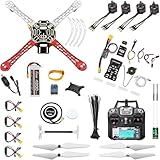
- 𝐘𝐨𝐮𝐫 𝟏𝐬𝐭 𝐃𝐈𝐘 𝐃𝐫𝐨𝐧𝐞 - F450 is the best DIY drone for both beginners to learn the basics and experts to conduct research or secondary development.
- 𝐌𝐨𝐫𝐞 𝐂𝐚𝐩𝐚𝐜𝐢𝐭𝐲 & 𝐌𝐨𝐫𝐞 𝐒𝐩𝐚𝐜𝐞 - Wheelbase: 450mm, Maximum take-off weight: approx. 1.8 kg. It has enough space for flight control, Raspberry Pi, camera, sensors, etc.
- 𝐍𝐞𝐰𝐛𝐢𝐞 𝐅𝐫𝐢𝐞𝐧𝐝𝐥𝐲 - We have prepared a quick start guide for new players that will assist you with the assembly and calibration of a DIY drone. Please contact us if you need it.
- 𝐁𝐫𝐚𝐧𝐝 𝐏𝐚𝐫𝐭𝐬 - We use parts from brands for stable and reliable quality. Free replacement for quality problems within 3 months.
- 𝐅𝐥𝐢𝐠𝐡𝐭 𝐂𝐨𝐧𝐭𝐫𝐨𝐥 𝐍𝐎𝐓 𝐈𝐧𝐜𝐥𝐮𝐝𝐞𝐝 – Assembling a complete drone requires flight controls, which are not included in this kit. You can choose the flight control according to your needs and budget.
In practical terms, such a system could help a platform process video, relay information to an operator and assist with a task or manoeuvre. Helsing AI lead Antoine Bordes described the goal to Le Monde as a system “capable of perceiving the environment via video images and then deciding on robotic actions to facilitate the piloting of a device such as a drone.” (Le Monde, 10 February 2025.)
That description signals a push toward more capable machine assistance, but it does not by itself say that a system will choose and attack a target without human involvement. “Supports robotic actions” and “operates as a fully autonomous lethal weapon” are not interchangeable claims.
Rank #2

- 1. Unique DIY Drone:This DIY drone integrates optical flow positioning modules, video modules, and high-power brushless motors.The assembly process takes approximately 1.5 hours and requires patience and hands-on skills. Recommended for users aged 14 and above. Difficulty level: 5/5.
- 2. A Project Worth Showcasing:Packed with extensive foundational knowledge about drones, this kit allows you to deeply understand drone technology during assembly. Master the principles and confidently showcase your expertise, gaining admiration from friends.
- 3. Multifunctional Flight Experience:360° flips,One-click takeoff/landing,Headless mode,Speed adjustment,Optical flow positioning,Real-time video transmission,Perfect for indoor/outdoor flight performances,Operation difficulty : 5/5(practice required for proficiency).
- 4. Worry-Free Flying:Includes spare propellers for quick post-crash replacements.Flight time can be up to 30 minutes.【about LED】Slight flight control algorithm differences across batches. If LEDs won't light up, switch to the other installation mode. No impact on flight.
- 5. Educational Value:The detailed manual explains drone fundamentals and serves as a reference for STEM project plans or curriculum design. Includes editable PowerPoint teaching materials to support educators.
Are Helsing and Mistral building autonomous weapons?
The partnership is aimed at defence AI, and its proposed technology could be used on military platforms. But the public announcement establishes a partnership and a technical direction—not proof that the companies had fielded fully autonomous lethal weapons by February 2025. The announcement does not specify a final weapon, its rules for target selection, or the level of human control in any operational system.
There is relevant context, but it should not be conflated with the new joint work. Le Monde reported that Helsing announced a December 2024 contract with Kyiv for 4,000 strike drones with embedded AI. That report does not establish that those drones use the VLA models planned with Mistral, or that they independently select and attack targets. It concerns a reported contract and embedded AI, not proof of a fully autonomous weapon. (Le Monde, 2024.)
Do these 3 things before closing this tab:
1Clear out junk files and repair common Windows errors2Scan for outdated or missing drivers - takes under a minute3Repair Windows errors before they cause bigger problemsRank #3
- Unique DIY Drone: This DIY drone integrates advanced optical flow positioning modules, video modules, and high-power brushless motors. You need to complete everything from every single screw to the overall assembly, and the assembly takes approximately 1.5 hours. It is recommended for users over 14 years old. Difficulty level: 5 stars (out of 5 stars).
- An Impressive Project to Show Off: This project is packed with extensive basic knowledge of drones. It enables you to acquire more profound knowledge about drones during the assembly process, allowing you to boast more confidently and draw more admiration from others.
- Multi-functional Flight Experience: It offers five amazing flight functions: 360° roll, one-click takeoff and landing, headless mode, speed adjustment, optical flow positioning, and real-time video viewing, adding infinite fun to your flight experience and allowing you to perform flight shows easily in the office or at home. Operation Difficulty: 5 stars (Proficiency in flight requires practice).
- Worry-free Flight: Spare propellers are included to ensure that you can quickly replace them even if you encounter an accident during flight and continue to enjoy the fun of flying. The single flight duration can reach 30 minutes.
- Educational Significance: The detailed instruction manual not only introduces the basic principles of drones but is also very suitable as reference material for STEM project plans or curriculum design. In addition, we provide easily modifiable PPT courseware to assist your educational work.【about LED】Slight flight control algorithm differences across batches.If LEDs won't light up, switch to the other installation mode.No impact on flight.
The European Parliament has described the Mistral–Helsing partnership as a flagship example of European defence AI, while highlighting the policy tension between building European capability, maintaining human safeguards and proposals to prohibit lethal autonomous weapons systems. The tension matters because AI that helps interpret a battlefield or control a platform may influence consequential decisions even if a person remains involved.
How could European AI be used in defence?
The European Commission’s Apply AI Strategy identifies several possible defence applications: unmanned vehicles, battlefield situational awareness, pattern recognition, support for weapons such as jet fighters, and automation in defence manufacturing, including drone production. It also proposes accelerating European AI-enabled command-and-control through the European Defence Fund and deploying secured computing for defence and space AI. These are strategy priorities; they are not evidence that every application is already deployed.
Helsing has described its own expertise as including AI-powered military technology, Ukraine-deployed strike drones and Eurofighter electronic-warfare capabilities. Its statement presents these alongside Mistral’s generative AI expertise as the basis for the partnership, not as confirmation that a particular new VLA system is already integrated into those platforms. (Helsing, 10 February 2025.)
Independent reader supportYour contribution helps us test, update, and keep practical guides available for everyone.Why does the partnership raise safety concerns?
Defence computer vision and autonomous-drone applications can create risks of injury, death and harm to fundamental rights if systems misread people or surroundings, or if their use weakens effective human oversight. The OECD AI Incidents and Hazards Monitor labels the partnership an AI hazard on that basis. A hazard classification signals plausible risk; it is not evidence that a specific harmful incident occurred.
The Tool Desk
Outbyte PC Repair FREERepair Windows errors before they cause bigger problemsFix Now →Outbyte Driver Updater FREEScan for outdated or missing drivers - takes under a minuteDriver Scan →The central questions are operational, not just technical: what information the model receives, what actions it can take, when an operator must approve an action, and what safeguards apply if the system is uncertain or fails. The public partnership announcement does not answer those questions in enough detail to establish how any future system would behave in combat.
Quick Recap
What to watch for in future claims
- Human control: Does a person approve consequential actions, or can the system initiate them? “Human-AI collaboration” is not, by itself, a detailed account of control.
- Mission and platform: Is the AI assisting with situational awareness, command-and-control, electronic warfare, drone piloting or a weapon function? These uses have different consequences.
- What is actually deployed: A partnership announcement, a development goal, a reported contract and an operationally fielded system are different kinds of evidence.
- Safeguards and accountability: What protections address error, civilian harm and fundamental rights, and who is responsible when a system contributes to a harmful decision?
- European sovereignty: The partnership is presented as a European defence-AI effort. Its practical independence also depends on which models, computing infrastructure and other critical components it relies on; the announcement does not settle that question.
Product prices and availability are accurate as of the date/time indicated and are subject to change. Any price and availability information displayed on Amazon at the time of purchase will apply.




