Do these 3 things before closing this tab:
1Fix the driver behind crashes, sound loss and screen glitches2Clear out junk files and repair common Windows errors3Scan for outdated or missing drivers - takes under a minuteWestern Digital did not say that every hard drive has vanished from stores. On its January 29, 2026, fiscal Q2 earnings call, CEO Irving Tan said the company was “pretty much sold out for calendar 2026,” referring to production capacity already committed through firm orders and long-term agreements. Retailers can still sell drives made earlier, but supply of some high-capacity and NAS models may become tighter as inventory is replenished.
The distinction matters: this is primarily a manufacturing-allocation warning, not proof of a universal consumer shortage.
What Western Digital actually sold out
Tan said WD had firm purchase orders from its seven largest customers. He also described long-term agreements covering capacity with two customers for calendar 2027 and one for calendar 2028, including volume commitments measured in exabytes and pricing terms. The statement appears in the January 29, 2026 earnings-call transcript.
In this context, “sold out” means future factory output was allocated. It does not mean WD counted every drive in warehouses and found none available. WD’s fiscal year also differs from the calendar year: its fiscal year ends on the Friday nearest June 30, while the quoted commitment covered January through December 2026. See WD’s fiscal-year explanation.
#1 Best Overall

- Reliable everyday computing
- Western Digital quality and reliability
- Free Acronis True Image WD Edition cloning software
- Capacities up to 12TB
Capacity booking is not the same as empty retail shelves
There are four separate points in the supply chain:
- Factory capacity: production slots reserved by large customers.
- Distributor inventory: finished drives moving through wholesalers.
- Retail inventory: units listed or physically stocked by stores.
- Model availability: the specific capacity, interface, form factor and firmware a buyer wants.
A retailer can continue selling WD drives from existing inventory even when WD is no longer accepting additional uncommitted production orders for the rest of the year. PCWorld made this production-versus-retail distinction. One 12TB or 24TB NAS model may be scarce while other WD Blue, external or lower-capacity products remain listed.
Why AI infrastructure is increasing HDD demand
AI systems create storage demand alongside demand for accelerators and networking. Training datasets, checkpoints, logs, generated media, agent activity and inference data must be retained, replicated and often accessed repeatedly. Hyperscalers and cloud providers commonly use high-capacity nearline HDDs for bulk, warm and archival layers because their cost per terabyte is generally below flash.
WD said about 90% of its revenue was driven by AI and cloud in its February 2026 Innovation Day materials. Its AI-era announcement positions HDDs as a cost-efficient storage layer. That does not mean AI computers replace GPUs with hard drives; it means expanding AI workloads create more persistent data for cloud storage fleets.
PC Slower Than It Used to Be?
A free scan shows the junk files, broken settings and background clutter dragging Windows down - then fixes them in one click.Free scan · Windows 10 & 11Crashes, No Sound, or Screen Glitches?
Random freezes, missing sound and display glitches usually trace back to one bad driver. Find and replace yours safely.Free scan · under a minuteWho is being prioritized?
WD’s public materials emphasize hyperscalers, cloud service providers, enterprises and AI-infrastructure customers. The earnings call identified the “top seven customers” but did not identify all seven, so it would be misleading to name them without separate confirmation. There is also no evidence in the cited material that WD has discontinued consumer products or refuses every consumer order.
Rank #2

- Reliable everyday computing
- WD quality and reliability
- Free Acronis True Image WD Edition cloning software
- Massive capacities up to 6 TB available
The business mix helps explain the allocation pressure. WD reported consumer revenue of approximately 6% of total revenue in its fiscal Q3 filing for the quarter ended April 3, 2026. That percentage describes WD’s revenue mix, not the entire consumer HDD market. The filing is available here.
What it could mean for prices and availability
Booked capacity can reduce flexibility for spot-market buyers, especially for large enterprise and NAS drives. Distributors may hold buffer stock, and retailers may price unusually high-capacity models differently from mainstream desktop drives. WD reported an improved pricing environment and higher average selling price per exabyte in the nine months ended April 3, 2026, but that is a manufacturer-level signal—not proof that every retail model rose by a specific percentage. Its fiscal Q3 filing provides the details.
WD’s April 30, 2026 results reported $3.337 billion in revenue, up 45% year over year, and cited persistent demand for cost-efficient HDD storage. The release is at WD’s investor site. Prices still vary by region, retailer, promotion, warranty and whether a listing is marketplace-supplied, so compare current listings for the exact model rather than assuming a universal increase.
Is the whole HDD industry sold out?
The WD statement covers WD production capacity, not every manufacturer or product category. Seagate was reported to have nearline capacity fully allocated through calendar 2026 during its own earnings call, suggesting that high-capacity enterprise supply is under broad pressure. That report does not establish identical conditions for every Seagate consumer model or channel; the available context is summarized by Digital Camera World.
Enterprise nearline products are most directly exposed. SATA desktop, USB external, surveillance and small-business NAS products can follow different allocation plans, qualifications and inventory cycles.
Rank #3
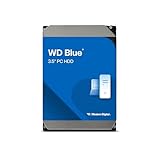
- Reliable everyday computing
- Western Digital quality and reliability
- Free Acronis True Image WD Edition cloning software
- Capacities up to 12TB
- 2-year limited warranty
What WD’s roadmap says—and does not say
- 40TB UltraSMR ePMR: in qualification with two hyperscale customers, with planned volume production in the second half of 2026.
- HAMR: qualification with two hyperscale customers, with ramp production planned for 2027.
- Longer term: WD described an ePMR path toward 60TB and HAMR toward 100TB by 2029, plus High Bandwidth Drive and Dual Pivot technologies for AI workloads.
These are qualification and roadmap statements, not confirmation that 40TB or 100TB consumer drives are broadly purchasable. The dates and technologies come from WD’s Innovation Day materials.
How to decide what to buy
If you need a drive now
- Check live inventory for the exact capacity and model at a reputable retailer or authorized channel.
- Compare usable-terabyte cost, warranty, workload rating, noise, vibration tolerance and duty cycle.
- Buy enough capacity for the near-term plan, but do not panic-buy at an inflated price.
If you are building a NAS
- Choose NAS-rated families such as WD Red Plus/Red Pro, Seagate IronWolf/IronWolf Pro or Toshiba N300, subject to current price, warranty and compatibility.
- Check the NAS vendor’s compatibility list. Mixed capacities can reduce usable capacity or complicate expansion.
- RAID or ZFS improves availability but is not a backup. Keep an independent copy, ideally offline or geographically separate, and plan for lengthy rebuilds.
If speed matters more than capacity cost
Use NVMe or SATA SSDs for operating systems, active projects, databases, scratch space and high-I/O AI workloads. Retain HDDs for media libraries, archives, backups and other sequential bulk data. Replacing a 20TB-plus HDD array entirely with flash can multiply acquisition cost.
If the drive is for backup
- Keep at least one copy that is not continuously mounted.
- Test restoration; cloud sync alone is not necessarily a backup unless version history and deletion recovery work as expected.
- Encrypt sensitive data before uploading it, and check restoration time and download fees.
Trade-offs buyers often overlook
| Factor | HDD | SSD |
|---|---|---|
| Cost per terabyte | Usually lower for bulk capacity | Usually higher |
| Random-access performance | Much slower | Much faster |
| Failure characteristics | Moving parts; vibration and rebuild considerations | No moving parts; endurance and retention depend on flash type |
| Best fit | Archives, backups, media and bulk storage | Operating systems, applications and active datasets |
Refurbished drives may cost less but can have shorter warranties, unknown prior workloads, incomplete SMART histories and inconsistent firmware. Large drives reduce bay count while increasing the amount of data exposed by one failure and potentially extending rebuild times. Remember that a manufacturer’s decimal 12TB is about 10.9TiB before formatting; RAID, parity, snapshots and reserved space reduce usable capacity further.
The Bottom Line
Western Digital’s “sold out” warning means its calendar-2026 production capacity was largely booked by major customers, not that consumers have no access to WD hard drives. Existing channel inventory should continue to matter, although particular high-capacity and NAS models may tighten and face pricing pressure. Buy from verified inventory for a real need, use SSDs where performance justifies the cost, and maintain independent backups regardless of which storage technology you choose.
Quick Recap
Product prices and availability are accurate as of the date/time indicated and are subject to change. Any price and availability information displayed on Amazon at the time of purchase will apply.




