Free tools Windows power users keep installed
One-click scans. No signup required.
CFM International ranks first on Aviation Week Network’s 2025 projection of 10-year commercial-engine aftermarket revenue, followed by GE Aerospace, Rolls-Royce Civil Aerospace, Pratt & Whitney and International Aero Engines (IAE). This is a commercial aftermarket ranking—not a league table of total company revenue, engine-unit production, military propulsion or every type of aircraft engine.
The ranking at a glance
| Rank | Manufacturer or program | Projected 10-year commercial-engine aftermarket-revenue share | Corporate structure and main footprint |
|---|---|---|---|
| 1 | CFM International | 36% | 50/50 GE Aerospace–Safran Aircraft Engines joint company; CFM56 and LEAP narrowbody fleets |
| 2 | GE Aerospace | 29% | Standalone aerospace business with narrowbody, widebody, regional, business-aviation and aeroderivative engines |
| 3 | Rolls-Royce Civil Aerospace | 16% | Civil division focused on large commercial aircraft, regional jets and business aviation |
| 4 | Pratt & Whitney | 9% | RTX operating business; major Geared Turbofan programs and participation in engine consortia |
| 5 | International Aero Engines (IAE) | 7% | Consortium involving Pratt & Whitney, Japanese Aero Engine Corporation and MTU Aero Engines |
The remaining manufacturers account for 1% in the same Aviation Week Network projection. Percentages are market-share estimates for future commercial aftermarket revenue, not ownership-adjusted corporate revenue.
What the ranking measures—and what it does not
Aviation Week Network’s 2025 measure projects each participant’s share of commercial engine aftermarket revenue over a 10-year period. Aftermarket income includes the long service, maintenance and parts demand generated after engines enter airline and other commercial fleets. A large installed fleet can therefore matter as much as current deliveries.
- It measures: projected commercial aftermarket revenue share.
- It does not measure: total company sales, annual engine deliveries, military-engine leadership, profitability, stock-market value or a complete ranking of every propulsion category.
- Why the distinction matters: CFM International and IAE are joint structures, while GE Aerospace, Rolls-Royce and Pratt & Whitney are operating businesses that also participate in collaborations. Their percentages should not be added together as if they were separate, non-overlapping corporate groups.
The five manufacturers
1. CFM International
CFM International is a 50/50 joint company owned by GE Aerospace and Safran Aircraft Engines. It produces the LEAP family and supports both LEAP and CFM56 fleets worldwide, according to CFM’s company description.
Do these 3 things before closing this tab:
1Scan for outdated or missing drivers - takes under a minute2Clear out junk files and repair common Windows errors3Fix the driver behind crashes, sound loss and screen glitches#1 Best Overall
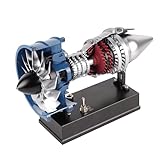
- Realistic & Authentic: The lifelike & visually stunning model provides a realistic depiction of a full-sized engine with main components including a first-stage fan, high-pressure rotor assembly, combustion chamber, high-pressure turbine assembly, low-pressure turbine assembly, and exhaust nozzle.
- High-Quality Construction: Made of high-quality metal, the meticulous model, full of detail and features, undergoes precision casting and CNC machining, along with sandblasting and anodized coloring treatment on the surface, ensuring durability and accuracy the same as the real model.
- Dynamic Display: Featuring a semi-transparent magnetic casing, this model offers a clear view of the engine's internal mechanics in motion when powered by the electric motor. The quick-release magnetic cover allows for effortless assembly and disassembly, making it ideal for demonstrations while protecting delicate components. Equipped with a sturdy mounting bracket and throttle control lever, this kit delivers an immersive hands-on experience with aviation engineering.
- DIY Assembly: Consists of 170+PCS (including screws & nuts) and comes with tools and paper-based English instructions. You will personally experience the entire assembly process, from small parts to the final completed model, constructing an awe-inspiring turbofan engine model.
- STEM Education: As an educational tool, this model unravels the internal workings of a turbofan engine, imparts knowledge about aerospace engineering, and stimulates interest, creativity, and awe for industrial technological achievements
The installed CFM56 fleet gives the venture a substantial base of engines requiring parts, repairs and scheduled maintenance. At the same time, LEAP production is expanding on Airbus A320neo-family and Boeing 737 MAX aircraft. GE Aerospace’s 2025 filing says LEAP is expected to overtake the mature CFM56 as the industry’s largest fleet in coming years, combining a large existing service base with a growing next-generation population.
2. GE Aerospace
GE Aerospace’s Commercial Engines & Services (CES) segment designs, manufactures and services engines for narrowbody, widebody and regional aircraft, as well as business-aviation and aeroderivative applications. Its broad product coverage gives it exposure to several commercial aircraft categories rather than a single narrowbody program.
Rank #2
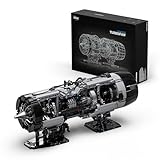
- Every gear, shaft, and joint is built for motion—an engineered engine flow you can set in motion with your own hands.
- Rotate the crank to drive linked parts in different directions and speeds, achieving a rare dual-direction, single-axis effect.
- A semi-exposed design lets you watch the mechanics at work, with metallic painted parts adding an authentic, engineered look.
- A hands-on challenge, leading to an engine you can see and operate—every gear and motion built by you.
- A build that engages both mind and hands, making this engine a memorable gift for any mechanical enthusiast.
GE’s 2025 Form 10-K reports that CES represented approximately 73% of GE Aerospace revenue in 2025 and that services generated 75% of CES revenue. Those are GE segment mix figures; they are not a 73% or 75% share of the global engine market. GE also owns half of CFM International, so CFM’s ranking and GE Aerospace’s ranking describe related but not identical economic entities.
3. Rolls-Royce Civil Aerospace
Rolls-Royce describes Civil Aerospace as a major manufacturer of aero engines for large commercial aircraft, regional jets and business aviation. Its economics are especially tied to large-aircraft propulsion, where engines are expensive, heavily supported and kept in service for long periods.
Rank #3

- 【F35 Fighter Jet Engine Model Kit】: This F35 engine block set realistically reproduces the structure and operation of an F35 fighter jet engine. With 3-bearing swivel duct, exhaust pipe, nozzle, rotating turbine, beautifully crafted stickers. Perfectly constructed lifelike mechanical engine models, showing the beauty of real military engineering.
- 【Interactive Features】: The F35 engine's nozzle rear section can be expanded and narrowed, high-speed turbine can be rotated by motor, some parts can be disassembled to clearly see the internal multi-gear linkage mechanism. Perfectly replicates the jet engine mechanics and operation of the F35 fighter jet.
- 【Precision Craftsmanship】: This F35 engine building sets consists of 1,812 bricks for a longer building experience. Each part is smoothly and precisely crafted with metallic paintwork and comes with detailed illustrated step-by-step instructions to make this F35 jet engine model perfect to build.
- 【Space Decorations】 this F35 engine buiding block sets for adults measures 9.25*27.16*14.56 inches after assembled, which can be perfectly displayed in any space such as desks and shelves at home or office collection. It is an attention-grabbing choice for military enthusiasts and collectors.
- 【Ideal Gift】 This F35 engine building toy combines creativity, engineering and hands-on fun, making it an ideal gift for adults. Whether it's a birthday, Valentine's Day, Christmas or Thanksgiving, it's the perfect gift for military, fighter, engine and technical modeling enthusiasts.
Rolls-Royce’s 2025 annual report records 14,263 in-service civil engines, 259 large-engine deliveries during 2025 and a 38% share of the installed widebody engine base at year-end. These operating measures provide context for its aftermarket position, but the 38% figure is specifically a widebody installed-base share, not a share of all commercial engines or of total aftermarket revenue.
4. Pratt & Whitney
Pratt & Whitney, part of RTX, supplies engines across several commercial aircraft programs. RTX’s 2025 filing says the PW1000G Geared Turbofan family powers more than 2,600 aircraft operated by more than 90 customers across the Airbus A320neo family, Airbus A220 and Embraer E-Jets E2.
Rank #4

- DETAILED TWIN-SPOOL ARCHITECTURE: This 1:10 scale model recreates the layered structure of an aerospace turbofan engine, including a single-stage fan, two-stage low-pressure compressor, four-stage high-pressure compressor, single-stage high-pressure turbine, and two-stage low-pressure turbine.
- PRECISION METAL CRAFTSMANSHIP: Made from precision-cast and CNC-machined metal components, the model features sandblasted and anodized surfaces for durability, refined texture, and a professional industrial finish. Its substantial construction highlights the complexity of modern turbofan engineering.
- MOTORIZED AND FULLY VISIBLE: The cutaway engine casing reveals the internal rotating assemblies as the motor simulates coordinated turbofan operation. A fixed display stand, throttle control lever, and engine sound module create a more engaging mechanical demonstration.
- 1000+ PART ASSEMBLY PROJECT: Build the engine from more than 1,000 components, including screws and nuts. Tools and an English instruction manual are included. The manufacturer estimates approximately 10 hours of assembly time. The multi-stage process is intended for experienced model builders familiar with small components and detailed mechanical assembly.
- IMPRESSIVE ENGINEERING DISPLAY: Measuring approximately 14.96 × 6.50 × 9.25 inches and weighing about 11.68 pounds when completed, the DM119 becomes a commanding mechanical centerpiece for a home, office, studio, workshop, or aviation-themed collection.
Pratt & Whitney also participates in IAE and other collaborative programs. Consequently, a program’s installed fleet, service obligations and financial contribution may be shared among partners rather than attributable solely to Pratt & Whitney. The PW1000G figure is an installed-aircraft and operator measure, not a percentage of the worldwide engine market.
5. International Aero Engines (IAE)
IAE is a consortium involving Pratt & Whitney, Japanese Aero Engine Corporation and MTU Aero Engines. Its principal commercial history includes the V2500 and the PW1100G-JM collaboration identified in RTX disclosures.
The Tool Desk
Outbyte Driver Updater FREEFix the driver behind crashes, sound loss and screen glitchesFind Drivers →Outbyte PC Repair FREERepair Windows errors before they cause bigger problemsFix Now →Best Value
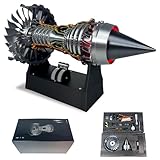
- Design: This jet engine model imitates the TR900 turbine engine
- Rotatable design: The jet engine model can be rotated to show the working principle of the turbojet engine
- Size: H 6.6 IN, L 11 IN, W 5.9 IN
- Material: 3D printed plastic
- Fun: Assembling design, more playable
IAE reports more than 7,000 engines delivered and approximately 190 customers in 80 countries. Those totals describe the consortium’s cumulative delivery and customer reach; they are not a forecast of annual production and should not be compared directly with a single manufacturer’s consolidated revenue.
Independent reader supportYour contribution helps us test, update, and keep practical guides available for everyone.Why aftermarket scale is a useful comparison
Commercial engines can generate revenue for decades after delivery through spare parts, repairs, overhauls, software, technical support and long-term service arrangements. A manufacturer with a large installed fleet may therefore have a different financial profile from a newcomer shipping many new engines but supporting a smaller in-service population.
The Aviation Week projection captures that installed-fleet effect, but it remains a forecast. Actual results can change with airline utilization, fleet retirements, engine reliability, maintenance intervals, aircraft production rates, contract terms, exchange rates and the timing of new engine programs.
How to compare the five beyond the headline ranking
- Identify the aircraft segment. Narrowbody, widebody, regional and business-aviation engines have different fleet sizes, utilization patterns and maintenance economics.
- Check the installed fleet. Existing engines create recurring parts and service demand, while a new program’s future depends on deliveries and durability in service.
- Separate OEMs from joint ventures. CFM and IAE are consortium structures; GE, Rolls-Royce and Pratt & Whitney also share programs with partners.
- Look at service exposure. GE’s disclosed CES mix illustrates how significant services can be within an engine business, but each company reports its segments differently.
- Match the metric to the question. Use aftermarket share for service-market scale, installed-engine counts for fleet reach, deliveries for manufacturing output and segment revenue for corporate contribution. None substitutes for the others.
Bottom line for readers
CFM International is the largest participant on the available commercial aftermarket-revenue forecast, with GE Aerospace next. Rolls-Royce is particularly significant in widebody propulsion, Pratt & Whitney has a large and growing Geared Turbofan presence, and IAE represents a major consortium fleet. The ranking is most informative when read as a view of future commercial service revenue—not as a universal scorecard for aerospace companies.
Quick Recap
Product prices and availability are accurate as of the date/time indicated and are subject to change. Any price and availability information displayed on Amazon at the time of purchase will apply.




