Quick wins for a faster PC:
Scan for outdated or missing drivers - takes under a minuteDriver Scan →Repair Windows errors before they cause bigger problemsFix Now →The reported 1:1 semiconductor rule did not become the operative policy. In September 2025, TechCrunch reported that the Trump administration was considering tariffs for companies that did not manufacture in the United States roughly as many chips as their customers imported. On January 14, 2026, President Trump instead issued a narrower Section 232 proclamation imposing a 25% tariff on specified advanced-computing chips and certain derivative products. The duty took effect January 15, 2026, subject to broad end-use exceptions. A wider tariff program remains possible, but it is not an established universal production mandate.
The short answer
- What was proposed: A reported requirement that U.S. semiconductor companies produce domestically about as many chips as their customers imported.
- What took effect: A 25% tariff on specified advanced-computing chips and certain derivatives entered for consumption on or after January 15, 2026.
- What is excluded: The proclamation provides exceptions for several data-center, research, startup, consumer, civil-industrial and public-sector uses.
- What could come next: Negotiations with foreign jurisdictions, investment-linked preferences and potentially broader tariffs.
The policy is therefore best understood as a combination of import duties, national-security investigations and bargaining over domestic investment—not as a blanket tax on every imported semiconductor.
How the policy developed
| Date | What happened |
|---|---|
| April 1, 2025 | The Commerce Department’s Bureau of Industry and Security began a Section 232 investigation into semiconductor and semiconductor-manufacturing-equipment imports. BIS overview |
| September 26, 2025 | TechCrunch reported a possible 1:1 relationship between U.S. production and customers’ imports. The report did not identify a signed order, tariff schedule, implementation date or final definitions. TechCrunch report |
| December 22, 2025 | The Commerce secretary transmitted the Section 232 investigation report to the president, according to the later proclamation. |
| January 14, 2026 | President Trump issued the semiconductor-import proclamation. |
| January 15, 2026 | The initial 25% duty became effective for qualifying covered imports. |
| July 1, 2026 | The proclamation directed Commerce to provide an update on the market for semiconductors used in U.S. data centers. |
| August 18, 2026 status | The official materials available for this article document the narrower tariff and the possibility of broader action, not a universal 1:1 production rule. |
What Section 232 does
Section 232 of the Trade Expansion Act of 1962 allows the president to adjust imports after Commerce determines that they threaten to impair U.S. national security. The administration’s position is that semiconductors support industrial, technological and military capabilities, so dependence on foreign supply chains is an economic and national-security vulnerability. The January fact sheet says the investigation reached that threat finding. White House fact sheet
This authority differs from other tools:
- Section 301 addresses another country’s acts, policies or practices, such as technology-transfer or intellectual-property concerns.
- Reciprocal tariffs are a broader mechanism aimed at trade deficits and trading-partner policies.
- Export controls restrict U.S. technology or products shipped abroad; they are not import tariffs.
- CHIPS Act incentives use grants, subsidies and tax incentives to encourage domestic production rather than penalizing imports.
What the January proclamation covers
The proclamation covers specified advanced-computing chips, certain derivative products, and semiconductor-manufacturing equipment and derivatives within the broader Section 232 determination. The 25% rate applies only to products and transactions that fall within the proclamation’s coverage and customs implementation.
What’s actually slowing this PC down?
Pick the symptom - the matching free tool is one click away.
#1 Best Overall

- Made with UV resistant industrial strength 6/6 Nylon
- 100 8 inch pieces
- 50 lbs tensile strength
- Working temperature: -40-85 degrees C or -40-185 degrees F
- Strong cable ties usable in many applications
It is not accurate to say that every imported semiconductor now faces a 25% duty. The proclamation directs Commerce, the U.S. International Trade Commission and Customs and Border Protection to make tariff-schedule and administrative changes. Importers should check the applicable Harmonized Tariff Schedule classification, country of origin and CBP guidance before relying on an exemption. Read the proclamation
End-use exceptions
The proclamation provides exceptions for covered products used in U.S. data centers, repairs and replacements, U.S. research and development, startups, non-data-center consumer applications, non-data-center civil-industrial applications, public-sector applications and other uses determined to strengthen the U.S. technology supply chain or domestic capacity. Eligibility depends on the precise product, end use and required documentation; an exemption is not automatic merely because a company operates in one of these sectors.
What the reported 1:1 plan would have meant
The September 2025 report described a possible system in which semiconductor companies would be expected to manufacture in the United States roughly as many chips as their customers imported. Companies falling short could have faced tariffs. The report did not establish:
Rank #2

- 【Ultra Strong Heavy-Duty Zip Ties】Extra Large Wide Cable Zip Ties Heavy Duty for outdoor use, Width 9mm with 18 inch /450mm long. 220 LBS Ultra Strong Tensile Strength. Wider, Thicker, More durable for use!
- 【Multi-Purpose】Armpow heavy duty cable zip ties use Industrial-strength nylon 66 fireproof material, Large and Wide design to meet any needs in industrial and your life.
- 【UV Resistant Outdoor】Can be used in the environment of -35℃ to 85℃,and will not break after exposure to the sun and severe cold. Features durability, strong load ability, anti-aging, anti-acid and anti-corrosion.
- 【Easy-Using Desgin】The clear zip ties tail curves to ensure easy head insertion and smooth edges for quick and smooth tightening. The teeth are not returned while fixing the self-locking, which can better fix the thing.
- 【Warranty】Armpow offer a 30-Days warranty period. Customer will receive a 100% refund if any quality issue under warranty period.
- an implementation timetable;
- the tariff rate;
- which companies or customers would be covered;
- how “chip” would be defined; or
- whether production would be measured by units, value, wafer area, capacity or computing performance.
That distinction matters. The 1:1 concept was reported policy development, not a signed executive order, regulation or final tariff schedule. The January proclamation does not establish a universal production-to-import ratio.
Who could bear the cost
The tariff is legally collected from the importer of record. Economically, the burden can be divided among suppliers, importers, manufacturers, distributors and customers depending on contracts, competition and supply conditions.
- U.S. chip designers and manufacturers: Firms importing qualifying chips may owe the duty unless an exception applies.
- Fabless companies: A U.S. headquarters does not mean the chip was made in the United States. Companies relying on foreign foundries could face higher landed costs.
- Device and equipment makers: Finished products containing covered chips may encounter classification and end-use questions.
- Cloud and data-center operators: Some data-center uses are exempt, but the exact scope and certification requirements matter.
- Automotive and industrial buyers: Exposure may depend on whether a component qualifies for a civil-industrial or other exception.
- Consumers: Importers may pass through some costs, absorb them, switch suppliers or redesign products. A 25% tariff does not automatically produce a 25% retail-price increase.
Why a production quota would be difficult to administer
Semiconductor manufacturing is spread across design, wafer fabrication, packaging, testing and final assembly. A single product can cross several borders before reaching a U.S. customer. A unit-based quota would therefore leave difficult questions:
Rank #3

- Extra Heavy Duty: The width of our 18 inch zip ties is 0.35", provide 220 lb tensile strength.
- Long Enough: zip ties 18 inch can competent for most bundles, the max bundle diameter is 5".
- Indoor/Outdoor Use: Our large zip ties heavy duty can be used for home, garden, garage.
- Specification: Length:18"| Width:0.35"| Max Dia:5"| Tensile Strength:220lb| Color:Black| Quantity:50 Pack.
- Warranty: Customer will receive a 100% refund if any quality issue under 1-year warranty period.
- Does a chip mean a wafer, die, packaged integrated circuit, chiplet or complete device?
- How are multi-die packages counted?
- Does U.S. design, packaging or testing qualify when fabrication occurs abroad?
- Are fabless firms treated differently from integrated manufacturers?
- Are memory, analog, power, microcontroller and automotive chips counted alongside advanced processors?
- Which customer’s imports are assigned to a manufacturer?
- Can contract manufacturing, joint ventures or a foreign-owned U.S. fab satisfy the requirement?
- What happens when U.S. demand grows faster than domestic capacity?
Counting one advanced artificial-intelligence processor and one low-value component as equal units could reward volume without measuring strategic capacity, yield, packaging capability or economic value.
What the administration is trying to achieve
The administration says the policy is intended to increase U.S. fabrication and packaging, reduce supply-chain dependence, protect technology and defense capacity, and use access to the U.S. market as leverage in negotiations. The proclamation describes negotiations with foreign jurisdictions before potentially broader tariffs and contemplates offsets or preferential treatment for companies investing in U.S. semiconductor production. Proclamation details
Commerce separately announced a framework under which Taiwan-linked companies building new U.S. capacity could import up to 2.5 times planned capacity without Section 232 duties during construction, and completed projects could import 1.5 times new U.S. production capacity without duties. Those figures describe the department’s announced framework; companies should verify the operative implementing documents. Commerce fact sheet
Rank #4
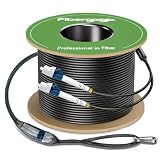
- ✅【Industrial TPU Jacket】:It features strong tensile strength, high abrasion resistance, water proof, high and low-temperature resistance, uv-resistant, bending resistant. Suitable for Various indoor & outdoor Harsh Installation Environments such as roads & snowfields & industrial fields & construction sites.
- ✅【Outdoor Armored Fiber Optic Cable】: Built-in helical metal steel armor and glass fiber yarns, provides additional dual physical protection against rodents ,and Can be installed overhead, buried directly in the ground, or routed through conduits.
- ✅【OD-5.0mm Fiber Cable】: A larger diameter and thicker 5.0mm outdoor cables compared to 3.0mm cables,suitable for environments where the cable might be subjected to more wear and tear, such as outdoor installations, industrial settings, or areas with a higher risk of physical damage.
- ✅【Pulling Eye Pre-Terminated Kit】:This OS2 Fiber cables with swivel pulling eye kit installed on one end to help you pull fiber optic cable through conduit to eliminate cable damage during installation.Pulling eye kit cover can be reused
- ✅【Widely Used】Outdoor fiber optic cable suitable for indoor or outdoor various harsh installation invironments,such as roads&snowfields&industrial fields.Lc to lc fiber patch cable have overhead installation, direct burial in the ground, or routing through conduits etc
Commerce also claims that the U.S. share of global wafer fabrication fell from 37% in 1990 to below 10% in 2024. That is the department’s statistic and should be read as an administration argument for rebuilding capacity, not as an independently calculated finding in this article.
Independent reader supportYour contribution helps us test, update, and keep practical guides available for everyone.The main objections and risks
Costs can arrive before fabs
A tariff can change procurement costs immediately. A new fabrication plant requires construction, equipment installation, process qualification, customer qualification and yield improvement, a process measured in years. The September report itself noted that domestic capacity would not appear quickly enough to remove near-term constraints. TechCrunch report
Global specialization may produce workarounds
Design, fabrication, packaging, testing and final assembly often occur in different countries. A tariff at one stage may encourage rerouting, supplier substitutions or changes in product classification rather than complete reshoring.
Free tools Windows power users keep installed
One-click scans. No signup required.
Best Value

- Made with UV resistant industrial strength 6/6 Nylon
- 100 12 inch pieces
- 50 lbs tensile strength
- Working temperature: -40-85 degrees C or -40-185 degrees F
- Strong cable ties usable in many applications
Fabless U.S. firms could be disadvantaged
Domestic producers may gain protection, while U.S.-headquartered companies without domestic foundry access face higher costs or fewer suppliers. Foreign firms with existing U.S. fabs or negotiated preferences could be better positioned.
Retaliation is possible
Trading partners could respond against U.S. chips, semiconductor equipment, software or downstream technology companies. That is a trade-policy risk, not a documented claim that retaliation has already occurred.
Exemptions create both relief and complexity
Exceptions for data centers, research, startups and consumer uses may reduce immediate price effects. They also require importers to document end use and may create disputes over products serving several markets.
How to judge whether the policy works
Investment announcements alone do not show that supply has shifted. Useful measures include:
The Tool Desk
Outbyte Driver Updater FREEFix the driver behind crashes, sound loss and screen glitchesFind Drivers →Outbyte PC Repair FREEClear out junk files and repair common Windows errorsFree Scan →- U.S. wafer capacity actually entering commercial production;
- yields and shipment volume, not only groundbreaking ceremonies;
- growth in domestic advanced packaging and testing;
- changes in the U.S. share of global manufacturing;
- import volumes and values by chip category;
- prices and lead times for automotive, industrial, consumer and data-center buyers;
- the number and value of tariff exclusions;
- evidence of rerouting through third countries;
- whether mature-node and power-chip shortages persist; and
- changes in U.S. technology exports if trading partners retaliate.
What to watch next
- Federal Register notices and CBP instructions that identify tariff classifications, certifications and entry procedures.
- Commerce’s directed market update on data-center semiconductors by July 1, 2026.
- Any new proclamation imposing broader Section 232 duties.
- Negotiated arrangements with Taiwan and other semiconductor-producing economies.
- Company filings describing tariff exposure, exemptions and supplier changes.
- Actual fab, packaging and testing milestones, including qualified production and yields.
Bottom line
The administration’s semiconductor strategy moved from a reported 1:1 domestic-production idea to a narrower, documented 25% Section 232 tariff on specified advanced-computing products. The policy is designed to pressure companies and foreign governments to build more capacity in the United States, but its success will depend on whether production becomes commercially viable before tariffs raise costs, disrupt specialized supply chains or shift imports without creating durable domestic capability.
Quick Recap
Product prices and availability are accurate as of the date/time indicated and are subject to change. Any price and availability information displayed on Amazon at the time of purchase will apply.




