Do these 3 things before closing this tab:
1Scan for outdated or missing drivers - takes under a minute2Repair Windows errors before they cause bigger problems3Fix the driver behind crashes, sound loss and screen glitchesFor most buyers, no. At $3,199.99, the TeamGroup QX 15.3TB costs about $209.15 per advertised terabyte, yet its headline transfer rates are typical of a SATA SSD, not a high-performance NVMe drive. It is worth considering only if you need roughly 15TB in one 2.5-inch, 7 mm SATA bay, cannot add storage another way, and value quiet, low-latency access more than cost. Treat the quoted price and the 15.3TB model’s availability as unverified until the exact seller, stock, condition, return terms, and warranty are confirmed.
What the TeamGroup QX 15.3TB is
The model number is T253X7153T0C101. It is a 2.5-inch, 7 mm internal SSD using a SATA III 6Gb/s interface and 3D QLC NAND. TeamGroup’s product sheet for the QX family lists capacities through 4TB, while the 15.3TB version appears in older launch and retailer material. That means its present availability and support should not be assumed from an old listing. See the TeamGroup QX specification sheet and historical launch coverage.
- Advertised capacity: 15.3TB, measured in decimal units. A computer reports less usable capacity after conversion to binary units and formatting.
- Dimensions: 100 × 69.9 × 7 mm; check the bay, connector, and cable arrangement in the target system.
- Advertised sequential performance: up to 560 MB/s read and 480 MB/s write.
- Rated endurance: up to 2,560TBW, or terabytes written.
- Advertised MTBF: 1.5 million hours. This is a statistical specification, not a prediction that an individual drive will last that long.
- Warranty: historical material generally describes a three-year limited warranty. Retailer wording is inconsistent, so verify coverage for this exact SKU with the seller and manufacturer before buying.
What $3,199.99 buys—and what it does not
At the price in the question, the arithmetic is $3,199.99 ÷ 15.3TB, or about $209.15 per advertised terabyte. Historical launch reporting put the original MSRP at $3,990, about $260.78 per advertised terabyte. Being below that launch MSRP does not make the drive good value by current storage standards.
For comparison, a QNAP store listing showed a Seagate Exos X16 16TB SATA hard drive at $639, or about $39.94 per terabyte. That is roughly one-fifth of the QX’s price per terabyte. The listing is a price snapshot, not a guarantee of current stock or price. The HDD is not a performance equivalent: it is slower, noisier, has higher access latency, and is more vulnerable to shock. It is, however, far more economical for bulk storage. See the QNAP 16TB listing.
Recommended Free Tools
#1 Best Overall

- A prime choice for professional gaming upgrades
- Performance enhanced by fourfold, ready to start a game anytime
- TB-level large capacity for worry-free gaming storage
- Exceptional performance and durability
- Optimized operational performance with reliability, improved lifespan and intelligent health monitoring
The comparison is about different trade-offs, not equivalent products. The QX’s premium buys a single compact, silent SSD with lower access latency than a mechanical disk. It does not buy NVMe-class throughput, an enterprise feature set, or a second copy of your data. Multi-drive SATA storage may cost less and offer flexibility, but the total depends on the chosen drives, enclosure, and system; no current all-in price is established here.
How fast is it in practice?
The QX’s capacity is unusual; its interface is not. SATA III limits practical sequential throughput far below what modern PCIe NVMe drives can deliver, and the advertised 560 MB/s read figure is already near the practical ceiling for SATA SSDs. A 15.3TB capacity does not make transfers faster.
Rank #2
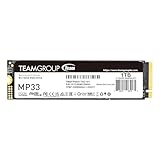
- NVMe PCIe Gen3x4 High Speed Interface - Sequential read/write speed can reach up to 1800/1500 MB/s which reduce the delays of the operating system and game/software.
- Ultra High Performance - Transfer performance is 5 times higher than the SATA III interface. Capable of reading and writing large amounts of game data, complex graphics and motion processing algorithms, or loading heavy duty video/graphics editing software.
- M.2 2280 specification: Supports the next-generation platforms of Intel and AMD. Suitable for both desktop and notebook
- Supports SLC Caching technology. Greatly enhance computing performance
- International products have separate terms, are sold from abroad and may differ from local products, including fit, age ratings, and language of product, labeling or instructions.
The quoted read and write figures are manufacturer claims associated with CrystalDiskMark testing. The 480 MB/s write claim may depend on pseudo-SLC caching: a portion of the QLC flash is operated temporarily in a faster mode. Short benchmark runs and writes that fit in cache are not the same as writing hundreds of gigabytes or terabytes continuously. After cache exhaustion, long-write performance may differ; the available product material does not establish a guaranteed sustained rate for that situation. TeamGroup also notes that transfer speed varies with hardware and software conditions.
Available specifications do not establish random-I/O performance for the 15.3TB model. Nor do they provide enough detail to infer its behavior under mixed workloads, when nearly full, or after the write cache is exhausted. If the workload depends on predictable sustained writes, request model-specific measurements from a reliable source or choose a drive with documented performance for that use.
Rank #3

- 3D NAND smart upgrade option for gaming
- Enhanced performance for seamless cutscenes
- Smart optimization to ensure reliable performance
- Shock-resistant, vibration-resistant, and reduced noise interference
- Manufacturer Warranty: 3-year or TBW (Terabytes Written) limited warranty. Free Technical Support and Customer Service on TEAMGROUP's official website. The definition and conditions of TBW are based on the JEDEC standard.
Is QLC suitable for this much storage?
QLC stores four bits in each flash cell. Its density makes very high capacities possible, but it generally has a less favorable sustained-write and endurance profile than comparable TLC flash. That does not make QLC automatically unsuitable: the workload matters, and the QX’s rated 2,560TBW is substantial in absolute terms.
Dividing the rated 2,560TBW by the advertised 15.3TB capacity gives about 167 full-drive writes over the rated endurance allowance. This is an arithmetic comparison, not a lifespan guarantee, a measure of the probability of failure, or a promise about performance as the drive ages. TBW alone does not disclose controller quality, NAND variation, firmware behavior, power-loss protection, or post-cache write speed.
Rank #4

- T-FORCE M200 uses USB 3.2 Gen 2x2 interface, reaching Read speeds up to 1800MB/s and Write speeds up to 1500MB/s — 3.6x faster than USB 3.2 Gen 1.
- Sniper rifle-inspired design featuring a tactical military-style hanging hole and ultra-lightweight body at only 83g for maximum portability.
- Patented graphene cooling technology with dual metallic structure ensures stable performance, paired with 2-meter drop resistance.
- Compatible with Windows 10, Windows 8.1, mac OS x 10.11 or higher, Linux 2.6. or higher, PlayStation 4 with system software version 4.50 or higher, PlayStation 5 (play and store PS4 games or archive PS5 Games), Chrome OS, Xbox
- Manufacturer Warranty: 5-year limited warranty. Free Technical Support and Customer Service on TEAMGROUP's official website. The definition and conditions of TBW are based on the JEDEC standard
- More suitable: mostly-read media libraries, game collections, archives that need fast access, and other bulk data that is not rewritten constantly.
- Less suitable: scratch storage, frequently rewritten databases, virtualization, surveillance recording, heavy editing caches, and write-intensive server roles.
Who might reasonably buy it?
The strongest case is a specialized one: a machine with a single 2.5-inch SATA bay, a real need for near-15TB local storage, and no practical way to add a second drive, NAS, or U.2/NVMe device. Silence, low access latency, and resistance to vibration may matter more than price per terabyte in that setting.
- A single-bay laptop or compact workstation owner who has checked capacity support and needs a large local library.
- A purpose-built local media or game-library system where quiet operation and quick access are important.
- A buyer who has a separate backup and can verify the drive is new, supported, and covered by a clear warranty.
Even in these cases, the drive should not be the only copy of valuable files. Consolidating data on one device simplifies the setup but concentrates the consequences of a failure.
Best Value
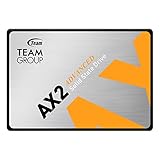
- Amazon Special edition SSD. Manufacturer Warranty: 3-year or TBW (Terabytes Written) limited warranty. Free Technical Support and Customer Service on TEAMGROUP's official website. The definition and conditions of TBW are based on the JEDEC standard.
- High Efficiency Performance - Uses SATA III 6Gb/s transfer interface. Read/write speed up to 540/490 MB/s which offers more efficient data transferring performance. It also provides lower power consumption and a quiet operation experience. Best selection for pc and laptop upgrade.
- Capacities available in 256GB ~ 2TB to satisfy all your needs, whether you are looking for a system drive or gaming drive.
- Trustworthy and Reliable - With garbage collection, wear-Leveling technology, ECC (Error Correction Code), S.M.A.R.T., and TRIM functions, AX2 SSD ensures operational efficiency, monitors the status of your drive, maintains maximum performance of compatible operating systems, and prolong the service life of the SSD.
- 4 Times Faster Than HDD - With great performance and ultra-fast read and write speed, AX2 solid state drive is 4 times faster than the traditional hard drive. It speeds up boot time, shutdown time and the response time of applications. Absolutely the best product to replace the traditional hard drive.
When another storage design is better
Choose an HDD for low-cost bulk storage
A 16TB-class HDD is a better financial fit for NAS storage, archives, backups, and media that does not need SSD latency. Accept its noise, slower access, and mechanical-shock sensitivity. The QNAP listing above is a dated price reference, not a current quote.
Use several smaller SATA SSDs when the system has bays
Multiple 2TB–4TB drives can provide a similar pool of capacity while allowing staged upgrades, easier sourcing, and less expensive replacement of a single failed drive. Depending on the setup, pooling or RAID can also improve availability or aggregate throughput. The trade-off is more bays, cables, power, heat, and management. RAID is not a backup, and pricing depends on the exact parts and system.
Consider enterprise U.2/U.3 NVMe only with compatible infrastructure
Enterprise NVMe drives can offer much higher throughput and may include server-oriented firmware, telemetry, endurance, or power-loss features. They are not drop-in SATA replacements: compatibility, cabling, carriers, cooling, and platform support matter. Supermicro listings have shown both a Solidigm 15.3TB U.2 PCIe 4.0 QLC drive at $8,028 and a Micron 15.36TB U.3 listing at $3,250 marked out of stock. Those examples demonstrate volatile listings, not reliable current pricing or comparable availability. See the Supermicro storage catalog.
Split active and bulk data for a balanced build
For most desktops, workstations, and home servers, a smaller SSD for active data plus an HDD or NAS for bulk storage is a stronger value compromise. It reserves SSD spending for workloads that benefit from lower latency instead of paying SSD prices for every archived file.
Windows Errors? Fix Them Before They Spread
Repair common Windows errors and clear accumulated junk for a smoother, more stable PC - no reinstall needed.Free scan · no reinstallOutdated Drivers Are Slowing You Down
One free scan finds every outdated or missing driver and matches the right update for your exact hardware.Free scan · exact hardware matchCompatibility, failure protection, and purchase checks
Confirm the machine can use it
- Check for a 2.5-inch SATA bay with 7 mm clearance, plus the required SATA data and power connections.
- Confirm system firmware, operating system, disk utilities, and any cloning tool support a drive of this capacity. For a volume of this size, GPT is the practical partitioning choice; older software may impose limits.
- Keep free space rather than filling the drive to its nominal limit. SSD background management and write consolidation need room, though the available material does not establish a universal reserve percentage for this model.
Verify the specific offer
- Match the listing to model T253X7153T0C101, not just the QX family name.
- Confirm that the item is in stock and new, and identify who is actually selling it.
- Get the return period and warranty terms in writing. The historical three-year limited-warranty description should not be treated as confirmed coverage for a particular seller or unit.
- Check that your system supports the capacity and decide how you will back up the data before installing the drive.
Keep a separate recovery copy
The 2,560TBW rating does not remove the need for backups. RAID can help keep a system available after some drive failures; snapshots can help recover from accidental changes or, depending on their implementation, ransomware. A backup is a separate recoverable copy, and an off-site or cloud copy can help if the device or location is lost. These protections solve different problems, and none makes one drive failure-proof.
Quick Recap
Product prices and availability are accurate as of the date/time indicated and are subject to change. Any price and availability information displayed on Amazon at the time of purchase will apply.




