Quick wins for a faster PC:
Repair Windows errors before they cause bigger problemsFix Now →Fix the driver behind crashes, sound loss and screen glitchesFind Drivers →Clear out junk files and repair common Windows errorsFree Scan →Amazon’s robotic-stowing project tackles a deceptively difficult job: placing a highly varied product into a soft storage pod that may already be crowded with unrelated items. The prototype combines cameras, force-sensitive robot control, a hook for elastic bin bands, paddle grippers with miniature conveyor belts, and a thin rearranging tool. It is a promising approach to automating part of stowing—not evidence that every Amazon product can be handled autonomously.
What “stowing” means in an Amazon fulfillment center
Inbound products arrive at a fulfillment center and are moved into totes. A worker or automated system places each item into a coded bin in a large yellow storage pod. Mobile robots later bring those pods to picking stations when customer orders require the contents. Amazon’s fulfillment-center tour describes this basic flow at Amazon’s fulfillment-center photo tour.

Stowing is not simply putting an item on an empty shelf. The pod is soft-sided, its opening is crossed by elastic strips, and the bin may already contain a random assortment of clothing, toys, books, sports equipment, and small packaged goods. The incoming product must fit, remain undamaged, and stay accessible for a later pick.
Why stowing is harder than picking
Picking and stowing share cameras, manipulators, and clutter, but they pose different decisions. Picking usually starts with a target item that must be identified and removed. Stowing starts with a known incoming item and asks where it can fit, what existing items can move, and how to create a contiguous pocket of space.
Recommended Free Tools
#1 Best Overall
Products vary in size, mass, rigidity, deformability, packaging, friction, and center of gravity. Elastic bands partly hide the bin, so the robot cannot simply measure an unobstructed cavity. A pod can also contain a different number or arrangement of items than the inventory record indicates, a discrepancy IEEE Spectrum describes in its feature on the project: IEEE Spectrum’s report on Amazon’s warehouse robots.
That makes the task a physical reasoning problem. Apparent empty area may be too narrow for the product; usable space may become available only after moving another item; and an apparently safe push can cause a neighboring object to roll, deform, or become inaccessible.
Why conventional industrial robots struggled
Traditional industrial robots excel when objects, fixtures, and trajectories are repeatable. They are commonly programmed to reach known coordinates while avoiding unexpected contact. A stowing robot must instead make contact deliberately and react to whatever resistance it encounters.
Position control versus compliant manipulation
Position control commands the arm to follow a predefined path. Compliant manipulation adjusts that path using contact forces. Amazon says the arm selected for the project supplied force feedback hundreds of times per second, allowing the system to detect resistance and change its behavior. The distinction matters when a product catches on an elastic band, meets another item, or encounters a bin wall earlier than expected.
The Tool Desk
Outbyte PC Repair FREERepair Windows errors before they cause bigger problemsFix Now →Outbyte Driver Updater FREEScan for outdated or missing drivers - takes under a minuteDriver Scan →Amazon’s original technical account of the system is available at Amazon Science.
Rank #2

- FUNCTIONALITY MEETS STYLE – The Sauder Cottage Road Chair Side Table is designed to elevate your living space while providing a charming solution for storing your robot vacuum, ensuring it stays out of sight yet easily accessible
- INNOVATIVE STORAGE SOLUTION – Featuring a concealed compartment, this side table allows for seamless access to your robot vacuum, making it a practical choice for modern homes that value organization and aesthetics
- VERSATILE PLACEMENT OPTIONS – Perfect for any room, this table enhances your decor while offering practical storage solutions, whether in the living room, home office, or entryway
- RUSTIC CHARM WITH A MODERN TOUCH - Finished in Soft White with a rustic Lintel Oak top, this side table adds warmth and character to your space, blending effortlessly with various decor styles
- SMOOTH OPERATION AND DURABILITY - Equipped with metal runners and safety stops, the storage drawer operates effortlessly, providing reliable performance for years to come, making it a smart investment for your home
The hardware that makes the work possible
Hook for the elastic band
A hook lifts or moves the elastic strip across the front of a pod bin. The mechanism is simple, but essential: a robot designed for rigid, open shelving would not have direct access to this storage environment.
Paddle gripper
Two paddles gently squeeze and hold the incoming product. Amazon’s researchers found this more suitable for the relevant product mix than relying only on suction cups or conventional pinchers, which can struggle with porous, soft, or irregular packaging.
Miniature conveyor belts
Early paddle designs interfered with insertion. A drop-and-push method improved access but produced inconsistent results because products responded differently to the push. The later design put miniature conveyor belts on the paddles. The belts feed the item into the bin while the paddles remain nearer the opening, separating secure holding from deep insertion. Amazon reported that this change raised success from roughly 80% to 99% at that development stage; it was not a universal production rate.
Do these 3 things before closing this tab:
1Repair Windows errors before they cause bigger problems2Fix the driver behind crashes, sound loss and screen glitches3Clear out junk files and repair common Windows errorsThe spatula
A thin, extendable metal sheet, described as a spatula, rearranges items already in the bin. It can sweep objects sideways, flip a flat item, consolidate or stack contents, and slide an item diagonally into a gap. Keeping this tool separate from the paddles prevents the grasping assembly from blocking the space-making motions.
Seeing space that is not obvious
The cameras must estimate more than visible floor area. The system reasons about whether a bin has capacity, whether empty pockets can be consolidated, which objects can be moved safely, and which sequence is likely to make room for the incoming product. The elastic bands create occlusion, so perception models or infers portions of the arrangement that cannot be seen directly.
Rank #3

- [Convenient Storage Options]: This robot vacuum cabinet features a hidden compartment for your robot vacuum, allowing it to dock and charge out of sight. The spacious top and open shelf offer additional storage, creating a versatile and clutter-free living space.
- [Flexible Door Installation]: Designed for your convenience, the side table door can be effortlessly installed to open from either the left or right side. This versatile design seamlessly adapts to any room layout and user preference.
- [Sturdy Construction]: Engineered with an anti-tipping device and non-slip foot pads, this small nightstand offers unwavering stability. Based on its robust construction, this freestanding wooden rack offers a total load capacity of 165 lbs.
- [Thoughtful Design]: An easy-grip handle with a premium finish offers both visual appeal and everyday convenience. The sweeping robot stand is also equipped with smooth-functioning metal hinges that ensure seamless and quiet door movement.
- [Elegant Farmhouse Style]: With its clean lines and neutral finish, this end table brings understated farmhouse charm to any space. It adapts seamlessly from a living room to a home office or bedroom, offering versatile storage for your vacuum, shoes, or linens.
- Available space: area that appears empty from the current view.
- Contiguous usable space: a connected region large and shaped appropriately for the incoming item.
- Creatable space: capacity that can be produced by safely moving existing contents.
This distinction explains why a nearly full bin can still accept an item, while a bin with visible gaps may not.
Motion primitives give the robot a reusable vocabulary
Amazon researchers studied how people stow and reduced common space-making actions to reusable motion types:
Free tools Windows power users keep installed
One-click scans. No signup required.
- Sideways sweeping.
- Flipping an item upright.
- Stacking or consolidating items.
- Slotting an item diagonally between neighboring objects.
Machine-learning models select and sequence these primitives instead of learning an entirely new trajectory for every product and bin. This middle ground is important: fixed paths are brittle in clutter, while unconstrained end-to-end behavior is difficult to validate. The primitives provide structure; force feedback lets execution adapt to contact.
How the buffer and confidence decision work
Products waiting for the workcell sit in a staging buffer, while the pod offers multiple candidate bins. The planner evaluates possible item-bin pairings and predicts the likely success of different motion sequences. It can choose a different item when another product fits more naturally, rather than treating the queue as a fixed order.
Amazon reported that when the best predicted success probability fell to about 96%, typically as a pod approached capacity, the system sent that pod away and brought in another. This is a throughput decision threshold, not a claim that the model is 96% accurate overall. A practical production system can preserve flow by declining a low-confidence attempt and routing the remainder to people.
Rank #4
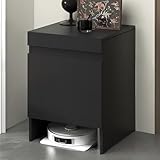
- Sturdy Solid Wood Construction--Crafted from multi-layer solid wood, this robot vacuum storage Sturdy Solid Wood Construction--Crafted from multi-layer solid wood, this robot vacuum storage rack offers a stable structure that resists warping and deformation over time, ensuring long-lasting durability for daily use.
- Concealed Storage with Door Design--This sweeper robot storage cabinet is designed with a front door that covers the lower compartment, allowing your robot vacuum to be hidden from view. It blends seamlessly into your home décor while keeping your space looking tidy and uncluttered.
- Pull-Out Top Shelf for Easy Access--Designed with a slide-out top shelf, this robot vacuum hidden cabinet provides convenient access for water changes or routine tasks—no need to move the entire unit, saving time and effort.
- Multi-Functional Use in Any Room--Versatile and stylish, this vacuum cleaner storage cabinet fits seamlessly in your living room, hallway, office, or even bedroom—offering more than just vacuum storage with its flexible shelving design.
- Quick and Easy Assembly--With clear instructions and simple components, this robot vacuum storage rack can be assembled in minutes, making setup hassle-free for anyone.
What the reported numbers actually mean
| Figure | Meaning | Qualification |
|---|---|---|
| About 80% to 99% | Improvement after adding miniature conveyor belts to the end-of-arm tool | Amazon-reported development-stage result, not a fleet-wide rate |
| 94 of 95 items | Result in a test containing selected challenging product attributes | Specific sample; it does not mean 98.9% of all Amazon products are robot-stowable |
| About 96% | Predicted-success threshold for sending away a nearly full pod | Decision threshold, not measured overall accuracy |
| 85% | Ultimate target for products stocked by a standard fulfillment center | Target, not a verified network-wide result |
IEEE Spectrum separately described laboratory success above 90% and repeated the 85% coverage goal. Those metrics describe different things: success is the outcome on attempted cases, while coverage is the share of inventory the system is intended to handle.
Products and situations that remain difficult
Amazon identified particularly bulky items, particularly heavy items, and cylindrical products that do not behave reliably on the conveyor mechanism as possible exclusions. Other engineering edge cases follow from the physical setup, although Amazon did not publish fleet-wide failure rates for them:
- Soft bags that deform unpredictably.
- Products with offset centers of gravity.
- Slippery or reflective packaging.
- Items that roll after insertion.
- Dimensions that differ from catalog data.
- A bin whose actual contents differ from its database record.
- An object that becomes trapped after a rearrangement.
A robust system therefore needs detection and recovery, not just a successful grasp. If the confidence estimate is low or the physical response differs from the model, the safe action can be to stop and hand the case to a worker.
Why Amazon uses a human-robot workflow
The project was presented as hybrid automation. Robots perform repetitive manipulation and reach awkward pod positions; people handle unusual, bulky, heavy, or otherwise difficult products. The design is intended to fit an existing “brownfield” building and workflow rather than require every fulfillment center to be rebuilt.
Amazon has described ergonomic and safety benefits, but those are company claims rather than independent measurements of injury rates or worker experience. The technical contribution is narrower and more concrete: automate a valuable subset while preserving a human path for exceptions.
Windows Errors? Fix Them Before They Spread
Repair common Windows errors and clear accumulated junk for a smoother, more stable PC - no reinstall needed.Free scan · no reinstallCrashes, No Sound, or Screen Glitches?
Random freezes, missing sound and display glitches usually trace back to one bad driver. Find and replace yours safely.Free scan · under a minuteHow this prototype fits Amazon’s later robotics strategy
Later announcements show broader investment, but they should not be confused with the fabric-pod stowing prototype.
- In October 2023, Amazon announced Sequoia, a containerized-storage system combining mobile robots, gantries, robotic arms, and ergonomic workstations. Amazon said it was operating at a Houston fulfillment center and could identify and store inbound inventory up to 75% faster while reducing order-processing time by up to 25%: Amazon’s Sequoia announcement.
- In October 2024, Amazon described a next-generation Shreveport, Louisiana, facility using Sequoia, Sparrow, Cardinal, and Robin: Amazon’s Shreveport robotics overview.
- In June 2025, Amazon said it had deployed its one-millionth robot across more than 300 facilities and introduced DeepFleet for coordinating robot movement. That milestone does not establish deployment of this specific stowing machine: Amazon’s fleet and DeepFleet announcement.
- Amazon introduced Blue Jay in October 2025 as a multi-arm system for picking, stowing, and consolidation, with a reported test covering about 75% of item types. An update dated February 25, 2026, said Blue Jay was no longer being used in operations: Amazon’s Blue Jay announcement and update.
- As of June 2026, Amazon was still announcing tactile and collaborative systems, including Vulcan and next-generation Proteus robots. These developments show continued investment, not the production status of the original stower: Amazon’s Vulcan and Proteus update.
What “solving” the beautiful problem really means
The breakthrough is not a universal robot that can pack every product into every bin. It is an architecture that combines visual inference, compliant contact, specialized tooling, reusable motions, confidence-based decisions, and human exception handling. That combination can make partial automation worthwhile in an environment where perfect inventory records, open shelves, and identical products cannot be assumed.
Quick Recap
Product prices and availability are accurate as of the date/time indicated and are subject to change. Any price and availability information displayed on Amazon at the time of purchase will apply.




