What’s actually slowing this PC down?
Pick the symptom - the matching free tool is one click away.
Advanced trading software is changing buy-side operations by connecting portfolio decisions, order creation, compliance, execution, allocation, settlement and analytics in one more continuous workflow. The biggest gains usually come from fewer manual handoffs, cleaner data, faster exception handling and stronger oversight—not from replacing traders with artificial intelligence.
Why buy-side operations are under pressure
Investment managers now trade more asset classes, venues and account types while facing tighter reporting, resilience and best-execution expectations. Liquidity is fragmented, settlement windows are shortening in some markets, and firms are expected to scale without adding headcount in proportion to assets or transaction volume.
In a legacy operating model, a portfolio manager may communicate an idea through email or a spreadsheet, a trader may re-enter it into an order system, compliance may check it in another application, and operations may reconcile a fourth record after execution. Each handoff creates delay and a chance for inconsistent positions, allocations, restrictions or cash data.
Modernization addresses that information fragmentation. The objective is not merely faster order submission; it is a controlled chain from investment decision to final settlement and performance review.
Free tools Windows power users keep installed
One-click scans. No signup required.
#1 Best Overall

- Universal Compatibility: Triple monitor stand perfectly fits most flat or curved LCD computer screens up to 27", including but not limited to 27, 25, 24, 23, 22, 21.5, 21, 20, 19, 17 inches displays. Each arm supports a weight of 4.4-19.8 lbs, compatible with VESA patterns 75x75mm and 100x100mm. Support C-clamp (desk thickness within 0.39''-3.15'') and grommet mount (desk thickness&hole diameter within 0.39''-2.36'') mounting installation.
- Articulating Triple Monitor Mount: The fully adjustable monitor arms can tilt -45°/+90°°, swivel ±90°, and support rotation 360 degrees. The center screen can be height adjusted. The arms make the extension, retraction, and height adjustment dynamically and easily. With multiple screen combinations, easily find an optimal viewing angle and position for comfortable work.
- Ultimate Desk Space Saver: The 3 monitor stand mount get displays off your desk conveniently, and the standing pole design helps you to gain a ton of extra space. Integrated cable management to keep cables tucked in arm neatly, hide the sore eyes wire clutter. Just enjoy your working, gaming, or viewing hours in a comfortable environment.
- Easy Assembly: This monitor desk mount is easy to assemble with C-clamp or grommet mount, quick-release VESA plate makes it simple to attach monitor. Comes with clear instruction and necessary hardware for mounting, and it takes less than 20 minutes from opening the box to use the monitor. Do not hesitate to relate with us for any pre-purchase or installation questions.
- Heavy-Duty & Friendly Customer Support: The 3 monitor mount features premium spring, made from heavy-gauge steel, strong enough to hold three monitor displays stably, ensuring the safety of your monitor setup. Tested for durability before leaving our factory, backed by MOUNTUP 3-year support.
What counts as advanced trading software?
The category is broader than an execution screen. It can include the following connected capabilities:
- Order management system (OMS): portfolio orders, order lifecycle control, compliance, allocations, books of record and audit trails.
- Execution management system (EMS): liquidity discovery, broker and venue connectivity, algorithmic execution, smart routing and trader tools.
- Order and execution management system (OEMS): a combined OMS and EMS environment with shared order, portfolio and execution data.
- Portfolio management and modeling: construction, rebalancing, cash management, scenario analysis, tax-lot handling and investment restrictions.
- Pre- and post-trade compliance: mandate, regulatory, client, concentration, exposure, ESG and restricted-list checks.
- Transaction-cost analysis (TCA): pre-trade estimates and post-trade measurement of implementation shortfall, spread, slippage, market impact, opportunity cost and broker performance.
- Connectivity: FIX networks, APIs, brokers, exchanges, dark pools, electronic fixed-income venues, custodians and administrators.
- Post-trade automation: confirmations, allocations, matching, settlement instructions, reconciliations, regulatory reporting and exception management.
- Data and analytics: market, reference, position, liquidity, risk and execution-quality information.
- Rules and AI: deterministic routing, exception triage, natural-language search, anomaly detection and workflow recommendations.
Coalition Greenwich identifies workflow automation, interoperability, cloud adoption and data automation as major areas of provider investment (Coalition Greenwich analysis).
How the connected trade lifecycle works
A modern workflow links these stages:
- Investment idea and portfolio model: a target position, rebalance or cash requirement is created in portfolio context.
- Order generation: the system converts targets into account-level orders, nets eligible activity and applies tax-lot, liquidity and mandate rules.
- Pre-trade control: restrictions, concentration, exposure, country, issuer, sector, currency, duration and client rules are checked before release.
- Execution: the trader or approved automation selects a broker, venue, algorithm, crossing opportunity or request-for-quote workflow.
- Allocation: fills are distributed across accounts using documented allocation rules, with exceptions routed for approval.
- Confirmation and matching: trade economics are compared with broker and custodian records.
- Settlement: instructions, status, fails and cash movements are monitored through completion.
- Review: TCA, compliance evidence, broker analysis, reporting and operational metrics feed back into future decisions.
Where the operational impact is greatest
Portfolio-to-order automation
Model-driven rebalancing can turn target positions into executable baskets while considering cash, account restrictions, tax lots, minimums and liquidity. Netting and crossing can reduce unnecessary trading, but the resulting orders still need transparent approvals and exception paths. SS&C describes portfolio modeling, construction, rebalancing, automated allocations and compliance as connected parts of its trade-order-management offering (SS&C Trade Order Management).
Pre-trade compliance as decision support
Instead of discovering a breach after a trade is sent, the portfolio manager and trader can see the effect of an order on mandate, concentration, exposure and restricted-security rules before release. A useful implementation records the rule version, data used, approver, override reason and final outcome.
Do these 3 things before closing this tab:
1Fix the driver behind crashes, sound loss and screen glitches2Clear out junk files and repair common Windows errors3Scan for outdated or missing drivers - takes under a minuteLiquidity discovery and execution
EMS functionality can aggregate broker quotes, exchange liquidity, alternative venues, dealer inventory, RFQs, algorithms, internal crossing and historical execution data. Bloomberg describes liquidity aggregation, price discovery, multi-asset execution, direct connectivity and straight-through processing in its buy-side trading products (Bloomberg Trading Solutions). These capabilities improve the ability to route and supervise an order; they do not guarantee a better price in every market condition.
Rank #2
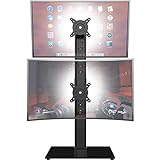
- COMPATIBILITY - Vertical dual monitor mount holds two screens 13” to 34” in size and 44 lbs in weight (each) with 50x50mm,75x75mm or 100x100mm backside mounting holes. Integrated cable management is included to keep cords clean and organized.
- SWIVEL AND HEIGHT ADJUSTABLE FUNCCTION - Adjustable brackets offer +50° to -50° Swivel, +10° to -15° tilt, , and 12 level height adjustment along the center pole.
- ERGONOMIC MONITOR RISER - Keep your monitors at ergonomic heights, improving your work posture and reducing the strain on your neck, back and shoulder for more productive work
- EASY INSTALLATION - Mounting your monitors is a simple process with removable VESA plates. We provide all the necessary hardware and instructions for assembly
- SAVE SPACE - Instead of standing with 2 large bases, this stand hold 2 monitors on 1 stand, saving more space on your desktop and keep your workstation spacious and clutter-free
Low-touch and high-touch trading
Low-touch, liquid and rules-based orders are candidates for approved automation. Large, illiquid, sensitive or complex orders still require human judgment about information leakage, market context and timing. Bloomberg’s automation products describe rules-based trading across equities, futures, options, fixed income, FX and ETFs through broker or venue APIs (Bloomberg Trade Automation).
Transaction-cost analysis
TCA can estimate costs before release, guide strategy selection, compare brokers and algorithms, identify outliers and support best-execution reviews. FactSet describes pre-trade and post-trade tools that compare execution with benchmarks and flag unusual results (FactSet Trading and Execution Management). Results depend on benchmark choice, timestamps, order classification, liquidity modeling, market-data quality and treatment of opportunity cost. Better measurement is not itself better execution.
Allocation and post-trade processing
Automation can generate allocations, broker and custodian instructions, matching records, settlement monitoring, reconciliation queues, audit trails and regulatory reports. Charles River describes connected confirmation, matching, settlement-instruction and shared post-trade data workflows (Charles River Institutional Investment Management). The critical test is what happens to partial fills, rejected messages, changed instructions and failed settlement—not only the straight-through path.
Continuous management information
Shared order, position, cash, exposure, P&L, compliance and exception views let managers supervise operations during the day rather than reconstructing events from separate reports after the fact.
OMS, EMS, OEMS or front-to-back platform?
| System | Core purpose and users | Strength | Limitation |
|---|---|---|---|
| OMS | Investment orders and lifecycle; portfolio managers, traders, compliance and operations | Portfolio context, compliance, allocations and audit trail | May lack specialist execution tools |
| EMS | Execution; traders | Liquidity, routing, algorithms, connectivity and execution analytics | May lack mandate and portfolio context |
| OEMS | Combined order and execution workflow | Fewer handoffs and shared data | Can compromise specialist functionality or increase vendor dependence |
| Front-to-back platform | Investment, trading, middle office, accounting and operations | Consistency, control and fewer reconciliations | Complex implementation and potentially high switching costs |
An OEMS is not an inevitable endpoint. Coalition Greenwich reports that a clear majority of surveyed North American traders still preferred separate OMS and EMS systems (Coalition Greenwich on separate OMS and EMS systems). A modular design may preserve best-of-breed execution and broker neutrality, while an integrated design can reduce handoffs and reconciliation.
Rank #3
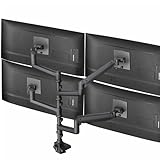
- Quad Ultrawide Desk Mount: Fits 4 ultra-wide screens (1 up to 49” and 2 up to 38”) with VESA 75x75mm or 100x100mm mounting holes. Holds 5.5 lbs to 44 lbs per arm
- Heavy-Duty Cast Aluminum Construction: Clamp base (fits desktops up to 2” thick) and arms are made of premium cast aluminum for maximum strength, scratch resistance, and durability. High-capacity tilt joints accommodate heavier screens without sagging
- Screen Articulation: Features +55° to -25° tilt, 180° swivel, and 360° rotation for optimal viewing angles and glare reduction
- Pneumatic Height Adjustment: Powerful pneumatic arms counterbalance the weight of your monitors so you can find the ideal screen height at the touch of a hand
- Detachable VESA Plates: Mounting your ultra wide monitors is made easier with the detachable VESA plates, and all instructions and hardware are provided for proper assembly
Architecture choices: cloud, APIs and automation
Cloud-native deployment
Cloud services can accelerate feature delivery, scale infrastructure and support distributed teams. They also introduce questions about data residency, network dependence, concentration risk, usage-based costs, migration and exit. SimCorp markets SimCorp One as a cloud-native platform with continuous deployment and connected trading, compliance, portfolio and IBOR workflows (SimCorp One Trading and Compliance). Treat such claims as capabilities to validate in your own operating model, not as proof of lower total cost.
APIs and FIX connectivity
“Open architecture” should mean documented interfaces, stable schemas, versioning, authentication, sandbox access, message monitoring, replay, error handling, data ownership and export rights. FactSet states that its trading technology provides managed FIX connectivity to hundreds of brokers and venues and supports external tools, proprietary models and third-party data (FactSet Trading and Execution Management). Ask to see the integration documentation and failure procedures.
Rules engines
Useful automation is deterministic, observable and reversible: route eligible orders, escalate restricted securities, send low-touch trades to approved algorithms, match confirmations and create exception queues. Authorized users should be able to override a rule only with a recorded reason, and every rule change should be versioned.
Artificial intelligence and machine learning
Practical uses include document extraction, classification, anomaly detection, natural-language search, liquidity or cost estimation, surveillance and workflow recommendations. Coalition Greenwich reports provider investment in AI, machine learning, generative AI and low-code tools, with the largest impact so far in listed and vanilla products rather than every complex asset class (Coalition Greenwich on new front-office technology).
AI that influences routing, compliance or risk needs human approval thresholds, explainability, model monitoring, confidentiality controls, bias testing, audit logs, fallback procedures and protection against data leakage or fabricated output. It should augment controlled workflows, not silently replace accountability.
Rank #4

- Ergonomically Designed Monitor Stand - it offers -90°to +70° tilt, -90° to +90° swivel, 360° rotation, and adjustable height up to 18.1" to easy find optimal view angle - increase productivity and comfort.
- Universal compatibility -The dual monitor stand widely fits most 13" to 27" LCD computer monitors with VESA 75x75 mm or 100x100 mm mounting holes on the back. Each arm can hold up to 17.6 lbs. This stand works better with two monitors of the same weight.
- Unique Base Design -This V-shaped base is heavy and wide enough to lift and tilt a monitor weighing up to 17.6 lbs, can stably fit any desk, avoid tipping or falling of the monitor. The groove of the base can put the mobile phone, free your hands, and increase comfort.
- Clutter-free Desktop - Raise your monitor to a demand height, freeing up your workstation. It comes with clips for tidy cable management and helps keep your power and AV cables clean and organized.
- Effortless Assembly- Work is already hard enough! We don't want to make things harder. And that's why this monitor stand comes with labeled parts and clear instructions for quick assembly. When installing monitors, please hang 2 monitors onto the arm at the same time to avoid the danger of tipping, and please keep the two arms in balance during use.
Asset-class realities
Equities
Standardized instruments, deep electronic liquidity, mature broker algorithms, FIX workflows and extensive TCA make equities a common starting point for automation.
Fixed income
Dealer inventory, RFQs, voice and electronic execution, sparse pricing, odd lots and security-level liquidity differences require more human and workflow nuance. Bloomberg’s Trade EMS describes pricing, quoting, risk, hedging, trade management and FIX/API connectivity, but its page is oriented to bank and broker-dealer trading desks, so it should not be treated automatically as a buy-side recommendation (Bloomberg Trade EMS).
FX
Evaluate multi-dealer connectivity, streaming prices, RFQs, hedging, currency overlays, best-execution analysis, confirmation and settlement support.
Derivatives
Requirements may include multi-leg orders, margin and collateral, Greeks, sensitivities, exercise and assignment, lifecycle events and specialized compliance rules.
Private markets and alternatives
Listed-market OMS or EMS functionality may not cover capital calls, valuations, side pockets, lock-ups, subscriptions, redemptions, complex fees, investor restrictions and document management. A strong equities EMS is not automatically an alternatives operating platform.
Best Value
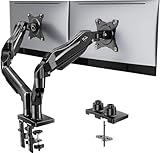
- Compatible with Wide Screens - To ensure compatibility with the dual monitor mount, your each monitor must meet three conditions at the same time: First, computer screens size range: 13 to 32 inches. Second, screen weight range: 4.4 to 19.8 lbs. Third, the back of the monitor screen must have VESA mounting holes with a pitch of 75x75mm or 100x100mm.
- Regarding the compatibility with desks - Your desk must meet three conditions at the same time: First, desk material: Only wooden desks are recommended, plastic or glass desks cannot be used. Second, desk thickness range: 0.59" - 3.54". Third, the bottom of the desk should not have any cross beams or panels, as this will interfere with installation. We recommend carefully checking that your desk and monitors meets all above conditions before purchasing.
- Dual C-Clamp Hold - Worried your dual monitors might wobble or slip? Our upgraded base uses a larger platform plus a dual C-clamp structure to lock the dual monitor arm firmly to your desk. Each arm safely keeps your screens steady while you type, click and game—no shaking, no sliding, just a clean and secure setup you can trust every day. It also provides Grommet Mounting installation choice, both options ensure stable and secure fixation for your 0.59" - 3.54" desk.
- Full-Motion Adjustment For Comfortable View - Pull the screen closer when you’re deep in a spreadsheet, push it back to watch videos, or rotate to portrait for coding — moving everything smoothly with just one hand. The monitor stand offers +85°/-50° tilt, ±90° swivel and 360° rotation. Raise your monitor up to 15.75″ to support a healthy sitting posture. Whether you’re working from home, gaming through the night, or switching between video calls and documents, getting the screens to your natural line of sight helps relieve neck, shoulder and back strain so you can stay focused longer with less fatigue.
- Keep Your Desk Organized: By lifting both screens off the desktop, this dual monitor stand opens up valuable space for your keyboard, notebook, docking station or a simple, clutter-free work area. Built-in cable management guides wires along the arms, keeping cords out of sight and out of the way. Enjoy a tidy, modern workstation that looks as good as it feels to use.
Regulatory and resilience context
Technology investment is driven by operational pressure: faster settlement, more demanding reporting, best-execution oversight, auditability, cybersecurity, resilience, transparency and geographic complexity. Regulation remains jurisdiction- and firm-specific. For example, the SEC states that the compliance date for amendments to U.S. order-execution disclosures was extended to August 1, 2026 (SEC: Disclosure of Order Execution Information). That date concerns the cited disclosure rule; it is not a universal mandate for every buy-side platform.
How to select and implement a platform
Selection criteria
- Functional fit: strategies, asset classes, accounts, order types, allocations, corporate actions, derivatives and post-trade needs.
- Execution: broker coverage, venue and RFQ connectivity, algorithms, crossing, routing, TCA and high-touch support.
- Data and integration: APIs, FIX, custodians, administrators, market and reference data, lineage, logging, export and replay.
- Controls: role-based access, segregation of duties, versioned rules, approvals, overrides, audit trails, disaster recovery and security testing.
- Economics: implementation, migration, integrations, market data, broker and venue charges, training, customization, upgrades, managed services and exit costs—not just licenses.
- Adoption: trader speed, portfolio-manager usability, false-positive rates, configurable workflows and exception-management quality.
Charles River’s public materials emphasize operating-model design and long-term growth in a total-cost perspective, but do not publish standard list pricing (Charles River). Major enterprise platforms generally require a tailored commercial proposal.
A phased implementation
- Map the current lifecycle from investment idea through settlement and reporting.
- Measure touches per trade, exceptions, allocation time, confirmation time, settlement fails, compliance false positives, reconciliation breaks and platform availability.
- Assign ownership for positions, cash, reference data, rules and exceptions.
- Choose integrated or modular architecture based on total operational friction, execution needs and exit requirements.
- Pilot one strategy, workflow or asset class with compliance and post-trade included from the start.
- Test partial fills, duplicate and out-of-sequence messages, FIX outages, stale data, failed instructions, API changes and recovery procedures.
- Compare measured results with the baseline before expanding.
Integrated versus modular: the practical trade-off
| Architecture | Advantages | Disadvantages |
|---|---|---|
| Integrated | Fewer handoffs, common permissions, shared positions and orders, lower reconciliation burden, consistent reporting | Larger implementation, vendor lock-in, possible lowest-common-denominator execution, concentration and migration risk |
| Modular | Best-of-breed components, replaceable services, specialist flexibility and negotiating leverage | More integrations, data models, vendors, service-level agreements and root-cause complexity |
The right answer is the architecture that measurably reduces end-to-end friction without sacrificing execution quality, resilience or control.
Failure modes to test before signing
- Partial automation: routing is automated but allocations, confirmations or reconciliation remain manual.
- Stale data: late positions, unsynchronized cash, missing corporate actions or conflicting reference prices undermine dashboards and compliance.
- Misleading TCA: weak benchmarks, bad timestamps, incorrect order classes, illiquid prices or ignored opportunity costs distort conclusions.
- Over-automation: thin markets, indicative quotes or information-sensitive orders can make automated routing unsafe.
- Integration defects: duplicate messages, out-of-sequence events, incorrect allocations, broken sessions and failed settlement instructions require monitoring and replay.
- Vendor concentration: an outage, cyber incident, commercial dispute or product change has greater impact when one provider supplies data, connectivity, trading and post-trade.
- Customization debt: extensive bespoke code can make upgrades and testing expensive; confirm what is genuinely configurable.
- Asset-class mismatch: a platform optimized for equities may not support fixed income, derivatives, private credit or alternatives adequately.
Vendors a buying team may evaluate
| Vendor or product | Potential fit | Important qualification |
|---|---|---|
| Charles River IMS / Charles River Trader | Large multi-asset managers, asset owners and insurers seeking broad front-to-back capabilities | Enterprise implementation may be excessive for execution-only needs (official page) |
| Bloomberg AIM, EMSX and trading tools | Firms already using Bloomberg data, terminals and broker ecosystem | Cost and ecosystem concentration; product scope varies by asset class (official page) |
| FactSet Portware, LiquidityBook and TCA | Modular OMS, EMS, analytics and managed connectivity | Validate exact modules, integration depth and implementation scope (official page) |
| SS&C Eze and related solutions | Alternative and global managers needing configurable workflows and operational services | Clarify module boundaries and software versus managed services (official page) |
| SimCorp One | Institutional firms seeking unified investment, trading, compliance and IBOR workflows | May be too broad for a best-of-breed execution strategy (official page) |
| FlexTRADER / FlexONE | Broker-neutral, multi-asset execution and configurable workflows | Confirm OMS and front-to-back depth (official page) |
| Trading Technologies TT | Futures, options, FX, fixed income, crypto and active multi-asset trading | Not a universal replacement for portfolio, accounting and investor operations (official page) |
Vendor-reported scale figures and connectivity counts should be treated as capabilities to verify through demonstrations, reference calls, service-level commitments and contract language. A defensible buying process includes a requirements checklist, implementation-readiness assessment, TCO model, proof of concept and—where needed—an independent systems integrator or trading-technology consultant.
How to measure whether modernization worked
- Touches and elapsed time per trade
- Straight-through-processing rate and exception volume
- Time to allocate and confirm
- Settlement-failure rate and reconciliation breaks
- Compliance false positives and override frequency
- Implementation shortfall and broker or algorithm dispersion
- Trader capacity and user adoption
- Cost per account or trade
- Availability, recovery time and message-replay success
These measures distinguish a genuinely improved operating model from a visually impressive system that merely relocates manual work.
Quick Recap
Product prices and availability are accurate as of the date/time indicated and are subject to change. Any price and availability information displayed on Amazon at the time of purchase will apply.




