Free tools Windows power users keep installed
One-click scans. No signup required.
Oracle changed who owns Ampere, not whether it uses Ampere processors. SoftBank completed its $6.5 billion acquisition of Ampere on November 25, 2025. Oracle sold its equity, convertible-debt and call-option interests, received $4.3 billion in cash and recorded a $2.7 billion realized gain. Yet OCI launched AmpereOne M-powered A4 Standard instances weeks later and continued adding regions in 2026.
The apparent contradiction disappears once ownership is separated from procurement: Oracle no longer has a financial stake in the chip designer, but it remains a cloud operator and customer that can buy Ampere CPUs when they fit its products and customers.




What Oracle actually sold
Before the transaction, Oracle reported approximately 29% equity ownership of Ampere as of August 31, 2025, with a carrying value of about $1.7 billion. Its exposure also included convertible debt and call-option interests, so the stake percentage did not describe Oracle’s entire economic position. The pre-close disclosure is in Oracle’s fiscal 2026 first-quarter filing.
SoftBank announced an all-cash $6.5 billion purchase on March 19, 2025 (U.S. time), and the deal closed on November 25, 2025. Ampere is now a wholly owned SoftBank subsidiary. Oracle’s fiscal 2026 filing says its equity, debt and option interests were settled for $4.3 billion in cash, producing a $2.7 billion realized gain, with no remaining Ampere investment as of May 31, 2026. See the Oracle fiscal 2026 Form 10-K, the SoftBank acquisition announcement and Ampere’s closing announcement.
The Tool Desk
Outbyte PC Repair FREEClear out junk files and repair common Windows errorsFree Scan →Outbyte Driver Updater FREEFix the driver behind crashes, sound loss and screen glitchesFind Drivers →#1 Best Overall
SoftBank’s disclosed pre-transaction voting-interest table listed Carlyle Partners VI Denver Holdings at 59.65%, Oracle Project Denver Holdings at 32.27% and Arm Technology Investment at 8.08%. Those figures are voting interests disclosed for the transaction, not a complete measure of Oracle’s economic exposure, which also included debt and options.
Why Oracle can keep buying Ampere processors
Ownership and supply are different decisions
Oracle’s chairman and chief technology officer, Larry Ellison, described the change as a move toward “chip neutrality”: OCI can source CPUs and GPUs from several suppliers rather than tying its infrastructure strategy to a company it partly owns. Oracle can therefore purchase Ampere silicon, collaborate on instance designs and support Arm-based customers without carrying Ampere’s financial results on its balance sheet.
Rank #2
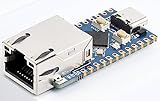
- 【RP2040-ETH Module】 Based On RP2040, Onboard Ethernet Port,Dual-core Arm Cortex M0+ processor, flexible clock running up to 133 MHz 264KB of SRAM, and 4MB of onboard Flash memory.
- Onboard CH9120 with integrated TCP/IP protocol stack. 14 × multi-function GPIO pins, compatible with some Pico HATs.
- Castellated module allows soldering direct to carrier boards. Drag-and-drop programming using mass storage over USB. 8 × Programmable I/O (PIO) state machines for custom peripheral support. Controllable via network.
- Support multiple communication modes: Supports TCP Server / TCP Client / UDP Server / UDP
- Support C/C++, MicroPython, Arduino: Comprehensive SDK, Dev Resources, Tutorials To Help You Easily Get Started
The sale transferred a capital-intensive risk
SoftBank’s transaction materials reported that Ampere generated $16.46 million of revenue in 2024, a $510.6 million operating loss, a $580.8 million net loss and approximately $1.51 billion of negative net assets. Chip design requires substantial research, validation and manufacturing commitments before demand is certain. Selling the investment gave Oracle liquidity and reduced exposure to those product-cycle and supply-chain risks. The $2.7 billion gain is a one-time accounting result, not recurring cloud operating profit; Oracle identifies the transaction as one-time in its fiscal 2026 earnings release.
Existing OCI demand did not disappear
OCI already had Arm-based instance families, software integrations and customers. Ending an investment does not require removing deployed instances or abandoning a supplier whose processors meet a workload requirement. It lets Oracle preserve product continuity while choosing among vendors over time.
Do these 3 things before closing this tab:
1Fix the driver behind crashes, sound loss and screen glitches2Repair Windows errors before they cause bigger problems3Scan for outdated or missing drivers - takes under a minuteWhat OCI launched after the transaction
On December 15, 2025, OCI announced general availability of A4 Standard instances using AmpereOne M processors, the successor to the A1 and A2 Ampere-based families. Ampere’s product announcement is at https://amperecomputing.com/blogs/delivering-next-gen-performance.
| Item | Published detail | Qualification |
|---|---|---|
| Processor | AmpereOne M, up to 192 cores and 12 DDR5 memory channels | Manufacturer specification |
| Performance claims | Up to 61% better per-core performance and 20% higher boost frequency than A2 in Oracle’s launch coverage; Ampere later cited up to 35% higher per-core performance and 20% higher clocks | Vendor-reported comparisons; results depend on configuration and workload |
| STREAM Triad | 143 GB/sec for a specified A4 setup versus 53 GB/sec for a specified AMD EPYC-based E6 configuration | Ampere’s test, not an independent benchmark |
| Indicative rates | $0.0138 per OCPU-hour and $0.0027 per GB-hour in Ampere’s December 15, 2025 post | Dated signal; verify live regional price, shape, storage, network, transfer and discounts |
On March 19, 2026, Ampere said A4 availability was expanding to London and Frankfurt. The announcement also referenced Oracle EU Sovereign Cloud and Oracle Alloy. An A4 deployment in one of those environments is not, by itself, a guarantee that every workload is sovereign or compliant with a particular regulation. Details are in Ampere’s European deployment announcement.
Where Ampere-based OCI instances fit
- Arm64-native microservices, APIs, web serving and horizontally scaled workers.
- Go, Java, Python, Node.js, Rust and other runtimes with mature Arm64 support.
- Memory-bandwidth-sensitive services and CPU-based AI inference.
- Deployments where power use and server density materially affect total cost.
- Oracle software that is certified for the chosen Arm shape and benefits from applicable licensing terms.
Ampere is not a universal AI replacement. Model training, CUDA-dependent software and high-throughput inference commonly require GPU instances. Applications with x86-only binaries, proprietary instruction extensions, binary-only agents or unsupported kernel modules can cost more to migrate than they save in compute charges.
Customer evidence—and what it does not prove
Oracle and Ampere identify Uber and the Oracle Red Bull Racing Formula 1 team as early A4 customers. Oracle said more than 1,000 customers had used its Arm-based instances since their 2021 launch. Oracle and Ampere also say Uber runs more than 20% of its OCI capacity on Ampere processors and reported a 30% reduction in power consumption and lower infrastructure costs. These are company or customer statements reported in CRN’s coverage and Ampere’s co-development account; they are not independently audited results for every application.
What the licensing factor means
Oracle’s Processor Core Factor Table lists Ampere Altra, AltraMax and AmpereOne with a 0.25 factor in the table’s Oracle licensing context. That is a licensing factor, not a performance multiplier and not a promise that every Oracle product costs 75% less on Ampere. Edition, product, deployment model, minimums, support terms and contract language still determine a customer’s bill.
Independent reader supportYour contribution helps us test, update, and keep practical guides available for everyone.Arm migration checks for an enterprise buyer
- Confirm support. Ask the software vendor whether Arm64 is supported in production for the exact operating-system version and OCI shape.
- Check every dependency. Verify container images, native libraries, endpoint security, monitoring, backup, CI/CD agents and kernel modules. Require both
linux/amd64andlinux/arm64images where a mixed fleet is possible. - Classify the bottleneck. Measure CPU throughput, single-thread latency, memory bandwidth, storage and network behavior. Do not infer application performance from a synthetic vendor test.
- Validate capacity and geography. Check the desired A4 shape in the target availability domain and confirm data-residency or sovereignty requirements separately.
- Benchmark the real service. Use production-like traffic, compiler settings, storage and network paths. Include migration engineering, testing, support and rollback costs.
- Compare total cost. Include OCPU and memory charges, storage, data transfer, support, Oracle licensing and the cost of maintaining multi-architecture builds.
Common migration failure modes
- Container tooling silently uses emulation because an Arm64 image was never published.
- A native dependency compiles but changes behavior or performance at runtime.
- A security, backup or observability agent installs without providing full Arm64 functionality.
- The benchmark compares unlike VM sizes or omits storage, network and compiler differences.
- Teams confuse OCPUs, vCPUs, physical cores and Ampere’s core-count terminology.
- A buyer assumes the 0.25 licensing factor applies to every Oracle metric or product.
How OCI compares with other architecture choices
| Option | Potential advantage | Likely limitation |
|---|---|---|
| OCI A4 Arm instances | AmpereOne M, OCI integration and an Arm path for scale-out services | Arm64 validation and regional capacity must be checked |
| AWS Graviton | Multiple generations and broad AWS tooling | Less useful when OCI-specific services or Oracle licensing are central |
| Azure Arm-based VMs | Azure-native and Microsoft enterprise integration | Does not provide OCI’s database and networking context |
| Google Cloud Tau T2A | Google Cloud’s general-purpose Arm option | Different platform services and performance profile |
| OCI x86 instances | Broadest legacy binary and commercial-software compatibility | May give up Arm’s workload-specific power or price advantages |
| OCI GPU instances | CUDA-oriented training and accelerated inference | Often uneconomic for ordinary microservices or CPU inference |
What the sale says about Oracle’s broader strategy
Oracle’s Ampere exit is one part of a much larger infrastructure program. In its fiscal 2026 results, Oracle reported $43 billion of debt financing and $5 billion of equity financing during the year, and expected about $40 billion of additional debt and equity financing in fiscal 2027. The company also forecast fiscal 2027 cloud-revenue growth of 58%–64% in U.S. dollars. Those figures show the scale of OCI’s buildout; they do not establish that Ampere-sale proceeds specifically funded it.
The strategic message is supplier flexibility. Oracle can combine x86 CPUs, Arm CPUs, GPUs and other accelerators, selecting on availability, economics and customer demand rather than protecting one owned chip asset. Ampere remains commercially relevant only if its processors continue to meet those tests.
The Bottom Line
Bottom line: Oracle sold its Ampere ownership and received substantial liquidity, but it did not reject Ampere-based cloud computing. OCI’s A4 launch and European expansion show a supplier relationship continuing under a chip-neutral strategy. For customers, the decision is practical: validate Arm64 support, regional capacity and full workload economics rather than treating the ownership change—or vendor benchmark claims—as a verdict on performance.
Quick wins for a faster PC:
Fix the driver behind crashes, sound loss and screen glitchesFind Drivers →Repair Windows errors before they cause bigger problemsFix Now →Quick Recap
Product prices and availability are accurate as of the date/time indicated and are subject to change. Any price and availability information displayed on Amazon at the time of purchase will apply.




