Data center optimization delivers a defensible return only when it improves useful IT output or reduces lifecycle costs without compromising reliability, security, or required capacity. Start with a complete baseline, identify the real constraint, and evaluate each change against measured benefits and implementation costs—not PUE alone.
1. What are we measuring, and is the baseline complete?
Before choosing a project, establish what the data center consumes, what work it delivers, what it costs to operate, and how reliably it meets service requirements. A baseline that tracks only facility electricity can miss wasted IT capacity; one that tracks only server utilization can miss cooling, water, and power-distribution costs.
Track facility inputs and useful IT output
- Facility energy: Record total site energy and the energy used by IT equipment over the same period and boundary.
- IT output and utilization: Select measures that reflect useful work for your workloads, such as completed transactions or jobs, alongside processor, memory, and storage utilization. Utilization alone does not establish business value.
- Water: Record site water use and its scope, including whether a figure covers direct cooling use, so it can be interpreted alongside IT energy.
- Operating costs: Include energy and water charges, maintenance, hardware and software, staffing, and other costs that a proposed project could change.
- Reliability and service: Record availability, incidents, service-level performance, and existing redundancy so cost reductions are not counted as wins if they degrade required service.
Use PUE as an overhead measure, not an optimization verdict
Power usage effectiveness (PUE) is total facility energy divided by IT equipment energy. A value closer to 1 means less facility energy overhead relative to IT energy, but PUE does not show whether that IT energy produced useful work. Water usage effectiveness (WUE) relates site water use to IT energy; document the water-use boundary and measurement period when comparing values. The U.S. Department of Energy’s Federal Energy Management Program (FEMP) recommends considering PUE-family measures alongside an output-based utilization metric.
FEMP’s 2024 guide reports an average annual PUE of 1.55 for large data centers in 2022, attributing the figure to Uptime Institute’s 2022 Global Data Center Survey. That is a dated benchmark, not a 2026 average, a universal target, or a promise of achievable savings. There is no single “good PUE” that establishes whether a site is optimized; workload, climate, measurement boundary, and service requirements matter.
The Tool Desk
Outbyte PC Repair FREERepair Windows errors before they cause bigger problemsFix Now →Outbyte Driver Updater FREEScan for outdated or missing drivers - takes under a minuteDriver Scan →#1 Best Overall

- Save valuable floor space: 6U wall mount server cabinet Dimensions: 13.78" H x21.65" W x17.72" D.Maximum mounting depth is 14.2"
- Keep critical network equipment secure: glass door and side panels are lockable to prevent unauthorized access. Front door can be installed on either side of the front of the cabinet to satisfy your door swing orientation preference
- Easy equipment configuration: Fully adjustable mounting rails and numbered U positions, with square holes for easy equipment mounting with top and bottom punch-out panels for easy cable access
- Durability: Made of high quality cold rolled steel holds up to 110lb (50kg) (Easy Assembly Required)
- PCI & HIPPA and EIA/ECA-310-E compliant
Make comparisons meaningful
Use consistent boundaries and time periods before and after a change, and account for changes in workload or occupancy. FEMP’s July 2024 guide spans IT systems, environmental conditions, air management, cooling and electrical systems, heat recovery, metrics, and benchmarking; it also notes that IT improvements can yield secondary mechanical and electrical savings. The guide cautions: “No design guide can offer ‘the most energy-efficient’ data center design, but these guidelines can provide efficiency benefits for a wide variety of data center scenarios.”
2. Where is capacity underused, and what can be consolidated safely?
Look for servers and workloads with persistently low utilization, overlapping functions, or capacity that could be hosted on fewer systems. Consolidation or virtualization can reduce the number of operating servers and the facility energy needed to support them, but the suitable target is not simply every lightly loaded machine.
Build a workload-level inventory
For each server, application, or workload, document utilization over representative peaks as well as ordinary periods, physical location, dependencies, owner, service-level requirements, and hardware or software support status. Include storage and network dependencies where they affect migration or performance. This helps distinguish idle capacity from deliberate headroom for failover, bursts, or planned growth.
Screen out unsafe or uneconomic candidates
- Keep workloads separate where privacy, security, regulatory obligations, or application dependencies require it.
- Do not reduce redundancy or capacity below the level needed to meet availability and recovery requirements.
- Estimate migration labor, testing, licensing changes, downtime risk, and the cost of retiring or disposing of equipment.
- Check rack-level density and cooling conditions: consolidating compute into fewer racks can concentrate heat even when total server energy falls.
ENERGY STAR says each server-level watt-hour saved can yield an additional 1.9 watt-hours of facility-level electricity savings, citing its referenced source. Treat that as the page’s stated relationship, not a universal multiplier: actual effects depend on the facility boundary, cooling and electrical systems, and operating conditions. Measure site results rather than multiplying server savings by 1.9 as a guaranteed forecast.
What’s actually slowing this PC down?
Pick the symptom - the matching free tool is one click away.
3. Which airflow and cooling changes suit this site?
Cooling projects should respond to the facility’s actual airflow, climate, rack density, water availability, controls, and maintenance limits. A measure that helps one room or climate may be ineffective or unsuitable elsewhere, so establish current conditions and test changes against operating requirements.
Rank #2

- Universal 19” Rack Mount Compatibility – Perfect for pro audio, video, IT, and network gear. Compatible with mixers, routers, patch panels, servers, power amps, and more.
- Heavy-Duty Load Capacity – Built to support up to 550 lbs. Ideal for studio gear, DJ setups, server equipment, and AV components that demand serious stability.
- Robust Steel Frame & Design – Made with 1.5mm thick steel and weighs 36 lbs for maximum durability, reduced vibration, and long-term reliability in any setting.
- Mobile & Secure – Preinstalled with 3” industrial-grade caster wheels (lockable), making it easy to move and position your rack exactly where you need it.
- All-In-One Setup Kit Included – Comes with 34 rack screws (5mm & 6mm), a 1U blank spacer, and an assembly tool—ready for fast installation out of the box.
Fix avoidable air mixing first
Inspect whether cold supply air reaches equipment intakes and hot exhaust returns to cooling equipment without mixing. ENERGY STAR identifies cable-opening grommets and rack blanking panels as inexpensive ways to limit unwanted airflow through openings and unused rack spaces. Confirm rack dimensions, ventilation compatibility, and the effect on the intended airflow path before installing hardware.
ENERGY STAR reports a U.S. Department of Energy estimate of 20% to 25% fan-energy reduction when hot-aisle/cold-aisle layout is used with containment. This is an estimate for the referenced measure, not a guaranteed reduction in a particular facility’s total energy use. ENERGY STAR also cites one large data-center example that saved $360,000 annually from inexpensive airflow-management measures; that single example is not a typical expected return.
Evaluate controls and cooling options against site conditions
- Containment and airflow separation: Assess whether hot and cold airstreams are separated effectively, and check for bypass airflow or recirculation.
- Temperature and humidity controls: Review sensor placement, operating setpoints, and equipment limits before changing controls; confirm that changes preserve manufacturer and service requirements.
- Economizers: Evaluate whether local climate and the design of the system allow outside conditions to reduce mechanical cooling, while accounting for air quality, controls, and maintenance.
- Localized cooling: Consider it where rack density or room layout creates a specific cooling constraint, and include its energy, water, maintenance, and redundancy implications.
For every proposed change, record the affected equipment, expected energy and water effects, control changes, maintenance needs, and the conditions under which the estimate holds. A lower cooling bill is not a useful result if the change causes hotspots or undermines required resilience.
Free tools Windows power users keep installed
One-click scans. No signup required.
4. What limits usable capacity?
Identify the binding constraint before buying or moving equipment. The limiting factor may be workload placement, power distribution, cooling capacity, rack density, or physical space; improving a different resource can add cost without creating usable capacity.
Find the constraint at the right level
Use granular monitoring to compare power and cooling availability with actual demand by room, row, rack, and relevant IT load. Examine peak conditions, not just facility-wide averages. Map where workloads can be placed and whether power, cooling, network, or redundancy limits prevent that placement.
Rank #3

- ADJUSTABLE DEPTH: 4- Post 22U 19" server rack enclosure with 4 vertical rails and adjustable mounting depth 5.7" to 33.0" (14,4cm to 83,8cm); IT rack is compatible with various servers / switches / data / video / AV and other IT networking equipment
- EASY SHIPPING AND ASSEMBLY: Enclosed 22U data rack cabinet ships compact flat-packed to avoid damage and facilitate installation; Include wheels & levelling feet to offer more stability; Home server rack cabinet is only 46.6in (118,3cm) in height
- DESIGN AND VENTILATION: Half height server rack cabinet has lockable and removable door and side panels with vented top allowing airflow; 4 Post 19" rack with 1764lb (800kg) weight capacity (stationary); Computer cabinet rack is EIA/ECA-310-E Compliant
- HARDWARE INCLUDED: Rolling home network rack includes rack mounting and equipment mounting hardware, such as 20 M6 cage nuts / screws, PVC cup washers; Front/rear doors and side panels Keys, 2x allen keys; Rack assembly hardware; Casters and leveling feet
- THE IT PRO'S CHOICE: Designed and built for IT Professionals, this 22U IT Server Cabinet is backed for life, including free lifetime 24/5 multi-lingual technical assistance
Forecast demand without spending the safety margin
Use realistic workload and growth assumptions, and separate committed demand from speculative expansion. Model normal operation and relevant failure or maintenance scenarios so usable capacity includes the headroom needed for service continuity. Uptime Institute’s 2026 survey summary identifies capacity forecasting, power availability, and cooling constraints as current concerns; it does not provide a basis here for assigning numerical prevalence to those issues.
A capacity project should state which constraint it removes, how much usable capacity it enables under the stated assumptions, and what redundancy or service headroom remains afterward. Avoid treating installed capacity as available capacity if distribution, cooling, or operational limits keep it from serving IT load.
Windows Errors? Fix Them Before They Spread
Repair common Windows errors and clear accumulated junk for a smoother, more stable PC - no reinstall needed.Free scan · no reinstallCrashes, No Sound, or Screen Glitches?
Random freezes, missing sound and display glitches usually trace back to one bad driver. Find and replace yours safely.Free scan · under a minute5. How will we calculate and verify ROI?
Compare the full lifecycle cost of the project with benefits that can be measured or supported by documented assumptions. Separate direct savings from avoided future costs, and show the baseline, time horizon, and uncertainty behind each figure.
Build the cost and benefit model
- Initial and implementation costs: Include equipment, installation, engineering, migration, testing, project labor, and any required downtime or transition costs.
- Recurring costs: Include software or licensing, maintenance, staffing, water, and energy. Account for costs that rise as well as those expected to fall.
- Retirement and residual costs: Include decommissioning, disposal, and any support or contract obligations that remain after equipment is removed.
- Benefits: Use measured or supportable reductions in energy, water, hardware, and maintenance costs. Count avoided capacity costs only when a credible expansion alternative and timing can be documented.
- Incentives: Include only incentives the organization is eligible for and can substantiate; verify current program terms with the relevant utility or administrator.
Use transparent financial measures
For a defined analysis period, a simple ROI calculation is (total benefits − total costs) ÷ total costs × 100%. Simple payback is the initial investment divided by expected annual net savings, but it does not reflect the timing of cash flows or benefits and costs beyond the payback date. For longer-lived projects, compare discounted cash flows using the organization’s chosen discount rate and a consistent analysis period; state those assumptions rather than presenting a single return figure as certain.
Keep energy and water assumptions tied to local rates and actual billing structures. Model workload changes, seasonal conditions, equipment life, and savings uncertainty with scenarios where they could materially change the result. Do not count the same avoided cost twice—for example, as both a lower operating expense and a separate benefit from deferred capacity.
Rank #4
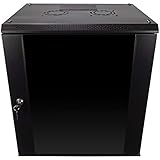
- DURABLE BUILD: Constructed from high-quality Cold Rolled Steel, the NavePoint Consumer Series 12U network cabinet boasts a sturdy, welded frame. Fitting EIA standard 19” networking equipment, this server cabinet confidently supports up to 110 lbs, providing a resilient base for your vital IT gear and equipment
- CONVENIENT DESIGN: This 12U cabinet features a reinforced, heat-treated, tempered glass front door with a security lock. Perfect for applications requiring both security and accessibility, its compact design of 17.72"L x 21.65"W x 24.42"H offers a practical solution for space-constrained settings.
- EASY & CUSTOMIZABLE EQUIPMENT SET UP - The 12U IT cabinet, with removable side panels and security locks, offers customization at its finest. Whether it's for an efficient device or cable management, this data cabinet ensures secure, adaptable configurations that suit your networking server requirements
- ENHANCED VENTILATION & SECURITY - Built-in fans and flow-through ventilation work to prevent overheating, ensuring optimal operation of your equipment. The reinforced, lockable tempered glass front door not only boosts security but also facilitates easy monitoring of installed equipment.
- SAFETY & COMPLIANCE - All NavePoint products are built to industry standards.
Verify after deployment
- Save the pre-project baseline, including measurement boundaries, workload or output, rates, operating conditions, and reliability measures.
- Record the project scope, schedule, one-time costs, assumptions, expected effects, and the person responsible for measurement.
- After commissioning, compare equivalent periods and boundaries, adjusting for material changes in workload or operating conditions.
- Check energy, water, service performance, and maintenance outcomes against expectations; investigate deviations before claiming a realized return.
Consolidation may reduce server and supporting facility energy, but its business case must include migration labor and equipment disposal rather than counting energy savings alone.
6. If we use colocation, what should we compare besides PUE?
Compare the service and contract the facility can provide, not a single efficiency ratio. A reported PUE is useful only when the provider explains its measurement context; it does not establish tenant-level efficiency, useful compute output, or the total cost and reliability of the service.
Ask for comparable operating information
- How and where is PUE measured, for what period, and under what operating conditions?
- What efficiency projects are planned, and how are tenants informed about their effects?
- What power procurement options are available, and can tenant participation or applicable incentives be documented?
- What are the available power density, redundancy, scalability, and uptime commitments for the specific service and contract?
- How are physical security, maintenance, outages, and customer responsibilities addressed?
Compare full cost and fit
Evaluate current rates, contract terms, escalation provisions, power charges, service levels, exit provisions, and any costs for changing capacity. Compare these with the cost and risk of operating or expanding your own facility, using equivalent assumptions for reliability, power density, security, and growth. Verify current rates and contract language directly with providers and utilities; older efficiency examples do not establish present-day pricing or incentive availability.
ENERGY STAR’s colocation guidance covers reliability, cost, scalability, power density, redundancy, uptime, security, efficiency, and procurement options. Use these as diligence categories, then judge providers against the workload and service requirements the contract must actually satisfy.
Quick Recap
Product prices and availability are accurate as of the date/time indicated and are subject to change. Any price and availability information displayed on Amazon at the time of purchase will apply.
Recommended Free Tools




