Free tools Windows power users keep installed
One-click scans. No signup required.
Nvidia CEO Jensen Huang’s “nanoseconds behind” comment was a rhetorical warning, not a measured chipmaking statistic. In a 2025 BG2 podcast interview, he argued that China’s engineers, AI companies and huge domestic market are close enough to the United States that export restrictions could accelerate Chinese substitutes and weaken Nvidia’s influence. His position also came as Nvidia faced billions of dollars in lost or delayed China business after new controls on its H20 accelerator.
What Jensen Huang actually said
Huang made the remark in a 2025 BG2 podcast interview. The original video is available on YouTube; the quotation and surrounding context were reported by Tom’s Hardware.
His short phrase was that China is “nanoseconds” behind the United States in chipmaking. He was not presenting a process-node comparison or a laboratory benchmark. Huang’s broader argument was that China has a large engineering and research workforce, companies that iterate quickly, and a domestic market large enough to influence which AI hardware and software platforms become standard.
He also argued that Chinese firms will continue developing AI whether or not they can buy the latest American accelerators. In his view, cutting off Nvidia products can give Huawei and other domestic suppliers a protected market while encouraging Chinese developers to build alternative software stacks.
#1 Best Overall

- Paperback with picture of the two inventors.
- 5 x 8
That is a strategic and commercial argument from an interested executive. It is not independent proof that China has matched the United States across semiconductor technology.
“Nanoseconds behind” is a metaphor, not a technical measurement
The phrase does not identify a manufacturing node, accelerator benchmark, yield rate, memory configuration, software capability or deployment figure. Depending on context, Huang could be referring to the speed of Chinese AI-model development, engineering iteration, or the time Chinese companies may need to narrow gaps in chips and systems.
It does not establish that China has achieved parity with the United States and its allies in:
- Advanced lithography and leading-edge fabrication
- GPU architecture or Nvidia’s CUDA software ecosystem
- High-bandwidth memory, advanced packaging and networking
- Reliable, high-volume production of complete AI systems
- Frontier-scale training infrastructure and global cloud availability
“China’s chipmaking” also covers several different layers: chip design, fabrication, packaging, memory, servers, networking and software. Progress in one layer is not evidence of parity in all the others.
Outdated Drivers Are Slowing You Down
One free scan finds every outdated or missing driver and matches the right update for your exact hardware.Free scan · exact hardware matchWindows Errors? Fix Them Before They Spread
Repair common Windows errors and clear accumulated junk for a smoother, more stable PC - no reinstall needed.Free scan · no reinstallWhy Nvidia wants fewer restrictions
The strategic case Nvidia makes
Huang’s public-policy case is that legally selling American hardware keeps Nvidia’s platform embedded in China’s developers, cloud services and AI applications. Continued use of Nvidia hardware and software could preserve U.S. influence over the global AI stack, he argues. If American products disappear, Chinese customers may standardize on Huawei or other domestic systems instead.
Rank #2
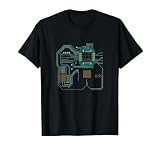
- Computer Hardware Technology design. Computer processor design, great for IT computer technicians, software engineers, or any engineer that deals with microprocessors. This funny computer scientist shows a CPU or circuit board.
- CPU Electronic Chip Circuit Board Gift. Ideal for computer science students, software developers, administrators and all who like to work with computers.
- Lightweight, Classic fit, Double-needle sleeve and bottom hem
Huang made a similar argument on Nvidia’s fiscal 2026 first-quarter earnings call, saying restrictions could strengthen Chinese chipmakers and weaken U.S. positioning. The company’s transcript is published by Rev.
Nvidia’s direct financial interest
Nvidia is not a neutral commentator. The company designed the H20 data-center GPU specifically for the China market under earlier export limits. Nvidia told investors that China’s AI-accelerator market could approach $50 billion, and said the market had effectively become closed to U.S. industry after the H20 action.
According to Nvidia’s earnings-call disclosures:
| Item | What Nvidia reported |
|---|---|
| H20 revenue recognized | $4.6 billion in the quarter, relating to sales made before April 9, 2025 |
| H20 revenue it could not ship | Approximately $2.5 billion during the quarter |
| Charge | $4.5 billion tied to inventory and purchase obligations |
| Potential China AI-accelerator market | Could approach $50 billion, according to Nvidia |
These are company-reported figures, not independent market estimates. They explain why Nvidia has a strong incentive to argue that a market presence can serve both commercial and strategic goals.
What’s actually slowing this PC down?
Pick the symptom - the matching free tool is one click away.
What happened with the H20 controls?
H20 was not simply an unrestricted flagship product. It was a China-focused accelerator designed to comply with earlier U.S. export limits. On April 9, 2025, the U.S. government imposed new controls requiring authorization for H20 exports to China, according to Nvidia’s account on its earnings call. Nvidia said the rule took effect without enough time to sell existing inventory and that it later explored whether a modified product could meet the revised limits.
Several concepts should be kept separate:
- Export-control rules: Government restrictions based on product characteristics, destination and end use.
- Licenses: Permission may be required even when a product is not categorically prohibited.
- Performance thresholds: Rules can target computing performance, interconnect or other technical attributes.
- Procurement decisions: Chinese agencies or companies may limit purchases independently of U.S. rules.
- Diversion concerns: Authorities may restrict shipments because of smuggling or unauthorized resale risks.
Calling every H20 restriction a total ban would therefore be inaccurate unless a specific rule barred the particular shipment and destination.
Rank #3

- Thermal conductivity > 6.5 W/m-k.
- Thermal resistance 0.0016 k-in/W.
- Working Temperature: -30/280°c.
- Each pack includes 1 gram high performance thermal paste/grease.
- Can be applied for cooling the interface of cooler heatsink and Computer Processor CPU GPU IC Chips, etc.
Where China is a serious competitor
China has several advantages that make Huang’s warning consequential:
- A large engineering and AI-research workforce
- A substantial electronics and manufacturing base
- Fast-moving internet and cloud companies developing custom accelerators
- Huawei’s Ascend hardware and software ecosystem
- Government-backed investment focused on semiconductor self-reliance
- The ability to deploy many systems at scale, even when individual chips are less advanced
Tom’s Hardware identified Huawei’s Ascend systems and Chinese hyperscalers’ custom-silicon programs as important parts of this push. Those developments show competitive momentum; they do not by themselves demonstrate performance parity with Nvidia.
The Tool Desk
Outbyte Driver Updater FREEScan for outdated or missing drivers - takes under a minuteDriver Scan →Outbyte PC Repair FREEClear out junk files and repair common Windows errorsFree Scan →Where the U.S. and allied ecosystem still has advantages
The relevant comparison is broader than which country fabricates the smallest transistor. Nvidia’s position rests on a combination of hardware, software and supply-chain relationships:
- GPU architecture and the CUDA developer stack
- Advanced chip design and system engineering
- Access to leading foundries and semiconductor equipment through allied supply chains
- High-bandwidth memory, advanced packaging and high-speed networking
- Hyperscaler purchasing power and frontier AI infrastructure
- A large ecosystem of developers, cloud providers and systems vendors
Leading-edge fabrication is geographically distributed. Taiwan, South Korea, the Netherlands, Japan, the United States and other economies each contribute important parts of the supply chain. Saying that “the U.S. makes the world’s most advanced chips” without specifying design, fabrication, packaging or another category obscures that reality.
The national-security case for keeping controls
Supporters of restrictions do not necessarily claim that export controls can prevent China from developing AI altogether. Their case is that access to the most efficient advanced hardware could accelerate military and dual-use capabilities, including:
Rank #4

- 🍭 MOLD SIZE: This mold has 4 cavities. The cavity capacity 1.1 ounces. Please do not use with hard candy. This mold is NOT dishwasher safe and should be cleaned by hand. The molds are not suitable for children under 3.
- 🧁 GET CREATIVE: Create goodies for parties such as birthdays and baby showers or delicious wedding favors. Make candies for holidays such a Valentines Days or Christmas. Unleash your inner artist and use the molds to make custom soaps, bath bombs or wax melts.
- 🍩 BE PROFESSIONAL: Create expert looking confections with the addition of our candy cups in a variety of colors and sizes, our high-quality lollipop sticks and clear cello bags. Take your chocolate molding to a new level with our exclusive Chocolatier's Guide, which explains how to melt, mold, and paint chocolate.
- 🍰 CYBRTRAYD: We are a company dedicated to providing confectionery and soap making tools. We want to provide you with quality tools to make your creative process as easy and fun as possible. Our experts are here to help. Your satisfaction is important to us. Contact us with any quality issues or concerns.
- Military AI and intelligence analysis
- Surveillance systems
- Cyber operations
- Autonomous weapons and targeting
- High-performance computing with dual-use applications
- An independent Chinese military-industrial technology base
On this view, controls can slow capability growth, raise the cost of scaling, deny access to the most efficient systems and buy time for U.S. and allied industry to widen its lead. Whether a policy is “working” depends on which of those objectives policymakers chose—not on whether China stops working on AI.
Do these 3 things before closing this tab:
1Scan for outdated or missing drivers - takes under a minute2Repair Windows errors before they cause bigger problems3Fix the driver behind crashes, sound loss and screen glitchesThe case against tighter restrictions
Critics, including Nvidia, point to a different set of risks:
- A guaranteed home market for Chinese substitutes such as Huawei’s systems
- Permanent migration of developers away from Nvidia’s software platform
- Lost U.S. sales that could otherwise fund research and manufacturing
- More incentives for gray-market distribution and workarounds
- Faster development of alternative Chinese software stacks
- Less American influence over how AI infrastructure is built worldwide
The Congressional Research Service describes both sides of this dispute: some stakeholders favor sales that preserve U.S. platform dependence, while others warn that looser rules could surrender a strategic advantage and supply China with advanced computing capacity.
Independent reader supportYour contribution helps us test, update, and keep practical guides available for everyone.Would selling a less-powerful chip solve the security problem?
A compliant or cut-down accelerator can preserve some U.S. market share, keep developers inside Nvidia’s software ecosystem and generate revenue for American suppliers. It may also deliver substantially less performance than a prohibited flagship product.
But a less-powerful chip is not automatically harmless. Customers can combine many units into a larger cluster, use them for model training or inference, and gain practical experience with Nvidia’s platform. As architectures improve, a fixed performance threshold can also become harder to enforce. The policy question is therefore about cumulative capability and scale, not just the specification of one board.
Recommended Free Tools
Best Value

- LOW ENERGY HIGH PERFORMANCE MINI PC - The Intel Core Ultra 5 125U is part of the Ultra 5 lineup, using the Meteor Lake architecture with BGA 2049. Intel Hyper-Threading technology is available and effectly doubles the core-count of the P-Cores, to a total of 14 threads. Core Ultra 5 125U has 12 MB of L3 cache and operates at 1300 MHz by default, but can boost up to 4.3 GHz, depending on the workload. With a TDP of 15 W, the Core Ultra 5 125U consumes very little energy but outputs high performance efficiency
- 32GB DDR5 RAM + 512GB SSD - The K15 mini computer is equipped with Dual 16GB (Total 32GB) SO-DIMM DDR5 4800MHz memory sticks. 512GB PCIE 4.0 SSD Drive with 3x M.2 2280 Expansion slots. Each slot capable of reading up to 8TB. (24TB MAX)
- QUAD SCREEN 4K DISPLAY SUPPORT - K15 Mini PC support 4-screen 4K/8K output via HDMI 2.1 (8K@60Hz), DisplayPort 1.4 (4K@60Hz), and USB Type-C Transfer speed (supporting PD3.0/DP1.4/DATA). Ideal for gaming, video editing, and multitasking, it provides expansive and crisp multi-display support
- OCULINK PORT - The Oculink port on the rear interface enables higher bandwidth capabilities, better frame rates and lower lag. The standard also operates at PCIe x4 speeds, compared to Thunderbolt's x3. Gamers and content creators can benefit from Oculink's higher bandwidth, resulting in better performance and lower lag for eGPU setups
- DUAL NIC FAST 2.5GBE + WIFI 6E + BT 5.2 - Dual Ethernet 2.5GbE LAN port design provides more applications, such as firewall, multichannel aggregation, soft routing, file storage server. Built-in WIFI 6E / Bluetooth 5.2 is more stable and efficient to connect multiple wireless devices such as projector, printer, monitor, speakers and etc
What happened to Nvidia’s China market?
In a later October 31, 2025 Reuters interview, Huang said Nvidia had gone from about 95% of China’s market to zero and described a potential annual opportunity of roughly $35 billion to $50 billion if the company were fully active there. The comments, available through Reuters, came after the BG2 interview and should not be presented as part of the original “nanoseconds” discussion.
Those figures are Huang’s characterization of a specific advanced-AI-accelerator market and period, not a formal dataset proving that every Nvidia product had zero sales in China.
How to judge Huang’s prediction
The strongest test is evidence, not the slogan. Watch for:
- Technical gap: Comparable accelerator performance, memory bandwidth, interconnect and packaging data.
- Scale: Whether China can produce enough reliable systems, not merely demonstrate one impressive chip.
- Ecosystem: Developer tools, cloud access, model portability and software maturity.
- Supply chain: Access to fabrication, advanced packaging, memory and networking.
- Market adoption: Whether customers continue using Nvidia platforms or switch permanently to domestic alternatives.
- Policy objective: Whether controls are intended to slow growth, raise costs, prevent military use or preserve a lead.
A chip can be less capable individually yet useful in a large cluster. Physical-export controls may also leave cloud access, remote use or gray-market servers unresolved. Conversely, more efficient AI models can reduce hardware needs for some workloads without eliminating the need for large-scale compute.
What readers should not assume about policy timing
The “nanoseconds” report concerns Huang’s 2025 remarks. It does not establish the complete export-control position on August 16, 2026 or any later date. Current reporting should separately verify H20 licenses, successor China-specific products, H200 or Blackwell permissions, Bureau of Industry and Security thresholds, Chinese procurement guidance and Nvidia’s latest filings.
The Bottom Line
Huang’s phrase is best read as a warning about competitive momentum and the loss of platform influence, not as proof that China has matched the United States across semiconductor technology. Nvidia’s argument may be strategically credible in parts, but its billions of dollars in exposed China business make it an interested advocate. The real choice is between a denial strategy that may slow Chinese access and a market-presence strategy that may preserve U.S. influence while giving China more computing capacity.
Quick Recap
Product prices and availability are accurate as of the date/time indicated and are subject to change. Any price and availability information displayed on Amazon at the time of purchase will apply.




