Intel Gaudi 3 is a credible Nvidia alternative for selected enterprise AI deployments, especially cost-sensitive inference, memory-heavy workloads and Ethernet-based clusters. It is not a universal replacement for Nvidia. Gaudi 3 directly targets H100-class systems and, in some configurations, H200 economics. Nvidia retains major advantages in CUDA compatibility, optimized software, cloud availability and system-level maturity. The practical question is therefore not whether Gaudi 3 “beats Nvidia,” but whether its lower-cost, open-Ethernet approach outweighs migration and operational risk for your workload.
What Intel Gaudi 3 is
Gaudi 3 is Intel’s third-generation AI accelerator from its Habana business. Intel designed it for large-language-model training and inference, fine-tuning, retrieval-augmented generation (RAG), multimodal models and other enterprise workloads. It launched on September 24, 2024.
The accelerator is sold in two main formats:
- HLB-325: an OAM/mezzanine module for specialized AI servers and clustered systems.
- HL-338: a PCIe Gen5 card for more conventional server integration. Intel lists Dell PowerEdge XE7440 systems with Gaudi 3 PCIe cards as shipping.
Intel’s product page lists IBM Cloud, Denvr Dataworks and Intel Tiber AI Cloud as access routes, although capacity and regional availability must be confirmed at purchase time.
Gaudi 3 hardware specifications
| Attribute | Intel Gaudi 3 |
|---|---|
| AI memory | 128 GB HBM2e |
| Memory bandwidth | Up to 3.7 TB/s |
| Tensor Processor Cores | 64 |
| Matrix Multiplication Engines | 8 |
| Networking | 24 × 200-GbE ports |
| Aggregate bidirectional networking | Up to 9.6 Tb/s |
| Deployment formats | OAM/mezzanine and PCIe Gen5 |
| Primary targets | LLM training, inference, fine-tuning, RAG and multimodal workloads |
These are accelerator specifications, not guarantees for a complete server or cloud instance. Host CPUs, system memory, storage, switch design and software configuration affect delivered performance. Intel’s launch details are documented in its launch release; additional specifications appear in Intel’s Gaudi 3 white paper and IBM’s platform specification.
#1 Best Overall

- Graphics Card Interface: Pci E
Why Ethernet is central to Intel’s strategy
Gaudi 3 integrates 24 200-GbE ports and uses standard Ethernet with RoCE-based scale-out. Intel’s argument is that customers can build clusters with familiar Ethernet switching instead of relying on an Nvidia-specific combination of NVLink, NVSwitch and InfiniBand.
Potential benefits
- More choice among networking vendors.
- Easier integration into Ethernet-oriented data centers.
- Potentially lower networking and infrastructure costs.
- Less dependence on one vendor’s interconnect roadmap.
What Ethernet does not guarantee
“Open Ethernet” is not automatically simpler or faster. Results depend on topology, congestion control, switch buffers, cabling, RoCE configuration, firmware and distributed-software tuning. A poorly engineered fabric can erase an accelerator’s theoretical advantage.
Which Nvidia products Gaudi 3 really challenges
Nvidia H100: the clearest target
Intel repeatedly compares Gaudi 3 with Nvidia’s H100 on training speed, inference throughput, power efficiency and price-performance. Intel reports selected averages of 1.5× H100 training speed, 1.5× H100 inference speed and 1.4× H100 inference power efficiency. Its launch material also claims up to 20% more throughput and 2× price-performance for Llama 2 70B inference.
Those figures are vendor-selected comparisons, not universal benchmarks. They depend on model, batch size, precision, software version, pricing assumptions and other test conditions. See Intel’s enterprise AI comparison and Gaudi 3 infographic.
What’s actually slowing this PC down?
Pick the symptom - the matching free tool is one click away.
Rank #2

- Professional AI & Creator Workstation: AMD Radeon AI PRO R9700 GPU with 32GB GDDR6 is engineered for AI development, professional content creation, and compute-intensive workloads.
- Massive 32GB Memory Capacity: 32GB of GDDR6 memory on a 256-bit bus provides ample bandwidth for large AI models, 8K video editing, and complex 3D rendering.
- Advanced RDNA 4 with AI Accelerators: 64 Compute Units with 3rd Gen Ray Tracing and dedicated 2nd Gen AI Accelerators for groundbreaking AI performance and visual computing.
- Professional Blower Cooling: Efficient single blower design exhausts heat directly out of the chassis, ideal for multi-GPU workstation and server configurations.
- Enterprise-Grade Thermal Solution: Vapor chamber heatsink with industrial Honeywell PTM7950 thermal interface material ensures reliable cooling under sustained professional loads.
Nvidia H200: a workload-dependent contest
Gaudi 3’s relationship with H200 is more complicated. H200 can produce higher raw tokens per second in some context-length and batch-size combinations. Gaudi 3 can still deliver better tokens per dollar when its cloud instance costs less.
Signal65 testing on IBM Cloud found Gaudi 3 generally ahead of H100 in its tested inference scenarios, while H200 results changed with input and output context and batch size. The study is useful evidence, but it is not a universal ranking.
Blackwell and newer Nvidia systems
Gaudi 3 should not be presented as comprehensively faster than Nvidia’s newer Blackwell generations. The available comparisons focus mainly on H100 and H200. Google Cloud’s current accelerator documentation lists newer B200 offerings, but a direct Gaudi 3-versus-Blackwell decision requires a common, workload-specific benchmark.
What the performance evidence actually means
Performance depends on the workload rather than the product name alone. Favorable Gaudi 3 cases are likely to include:
Rank #3

- NVIDIA Volta GV100 Architecture — 4,608 CUDA Cores, 640 1st-Gen Tensor Cores delivering 14 TFLOPS FP32 and 112 TFLOPS deep learning performance for AI training, inference, HPC, and scientific computing workloads
- 32GB HBM2 ECC Memory — 900 GB/s Bandwidth — High-bandwidth memory on a 4096-bit bus with ECC error correction provides the memory capacity and throughput required for the largest AI models, simulations, and datasets
- PCIe 3.0 x16 Interface — 250W TDP — Standard PCIe Gen3 connectivity with passive cooling designed for enterprise rack server deployment in HPE ProLiant, Dell PowerEdge, and Supermicro platforms with adequate chassis airflow
- NVLink — Scale to 96GB Unified Memory — Connect two V100 GPUs via NVLink at 300 GB/s bi-directional bandwidth to scale GPU memory from 32GB to 96GB for larger AI training and HPC workloads
- Multi-Precision Computing — Supports FP64 (7 TFLOPS), FP32 (14 TFLOPS), FP16 (112 TFLOPS) and INT8 precision modes for flexible deployment across training, inference, and scientific simulation workloads
- Inference for models that fit effectively within 128 GB of accelerator memory.
- Large-output or memory-bandwidth-sensitive generation.
- High-throughput batch inference where hourly instance cost matters.
- Fine-tuning or training already supported by Intel’s software stack.
- RAG and multimodal deployments where total solution cost matters more than peak benchmark leadership.
Signal65’s IBM Cloud study recorded historical prices accessed March 21, 2025: $60 per hour for Gaudi 3, compared with $85 per hour for H100 and $85 per hour for H200. Those were test prices, not guaranteed current rates. A lower hourly rate can produce better tokens per dollar even when raw throughput is lower.
Benchmark variables that can reverse the result
- Input and output token lengths.
- Batch size and concurrency.
- BF16, FP8 or other precision modes.
- Quantization method.
- Sequence length and KV-cache behavior.
- Prompt processing versus token generation.
- Single-accelerator versus multi-accelerator execution.
- Drivers, firmware and framework versions.
Always identify the model, task, precision, batch size, comparison system and metric before treating a published result as representative.
The software trade-off: portability versus maturity
Gaudi’s software stack supports PyTorch, Hugging Face, ONNX, DeepSpeed, vLLM-related tooling and Optimum Habana. Intel promotes migration from GPU-based models, and IBM describes examples requiring only a few lines of code. That can establish model portability, but it does not prove production equivalence.
Six migration checks
- Model portability: confirm that the model loads, converts and runs.
- Operator coverage: test custom and less-common operations, not only the main layers.
- Kernel performance: profile the operators that dominate execution time.
- Serving: verify batching, streaming, quantization and monitoring in the selected inference server.
- Distributed scaling: measure multi-accelerator and multi-node efficiency.
- Operations: confirm profiling, upgrades, alerting, checkpoint recovery and support procedures.
A team with CUDA extensions, TensorRT integrations or Nvidia-specific kernels may face substantial rework. CUDA is not merely lock-in; it also represents accumulated engineering, tested libraries and a large pool of experienced developers. Intel’s software resources are available through its Gaudi portal and IBM’s platform documentation.
Rank #4
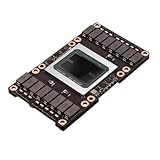
- Robust Design:Constructed to withstand high temperatures, the V100 16GB SXM2 card operates efficiently up to 105℃.
- Advanced Connectivity:Features a SXM2 connector for seamless integration with a wide range of systems, ensuring compatibility.
Availability and buying paths
IBM Cloud
IBM offers Gaudi 3 through Virtual Servers for VPC. Its documented eight-accelerator profile is gx3d-160x1792x8gaudi3, with eight 128-GB accelerators. IBM marks the profile Select Availability, so region, quota and capacity are material procurement constraints. Check the profile documentation before planning production capacity.
IBM also advertises a 50% discount for the first six months under a promotion. That is a temporary offer, not proof that Gaudi 3’s standard price is half the price of an Nvidia accelerator. Current terms appear on IBM’s GPU and accelerator page.
On-premises systems
The PCIe card can fit qualified enterprise servers, with Dell’s PowerEdge XE7440 identified by Intel as shipping. Verify the exact regional configuration, host requirements, networking, support terms and lead time. An on-premises total-cost calculation must include CPUs, memory, switches, cabling, storage, power, support and engineering time.
Who should choose Gaudi 3?
- Teams running inference-heavy workloads where cost per token matters more than maximum single-node speed.
- Organizations whose models and serving stack pass a Gaudi proof of concept.
- Buyers that benefit from 128 GB of accelerator memory.
- Data centers already operating Ethernet-based fabrics.
- Companies seeking to reduce Nvidia concentration without abandoning enterprise-scale accelerators.
- Customers with confirmed IBM Cloud or OEM capacity in the required region.
Who should stay with Nvidia?
- Teams dependent on CUDA-specific code, TensorRT or Nvidia-only libraries.
- Workloads with unusual operators or rapidly changing model architectures.
- Organizations needing the broadest managed-cloud availability.
- Large distributed-training programs where mature system software and operational experience reduce risk.
- Projects where developer time and predictable execution outweigh accelerator-hour savings.
Nvidia H100 and H200 remain practical choices for CUDA-centric deployments. Blackwell systems are a newer purchasing option, but Gaudi 3 should not be compared with them without direct, like-for-like testing.
How to run a fair procurement test
- Select representative production models, not only a popular benchmark model.
- Measure time to first token, steady-state tokens per second, latency percentiles and utilization.
- Test several context lengths, output lengths, batch sizes and concurrency levels.
- Use the same quantization, precision and serving objectives where technically possible.
- Calculate tokens per dollar using current quotes, including host and networking charges.
- Include migration, tuning, support and expected utilization in total cost of ownership.
- Test checkpoint recovery, node failure, upgrades and multi-node scaling.
- Confirm region, quota, capacity commitments and escalation support before signing a contract.
Bottom line
Gaudi 3 is best understood as a pressure point against Nvidia’s pricing and lock-in, not as proof that Intel has displaced Nvidia. It is most compelling when enterprise inference economics, 128 GB memory, Ethernet scale-out and vendor diversification matter—and when the software stack has been validated on the buyer’s actual models. Nvidia remains the safer default for CUDA-heavy teams, broad availability and mature distributed AI operations.
Quick Recap
Product prices and availability are accurate as of the date/time indicated and are subject to change. Any price and availability information displayed on Amazon at the time of purchase will apply.




