Short answer: Intel does not appear to be abandoning glass-substrate technology. The evidence points instead to a retreat from making and commercializing the entire glass-substrate supply chain alone. Reports in 2025 described possible external sourcing and licensing, while Intel’s July 24, 2026 collaboration with Lens Technology publicly confirms a partnership-led direction.
What Intel is—and is not—abandoning
“Abandonment” can describe several different decisions: ending research, closing an internal pilot line, outsourcing manufacturing, licensing intellectual property, delaying commercialization, or stopping plans to use glass in Intel packages. The available evidence supports only the narrower interpretation: Intel’s exclusively in-house manufacturing strategy appears to be weakening.
Intel has not announced that it has cancelled glass-substrate research, exited the technology, or committed to buying all future substrates from one supplier. The Lens announcement describes collaboration and exploration, not a disclosed production contract.
| Question | What the public evidence indicates |
|---|---|
| Is Intel retaining glass-substrate technology work? | Yes; the 2026 Lens collaboration is direct evidence of continuing activity. |
| Is Intel still committed to making every substrate itself? | That appears less likely, based on 2025 industry reports, but Intel has not formally confirmed a complete withdrawal. |
| Has Intel signed a disclosed mass-production deal with Lens? | Not stated in the announcement. |
| Is commercial production confirmed? | Not in the cited first-party announcements. |
What a glass substrate is
A package substrate connects semiconductor dies or chiplets to the rest of an advanced package and ultimately to the circuit board. Today’s high-end packages commonly use organic materials, including ABF-based constructions.
The Tool Desk
Outbyte PC Repair FREEClear out junk files and repair common Windows errorsFree Scan →Outbyte Driver Updater FREEScan for outdated or missing drivers - takes under a minuteDriver Scan →#1 Best Overall

- NVIDIA GT 730 graphics cards offer basic display capabilities for office work and light multimedia,which with 1000 MHz Memory Clock 4GB DDR3 on Kepler architecture, support multiple monitors and HD video playback,easily upgrading for convenient usage to save your budget for your old pc
- The low-profile design of the PC graphics card saves installation space, easy to install,plug &play,making it easy to build a compact computer system, even compatible with ITX chassis.
- The 4x outputs enables multi-monitor productivity on up to 4 monitors simultaneously,including 2x HDMI,VGA,DP.Designed for full-size chassis and small case installations.
- PCI Express based PC is required with one X8 lane graphics slot available on the motherboard. 300 Watt or greater power supply. This video card can automatically install new drivers and support Win11,DirectX 12.
- 30W low power,no external power supply and the all-solid-state capacitor keeps low power consumption and high performance.If you have any problems about this card,please contact us via amazon messages.
A glass-core substrate uses a glass panel or core as the mechanically stable foundation, with conductive redistribution layers and potentially through-glass vias. It is not the same as a glass wafer, display glass, or a finished semiconductor package. A glass interposer is related but serves a different position and function in some package designs.
Intel’s program concerns glass-core package substrates and associated advanced-packaging processes, not a universal replacement for every substrate or interposer used in semiconductor manufacturing.
Intel’s original glass-substrate plan
On September 18, 2023, Intel said it had researched glass substrates for more than a decade and had developed one of the industry’s early glass-substrate technologies. It planned to deliver complete solutions in the latter half of the 2020s for data-center, artificial-intelligence, graphics and other large-form-factor packages. The announcement is available from Intel and its investor-relations release at Intel’s website.
Intel said glass could provide lower flatness variation, better thermal and mechanical stability, less pattern distortion, greater dimensional stability for fine-pitch alignment, larger package formats and more room for optical interconnects or embedded passives. It also cited a potential 10× increase in interconnect density and 50% less pattern distortion versus the relevant organic-substrate comparison. Those are Intel’s claims; the announcement does not establish that every glass implementation will achieve those figures under production conditions.
Rank #2

- Powered by NVIDIA GeForce GT 610, 40nm chipset process with 523MHz core frequency, integrated with 2048MB DDR3 memory and 64-bit bus width
- Compatible with windows 11 system, no need to download driver manually
- HDMI / VGA 2 ports output available. HDMI Max Resolution-2560x1600, VGA Max Resolution-2048x1536
- Support DirectX 11, OpenCL, CUDA, DirectCompute 5.0
- Original half height bracket matches with the low profile brackets make the Glorto GeForce GT 610 graphics card fit well with all PC tower, small form factor and HTPC(except micro form factor)
The same roadmap connected glass substrates with Intel’s broader ambition to support packages containing 1 trillion transistors by 2030. That is a packaging goal, not proof that a commercial glass-substrate product had entered production.
What changed in 2025
Reports in July 2025 said Intel was considering dropping or scaling back its own glass-substrate production effort and relying more heavily on outside suppliers. TrendForce reported that South Korean companies, including Absolics and Samsung Electro-Mechanics, could benefit.
An August report said Intel was reportedly offering licenses for parts of its glass-substrate technology, potentially making Intel a customer or ecosystem coordinator rather than the sole manufacturer. That account, attributed to industry reporting, is not an Intel-confirmed list of signed licenses: TrendForce, August 22, 2025.
A September 2025 report said Intel had reaffirmed the roadmap while leaving unresolved whether future production would be internal or outsourced: TrendForce, September 10, 2025. Taken together, those reports describe a possible change in ownership and economics, not a confirmed technology cancellation.
Recommended Free Tools
Rank #3

- Chipset: NVIDIA GeForce GT 1030
- Video Memory: 4GB DDR4
- Boost Clock: 1430 MHz
- Memory Interface: 64-bit
- Output: DisplayPort x 1 (v1.4a) / HDMI 2.0b x 1
What the Lens Technology announcement confirms
On July 24, 2026, Intel announced a strategic collaboration with Lens Technology to explore glass-substrate-based advanced-packaging solutions. Intel contributes advanced-packaging expertise; Lens contributes precision-glass processing, glass-substrate research, manufacturing and process-development capabilities. The announcement is at Intel’s newsroom.
This is the clearest current evidence that Intel is building a partner ecosystem. It does not say that Lens will manufacture all of Intel’s production substrates, that Intel has shut down a pilot line, that all relevant intellectual property has been licensed, or that Lens is an exclusive supplier. Production volumes, financial terms, qualification milestones and a mass-production date are not disclosed in the announcement.
Why a partner model makes economic sense
Capital and utilization
Glass-substrate manufacturing requires specialized panels, via formation, metallization, inspection, handling and yield-development equipment. A dedicated Intel line could be uneconomic if customer demand remains too low to keep it highly utilized.
Specialized manufacturing know-how
Precision-glass companies may already have relevant processes, facilities and defect-control expertise. Working with them can shorten development cycles without requiring Intel to own every step.
Do these 3 things before closing this tab:
1Fix the driver behind crashes, sound loss and screen glitches2Repair Windows errors before they cause bigger problems3Scan for outdated or missing drivers - takes under a minuteRank #4
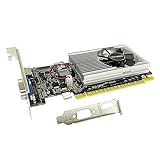
- The Geforce 210 is with a 589MHz core clock,up to 1066Mbps effective,perfect for working,video and photo editing,allows good fluency,which can effectively meet your needs.
- PCI Express 2.0 interface,offers compatibility with a range of systems. Also includes VGA and HDMI outputs for expanded connectivity,supports up to 2 monitors.Good for adding a simple low profile gpu to a small form factor pc.
- The computer graphics cards is small in size and saves more space,easy to install,plug and play,you can build a compact PC system easily for slim/ITX chassis.
- This low profile video card is good value option for entry level, if you just want basic upgrade graphics and daily simple work for your computer, or not be AAA gamer.(include low profile bracket)
- No external power supply and the all-solid-state capacitor keeps low power consumption and high performance,supports Windows 10/8/7/Vista/XP(not compatible with windows 11).
Risk sharing and supply flexibility
Partners can share scale-up costs and give Intel the option to qualify multiple sources. That matters if Intel wants to serve external foundry customers, whose packaging requirements and volumes may differ.
Intel’s broader foundry direction
Intel’s 2025 annual filing emphasizes a systems-foundry model that combines process technology, advanced packaging, assembly and test, including packaging for wafers made by other foundries. The filing provides strategic context but does not itself confirm a glass-substrate outsourcing decision: Intel’s SEC filing.
Independent reader supportYour contribution helps us test, update, and keep practical guides available for everyone.What glass could enable—and what it cannot guarantee
Glass’s dimensional stability could help large chiplet packages maintain fine alignment as package sizes and interconnect counts rise. That is relevant to AI accelerators, high-performance computing and graphics devices. It may also provide more design latitude for optical links and embedded passive components.
Those advantages do not establish commercial success. Manufacturers must achieve repeatable yields across large panels, fine-pitch redistribution layers, through-glass vias, copper plating, thermal cycling, dicing, edge protection and automated inspection. Glass can still face cracking, edge damage, warpage, thermal-expansion mismatch and through-via yield loss. The decisive question is whether it can be processed at acceptable cost and yield compared with organic substrates.
Free tools Windows power users keep installed
One-click scans. No signup required.
Best Value

- Robust 4GB Memory & Quad Display Ready: Equipped with 4GB of fast GDDR5 memory to smoothly handle daily graphics tasks. Features four built-in HDMI ports, enabling a seamless quad-monitor setup directly out of the box—perfect for multi-tasking offices, digital signage, or trading desks.
- Plug-and-Play Installation & Wide Compatibility: Utilizes a standard PCI Express interface for broad compatibility with most desktop PCs. Offers straightforward plug-and-play installation and stable driver support for modern Windows and Linux operating systems, ensuring a hassle-free setup.
- Quiet, Cool & Compact Design: Engineered with a silent fan and efficient cooling system for near-silent operation, making it ideal for noise-sensitive environments. Its low-profile design fits easily into small form factor cases, with both half-height and full-height brackets included for flexible installation.
- Enhanced Multimedia & Everyday Performance: Delivers smooth 1080P video playback and supports hardware-accelerated decoding, offering an excellent experience for home theater PCs (HTPC). Provides capable performance for everyday applications, multimedia tasks.
- Complete Package & Reliable Support: Includes the graphics card, both low-profile and standard brackets, a quick start guide, and screwdriver, which make it simple and quick setup process.
The emerging supplier landscape
Lens Technology
Lens is Intel’s publicly announced collaboration partner. Its relevant capabilities are precision-glass processing, manufacturing and process innovation. The agreement does not disclose volumes, exclusivity, pricing or an order schedule. Lens’s corporate site is lens.com.cn.
Absolics
Absolics, associated with SKC, describes next-generation glass-substrate platforms, feasibility testing and process optimization on its official site. Industry coverage has identified it as one of the more advanced commercialization efforts, but production scale, customer qualifications and delivery dates remain subject to change.
Samsung Electro-Mechanics
Industry reports have described a pilot line and a possible 2027 commercialization target, including a reported shift of the project into a business unit: TrendForce. Those are reported targets, not an official Intel supply commitment. Samsung’s sustainability report is useful corporate background but does not establish Intel-specific cooperation: Samsung Electro-Mechanics sustainability report.
Other participants
LG Innotek, Nippon Electric Glass, AT&S, Ibiden, Unimicron, materials and inspection vendors, and advanced-packaging companies such as Amkor could participate in the wider ecosystem. None should be treated as confirmed Intel glass-substrate partners without a direct announcement.
What’s actually slowing this PC down?
Pick the symptom - the matching free tool is one click away.
What investors and suppliers should watch next
- An Intel disclosure about whether an internal pilot line remains active.
- Named licensees, supplier-qualification announcements or disclosed capacity commitments.
- Glass-substrate use in an Intel product, foundry or packaging roadmap.
- A firm high-volume-manufacturing date and evidence of customer qualification.
- AI-chip designers or external foundry customers adopting Intel glass-based packaging flows.
- Commercial terms for the Intel–Lens collaboration, including scope, exclusivity and volumes.
For businesses evaluating the opportunity, current offerings are B2B and quotation-based rather than catalog products. Intel Foundry information is available at Intel’s official foundry page; no standard public pricing or open procurement plan is established for the glass-substrate programs described here.
The bottom line
Intel appears to be abandoning the idea that it must own the entire glass-substrate manufacturing chain, not abandoning glass substrates themselves. The 2025 reports suggest external sourcing and possible licensing; the 2026 Lens Technology collaboration makes a partnership-led model visible. Until Intel discloses production ownership, volumes, qualifications and timing, the most accurate description is a shift from solo manufacturer to technology owner, package integrator and ecosystem coordinator.
Quick Recap
Product prices and availability are accurate as of the date/time indicated and are subject to change. Any price and availability information displayed on Amazon at the time of purchase will apply.




