On May 7, 2014, HP launched Helion, a portfolio of OpenStack-based cloud products and services, and said it would invest $1 billion in cloud research, development, innovation and integration over two years. The move was aimed at the same enterprise shift that Cisco and Red Hat were pursuing: turning OpenStack into a supported hybrid-cloud infrastructure rather than leaving customers to assemble it themselves.
The $1 billion was a corporate investment commitment—not a Helion purchase price, revenue forecast or acquisition fund. Helion also was not one product. It combined an OpenStack distribution, a planned Cloud Foundry platform-as-a-service offering, public-cloud expansion, professional services, partner delivery and an intellectual-property indemnification program.
What HP actually announced
HP presented Helion as a unified route to private, public and managed cloud services. The launch mixed immediately available software with previews and forward-looking plans, so the status of each component matters.
| Helion element | What HP announced in 2014 | Status or qualification |
|---|---|---|
| HP Helion OpenStack Community edition | Free download, with optional support listed at $900 per server per year | Available at the May 7, 2014 launch; the price is historical launch pricing |
| Commercial HP Helion OpenStack | Annual subscription listed at $1,400 per server | Planned for general availability in the second half of 2014; not a current price |
| Cloud Foundry-based PaaS | A platform-as-a-service preview | Planned for later in 2014 |
| HP public cloud | OpenStack public-cloud services in 20 data centers worldwide within 18 months | Forward-looking 2014 plan, not proof that the target was completed |
| Professional services | Advisory, strategy, design, application transformation and implementation | Designed to address the operational work around OpenStack |
| Partner delivery | Services through HP’s partner network, including 110 service providers cited in launch coverage | Channel claim from the period |
| OpenStack IP indemnification | A program described in contemporary coverage as “no-cap” | Its contractual scope and exclusions required review |
HP’s launch fact sheet records the historical product names, pricing and availability plans: HP Helion OpenStack fact sheet. The portfolio and investment announcement were reported by CRN.
Recommended Free Tools
#1 Best Overall

- 2.80 GHz processor speed ensures efficient operation with consistent reliability
- Intel Xeon 2.80 GHz processor provides enterprise-grade performance with built-in security and remote management capabilities
- Quad-core (4 Core) processor core helps server process data quickly and reliably for maximum productivity
- 1 processors supported for faster processing and improved access to data, optimizing performance under heavy loads
- With 16 GB memory, you can multitask between applications seamlessly, keeping productivity high and response times quick
What the $1 billion meant
HP said the investment would take place over two years and cover cloud-related research and development, innovation, engineering, integration and other resources. It should therefore be read as a broad corporate commitment supporting HP’s cloud strategy, not as money allocated solely to one Helion software package.
The figure also belonged to a wider 2014 spending contest. Cisco separately announced an investment of more than $1 billion over two years for its Intercloud expansion, describing a network of Cisco and partner clouds intended to move workloads between public and private environments. Cisco’s announcement is archived at Cisco’s Intercloud release.
- Corporate investment: HP’s stated two-year cloud commitment.
- Product pricing: The $900 support figure and $1,400 planned commercial subscription were historical per-server prices.
- Customer spending: Neither price represented a customer’s complete cost of ownership.
- Partner opportunity: Integrators expected revenue from architecture, migration and operations, but partner forecasts were opinions rather than audited results.
Why Cisco and Red Hat were the reference competitors
The rivalry was between strategies and ecosystems, not two identical products or a single combined “Red Hat-Cisco” company. HP promoted a broad, vertically coordinated cloud portfolio. Cisco supplied data-center compute and networking and pursued an Intercloud ecosystem; Red Hat supplied enterprise Linux and OpenStack software.
Rank #2

- Renewed server with the highest quality standards
- Ideal for a robust enterprise environment or data center
- All servers include power cords, and other parts detailed in full product description below
- Custom configurations available upon request
| Dimension | HP Helion | Cisco–Red Hat approach |
|---|---|---|
| Infrastructure | HP-branded cloud portfolio spanning software, hardware and services | Cisco UCS compute and networking infrastructure |
| Cloud software | HP Helion OpenStack | Red Hat Enterprise Linux OpenStack Platform |
| Application platform | Planned Cloud Foundry-based PaaS preview | Enterprise Linux/OpenStack focus in the announced integrated stack |
| Networking and policy | HP integration and services | Cisco ACI policy-based networking |
| Public-cloud strategy | HP public-cloud expansion and hybrid-cloud positioning | Cisco’s partner-based Intercloud vision |
| Services and route to market | HP professional services and channel partners | Cisco and Red Hat partner and service-provider ecosystems |
| Risk-reduction message | OpenStack IP indemnification program | Validated, supported infrastructure integration |
In September 2014, Cisco and Red Hat announced integrated infrastructure combining Cisco UCS, Cisco ACI and Red Hat Enterprise Linux OpenStack Platform: Cisco and Red Hat announcement. Cisco also announced its intent to acquire Metacloud as part of its managed OpenStack private-cloud direction: Metacloud announcement.
Why OpenStack mattered to enterprises in 2014
OpenStack was being sold as an open-source foundation for private and public clouds. Companies hoped to reduce dependence on a single proprietary infrastructure provider, use a common cloud layer across environments and let service providers build differentiated offerings.
- Private-cloud deployment for controlled or regulated workloads.
- Public-cloud capacity without abandoning an OpenStack-based operating model.
- Partner-built managed services.
- A software-led cloud story for hardware and networking vendors.
“Open” did not make deployment simple or portability automatic. A production environment still required expertise in networking, storage, identity, security, automation, monitoring and lifecycle management.
Rank #3
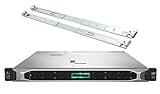
- HP ProLiant DL360 Gen10 Business Server bundle with Rail Kit
- Dual (2) Intel Xeon Silver 4210 10-Core 2.20GHz 13.75MB CPUs
- 64GB (4 x 16GB) DDR4 PC4-19200 2400MHz Registered Memory
- 7.68TB (4 x 1.92TB) 6Gb/s SATA III Solid State Drives for Ultra Fast Enterprise Storage in RAID; HP Smart Array P408i-a 12Gb/s with 2GB FBWC
- Hard drives and memory upgrades included separately NOT installed, installation required.
The practical catch: operating OpenStack
The headline software price was only one part of the decision. An enterprise also had to identify who would install, patch, upgrade, secure and support the platform.
Portability was conditional
Two clouds could both call themselves OpenStack-based while differing in networking plug-ins, storage back ends, image formats, identity systems, orchestration, hardware acceleration, security policy, API versions and operational tools. A workload might move only after changes to images, data, policies, automation or application dependencies.
Total cost could exceed licensing
- Specialist staff and training
- Deployment and integration consulting
- Hardware, storage and network refreshes
- Support subscriptions
- Upgrade and testing projects
- Monitoring, incident response and security operations
Indemnification had limits
HP’s indemnification announcement could reduce procurement anxiety about certain intellectual-property claims, but it was not blanket protection. Contemporary coverage specifically noted that it did not cover security breaches. Buyers would need the contract to determine beneficiaries, exclusions, approved configurations, third-party components and the claims process. It did not automatically cover downtime, data loss, regulatory penalties, misconfiguration or operational failure.
Rank #4
- MODEL P74439-005: Compact and affordable HPE ProLiant MicroServer Gen11 powered by Intel Pentium Gold G7400 3.7GHz processor, ideal for file sharing, NAS, and basic business workloads
- READY OUT OF THE BOX: Includes 16GB DDR5 UDIMM memory (expandable to 128GB), one 1TB SATA 6G Business Critical HDD, embedded Intel VROC SATA, dedicated iLO-M.2 port kit, 180w external power adapter and 1/1/1 warranty for dependable plug-and-play server operation
- WHISPER-QUIET & SPACE-SAVING: Ultra-compact mini tower design fits easily in small office spaces; supports wall, flat, or vertical placement for deployment flexibility
- INTEGRATED REMOTE MANAGEMENT: Comes with HPE iLO 6 and embedded TPM 2.0 for secure, license-free remote server administration through shared port access
- EXPANDABLE DESIGN: Two PCIe slots (including PCIe 5.0) and four LFF-NHP drive bays provide robust options for storage and component scalability. Features new MR408i-p controller support for enhanced storage performance
The channel business behind Helion
HP’s strategy depended on resellers, systems integrators and service providers. The commercial opportunity was less about forwarding a software license than about making a complicated cloud usable.
- Assessing workloads and designing a target architecture
- Building private or hybrid environments
- Modernizing applications
- Migrating data and workloads
- Running managed cloud operations
- Providing ongoing support, governance and security
HP said partners were fundamental to Helion’s success and promoted a consulting methodology and services framework. Statements from solution providers in contemporary coverage show channel enthusiasm, but they do not establish customer adoption, market share or financial returns. See CRN’s coverage of HP’s channel strategy.
How an enterprise would have evaluated the choice
- Choose the deployment model: private, public, managed private or hybrid cloud.
- Assign operational responsibility: identify who handles installation, patching, monitoring, security and upgrades.
- Check hardware and software support: confirm certified servers, networking, storage, release cadence and escalation terms.
- Define portability precisely: specify whether virtual machines, containers, applications, data, identities, policies and automation must move.
- Assess application-platform needs: determine whether infrastructure-as-a-service alone is sufficient or a PaaS is required.
- Verify local expertise: identify an integrator or service provider with relevant OpenStack experience.
- Review legal protections: read the indemnity’s scope and exclusions rather than relying on the “no-cap” label.
- Model total cost and exit: include operations and define how images, data, identities and automation would leave the platform.
What remained unproven
At launch, several important claims were plans or positioning rather than demonstrated outcomes: the completion of 20 planned public-cloud data centers, the timing and final delivery of the commercial edition, the effect of indemnification on procurement, and interoperability across independently operated clouds. The $1 billion commitment also did not prove that Helion would win customers or generate a financial return.
Free tools Windows power users keep installed
One-click scans. No signup required.
Historical assessment
Helion is best understood as an example of the 2014 attempt to commercialize OpenStack through complete vendor portfolios. HP combined a distribution, a proposed PaaS, public-cloud capacity, consulting, channel delivery and legal-risk messaging. Cisco and Red Hat pursued a more explicitly validated infrastructure stack linked to Cisco’s Intercloud ambitions.
The episode shows why enterprise cloud competition was moving beyond servers and software licenses. Vendors were competing to own the architecture, the operating expertise, the partner relationship and the customer’s path between private and public infrastructure. It also shows the enduring distinction between an open technical foundation and a genuinely portable, economical and supportable production cloud.
Quick Recap
Product prices and availability are accurate as of the date/time indicated and are subject to change. Any price and availability information displayed on Amazon at the time of purchase will apply.




