The Tool Desk
Outbyte Driver Updater FREEScan for outdated or missing drivers - takes under a minuteDriver Scan →Outbyte PC Repair FREERepair Windows errors before they cause bigger problemsFix Now →Renewables are likely to supply nearly half of the additional electricity that data centers need through 2030, but they will not physically power most AI data centers every hour. The International Energy Agency (IEA) expects global data-center electricity use to rise from about 485 TWh in 2025 to 950 TWh in 2030, with AI-focused consumption tripling. Gas, coal, nuclear, hydro, storage and grid imports will remain important.
The answer depends on what “powered by renewables” means: electricity physically flowing from a local grid, annual matching through contracts and certificates, or hourly carbon-free supply in the same region.


The electricity boom behind AI
Data centers support far more than model training. Their load includes conventional cloud services, storage, networking, enterprise software, AI training, fine-tuning, inference and increasingly autonomous or “agentic” workloads. Training clusters can create concentrated, high-density demand; inference may run continuously and closer to users.
| Measure | IEA outlook |
|---|---|
| Global data-center electricity use in 2025 | About 485 TWh |
| Projected use in 2030 | About 950 TWh (base case) |
| AI-focused data-center consumption | About three times 2025 use by 2030 |
These are projections, not guarantees. Chip availability, construction delays, financing, model efficiency and the ability to connect new campuses to the grid could all change the outcome. The IEA’s executive summary provides the underlying outlook at https://www.iea.org/reports/key-questions-on-energy-and-ai/executive-summary.
Quick wins for a faster PC:
Fix the driver behind crashes, sound loss and screen glitchesFind Drivers →Repair Windows errors before they cause bigger problemsFix Now →#1 Best Overall
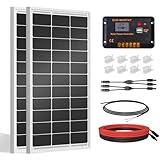
- [Wide Application]: Daily Output 800wh/day under 4 hours full sunshine condition. Perfect for RV, Caravan, Marine, Camper, Electric scooter, Golf Carts, Power wheels, Trolling motor, Tool trailer, Backup power supply for cabin shed home etc.
- [Excellent Performance]: ECO-WORTHY solar panels use high-performance monocrystalline solar cells, which can provide up to 21.5% higher efficiency sufficient light conditions.size:35.2*23.1.37in
- [Durable]: Corrosion-resistant aluminum alloy frame, so that the panel can be used for decades, and can withstand strong wind (2400Pa) and snow load (5400Pa), with a long service life. Ip65 rated junction box provides complete protection.:
- [Complete and Easy]: The back of the pre-drilled and plug-and-play cables allow quick installation, the kit can be connected in series (24V) or parallel (12V) if you need. What you will get: 2 pcs 100W mono solar panel + 2 set of Z mounting brackets + 30A solar controller + 1 pair of 16.4ft 10 awg solar cables + 1 pair of 2-in-1 connectors + 1 pair of 4.92ft tray cable.
- [Support]: 1 year with 24/7 tech support, if any problems or questions about the product,please do not hesitate to let us know through Amazon or call ECO-WORHTY hotline for solution.
Three different meanings of “powered by renewables”
1. The physical grid mix
The most literal definition is the electricity delivered to a facility at a particular moment. It reflects the local mix of wind, solar, hydro, nuclear, gas, coal and other generators. The IEA estimates renewables currently provide about 27% of data-center electricity worldwide, with substantial regional variation. See https://www.iea.org/reports/energy-and-ai/energy-supply-for-ai.
2. Annual renewable matching
A company can contract for, or purchase certificates representing, enough renewable generation to equal its electricity use over a year. This can finance new projects, but it does not mean the facility receives renewable electricity every hour. A solar contract can cover annual consumption while the data center draws grid power generated by gas or coal overnight.
3. Hourly, location-specific carbon-free energy
Hourly matching seeks to cover consumption with carbon-free generation in the same hour and often the same grid region. Solar output disappears at night; wind varies; hydro changes seasonally; batteries have finite duration; and transmission can be congested. This is a substantially harder standard than annual matching.
Google’s target is to operate its data centers and offices on carbon-free energy 24 hours a day, seven days a week by 2030. Its explanation of that approach is at https://sustainability.google/reports/247-carbon-free-energy/.
Recommended Free Tools
Rank #2

- 【Efficient Performance】This Starter Kit can generate an average of 500Wh of electricity per day (varies with sunlight). The solar panel boasts a 22.5% cell efficiency, 1.3% higher than other counterparts. Each panel dispatched from our facility undergoes 100% EL testing, ensuring that your panel is completely free from any hidden cracks.
- 【Market-Leading Service Plan】Enjoy worry-free usage with our market-leading service plan, providing 10 years of coverage for solar panel material and workmanship, along with a 2-year plan for the charge controller. Additionally, benefit from a 25-year service plan for the power output of the panel.
- 【Exceptional Safety】Certified by UL 61730, CSA C22.2#61730, IEC 61730/IEC 61215, our solar panel withstands 2400Pa wind and 5400Pa snow loads. Featuring IP65-rated J-box and IP67-rated solar connectors, rest assured, it can tackle any weather challenge.
- 【Remote Monitoring】The Wanderer PWM Charge Controller features an RS232 Bluetooth port. By adding a Renogy BT-1 Bluetooth Module, you can remotely monitor your solar system on the Renogy DC Home app. Keep track of voltage and current at any time, and receive timely warnings for over-voltage, under-voltage, and over-discharge.
- 【Excellent Compatibility】The solar kit with the Wanderer 30A PWM Charge Controller, supports expansion up to 400W with additional solar panels and is compatible with AGM, Gel, Flooded, and Lithium batteries.
What the global forecast actually says
The IEA expects renewables to meet nearly half of the growth in data-center electricity demand between 2024 and 2030. If demand rises from 485 TWh to 950 TWh, the increase is roughly 465 TWh; applying “nearly half” implies about 230 TWh of additional renewable generation associated with that growth.
That calculation is an illustration of the IEA figures, not a published forecast that 50% of all 2030 data-center electricity will be renewable. The existing demand base remains a mixture of sources, and the rest of the increase comes from gas, coal, nuclear, hydro and other grid changes. The IEA expects gas and coal together to supply more than 40% of incremental data-center demand through 2030. Renewables are the fastest-growing source, with generation for data centers rising at roughly 22% per year from 2024 to 2030.
Why renewable procurement will accelerate
- Wind and solar projects can generally be developed faster than new nuclear plants.
- Corporate power-purchase agreements (PPAs) let technology companies finance new capacity.
- Costs and supply chains are mature in many markets.
- Distributed projects can be added across several regions.
- Batteries, flexible computing and better transmission can make variable output more useful.
Technology companies accounted for about 40% of corporate renewable PPAs signed in 2025, according to the IEA’s April 2026 update: https://www.iea.org/news/data-centre-electricity-use-surged-in-2025-even-with-tightening-bottlenecks-driving-a-scramble-for-solutions.
Why renewables will not be enough by themselves
Reliability and timing
AI services often require extremely reliable power. A portfolio that produces surplus solar at noon still needs firm supply after sunset or during prolonged low-wind periods. Batteries help, but their duration and economics do not cover every weather event or seasonal gap.
What’s actually slowing this PC down?
Pick the symptom - the matching free tool is one click away.
Rank #3
Interconnection and transmission
A renewable plant cannot serve a campus if the transmission network is full or the local substation lacks capacity. The IEA identifies transformers, turbines, chips, permitting and grid connections as bottlenecks. A project can be contracted yet unable to deliver when the data center opens.
Local concentration
A large AI campus can add gigawatts in one region. A remote wind PPA may add clean generation elsewhere while the local system uses gas or coal to meet immediate demand. The relevant marginal question is which generator produces the next megawatt-hour at that location and time.
Why gas can grow alongside clean-energy buying
The IEA expects developers, particularly in the United States, to pursue on-site natural-gas generation where grid connections are slow. That creates a paradox: hyperscalers can finance substantial new wind and solar while their immediate need for firm power increases gas dispatch and fossil infrastructure.
Gas may be a short-term reliability solution, but new plants can create emissions and infrastructure lock-in for decades. “Renewables purchased,” “electricity physically consumed,” “local marginal emissions” and “corporate market-based accounting” are four different measures and can produce different conclusions.
Outdated Drivers Are Slowing You Down
One free scan finds every outdated or missing driver and matches the right update for your exact hardware.Free scan · exact hardware matchWindows Errors? Fix Them Before They Spread
Repair common Windows errors and clear accumulated junk for a smoother, more stable PC - no reinstall needed.Free scan · no reinstallNuclear and other firm low-carbon resources
Nuclear is not renewable, but it can supply firm, low-carbon electricity. The IEA reports that conditional data-center offtake agreements for small modular reactors rose from 25 GW at the end of 2024 to 45 GW in 2026. Conditional agreements are not operating generation and may arrive after the immediate demand surge.
Companies are also considering existing nuclear plants, reactor restarts, advanced geothermal, hydropower, long-duration storage and grid-enhancing technologies. The likely system is therefore a portfolio: wind and solar for low-cost energy, nuclear and hydro for firm clean supply, storage and flexible workloads for balancing, and gas where networks cannot expand quickly.
What Big Tech’s claims mean
| Company | Reported claim | How to interpret it |
|---|---|---|
| About 65% average carbon-free energy across data centers and offices in 2025 | Global company-reported average; carbon-free is broader than renewable. Goal: 24/7 carbon-free energy by 2030. Source | |
| Microsoft | 34 GW of renewable assets contracted in 24 countries | Contracted capacity is not the same as delivered electricity. Source |
| Amazon | 100% annual renewable matching for electricity consumed in 2025 | Company-level annual matching; Amazon’s broader carbon-free definition includes nuclear. Source |
| Meta | Electricity for owned and operated data centers and offices matched with clean and renewable energy | A company matching claim, not proof of hourly physical renewable supply at every facility. Source |
Google also reports a 2025 fleet-wide average power-usage effectiveness (PUE) of 1.09, while Amazon reports a global data-center PUE of 1.14. PUE measures facility overhead, not whether electricity is renewable.
Independent reader supportYour contribution helps us test, update, and keep practical guides available for everyone.Geography changes the answer
Renewable-rich grids
Regions with abundant hydro, wind or solar and relatively low-carbon grids can make hourly matching easier, although seasonal output and transmission constraints remain.
Free tools Windows power users keep installed
One-click scans. No signup required.
Best Value

- Portable Generator with 60W Solar Panel Included: with a big battery pack, ZeroKor 300W solar powered generator are powerful enough to charge smartphones,tablets,laptops,headphones or other outdoor small camping supplies(Tips:Using electrical appliances over 300W may damage the portable solar generator, especially some devices that are prone to heat or built-in air compressor such as coffee maker,Hair dryer, water pump etc )
- Multiple Charging outlets for camping gear with SOS Flashlight: with 2* 300W Max wall AC outlets, 1* DC port (9V-12.6V/10A max ), 3* 5V/3A Max USB ports, 1*quick charge USB port (5V/3A 9V/2A Max), Flashlight with reading mode and SOS mode for your outdoor Adventures, our portable solar power station offers a versatile charging solution,allowing you to charge your outdoor smart devices directly from a wall AC outlet
- Multiple Charging Optional, Solar Panel Charger 60W Included: ZeroKor portable power bank generator can be recharged by Home AC outlet, DC5521 13V-23V Solar Panel (Portable Power Station built-in MPPT), 12V Carport. Take the portable solar power bank generator with you on-the-go and never worry about power shortage,the portable AC outlet design makes it more suitable for Tent camping OFF-Grid
- Built in BMS(Battery Management System) : ZeroKor portable power station features short circuit protection, over-current protection, over-voltage protection, overload protection and overheating protection. The built-in cooling fan system will automatically start and stop according to the portable battery pack internal temperature during use. Acting as a portable solar power bank, it accommodates multiple devices simultaneously, making it perfect for indoor and outdoor use
- HIGH CONVERSION EFFICIENCY: ZeroKor solar panels 60W monocrystalline solar cell have a high conversion efficiency of 20.5%, and its performance is better than that of polycrystalline solar panels under the condition of insufficient light
Gas-heavy U.S. markets
In fast-growing U.S. data-center corridors, existing gas plants, new gas units or on-site systems may serve load while renewable and transmission projects await approval. The U.S. Department of Energy cites Lawrence Berkeley National Laboratory estimates that data centers could use 11.8% of U.S. electricity by 2030, with a 9.5%–15.3% range: https://www.energy.gov/powering-americas-ai-future-data-center-resource-hub.
Coal-heavy grids
Where coal remains a major source, a renewable contract in another region may not stop local coal or gas dispatch from rising. The IEA says coal currently supplies roughly 30% of global data-center electricity, with regional differences.
Can workloads move to cleaner power?
Training, batch processing, backups, indexing and some non-latency-sensitive inference can potentially move to cleaner hours or regions. Scheduling can use hourly carbon-intensity data, available transmission and storage.
Latency commitments, data-residency rules, bandwidth, GPU availability, service-level agreements and continuous inference limit how far workloads can move. Shifting computation is useful, but it cannot replace new generation, transmission and firming resources.
Efficiency helps, but may not cut total demand
More efficient accelerators, models, cooling systems, data-center designs and workload scheduling reduce electricity per task. The IEA cautions that greater adoption and energy-intensive uses such as AI agents can overwhelm those gains. Cheaper, more capable AI can create a rebound effect in which total usage rises even as each task becomes more efficient.
How to judge a renewable-power claim
- Is the claim about physical electricity or contractual matching?
- Is matching annual, monthly, hourly or 24/7?
- Are generation and consumption in the same grid region?
- Does the contract support new projects or existing assets?
- What serves the local marginal load?
- Are storage, transmission and backup generators included?
- Does “clean” include nuclear or other non-renewable sources?
- Does the claim cover the specific AI facility or the company overall?
Verdict
Renewables will probably be the largest single contributor to new electricity supply for the AI data-center boom and may cover nearly half of demand growth through 2030. That is not the same as renewables supplying most of the electricity physically consumed by AI data centers.
Annual renewable matching by large technology companies will expand faster than true hourly, location-specific renewable supply. The decisive issue is whether grids build transmission, storage and firm low-carbon generation quickly enough to meet concentrated AI demand without locking in gas and coal.
Quick Recap
Product prices and availability are accurate as of the date/time indicated and are subject to change. Any price and availability information displayed on Amazon at the time of purchase will apply.




