What’s actually slowing this PC down?
Pick the symptom - the matching free tool is one click away.
Banks can use RFID to identify and track cash boxes, support custody handovers, and manage fixed assets. In a typical workflow, a tagged item is read by a handheld device and the scan is synchronized with a back-end system. That creates an inventory or movement record; it does not, by itself, prove who handled the item or secure a vault.
What RFID does in a banking workflow
Radio-frequency identification (RFID) uses radio-frequency fields to transmit information from a tag to a reader. In a bank, the tag is attached to an object—such as a cash box or piece of equipment—and a reader captures its identifier. The system can then connect that scan to an inventory or custody record.
RFID is an identification and data-capture method, not a complete security system. Its design depends on the business process: what is tagged, how items are read, what information is recorded, and how the records reach systems used by bank staff.
Where banks and financial institutions can apply RFID
Vault inventory and cash-box handovers
A Chainway case study identifies the Bank of China and describes a workflow combining UHF RFID, barcode scanning, network-connected handheld devices, and separate clerk identity verification. The handheld captures cash-box or bag IDs and handover details; the records are synchronized to a server for administrators to consult. Chainway names its C4050 handheld reader in the example. These are vendor-reported implementation details, not an independent evaluation of the system’s effectiveness (Chainway’s Bank of China case study).
#1 Best Overall
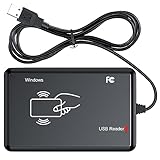
- RFID Reader Scanner read both 125KHz/13.56Mhz 1326 family ISO Prox whole family cards & EM ID EM4100 cards together, MF S50 S70 bank card and other 14443A protocol labels that support ISO14443-A/B protocol, ID card and other 14443B protocol labelsHID USB device no driver request.
- 125KHz/13.56Mhz Dual-frequency RFID reader supports EM4100 ID cards and also 1326 1346 1386 ISO Prox card, H10301 H10304 format etc.
- RFID Reader with 40 output formats for EM4100 ID card UID, max. 40 bits card number in 10H or 13 digital decimal format, configurable with config card by user.
- Proximity card reader sends 125KHz/13.56Mhz Dual-frequency proximity card 1326 family card number in 40 type formats or in raw wiegand bit data format, from 24 bit to 80 bits data, easy for understanding 1326 family card type.
- USB Inteface,Card reader only, Open the software or document that needs to be read,simulate keyboard input, works in Linux Andriod Windows Mac IOS.
The division of roles matters: RFID identifies the tagged box or bag, while the separate identity check associates a clerk with the transaction. A tag read alone does not establish a person’s identity or authorization, and an inventory record is not a substitute for physical vault controls.
Cash-in-transit and custody tracking
Seuic describes an unnamed bank using tagged cash boxes and an industrial RFID handheld terminal to track assets from storage into circulation, record handovers, and transmit scan data in real time. The vendor presents this as a closed-loop lifecycle workflow, but does not name the bank or show a publication date on the case page. Treat it as an example of a proposed or reported process, not a verified result for a named institution (Seuic’s banking solution page).
Rank #2
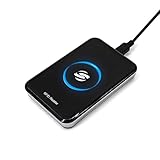
- New Metal Case RFID Reader Durable, Beautiful and More Accurate Reading.Note: 1. Not compatible with Mac, need to use with USB converter. 2. Windows system if you can not use, you need to install a patch in Windows: VCRedist 2008 SP1 (x64). 3. H10301, 8310 card does not support reading, setup tools, please go to the last link to download, thanks!
- RFID Reader Scanner read both 125KHz/13.56Mhz 1326 family ISO Prox whole family cards & EM ID EM4100 cards together, MF S50 S70 bank card and other 14443A protocol labels that support ISO14443-A/B protocol, ID card and other 14443B protocol labelsHID USB device no driver request.
- RFID Reader with 40 output formats for EM4100 ID card UID, max. 40 bits card number in 10H or 13 digital decimal format, configurable with config card by user.
- Proximity card reader sends 125KHz/13.56Mhz Dual-frequency proximity card 1326 family card number in 40 type formats or in raw wiegand bit data format, from 24 bit to 80 bits data, easy for understanding 1326 family card type.
- USB Inteface,Card reader only, Open the software or document that needs to be read,simulate keyboard input, works in Linux Andriod Windows Mac IOS.
Fixed-asset inventory
RFID can also support tracking institutional assets. NIST lists asset management and tracking among RFID application classes, while Seuic describes fixed-asset processes such as receiving, allocation, transfer, and inventory counts. The general application is established; the specific banking workflow details on Seuic’s page remain vendor claims (NIST, Securing Radio Frequency Identification (RFID) Systems; Seuic).
What RFID records can—and cannot—prove
A scan can create evidence that a particular tag was read at a particular point in a workflow, provided the system records the event reliably. To make that record useful for custody, the process should associate the item with the relevant handler, time, location, and transaction. The Bank of China example’s separate clerk verification illustrates why item identification and staff authentication are distinct steps.
Quick wins for a faster PC:
Scan for outdated or missing drivers - takes under a minuteDriver Scan →Repair Windows errors before they cause bigger problemsFix Now →Fix the driver behind crashes, sound loss and screen glitchesFind Drivers →Rank #3

- RFID Reader read both 125KHz 1326 family ISO Prox whole family cards & ID 4100 RF/64 RF/32 cards together, USB device no driver request.
- 125KHz RFID reader supports 4100 ID cards and also 1326 1346 1386 ISO Prox card, 10301 10304 format etc.
- RFID Reader with 40 output formats for ID card UID, max. 40 bits card number in 10H or 13 digital decimal format, configurable with config card by user.
- Proximity card reader sends 125KHz proximity card 1326 family card number in 40 type formats or in raw wiegand bit data format, from 24 bit to 80 bits data, easy for understanding 1326 family card type
- Advanced config process allow user to choice 20 clients format output and set prefix/suffix, ingore leading zero. This is read only. If you want to write card with ID/FC number, you may go ASIN:B0BCYRSLSF
RFID does not by itself confirm that a box contains the expected cash, prevent an authorized person from misusing access, or guarantee that a handover record cannot be altered. Those outcomes depend on physical procedures, identity controls, software, networks, and audit practices around the RFID equipment.
Security and privacy depend on the deployment
NIST advises organizations to address RFID security and privacy across the system lifecycle, from initiation and design through implementation and operation. It emphasizes that risks and available controls vary with the system’s components and customizations (NIST, 2007; NIST Special Publication 800-98). These are foundational publications from 2007, not product-specific guidance about current equipment.
Rank #4

- 【Instant Plug & Play Setup】: No external power supply or battery needed. Simply connect the contactless card reader to your computer’s USB port, and it’s ready to use instantly—no complicated setup, and no additional software or drivers required, saving your time on installation.
- 【Lightning-Fast Performance】:Boost your efficiency with a high-speed response time of less than 0.2s. This 125kHz reader offers a stable reading distance of up to 8cm (depending on the tag type used), ensuring quick and reliable data capture without the frustration of repeated swipes.
- 【Universal OS Compatibility】:Designed for seamless integration across all your devices. This contactless reader fully supports Windows, Mac OS, Linux, Chrome OS, and Android 7.0+. Whether you're using a PC, laptop, or tablet, it provides consistent performance across multiple platforms.
- 【Standardized Data Output】:Specifically engineered for EM4100, EM4200, and TK4100 cards/tags. It automatically outputs the first 10 digits in a standardized format, making it perfect for office attendance, library management, and inventory tracking without manual entry errors.
- 【Standardized & Customizable Output】:Specifically engineered for EM4100, EM4200, and TK4100 cards/tags. By default, it automatically outputs the first 10 digits, making it perfect for office attendance and inventory tracking. Need a different format? Use our exclusive configuration tool to customize data output (such as 8-digit HEX, reversed formats, or adding a suffix like "Enter"), Setting tool is compatible with Windows system Only.
For a bank evaluating a deployment, the practical questions include:
- What information is stored on each tag, and what can be learned from an unauthorized read?
- How are readers authenticated and protected from unauthorized use?
- Who can access the back-end inventory and handover records?
- Are scan events logged, retained, and reconciled against expected movements?
- How will the institution detect and respond to data exposure, unexpected reads, or missing records?
RFID is not a regulatory requirement or a compliance shortcut
The cited U.S. guidance does not mandate RFID. Federal Reserve interagency authentication guidance recommends risk assessment and layered security, including monitoring and stronger authentication such as multifactor authentication when warranted; it says it does not establish a new compliance standard (Federal Reserve SR 10-4). The Federal Reserve’s bank security procedures rule requires member banks to adopt appropriate security procedures and specified baseline devices, with additional devices determined through the security officer’s risk assessment (12 CFR § 208.61). Neither source says that RFID satisfies those obligations on its own. These references concern U.S. institutions and should not be treated as rules for other jurisdictions.
Windows Errors? Fix Them Before They Spread
Repair common Windows errors and clear accumulated junk for a smoother, more stable PC - no reinstall needed.Free scan · no reinstallOutdated Drivers Are Slowing You Down
One free scan finds every outdated or missing driver and matches the right update for your exact hardware.Free scan · exact hardware matchBest Value

- . IC card USB reader, Send data to cursor location, HID USB no driver is requested
- . usb reader supports iso14443A protocol cards
- .Support 4 byte UID and 7 byte UID 13.56M card
- .Emualte USB keyboard output, so easy interfaced into RFID system without changing the original software or program, selectable 28 formats are suitable for most common system
- .Default setting is 8H 10D format, Send card data in 10 digital datas to focused window as an external input device
How to assess an RFID proposal
RFID should be compared with barcode workflows and other controls against the actual banking task. The vendor case studies do not provide a neutral benchmark or independently verified performance figures, so the decision should rest on a process-level assessment.
- Read workflow: Determine whether staff must scan each item individually or can read multiple tagged items in a controlled batch, and how much manual handling remains.
- Tag and environment: Check that tags suit the assets and work in the intended conditions, including around metal, inside vaults, and during transport.
- Custody evidence: Confirm whether records identify the item, handler, time, location, and handover event—not just a tag read.
- Integration: Establish how readers connect, how records synchronize, how inventory is reconciled, and how long audit logs are retained.
- Security and privacy: Review tag-data exposure, reader authorization, access to back-end records, and safeguards against unauthorized reads or tracking.
- Deployment fit: Account for compatible readers and tags, software and network needs, staff training, and ongoing maintenance.
Specialized UHF RFID handheld readers and industrial terminals appear in the cited banking examples. A reader alone does not create a working bank process: the institution also needs suitable tags, compatible software and connectivity, defined procedures, and controls for identity, custody, and records.
Quick Recap
Product prices and availability are accurate as of the date/time indicated and are subject to change. Any price and availability information displayed on Amazon at the time of purchase will apply.




