2025 annual TFSA dollar limit: $7,000. That is the annual limit, not necessarily your personal contribution room: your room depends on eligibility, unused room, contributions and withdrawals. Use the tracker below as a record-keeping aid, then reconcile it with CRA and financial-institution records before contributing. A 2025 setup is not a current-year limit table: update it for later years and check your live room with CRA.
Go to the free copyable tracker template
Free copyable TFSA contribution tracker template
Copy this workbook structure into Google Sheets or Excel. The template is designed to track activity across multiple institutions; it is not an official CRA calculation or tax record. Create a personal copy in your spreadsheet app, restrict access if it contains sensitive information, and keep a separate backup.
Google Sheets: Google Sheets. Excel: Microsoft Excel. The tables and formulas below are the copyable template; this article does not provide a hosted workbook download.
Tab 1: Instructions
- Purpose: maintain a dated transaction trail and estimate room from the information entered.
- Contribution: an amount contributed to a TFSA, including an in-kind contribution. Use the issuer-reported amount and transaction date.
- Withdrawal: an amount removed from a TFSA. It generally becomes room again on January 1 of the following calendar year, not on the withdrawal date.
- Direct transfer: a transfer handled directly between TFSA issuers. Keep its confirmation and do not automatically classify it as a cash withdrawal and a new contribution.
- Investment return: interest, dividends, or gains and losses within the TFSA; these change account value, not contribution room.
- Check CRA and issuer records before contributing. Update the annual-limits tab when a new limit is announced. The workbook is an estimate, not CRA advice or an official room determination.
Tab 2: Annual Limits
Enter one annual limit per row so future changes can be made in one place rather than hidden inside formulas. These are the CRA-listed annual dollar limits, not a statement of any individual’s available room.
#1 Best Overall

- Effective Budget Plan Book – Take control of your finances with the SUNEE budget account book. This all-in-one budget planner allows you to plan and track your income, expenses, savings, and financial goals. Its intuitive layout and easy-to-use sections help you stay organized and make smart decisions to reach financial success. Our financial planner also included a comprehensive guidebook with valuable tips and instructions to help you get the most out of your budgeting planner.
- Full-Page Calendars – Each month’s full-page calendar provides plenty of space to track paydays, bills due dates, appointments, and important events. No more cramped boxes or tight writing areas, you can easily plan and organize your schedule at a glance.
- Colorful Pages Layout and Tabs – This vibrant budget planner features a user-friendly design for easy navigation and organization. Each month includes dedicated budget pages to set financial goals, track income, and plan expenses. Additional sections like debt trackers, savings goals, and bill payment trackers make managing your finances a breeze. The colorful backgrounds on each page offer clear, instant visibility.
- Bonus 4 Stickers and Convenient Design – This monthly budget planner is built for convenience and durability. Water-resistant cover protects against spills, while the elastic band keeps everything secure, and the dual-sided pocket offers extra storage. Plus, we’ve included 4 adorable sticker sheets to personalize your planner and make budgeting more enjoyable. Experience a budget planner that combines practicality with lasting quality.
- UNDATED DESIGN & 1 YEAR USE - Undated finance books start with 1 page-financial goals, 1 page-Mind Map, 1 page-Financial Strategy, 1 page-Tactics, 2 pages-Important Dates, 4 pages-Bill Tracker, 4 pages-Saving Tracker, 8 pages-Debt Tracker, followed by 12 Months(10 pages per month, 1 unique color for each month). 2 pages-Christmas Budgeting, 2 pages-Yearly Summary, 2 pages-Check Register and 12 pages-Notes(dotted). It is UNDATED, so you could start at any time, suitable for 1 year use.
| Year | Annual TFSA dollar limit |
|---|---|
| 2009 | $5,000 |
| 2010 | $5,000 |
| 2011 | $5,000 |
| 2012 | $5,000 |
| 2013 | $5,500 |
| 2014 | $5,500 |
| 2015 | $10,000 |
| 2016 | $5,500 |
| 2017 | $5,500 |
| 2018 | $5,500 |
| 2019 | $6,000 |
| 2020 | $6,000 |
| 2021 | $6,000 |
| 2022 | $6,000 |
| 2023 | $6,500 |
| 2024 | $7,000 |
| 2025 | $7,000 |
Source: CRA’s TFSA guide and annual-limit table. The TFSA program began in 2009. Do not add these limits together and assume the result is your available room: age, Canadian residency, eligibility, and your own transaction history matter. See CRA’s room calculation guidance and CRA’s non-resident rules.
Tab 3: Transactions
Use one row per transaction. Suggested columns:
| Column | What to enter |
|---|---|
| Date | Transaction date shown by the institution, not the date you enter the row. |
| Tax year | Calculated from the date. |
| Institution | Bank or brokerage name. |
| Account nickname | A label that distinguishes accounts without exposing sensitive account numbers. |
| Transaction type | Choose from the categories below. |
| Amount in CAD | Issuer-reported Canadian-dollar amount where available. |
| Description | Brief explanation, such as scheduled deposit or in-kind transfer. |
| Statement/reference | Statement period or transaction reference to find supporting records. |
| Included in contribution total? | Yes/no flag used by your summary logic. |
| Included in withdrawal total? | Yes/no flag used by your summary logic. |
| Notes | Corrections, transfer details, or other context. |
Suggested transaction-type dropdown values: Contribution; Withdrawal; Direct transfer in; Direct transfer out; Reversal/correction; Investment income or capital gain; Fee; Other. Treat transfers, reversals and other unusual items deliberately rather than allowing them to flow into contribution totals by default. Fees and investment returns affect account value but are not contributions merely because the balance changes.
Tab 4: Dashboard
Include fields for selected tax year, opening estimated room, annual limit, contributions this year, withdrawals this year, estimated room remaining, possible excess contribution, next January withdrawal restoration, last reconciliation date, CRA room figure entered by you, and the difference between the estimate and CRA’s figure.
Tab 5: Reconciliation
Use one row per institution and account. Suggested columns: Institution; Account; Statement period; Issuer-reported contributions; Issuer-reported withdrawals; Spreadsheet contributions; Spreadsheet withdrawals; Difference; Resolved?; Explanation.
Quick wins for a faster PC:
Clear out junk files and repair common Windows errorsFree Scan →Scan for outdated or missing drivers - takes under a minuteDriver Scan →Rank #2
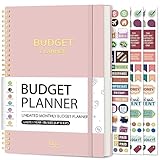
- Effective Budget Planning - Take control of your finances with the budget account book. This comprehensive planner allows you to plan and track your income, expenses, savings, and financial goals in one convenient place. With its intuitive layout and easy-to-use sections, you can stay organized and make informed decisions to achieve financial success.
- User-Friendly Layout - The budget planner features a user-friendly layout designed for easy navigation and organization. Each month, you'll find dedicated budget pages where you can set financial goals, track your income, and plan your expenses. Additional sections include debt trackers, savings goals, bill payment trackers, and more, making it simple to stay on top of your finances.
- Undated Monthly Calendar & Bonus Stickers - Featuring undated calendar each month, you'll have ample space to mark paydays, bills due, appointments, and important dates. Say goodbye to difficult writing spaces. Plus, we've included 3 cute sticker sheets that allow you to personalize your financial organizer and make budgeting more fun. Dates are not pre-printed and are completed by the user.
- Reliable and Convenient Design - Our monthly budget planner is designed for your convenience and built to last. The elastic band keeps everything securely in place, and the dual-sided pocket provides extra storage. Experience a budget planner that combines practicality and durability.
- Master Budgeting with Ease - Our financial planner includes a complete guidebook that provides valuable insights and instructions for optimal usage. From setting financial goals to tracking expenses, this guidebook offers step-by-step guidance and practical tips. Whether you're new to budgeting or an experienced user, this resource will help you make the most of your budget planner, empowering you to achieve financial success.
How the tracker estimates room
For a chosen date, the conceptual calculation is eligible annual limits through that year, plus unused room carried forward and prior-year withdrawals, less contributions. A practical 2025 dashboard can separate its inputs like this:
Opening room for 2025 + 2025 annual limit − 2025 contributions = estimated room remaining during 2025.
The opening-room figure must already account for eligible prior-year room, prior contributions and prior-year withdrawals. Keep 2025 withdrawals in a separate field: they generally return as room on January 1, 2026, rather than increasing room available during 2025. Unused room generally carries forward. See CRA’s contribution guidance and CRA’s withdrawal rules.
Example: a withdrawal does not refill this year’s room
Suppose an eligible account holder starts 2025 with $3,000 of unused room, has a $7,000 annual limit, contributes $2,000 at one institution and $1,500 at another, then withdraws $4,000 on June 15. The estimated room during 2025 is $3,000 + $7,000 − $3,500 = $6,500. The $4,000 withdrawal is tracked separately and generally becomes available on January 1, 2026; it is not added to that 2025 estimate. This illustration assumes the opening-room figure is correct and there are no other transactions or eligibility complications.
Free tools Windows power users keep installed
One-click scans. No signup required.
Rank #3

- Budget Planner: Stay on top of your finances and achieve your financial goals with our A5 Budget Planner. This beautifully designed budget book combines functionality and style, empowering you to effectively manage your budget month after month.
- Classic Design: The elegant pink cover with the striking "Budget Planner" in gold adds a touch of sophistication to your financial planner. Carry it with pride and make a statement as you take charge of your financial.
- Comprehensive Layout: Our monthly budget planner features a well-thought-out layout that simplifies your budgeting process. With a dedicated monthly budget page, four expense tracking pages, a monthly summary, and a notes section, you have all the tools you need for effective financial planning.
- 14-Month Duration: Unlike many other planners on the market, ours covers a total of 14 months, giving you an extended period of financial organization. Now you can make income and expense records at any time, ensuring every financial decision aligns with your long-term goals.
- Premium Quality and Convenience: Crafted with attention to detail, this budget planner boasts superior quality. The sturdy pink and gold coil binding allows for effortless flipping, while the A5 size makes it the perfect companion for your daily adventures, fitting into your bag or backpack without taking up too much space.
Spreadsheet formulas
Assume the Transactions tab uses column A for date, B for tax year, E for transaction type, F for amount in CAD, and the Dashboard cell B1 for selected tax year. In B2, calculate year from the date with =YEAR(A2), then fill down. Annual contribution total:
=SUMIFS(Transactions!$F:$F,Transactions!$B:$B,Dashboard!$B$1,Transactions!$E:$E,"Contribution")
Annual withdrawal total:
=SUMIFS(Transactions!$F:$F,Transactions!$B:$B,Dashboard!$B$1,Transactions!$E:$E,"Withdrawal")
If the estimate is in a named cell called EstimatedRoom, a basic warning is =IF(EstimatedRoom<0,"Possible over-contribution","Within estimated room"). This warning only reflects the formula inputs; it cannot confirm that the entries or opening-room figure are complete.
Rank #4

- 【Take Control Of Your Money】Easily plan your monthly budget, track income & expenses, and stay on top of your finances. This budget planner helps you clearly see where your money goes and avoid overspending.
- 【Designed For Real Life Use】Perfect for young professionals, families, students, and anyone working toward financial goals. Whether managing daily expenses or planning long-term savings, this budget book keeps everything organized.
- 【All-In-One Budget System:】Our monthly budget planner features a well-thought-out layout that simplifies your budgeting process. Includes monthly budget pages, expense trackers, bill organizers, savings goals, and debt trackers. Everything you need to manage money in one convenient planner.
- 【12-Month Duration】Our budget planner covers a total of 12 months, giving you an extended period of financial organization. Now you can make income and expense records at any time, ensuring every financial decision aligns with your long-term goals.
- 【Premium Quality and Convenience】Crafted with attention to detail, this budget planner boasts superior quality. The sturdy pink and gold coil binding allows for effortless flipping, while the metal corner protectors effectively prevent damage to the cover, ensuring long-lasting durability.
Set up and use the tracker
- Make a personal copy. Create a new Google Sheet or Excel workbook and add the five tabs described above. Use a private storage location and restrict sharing.
- Enter eligibility and starting information. Establish the opening-room amount from your records and CRA guidance, taking account of eligible years, residency and prior activity. Do not seed the sheet with a generic cumulative maximum.
- Confirm the annual-limit table. Use the CRA table linked above for 2025, and update later-year rows only with confirmed limits.
- Gather records before entering history. Collect CRA My Account TFSA information, statements from each issuer, transfer confirmations, contribution confirmations, withdrawal records, and statements for closed or transferred accounts.
- Enter historical transactions using their original dates. Do not use today’s date just because you are entering the transaction now. For foreign-currency activity, record the Canadian-dollar amount used by the issuer when available; CRA notes issuers convert using the exchange rate on the transaction date. See CRA’s contribution guidance.
- Log withdrawals separately. Record the date and amount, then show the following January 1 as the room-restoration date. A $4,000 withdrawal on June 15, 2025 does not generally make $4,000 available for a 2025 redeposit; the restoration is generally January 1, 2026. CRA provides examples of how recontributing can cause an excess.
- Log every contribution across every TFSA. Include scheduled deposits, cash deposits, deposits into multiple accounts, in-kind contributions and redeposits after withdrawals. Use the issuer’s transaction date.
- Set the dashboard year and review the estimate. Confirm the selected year, totals, unusual entries, and reconciliation date before relying on the estimate.
Reconcile the spreadsheet with CRA and issuer records
CRA room information may not include transactions made during the current year, and the timing of updates can vary. CRA said its 2025 TFSA records were expected to be processed by April 2026; an online figure can still differ from current activity or issuer records. Use the spreadsheet to organize evidence, not to overrule the records. CRA advises checking its information against personal financial records: calculate your room.
- Compare transactions by date against statements and confirmations.
- Check that every TFSA, institution and closed account is represented.
- Check that a current-year withdrawal has not been added back to current-year room.
- Check whether a direct transfer was mistakenly counted as both a withdrawal and a contribution.
- Look for duplicate rows, missing corrections and reversed transactions.
- Ask the financial institution about missing or incorrectly reported issuer data.
- When CRA’s information is incomplete or you made current-year contributions, use CRA’s RC343 TFSA contribution room worksheet as applicable.
Handle transfers, returns, corrections and other tricky entries
Direct transfers between TFSAs
A properly completed direct TFSA-to-TFSA transfer should not normally be treated like withdrawing cash and making a new contribution. Keep the transfer paperwork and ask the issuer how it processed and reported the transaction. If you withdraw the money yourself and then deposit it into another TFSA, the new deposit can count as a contribution and use room.
Investment gains, losses and fees
Room tracks contributions, not account market value. If a $10,000 contribution grows to $12,000, the increase is not another $2,000 contribution. If it falls to $8,000, the loss does not restore $2,000 of room. Record income, gains, losses and fees separately if useful for account tracking, but do not include them in contribution totals.
Foreign currency and in-kind contributions
For a foreign-currency transaction, prefer the issuer’s Canadian-dollar contribution amount and transaction date; do not substitute today’s exchange rate. An in-kind contribution can count even when no cash changes hands, so use the institution-reported amount and date.
Best Value

- EFFECTIVELY MANAGE YOUR MONEY - Our budget planner helps you take control of your finances by providing sections for financial goals, savings, debts, daily expenses, monthly budget, monthly budget review. This finance planner is a good finance book and will help you manage your money effectively.
- PREMIUM QUALITY - Our budget planner is made with high-quality 100gsm paper that reduces ink leakage, fraying, and shade issues. The sturdy and flexible cover,, helps protect the pages. The metal lay-flat twin-wire binding ensures durability and longevity.
- ORGANIZED MONTHLY GOALS & BUDGETS - Our 12-month budget planner helps you set monthly goals, budgets, reviews, and develop good monetary habits, strategies, and action plans. Write down monthly financial goals, put reminders of bills and payments on the calendar, plan your monthly budget in each category, track daily expenses, and review the monthly budget at the end of the month.
- FLEXIBLE USAGE - Our undated finance planner allows you to start at any time and place, making it convenient to use. It has a perfect size of 8.6x5.9 inches and fits in every bag, so it's always at hand.
- CREATE FINANCIAL FREEDOM - Our budget planner is your chance to develop monthly habits, monetary strategies, and action plans to start your journey to long-term financial freedom. It allows you to track monetary flow and review each area for improvements. With this 1-Years budget book, you can take the first step towards financial freedom.
Corrections and reversals
Do not erase the audit trail when a transaction is cancelled or corrected. Keep the original entry, mark it as reversed or corrected, and add a linked note or adjustment entry so the reason and supporting record remain visible.
Common TFSA tracking mistakes
- “I withdrew $3,000 and put it back two months later.” Unless you had at least $3,000 of other unused room, the redeposit may create an excess because the withdrawal generally returns as room only the next calendar year.
- “I contributed $4,000 at two brokerages.” Room is personal and shared across all TFSAs; total contributions across institutions, not each account separately.
- “My account is worth $25,000, so I assumed I contributed $25,000.” Balance includes market gains, losses, income and withdrawals; it is not a contribution ledger.
- “My spreadsheet says one thing and CRA says another.” Reconcile dates and accounts, check transfer treatment and current-year activity, and consult RC343 where relevant rather than choosing whichever figure is higher.
- “I became a non-resident.” Do not assume annual room accrued in non-resident years or that contributions while non-resident are treated like resident contributions. Review CRA’s non-resident rules.
- “I moved my TFSA to another bank.” Determine whether the institutions completed a direct transfer or you withdrew and redeposited the funds; retain the transfer or transaction confirmations.
Spreadsheet or automated tracking app?
A spreadsheet costs little or nothing and works across institutions without linking accounts, but every entry is manual and omissions, duplicates or formula errors can distort the estimate. An automated portfolio aggregator can reduce data entry and help show accounts together, but connectivity and transaction categorization vary; automation does not establish CRA room or remove the need to reconcile.
| Option | Useful for | Trade-off |
|---|---|---|
| Spreadsheet | Free, customizable transaction ledger; offline storage possible; no account linking required. | Manual entry and formula maintenance; no automatic knowledge of CRA reporting. |
| Google Sheets | Browser access, easy copying and sharing. | Cloud storage and sharing settings may not suit readers who prefer sensitive records offline. |
| Excel | Readers already using Excel who want offline files, tables and workbook controls. | Availability depends on the reader’s software access or plan. |
| Wealthica | Readers seeking connected account aggregation, portfolio views and spreadsheet export/sync options. | Features and institution connections depend on the plan; aggregation is not an authoritative contribution-room calculation. See product details and current pricing. |
Choose the spreadsheet if you only need a contribution ledger or do not want to connect accounts. Consider an aggregator for convenience across many accounts, while checking its current features and privacy terms. Neither replaces CRA and issuer records.
Maintain the workbook and respond to a possible excess
- Update the annual-limit table each year using CRA’s published information.
- Reconcile at least quarterly and after transfers or large transactions.
- Save statements and transaction confirmations; record the last reconciliation date.
- Keep a clean backup and avoid overwriting historical transactions.
- In Google Sheets, use data validation for transaction types and conditional formatting for negative estimated room, blank dates, blank institution names, unusually large entries and transactions added after the reconciliation cutoff.
- In Excel, format Transactions as an Excel Table so formulas and data validation extend when rows are added.
If you discover a possible over-contribution, stop further deposits while you confirm the amounts and dates, contact the institution if needed, and review CRA’s TFSA tax guidance and excess-amount examples. CRA states that excess contributions can be subject to a 1% per month tax on the excess amount. Whether and how to remove an excess or address filings depends on the facts; keep records and seek qualified tax help where needed.
Do these 3 things before closing this tab:
1Fix the driver behind crashes, sound loss and screen glitches2Repair Windows errors before they cause bigger problems3Scan for outdated or missing drivers - takes under a minuteQuick Recap
Product prices and availability are accurate as of the date/time indicated and are subject to change. Any price and availability information displayed on Amazon at the time of purchase will apply.




