Quick wins for a faster PC:
Clear out junk files and repair common Windows errorsFree Scan →Scan for outdated or missing drivers - takes under a minuteDriver Scan →Repair Windows errors before they cause bigger problemsFix Now →Hossein Fateh, the co-founder and former chief executive of DuPont Fabros Technology (DFT), started CloudHQ in 2016 after leaving DFT in 2015. The new company was described as a wholesale data-center developer that would build facilities at “massive scale” and lease space to large technology customers. That made the move significant: Fateh was applying the same large-campus, large-customer model associated with DFT rather than moving into an unrelated business.
The initial account, published by Data Center Knowledge on July 8, 2016, identified Fateh as CloudHQ’s founder and principal. CloudHQ’s current materials identify him as founder and CEO and say the company was founded in 2016.
Who is Hossein Fateh?
Fateh is a data-center real-estate executive whose career is closely tied to large-scale wholesale facilities. He co-founded DuPont Fabros Development, the predecessor to DFT, and became chief executive when the business was renamed DuPont Fabros Technology. DFT went public in 2007, giving Fateh experience running a listed data-center real-estate company as the sector was becoming an institutional infrastructure asset.
His role changed with time. The 2016 contemporary report called him CloudHQ’s founder and principal. CloudHQ’s current founder biography and team page describe him as founder and CEO. Those titles should not be treated as interchangeable descriptions of the same date.
#1 Best Overall

- Save valuable floor space: 6U wall mount server cabinet Dimensions: 13.78" H x21.65" W x17.72" D.Maximum mounting depth is 14.2"
- Keep critical network equipment secure: glass door and side panels are lockable to prevent unauthorized access. Front door can be installed on either side of the front of the cabinet to satisfy your door swing orientation preference
- Easy equipment configuration: Fully adjustable mounting rails and numbered U positions, with square holes for easy equipment mounting with top and bottom punch-out panels for easy cable access
- Durability: Made of high quality cold rolled steel holds up to 110lb (50kg) (Easy Assembly Required)
- PCI & HIPPA and EIA/ECA-310-E compliant
What happened at DuPont Fabros Technology?
DFT’s history provides the timeline for Fateh’s return to the market. The company began nearly two decades before the 2016 report as DuPont Fabros Development, later became DuPont Fabros Technology, and listed its shares publicly in 2007. The company had begun looking for a successor as early as 2013. Christopher Eldredge became CEO in 2015, the same year the available reporting says Fateh left DFT.
| Period | Event | What the sources establish |
|---|---|---|
| Nearly two decades before 2016 | DuPont Fabros Development begins | Reported in the contemporary account; the article does not give an exact founding year. |
| 2007 | DFT goes public | Reported by Data Center Knowledge. |
| 2013 | Succession planning begins | The company was reported to be looking for a successor. |
| 2015 | Fateh leaves DFT; Christopher Eldredge becomes CEO | The chronology is established, but the sources do not explain why Fateh left or the terms of his departure. |
| 2016 | CloudHQ is founded | CloudHQ’s current About page gives 2016 as its founding year. |
Nothing in the available sources shows that Fateh’s departure was caused by CloudHQ, that it was involuntary, or that a dispute existed between him and DFT. The record supports chronology, not motive.
What CloudHQ was intended to do
A wholesale data-center model
At the time of the report, CloudHQ was described as providing data-center space for lease and building very large facilities. This is the wholesale-colocation model: a provider develops a substantial powered building or campus, then leases large blocks of capacity to cloud companies, internet platforms and other technology businesses.
Rank #2

- Universal 19” Rack Mount Compatibility – Perfect for pro audio, video, IT, and network gear. Compatible with mixers, routers, patch panels, servers, power amps, and more.
- Heavy-Duty Load Capacity – Built to support up to 550 lbs. Ideal for studio gear, DJ setups, server equipment, and AV components that demand serious stability.
- Robust Steel Frame & Design – Made with 1.5mm thick steel and weighs 36 lbs for maximum durability, reduced vibration, and long-term reliability in any setting.
- Mobile & Secure – Preinstalled with 3” industrial-grade caster wheels (lockable), making it easy to move and position your rack exactly where you need it.
- All-In-One Setup Kit Included – Comes with 34 rack screws (5mm & 6mm), a 1U blank spacer, and an assembly tool—ready for fast installation out of the box.
Wholesale is different from retail colocation, where many smaller customers rent individual cabinets or suites. It is also different from a public-cloud provider such as Amazon Web Services, Microsoft Azure or Google Cloud. CloudHQ’s described business was the physical infrastructure underneath those services, not a platform offering compute or storage directly to the public.
What’s actually slowing this PC down?
Pick the symptom - the matching free tool is one click away.
Why “massive scale” matters
Large customers need dependable power, land for expansion, diverse fiber routes, cooling systems and standardized space. Building at campus scale can lower unit costs and let a provider deliver capacity in phases. It also shifts major risks—power procurement, construction, permitting and long-term capital—from the customer to the data-center developer.
That model explains why CloudHQ resembled DFT without being the same corporate entity. The platform was new, but the operating playbook was familiar to its founder: develop large facilities and lease them to customers with substantial, predictable requirements.
Rank #3

- ADJUSTABLE DEPTH: 4- Post 22U 19" server rack enclosure with 4 vertical rails and adjustable mounting depth 5.7" to 33.0" (14,4cm to 83,8cm); IT rack is compatible with various servers / switches / data / video / AV and other IT networking equipment
- EASY SHIPPING AND ASSEMBLY: Enclosed 22U data rack cabinet ships compact flat-packed to avoid damage and facilitate installation; Include wheels & levelling feet to offer more stability; Home server rack cabinet is only 46.6in (118,3cm) in height
- DESIGN AND VENTILATION: Half height server rack cabinet has lockable and removable door and side panels with vented top allowing airflow; 4 Post 19" rack with 1764lb (800kg) weight capacity (stationary); Computer cabinet rack is EIA/ECA-310-E Compliant
- HARDWARE INCLUDED: Rolling home network rack includes rack mounting and equipment mounting hardware, such as 20 M6 cage nuts / screws, PVC cup washers; Front/rear doors and side panels Keys, 2x allen keys; Rack assembly hardware; Casters and leveling feet
- THE IT PRO'S CHOICE: Designed and built for IT Professionals, this 22U IT Server Cabinet is backed for life, including free lifetime 24/5 multi-lingual technical assistance
Why Fateh’s move mattered in 2016
Executive continuity
Fateh was not an executive leaving data centers for another industry. He brought experience developing and operating the type of wholesale facilities CloudHQ intended to provide. For investors, lenders, landowners and prospective customers, that background could reduce the perceived execution risk of a new private company, even though the sources do not quantify any financing or customer commitments.
A signal about hyperscale demand
Cloud adoption and internet traffic were increasing demand for very large facilities in strategically located markets. A former public-company CEO choosing to build another wholesale platform was evidence of the commercial opportunity he saw in that segment. It was not proof of a particular CloudHQ project, lease or funding round.
Data centers as infrastructure real estate
The story also illustrates the convergence of technology and commercial real estate. A modern data center depends on electrical interconnection, utility capacity, land, fiber and construction expertise as much as on servers. Those characteristics make campuses investable infrastructure assets, while customer demand is tied to long-term digital services.
Rank #4
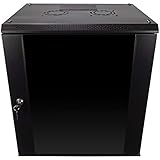
- DURABLE BUILD: Constructed from high-quality Cold Rolled Steel, the NavePoint Consumer Series 12U network cabinet boasts a sturdy, welded frame. Fitting EIA standard 19” networking equipment, this server cabinet confidently supports up to 110 lbs, providing a resilient base for your vital IT gear and equipment
- CONVENIENT DESIGN: This 12U cabinet features a reinforced, heat-treated, tempered glass front door with a security lock. Perfect for applications requiring both security and accessibility, its compact design of 17.72"L x 21.65"W x 24.42"H offers a practical solution for space-constrained settings.
- EASY & CUSTOMIZABLE EQUIPMENT SET UP - The 12U IT cabinet, with removable side panels and security locks, offers customization at its finest. Whether it's for an efficient device or cable management, this data cabinet ensures secure, adaptable configurations that suit your networking server requirements
- ENHANCED VENTILATION & SECURITY - Built-in fans and flow-through ventilation work to prevent overheating, ensuring optimal operation of your equipment. The reinforced, lockable tempered glass front door not only boosts security but also facilitates easy monitoring of installed equipment.
- SAFETY & COMPLIANCE - All NavePoint products are built to industry standards.
What was—and was not—known when CloudHQ emerged
Established in the July 2016 account
- The company was called CloudHQ.
- Fateh was identified as its founder and principal.
- The business involved leasing data-center space and building at massive scale.
- Fateh had been DFT’s co-founder and CEO and had left DFT in 2015.
- Christopher Eldredge had become DFT’s CEO.
Not established by that report
- CloudHQ’s capitalization, investors or ownership structure.
- Named customers, signed leases or total planned megawatts.
- Specific launch campuses, construction schedules or completed facilities.
- The circumstances of Fateh’s departure from DFT.
- Any noncompete, severance or governance arrangements.
The report relied in part on Fateh’s LinkedIn profile and a person familiar with the company; it did not document a conventional public launch event. It is therefore more accurate to say that Fateh had started CloudHQ, according to the report, than to claim CloudHQ formally launched on July 8, 2016.
What CloudHQ says about its later scale
CloudHQ’s current website provides retrospective context, but its figures are company-reported and time-sensitive. They should not be projected backward as conditions that existed at the 2016 founding.
| Current company-reported measure | Figure | How to read it |
|---|---|---|
| Global campuses and portfolio | 23 campuses and 30M+ square feet | Reported on the About page; “portfolio” is not necessarily delivered space. |
| Contracted critical IT load | 1,380+ MW | Reported on the homepage; contracted capacity is not the same as operating capacity. |
| Expansion potential | 6,000+ MW | Reported on the About page; potential is not delivered capacity. |
| Dedicated professionals | 330+ | Reported by CloudHQ and subject to change. |
| Homepage inventory | 5.2+ GW | A separate homepage measure; “inventory” should not be added to contracted or delivered capacity. |
| Delivered space | 9.2M+ square feet | A separate homepage measure; it is not the same as the 30M+ square-foot global portfolio figure. |
CloudHQ currently describes itself as designing, building and operating mission-critical, hyperscale-oriented data centers for large technology companies across North America, Europe and Latin America. Those statements show that the company became a broader global platform, but they do not establish what facilities or customers existed at launch.
How to interpret the story accurately
- “Started” does not mean “publicly launched.” The contemporary report documents the new company but not a formal launch event.
- CloudHQ was a data-center company, not a cloud-service provider. Its described product was physical capacity leased to large customers.
- Similar model does not mean identical company. CloudHQ carried forward a wholesale development and leasing approach associated with DFT, while operating as a new platform.
- Capacity measures are not interchangeable. Megawatts, square feet, campuses, inventory, contracted load and expansion potential describe different things.
- Current scale cannot be backdated. Later company figures provide context, not launch-year facts.
Bottom line
Fateh’s 2016 move mattered because a proven DuPont Fabros Technology executive returned to the same large-scale wholesale data-center market with a new company. The evidence supports a careful conclusion: CloudHQ was founded in 2016 to develop and lease massive data-center capacity, drawing on a business model Fateh knew well. The original report did not establish its funding, customers or projects, while CloudHQ’s later self-reported figures show how far the platform subsequently expanded.
Quick Recap
Product prices and availability are accurate as of the date/time indicated and are subject to change. Any price and availability information displayed on Amazon at the time of purchase will apply.




