Recommended Free Tools
Fermata and yieldsApp announced a technology collaboration on October 7, 2024, intended to connect Fermata’s Croptimus camera-based crop monitoring with yieldsApp’s agronomic-management tools. The aim was to link detection of crop problems with field-specific treatment and fertilization recommendations. The announcement describes a planned integrated workflow; it does not establish a merger, an independently validated system, or a universally available combined product.
What did Fermata and yieldsApp announce?
The companies described a collaboration to combine Fermata’s Croptimus computer-vision platform with yieldsApp’s agronomic-management capabilities. Their stated ambition was to help growers move from identifying a potential crop problem to deciding how to respond. The announcement discussed pests, diseases, and nutrient deficiencies, as well as recommendations involving fertilization and pesticide use. The October 7, 2024 announcement characterizes the offering as a combined solution, but does not provide a detailed product specification or rollout plan.
The public description supports calling this a technology collaboration or intended software integration. It does not establish a merger, acquisition, joint venture, or detailed commercial-distribution agreement. Nor does the phrase “all-encompassing” demonstrate that every function is already integrated in one generally available product.
What each company contributes
| Fermata / Croptimus | yieldsApp |
|---|---|
| Camera-based crop monitoring and image collection | Agronomic-management layer, as described in the partnership announcement |
| Computer-vision detection of potential pests, diseases, and other plant issues | Field-specific treatment protocols and recommendations, as described in the announcement |
| Alerts, images, maps, and heat maps to help locate issues | Weather- and crop-data-informed management, including fertilization and pesticide-use recommendations |
| Follow-up monitoring after an intervention | Further implementation details, supported crops, regions, pricing, and integrations: not stated in the public announcement |
Fermata describes Croptimus as a camera, machine-learning, and computer-vision system for automated scouting. Its product materials say it processes images from cameras installed in a growing facility, flags potential issues, and presents detections and location information to growers or integrated pest-management (IPM) teams. See Croptimus platform details and Fermata’s current product overview.
#1 Best Overall

- Payload Capacity: 8 Gallons / 67 lbs
- Spray Efficiency: 30 – 38 Acres per hour
- Spray Width: 26 – 33 Feet
- Max Take-off Weight: 155 lbs
- Flight Speed: 0 – 27 mph
The available public description of yieldsApp is narrower: it identifies the platform as the agronomic-management side of the collaboration, with treatment and fertilization recommendations. It does not establish a verified current buying page, public pricing, detailed API documentation, supported regions, or whether yieldsApp remains independently available.
How the intended workflow would work
- Capture: Cameras and other data sources collect crop-condition information. Fermata’s clearest public product documentation concerns facility cameras and image capture.
- Detect and locate: Croptimus analyzes images for visible signs of pests, diseases, or other plant issues and presents alerts and location information.
- Add context: The partnership description names local weather, crop models, satellite imagery, agronomic data, and treatment protocols as inputs intended to inform decisions.
- Recommend: The proposed yieldsApp management layer supplies field-specific treatment or fertilization recommendations. The public materials do not document the precise data exchange or recommendation logic.
- Review and act: Growers, agronomists, and IPM staff assess alerts and decide whether and how to intervene.
- Monitor: Later observations can help the team assess whether the issue is changing after intervention. Fermata describes post-intervention monitoring as part of Croptimus; the partnership announcement does not publish measured outcomes from the combined workflow.
Why connect detection to agronomic advice?
Automated monitoring and agronomic management address different gaps. Periodic manual scouting can take time and may miss a problem between inspections. A detection alert, however, does not by itself tell a grower which response is suitable for a specific crop, location, and production system. The partnership’s logic is to connect more frequent observations with recommendations that account for crop and environmental context.
If it works as intended, that connection could help staff prioritize inspections, target interventions, document incidents, and follow changes after treatment. Those are potential operational benefits, not demonstrated outcomes of this specific partnership. Fermata separately claims Croptimus can save up to 50% of scouting time, reduce crop loss by up to 30%, and reduce crop inputs by up to 25%. These are vendor-published claims, not independent comparative results for the Fermata–yieldsApp collaboration; the company uses different wording for the relevant measures across its materials. Fermata’s platform page provides its claims and product description.
Rank #2

- Greatly enhances lawn and turf spraying by marking where the turf has been sprayed and allowing the operator to avoid overlap and skips
- Works well on sprayer booms up to 60’ and speeds up to 5 mph
- Runs for approximately 2 hours before needing to be refilled
- Comes with a 25’ wiring harness and a tractor mounted control box
- Country of Origin: USA
What Croptimus currently says it can do
Fermata positions Croptimus for high-tech greenhouses, propagators and nurseries, seed producers, and other controlled-environment operations. Its current site lists tomatoes, cucumbers, peppers, cannabis, and ornamentals among the crops it serves. Fermata says the system detects more than 20 classes of pests, diseases, and other plant issues and can process up to 10,000 images per day per hectare under its operating model. These are company-published specifications, not independently established performance averages. See Fermata’s current overview.
Installation and calibration
Fermata says Croptimus can use hardware that meets its image-quality requirements, and that cameras may be bought by the customer or supplied through Fermata. The company’s current FAQ gives a typical camera cost of approximately €400–€600 per unit, varying by geography and distributor; software pricing is customized to factors such as greenhouse size, crops, features, and camera coverage. This is not a quoted price for the Fermata–yieldsApp combination. The FAQ also says calibration generally takes two to three weeks after installation, with detection thresholds and alert priorities tuned with facility staff. Details can change, so buyers should confirm current terms directly in Fermata’s FAQ.
Integrations and data handling
Fermata says its API can ingest partner data and make Croptimus data available to partner applications or reports. That establishes a general integration capability, not that a particular yieldsApp connection is currently live or that every customer workflow is supported. Buyers should confirm what data moves between systems, whether incident and treatment records can be exported, and who is responsible for integration. See Fermata’s partner information.
Rank #3

- High Capacity Field Coverage: 110 gallon UV resistant roto molded tank for large acreage spraying, pasture and crop fields with consistent liquid distribution for farm and land management applications
- Heavy Duty Pump Performance: HYPRO 6500C 6 roller cast iron pump delivers up to 18.2 GPM with PTO quick coupler for high flow spraying of weeds, pests control and fertilizer application
- Wide Spray Boom System: 1025FX4 10 nozzle folding steel boom provides 16.7 feet coverage with TeeJet air induction tips for low drift precision spray and reduced chemical waste in field use
- Multi Hitch Compatibility: Compatible with Category 1, 2, and 3 3 point hitch systems for small to mid-size tractors used in farms, ranches, orchards, food plots, and acreage maintenance
- Professional Spray Wand Control: 22 inch aluminum spray wand adjusts stream to cone spray, reaches up to 45 feet horizontal and 30 feet vertical with 25 feet hose for targeted spot spraying needs
Fermata’s FAQ says images are processed locally at the facility and then transmitted through an encrypted connection to a company-specific or dedicated AWS virtual private cloud. It also says customer data is not placed in shared tenancy or used for cross-customer model training. Those are Fermata’s statements; customers should verify data ownership, retention, region, access, and offboarding provisions in the contract. See Fermata’s FAQ.
What the announcement does not establish
- Availability: The announcement does not give a commercial availability date, named launch customers, rollout geography, or service-level commitments for the combined solution.
- Pricing: Fermata describes a customized sales model for Croptimus. Public pricing for yieldsApp or the combined offering is not stated.
- Independent performance: The available sources do not provide an independent validation dataset or comparative trial specific to the partnership.
- Recommendation boundaries: The public material does not specify whether recommendations are advisory, how they are generated, or how responsibility is allocated between software providers and growers.
- Open-field performance: Fermata’s clearest product positioning is commercial greenhouse and controlled-environment production. The partnership description mentions satellite and weather data, but does not establish equivalent performance in open fields.
Why the system still needs human judgment
Computer vision can flag visible patterns; it cannot guarantee that a visual symptom has a single cause. Nutrient imbalance, disease, water or heat stress, chemical injury, pests, and mechanical damage may look similar. Cameras also cannot reliably show every part of a plant: dense canopies, leaf undersides, roots, and areas outside camera coverage can limit what the system sees. A clean dashboard is not proof that a crop is free of problems, and a flagged image may need human confirmation or laboratory testing.
The Tool Desk
Outbyte PC Repair FREEClear out junk files and repair common Windows errorsFree Scan →Outbyte Driver Updater FREEFix the driver behind crashes, sound loss and screen glitchesFind Drivers →Automated monitoring is best understood as a way to support and prioritize scouting, not as proof that manual inspection is unnecessary. False positives can create alert fatigue; false negatives can leave an issue unnoticed. Changes in crop variety, canopy density, lighting, camera position, or facility layout may also affect performance and warrant review or recalibration.
Rank #4

- Large 4 Gallon (15L) Capacity – Ideal for Garden & Lawn Care This electric backpack sprayer features a generous 4 gallon (15L) tank, allowing you to cover larger areas with fewer refills. Perfect for garden and lawn care, weed control, and agricultural spraying, it improves efficiency for both home and farm use. A practical solution for medium to large outdoor projects.
- Battery Powered Sprayer with Long-Lasting Performance Powered by a 1500–2500mAh 3.7V rechargeable battery, this battery powered sprayer delivers up to 2 hours of continuous spraying on a full charge. Charging time is approximately 3–4 hours using a 5V-1A charger (do not use fast chargers). Red light indicates charging, green light signals full charge for easy monitoring.
- Multi-Nozzle System + Telescopic Wand for Versatile Applications Equipped with four interchangeable nozzles—Tri-Rotating Jet, Wide-Fan, Dual-Rotating Jet, and Direct Stream—this battery sprayer for garden adapts to different spraying needs. The adjustable telescopic spray wand makes it easy to reach taller plants, wide lawn areas, or tight corners with precision.
- Anti-Clog Filtration – Reliable for Weed & Pest Control Designed with a built-in filter at the bottom of the internal hose, this backpack sprayer for weeds helps prevent clogging from small debris or sediment. It ensures smooth spraying performance during weed control, pest control, or crop spraying applications.
- Adjustable Backpack Design for Flexible Use Constructed with a durable HDPE tank and sturdy ABS handle, this electric sprayer for yard and garden use is built for reliability. The adjustable shoulder straps allow a customizable fit for different body sizes, while the breathable back pad helps improve airflow during use. Designed for practical and stable carrying during various spraying tasks.
Treatment recommendations require a separate check. A software suggestion does not replace the pesticide label, local registration rules, worker-protection requirements, pre-harvest intervals, residue limits, resistance-management practices, or compatibility checks for biological controls. The grower and qualified advisers remain responsible for verifying what is lawful and appropriate for the crop and location.
Independent reader supportYour contribution helps us test, update, and keep practical guides available for everyone.How a grower can evaluate a pilot
A limited pilot in one greenhouse or selected zone can show whether the system fits a facility before a wider deployment. Fermata offers a customized ROI assessment and describes starting with a single greenhouse or selected area; its illustrative payback model is not a guaranteed result. Define measures in advance and compare them against the operation’s own baseline.
Check the fit and detection evidence
- Confirm that the crop, facility layout, lighting, camera positions, and connectivity meet the vendor’s requirements.
- Ask for precision, recall, false-positive and false-negative rates by pest or disease class, crop variety, and growth stage.
- Request evidence from facilities resembling yours, including how people verify ambiguous alerts.
- Establish how camera coverage, calibration, and alert thresholds will be maintained when growing conditions change.
Check recommendations and integration
- Ask which observations and environmental data inform a recommendation, and whether the system distinguishes a detection from a diagnosis or treatment instruction.
- Confirm whether Croptimus incident data can reach yieldsApp automatically, what integration is live, and whether existing farm-management or climate systems can connect.
- Agree how treatment decisions, records, and follow-up observations will be documented, and who reviews them.
- Obtain written terms for data ownership, retention, access controls, storage region, model-training use, and data export at contract end.
Measure cost and operational results
Include cameras, mounting, power and network work, installation, software, calibration, onboarding, staff training, integration, support, and the labor needed to review alerts. Track scouting hours, time from detection to intervention, treatment area and volume, crop loss, saleable yield, false-alert rate, missed incidents, incident closeout time, and payback. Compare results with a defined baseline rather than relying only on a vendor’s general savings claim.
Best Value
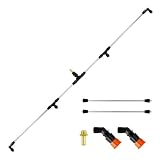
- Crafted with reinforced metel rods & corrosion-proof brass 1/4" and 3/8", lightweight and durable, can withstand heavy duty use in garden, farm or commercial spraying applications.
- DIY Lenght Up to 190cm : Features 4×40cm/15.8 inch + 2×20cm/7.9 inch rods, creating the industry's longest customizable wand (extendable to 190cm/74.8 inch) for large-scale spraying in fields, pastures and orchards.
- Dual-Angle Nozzle System: Includes 2×90° precision nozzles + 2×135° wide-spray nozzles (broad-coverage irrigation) – outperforms single-pattern sprayer booms.
- Universal Hose/Tank Integration: Seamless connection to backpack sprayers, sprayer tanks, or garden hoses via brass threaded adapter.
- 4-in-1 Scene Adaptation: Switch configurations: use as 4-nozzle boom sprayer for fields, detach into 2-nozzle watering wand for garden beds, greenhouses, or livestock pens.
Who may benefit—and who may not
The proposition is most relevant to commercial greenhouses and other high-value controlled environments with recurring scouting demands, meaningful labor costs, camera-friendly layouts, and staff able to validate alerts and act on them. It may be a poor fit for small or low-margin operations that cannot justify a customized deployment, facilities with unreliable connectivity or inadequate camera coverage, open-field growers seeking a proven broad-acre system, or buyers expecting autonomous pesticide decisions.
As of the public materials available through August 2026, the partnership is best understood as an attempt to connect automated observation with agronomic action. Whether that produces value for a particular grower depends on the live integration, detection quality, recommendation usefulness, implementation cost, and results measured at that facility—not on the breadth of the announcement’s label.
Quick Recap
Product prices and availability are accurate as of the date/time indicated and are subject to change. Any price and availability information displayed on Amazon at the time of purchase will apply.




