World Labs publicly launched on September 13, 2024, announcing approximately $230 million in cumulative funding to develop AI systems that can understand, generate, and interact with three-dimensional environments. Founded by Stanford researcher Fei-Fei Li and three computer-vision and graphics specialists, the startup was making a major bet on “spatial intelligence”—but it did not yet have a generally available commercial product.
What happened when World Labs launched?
World Labs came out of stealth with roughly $230 million in funding, according to TechCrunch’s contemporaneous report. The money represented funding accumulated across multiple financing rounds rather than necessarily one $230 million transaction.
The announcement introduced the company’s central ambition: build “large world models” that give AI a form of spatial intelligence. In practical terms, World Labs wants models that can perceive the layout of a three-dimensional environment, represent it internally, predict how objects and spaces relate to one another, and support interaction within that environment.
At launch, this was primarily a company and research thesis announcement. Reporting indicated that World Labs expected its first product in 2025, but no generally available product had been released in September 2024. WIRED reported that the company had not clearly specified its initial product, customers, or business model.
#1 Best Overall
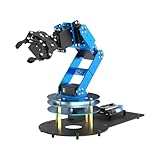
- ESP32 Controller & Arduino Programming. LeArm Open Source AI robotic arm powered by ESP32 and fully compatible with Arduino programming. It features built-in Bluetooth and multiple expansion ports, making it ideal for function upgrades and secondary development.
- Smart Digital Servos & Inverse Kinematics. Equipped with 6 smart PWM servos and an advanced inverse kinematics algorithm, LeArm Open Source delivers precise path planning and smooth, efficient movements—perfect for tackling complex tasks.
- Multiple Control Options. LeArm Open Source can be controlled by App, PC software, and wireless controller. It's beginner-friendly and easy to get started, even with no prior experience.
- Versatile Sensor Expansion. LeArm Open Source supports a wide range of sensors, including AI vision, voice module, ultrasonic, and acceleration sensors. It enables creative applications like color recognition, target tracking, face detection, voice control, and distance measurement.
- Enjoy Robotic Arm Making with Comprehensive Learning Resources. Enjoy the robot assembly process. LeArm is great for learning and building robot structures! Designed for students, engineers, university courses, and robot lovers. Comes with 200+ tutorials, sample experiments, open-source code, circuit schematics, and extensive programs—helping users dive into AI and programming while sparking endless creativity.
Who founded World Labs?
- Fei-Fei Li: Stanford AI researcher and computer-vision pioneer.
- Justin Johnson: computer-vision and machine-learning researcher.
- Christoph Lassner: computer-vision and computer-graphics researcher.
- Ben Mildenhall: researcher known for work in neural rendering and three-dimensional scene representation.
The company’s credibility came from the combined research background of this team—not simply from Li’s public profile. Their expertise spans computer vision, machine learning, graphics, neural rendering, and spatial representation.
What does “spatial intelligence” mean?
“Spatial intelligence” is World Labs’ strategic framing rather than a universally standardized technical category. The concept can be understood through five capabilities:
| Capability | What it involves |
|---|---|
| Perception | Recognizing objects, surfaces, depth, layout, and relationships in a scene. |
| Representation | Building an internal model of a physical or virtual environment. |
| Prediction | Estimating what may happen when objects or agents move. |
| Interaction | Allowing a person or AI system to navigate, manipulate, or act within a space. |
| Generation | Creating coherent, persistent, navigable three-dimensional environments. |
Li’s stated vision was to move AI beyond the “2D plane of pixels” toward systems that understand three-dimensional worlds. That is different from generating a single attractive image. A spatially intelligent system would ideally preserve geometry, object relationships, scale, persistence, and the consequences of actions.
What are large world models?
As World Labs uses the term, large world models are AI models intended to perceive, generate, and interact with 3D worlds. They sit conceptually alongside several existing categories:
- Large language models model and generate language.
- Image and video models synthesize primarily two-dimensional visual content.
- 3D reconstruction systems infer spatial structure from images, video, or other measurements.
- Neural rendering systems represent scenes in ways that can produce novel views.
- Robotics and simulation models represent environments for planning and action.
The distinction is important. A 3D generator may produce something that looks plausible from a particular viewpoint. A world model is expected to support a more persistent representation that can be explored, updated, and used for reasoning or interaction.
However, World Labs had not demonstrated a generally reliable physical simulator, universal robotics system, or solved theory of real-world causality at launch. Those were ambitions and research directions, not established commercial capabilities.
Rank #2

- Arduino Programming, Open Source: miniArm is built on the Atmega328 platform and is compatible with Arduino programming. The programs for miniArm are open-source, and learning tutorials and secondary development examples are available, making it easier for you to develop your robotic hand.
- High-Performance Hardware, Support Sensor Expansion: miniArm is equipped with a 6-channel knob controller, Bluetooth module, high-precision digital servos, and other high-performance hardware. Moreover, it provides multiple expansion ports for sensor integration, including ESP32 Cam, accelerometer, touch sensor, glowy ultrasonic sensor, etc., empowering users to engage in secondary development for sonic ranging and pose control capabilities.
- Versatile Control Options: miniArm supports app control, and users can utilize knob potentiometers for real-time knob control and offline action editing.
- Spark Your Creativity with miniArm: Expand the capabilities of miniArm with various sensors and unlock endless possibilities for your project.
- Starter Kit NO Glowing ultrasonic sensor, Touch sensor, Acceleration sensor, ESP32Cam Module.
Why did investors commit $230 million before a product?
The financing reflected investor conviction about the opportunity and the team, not proof that World Labs already had product-market fit.
Potential reasons for the investment included:
- Research pedigree: Li and her co-founders had unusually strong credentials in computer vision, graphics, and spatial reasoning.
- A possible next AI platform: Investors were looking beyond text and image generation toward systems that understand physical environments.
- Robotics and autonomy: Machines need representations of space, objects, motion, and surroundings to operate reliably.
- Creative applications: Games, film, visual effects, design, architecture, and virtual environments could benefit from faster world creation.
- Strategic scarcity: There were relatively few teams combining frontier AI research with deep 3D and computer-vision expertise.
The risks were equally significant. World models require expensive data, training, inference, and rendering infrastructure. Visually convincing output does not automatically provide accurate geometry, reliable physics, consistent object identity, or safe real-world behavior. A large venture round can validate investor expectations while leaving customers, revenue, and economics unproven.
Who invested in World Labs?
Reported investors included Andreessen Horowitz (a16z), New Enterprise Associates (NEA), Radical Ventures, NVIDIA’s venture arm, Marc Benioff, and Ashton Kutcher’s Sound Ventures, among others. Participation should not be read as meaning that every investor joined every financing round.
TechCrunch reported that the first financing was led jointly by Andreessen Horowitz and Radical Ventures. It later reported a $100 million round led by NEA, with the startup valued at more than $1 billion after that financing. Earlier funding was reportedly associated with a valuation of about $200 million. These are contemporaneous media reports, not a detailed valuation breakdown publicly disclosed by the company. See TechCrunch’s financing coverage.
What could World Labs’ technology be used for?
At launch, the potential markets included:
- Game development and interactive digital environments
- Film production and visual effects
- Architecture, product design, and engineering visualization
- Augmented and virtual reality
- Robotics and autonomous systems
- Training, simulation, and scientific discovery
These possibilities fall into two broad groups. In the nearer term, generative tools could help creators produce or explore 3D environments from text and visual inputs. In the longer term, spatial models could support AI agents or robots that navigate and act in real-world spaces.
Those markets have different requirements. A creator may value speed and surprising results. A robotics or engineering customer needs repeatability, stable coordinates, accurate measurements, controllable geometry, and reliable physical behavior.
Free tools Windows power users keep installed
One-click scans. No signup required.
Rank #3

- 3 Flexible Programming Methods. The xArm AI supports Arduino, Scratch, and Python. With comprehensive tutorials, users can easily master AI and programming skills while unlocking their creativity.
- Enhanced AI Interaction. Equipped with the WonderCam AI vision module and WonderEcho AI voice interaction module, the xArm AI enables color recognition, tag tracking, facial recognition, voice broadcasting, and voice control, opening up a world of advanced AI applications.
- Advanced Inverse Kinematics. The xArm AI features intelligent serial bus servos and an advanced inverse kinematics algorithm, ensuring precise motion planning and smooth execution—even for complex tasks.
- Open for Secondary Development. Powered by the CoreX Controller, the xArm AI offers multiple ports for servos, motors, and sensors, making it fully compatible with the Hiwonder sensor lineup and ideal for secondary development.
- With Abundant Learning Materials. xArmAI is an AI robot designed for students and beginners in artificial intelligence education. Have fun with xArmAI robotic arm and learn coding skills at the same time!
What had World Labs actually shown in 2024?
The September 2024 announcement established that a heavily funded team was pursuing spatial intelligence and large world models. It did not establish that the company had a production-ready 3D generator, a reliable simulator, paying customers, or a settled monetization strategy.
This distinction matters because a generated environment can look realistic while containing incorrect scale, broken geometry, poor occlusion, nonphysical surfaces, unreliable collisions, or invented hidden areas. Photorealism is not the same as physical accuracy. Similarly, a browser demonstration can show that a technical capability exists without proving that it can support a profitable, repeatable production workflow.
What happened after the stealth launch?
| Date | Development |
|---|---|
| September 13, 2024 | World Labs launches publicly with approximately $230 million in cumulative funding. |
| December 2, 2024 | World Labs publishes an early demonstration of persistent, navigable 3D worlds viewable in a browser. Company blog |
| September 16, 2025 | Marble enters limited-access beta for creating and viewing 3D worlds. The company described generation from images or text and export as Gaussian splats. World Labs announcement |
| November 12, 2025 | World Labs announces Marble general availability, with company-reported support for text, images, video, coarse 3D layouts, editing, expansion, Gaussian-splat exports, mesh exports, and video exports. Marble announcement |
| January 21, 2026 | World Labs announces the World API for generating explorable 3D worlds from text, images, panoramas, multi-view inputs, and video. World API announcement |
| February 18, 2026 | World Labs announces an additional $1 billion funding round, with investors including AMD, Autodesk, Emerson Collective, Fidelity Management & Research Company, NVIDIA, and Sea, among others. Company announcement |
By August 2026, the story had therefore moved beyond a well-funded thesis. World Labs had a named product, a public developer API, and a broader stated focus spanning creativity, robotics, and simulation. Those developments still do not prove that the company has solved general-purpose world modeling or reliable physical reasoning.
Independent reader supportYour contribution helps us test, update, and keep practical guides available for everyone.Marble versus the World API
Marble is the browser-based product for creators and other users who want to generate and edit worlds directly. The World API is intended for developers embedding world generation into their own applications, interactive systems, or workflows. They are separate buying paths, and Marble credits cannot be substituted for API credits.
Do these 3 things before closing this tab:
1Scan for outdated or missing drivers - takes under a minute2Repair Windows errors before they cause bigger problems3Fix the driver behind crashes, sound loss and screen glitchesPrices below were listed on the relevant sites on August 18, 2026 and may change:
| Product or plan | Listed price and allowance | Important qualification |
|---|---|---|
| Marble Free | $0 per month; 7,000 credits; up to four generations | Useful for exploration; commercial rights are not listed here. |
| Marble Standard | $20 per month; 20,000 credits; up to 12 generations | For more frequent experimentation. |
| Marble Pro | $35 per month; 40,000 credits; up to 25 generations | The pricing page lists commercial rights under Pro and above. |
| Marble Max | $95 per month; 120,000 credits; up to 75 generations | For heavier use; confirm current rights and limits. |
| World API | $1 per 1,250 credits; $5 minimum purchase | Standard generation is listed at 1,500 credits before applicable input-conversion costs. |
API documentation lists the models marble-1.1-plus, marble-1.1, marble-1.0, and marble-1.0-draft. Draft generation costs 150 credits. Marble 1.1 Plus uses 1,500 base credits and may add 0–1,500 credits for larger generated worlds. Input type can also affect cost because text, image, multi-image, or video requests may involve an additional panorama-generation event. See the API pricing documentation.
Rank #4

- 35+ Guided Electronics Projects: Progress from LEDs and buttons to RFID access, real-time clocks, motion and distance sensing, environmental monitoring, motor control and interactive displays for STEM learning, coding clubs and maker projects
- More I/O and Memory for Larger Builds: The MEGA 2560 R3 provides 54 digital I/O pins, including 15 PWM outputs, 16 analog inputs, 4 hardware serial ports and 256 KB flash for projects that combine more sensors, controls and displays
- 200+ Components for Prototyping: Includes LCD1602, RC522 RFID, RTC, DHT11, HC-SR501 PIR, ultrasonic and water-level sensors, GY-521, MAX7219, keypad, joystick, rotary encoder, relay, SG90 servo, stepper motor, DC motor, breadboard and more
- Learn, Modify and Create: Follow 35+ guided lessons with example code, then adjust sensor thresholds, timing, display text, motor behavior and control logic to turn structured exercises into access systems, monitors, alarms and interactive projects
- Organized for Repeatable Learning: Pre-soldered modules, a solderless breadboard, storage case and small-parts box reduce setup time and keep sensors, LEDs, ICs, wires and other components easy to find between projects
Developers using the API can begin with the documented POST https://api.worldlabs.ai/marble/v1/worlds:generate endpoint and the required WLT-Api-Key header. Model names, defaults, pricing, and availability can change; the documentation says the default model is expected to move from Marble 1.0 to Marble 1.1 in a future release.
Where does this fit compared with conventional 3D tools?
World Labs is not a universal replacement for established 3D software.
- Blender is better suited to manual modeling, animation, and conventional asset production.
- Unity and Unreal Engine provide controlled, interactive environments with established scene logic and production pipelines.
- NVIDIA Omniverse is oriented toward industrial collaboration and simulation, although it generally brings greater infrastructure and integration requirements.
- Meshy focuses more directly on AI-assisted individual 3D asset generation.
- Luma AI offers generative 3D and video tools aimed at visual experimentation.
Marble may be a reasonable starting point for creators prototyping environments, while the World API is more relevant to software teams. Buyers needing deterministic behavior, CAD-grade geometry, precise measurements, or production-ready conventional meshes should evaluate traditional tools instead.
The investment case—and the unresolved risk
World Labs represents a bet that the next major layer of AI will extend beyond generating content to modeling the environments in which people and machines operate. If successful, that could create infrastructure for new creative tools, interactive software, robotics, simulation, and spatial computing.
The unresolved question is whether generated worlds can become dependable work products rather than compelling demonstrations. Commercial success will depend on controllability, quality, latency, compute cost, export compatibility, licensing, customer retention, and the ability to produce consistent results at scale. A world suitable for visual exploration may be unsuitable for robotics training or safety-critical simulation.
The 2024 financing showed that investors were willing to fund this possibility early. Marble, the World API, and the later $1 billion financing show meaningful progress toward commercialization, but they should be evaluated as evidence of product development and continued investor support—not as proof that every original ambition has been achieved.
Recommended Free Tools
Quick Recap
Product prices and availability are accurate as of the date/time indicated and are subject to change. Any price and availability information displayed on Amazon at the time of purchase will apply.




