Recommended Free Tools
The United States still leads the frontier AI stack, but China is narrowing the gap by pursuing a different route. American firms have the clearest lead in notable model development, private investment, advanced chips, hyperscale cloud and disclosed data-center capacity. China’s advantages are research volume, manufacturing depth, state-coordinated infrastructure, domestic deployment and the ability to place AI in factories, vehicles, logistics networks and robots at large scale.
That makes “Who is winning AI?” the wrong single question. The competition spans several linked contests, and the leader changes depending on whether the measure is model quality, usable compute, talent, cost, industrial adoption or global influence.
AI is several races, not one leaderboard
A useful comparison separates at least five contests:
- Frontier models: Which country produces the strongest general-purpose language, multimodal, reasoning and agentic systems?
- Compute and infrastructure: Who can obtain accelerators, build data centers, secure electricity and run large-scale training and inference?
- Talent: Who can train, attract, retain and deploy researchers, engineers and specialized implementation teams?
- Applications and industrialization: Who embeds AI into manufacturing, vehicles, logistics, medicine, agriculture, robotics and public services?
- Standards and ecosystems: Whose models, hardware, cloud services and governance practices become internationally adopted?
On the digital frontier, the United States remains stronger. In the physical economy, China may be better positioned to turn “good enough” intelligence into products and operating systems used at enormous scale.
#1 Best Overall
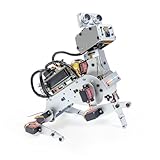
- AI-Powered Raspberry Pi Robot Dog — PiDog: Powered by Raspberry Pi (5/4B/3B+/3B/Zero 2W), OpenClaw, and multi-LLMs like ChatGPT, Gemini, Grok, DeepSeek, Qwen & Ollama. With 12 servos, camera, gyroscope, hearing & touch sensors, PiDog can see, listen, talk, move, and interact intelligently. Supports OpenCV, MediaPipe, TTS & STT, app control, FPV & Python. A great STEM robotics gift for students, makers & tech enthusiasts—perfect for birthdays and holidays. (Raspberry Pi not included)
- Realistic Dog-like Movements: PiDog's 12 powerful servos enable 32 dog-like actions, including walking, sitting, standing, shaking its head, wagging its tail, and performing playful tricks, closely mimicking a real dog and providing an engaging experience. This is an AI development robot product designed for engineers, suitable for ages 15 and above
- Rich Sensor Suite for Interactive Experiences: PiDog features ultrasonic, touch, gyroscope, sound, camera, speaker and microphone. These provide it with advanced hearing, vision, and touch, enabling it to see, detect obstacles, respond to touch, and recognize sounds, making interactions highly engaging
- AI-Powered Interactions with OpenClaw & Multi-LLMs. PiDog combines voice, vision, and gesture recognition for immersive AI experiences. Powered by OpenClaw and multi-LLMs like ChatGPT, Gemini, Grok, DeepSeek, Qwen, Doubao, and Ollama (local LLMs), it can understand questions, respond naturally through TTS & STT, recognize math problems, interpret hand gestures, and hold smart conversations. OpenClaw also enables customizable AI behaviors and personalized robotics development, helping users create their own intelligent robotic companion
- Comprehensive Learning Resources and Support: PiDog offers detailed online documentation, video tutorials, prompt technical support, and an active forum community, ensuring beginners can easily complete all projects and enjoy a great experience
The current scorecard
| Layer | Current advantage | Why it matters |
|---|---|---|
| Notable frontier-model development | United States, with a narrowing gap | Sets the ceiling for general capability and global prestige |
| Data-center scale | United States | Supports training and inference, although counts do not equal usable AI compute |
| Advanced accelerators and semiconductor ecosystem | United States and allied suppliers | Determines access to leading training hardware and networking |
| Research output | China | Expands the knowledge and engineering base |
| Private AI investment | United States | Funds frontier laboratories, cloud capacity and commercialization |
| Manufacturing and physical deployment | China is especially competitive | Creates operating data and lowers hardware-production costs |
| Industrial policy and coordinated procurement | China | Can connect infrastructure, finance and adoption |
| Global ecosystem influence | Contested | Determines standards, exports, dependence and diplomatic leverage |
Stanford’s 2026 AI Index summarizes the split directly: China leads in AI research, while the United States leads in notable model development. It also finds that leading-model performance differences had become very small by early 2026. Those are different claims from saying the countries are equal across the entire AI stack.
Infrastructure: America has scale, China is building an alternative
Why the U.S. lead matters
Stanford estimates that the United States had 5,427 data centers, more than ten times the number in any other country. Global AI compute reached 17.1 million H100-equivalents, a normalized measure rather than a literal count of Nvidia H100 chips. The figures are from the AI Index research and development chapter.
Data-center counts are only a rough proxy. A conventional facility may not have advanced accelerators, high-bandwidth networking, sufficient power or software optimized for AI training. Utilization, cooling, grid connections and the ability to expand can matter more than the building count. U.S. capacity also faces permitting, electricity and chip-supply constraints, so today’s lead is not automatically permanent.
China’s state-backed compute strategy
China’s 2026–2030 planning emphasizes national data infrastructure, rentable computing services, standardized intelligent clouds and large intelligent-computing clusters. The plan also calls for “AI Plus” across manufacturing and other sectors, with government purchasing and computing rentals helping create demand. The policy outline is described by China’s Ministry of Education at this page.
A June 2026 State Council meeting called for faster breakthroughs in key AI technologies, ultra-large-scale intelligent-computing clusters, and stronger support for talent and funding (government coverage). China’s publicly reported capacity may omit private, local-government or military-linked infrastructure, while some built capacity may be inefficiently used. The relevant question is therefore not “Who has more data centers?” but “Who can connect productive compute to users at sustainable cost?”
The chip bottleneck
U.S. export controls raise China’s cost of obtaining the most advanced accelerators and semiconductor-manufacturing equipment. They can constrain frontier-scale training, but they have not stopped Chinese progress. Firms have incentives to develop domestic chips, optimize software, use smaller or specialized models, and share available compute.
Rank #2

- Optimized AI Arm Kit for LeRobot & Hugging Face Projects – The SO-ARM101 is an upgraded low-cost robotic arm servo motor kit designed for AI robotics enthusiasts and developers. Fully compatible with LeRobot and Hugging Face frameworks, it supports imitation learning and reinforcement learning, making it ideal for real-world robotics applications. (3D-printed parts not included.)
- Enhanced Wiring & Performance – Compared to the SO-ARM100, the SO-ARM101 features improved wiring to prevent disconnection at joint 3 and eliminates range-of-motion limitations. The leader arm uses optimized gear ratio motors for smoother performance—no external gearboxes required.
- Real-Time Leader-Follower Functionality – New real-time tracking allows the leader arm to follow the follower arm, enabling human intervention and correction during reinforcement learning (RL) training. Perfect for hands-on AI robotics development and research.
- Open-Source, DIY-Friendly & Nvidia-Compatible – Developed by TheRobotStudio, this open-source AI Arm kit integrates seamlessly with the LeRobot platform, offering PyTorch-based datasets, simulation, training, and deployment tools. Fully compatible with Nvidia Jetson edge devices, including reComputer Mini J4012 Orin NX 16 GB.
- Comprehensive Learning Resources – Includes detailed open-source assembly and calibration guides, testing tutorials, and deployment instructions. From wiring to AI training, get everything you need to start building, teaching, and optimizing your robotic arm for grasping and placing tasks.
China’s actual compute stock is difficult to verify because of stockpiling, cloud access, gray-market acquisition and possible circumvention. The Federal Reserve notes that estimates may understate Chinese capacity for these reasons in its assessment of AI competition.
Talent is a quality, scale and mobility contest
“Who has more engineers?” is too crude. Frontier theorists, model researchers, chip designers, robotics specialists, product managers, data engineers and factory-integration teams perform different jobs.
Stanford says the United States remains home to more AI talent than any other country, but its rate of attracting new talent is the lowest in more than a decade (AI Index research chapter). American universities, laboratories, venture capital and hyperscalers still provide a deep concentration of globally influential frontier researchers. Immigration and retention policy are therefore economic and strategic variables, not side issues.
China combines a large technical workforce, strong engineering education, domestic demand and coordinated national priorities. Chinese researchers trained overseas may return, and engineers can move between model companies, hardware firms and industrial projects. That creates scale in implementation even if the United States retains the deeper concentration of frontier research leadership.
Investment reinforces the difference. Stanford reports U.S. private AI investment of $285.9 billion in 2025 versus $12.4 billion in China. The comparison is not a complete measure of national spending: Chinese government guidance funds and other state-backed financing are not fully captured in private-investment totals.
Model performance is close, but “close” is not parity
Research volume, patents and benchmark scores measure different things. Publication counts can reward quantity; patent totals reflect filing practices and definitions; and closed-model evaluations are difficult to audit because companies control access and testing conditions.
Rank #3
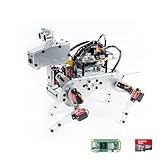
- Raspberry Pi AI Robot: powered by Raspberry Pi (5/4B/3B+/3B/Zero 2W), features 12 servos and sensors for vision, hearing, and touch. Integrated with ChatGPT-4o, it responds to complex queries. With app control and FPV, users can manage and see its view in real-time. It supports Python programming
- Realistic Movements: 12 powerful servos enable 32 actions, including walking, sitting, standing, shaking its head, wagging its tail, and performing playful tricks, closely mimicking a real and providing an engaging experience
- Rich Sensor Suite for Interactive Experiences: features ultrasonic, touch, gyroscope, sound, camera, speaker and microphone. These provide it with advanced hearing, vision, and touch, enabling it to see, detect obstacles, respond to touch, and recognize sounds, making interactions highly engaging
- Engaging Interactions with ChatGPT-4o: with ChatGPT-4o enables voice interactions and visual recognition, making it smarter and more responsive. Users can have natural conversations, solve math problems via the camera, and interpret gestures, creating diverse and fun interactions
- Comprehensive Learning Resources and Support: offers detailed online documentation, video tutorials, prompt technical support, and an active forum community, ensuring beginners can easily complete all projects and enjoy a great experience
The 2026 AI Index reports that DeepSeek-R1 briefly matched a leading U.S. model in February 2025. In a cited March 2026 comparison, Anthropic’s top model led the leading Chinese model by 2.7%. That figure applies to the named evaluation, date and models; it does not establish parity in every area, including coding, multimodal tasks, agents, reliability, safety, language coverage, cost or real-world uptime.
China’s strongest argument is real-world deployment
China’s manufacturing base, logistics networks and vehicle industry give it opportunities to place AI in physical systems and collect operational feedback. Priority areas include smart-factory quality control, warehouse robotics, autonomous driving, energy management, agricultural machinery, medical devices, consumer hardware and urban services.
China’s Ministry of Industry and Information Technology says its AI core industry exceeded 1.2 trillion yuan in 2025 and that the country had more than 6,200 AI companies. These are official Chinese estimates, and “core AI industry” is a government category rather than a directly comparable measure of U.S. private-market revenue. The ministry’s account highlights manufacturing, autonomous vehicles, humanoid robots, agricultural machinery and intelligent medical devices (source).
Embodied AI and robotics
A 2026 program from China’s Ministry of Industry and Information Technology and the State-owned Assets Supervision and Administration Commission targets more than 100 high-value humanoid-robot and embodied-AI scenarios, with deployment capacity at the 10,000-unit scale by the end of 2026. The stated areas include manufacturing, inspection, maintenance, warehousing, logistics, healthcare, emergency response and disaster prevention (program notice).
Those are policy objectives, not verified completed deployments. A pilot, a subsidized demonstration and a profitable commercial rollout are different milestones.
Independent reader supportYour contribution helps us test, update, and keep practical guides available for everyone.The physical-data flywheel
The U.S.–China Economic and Security Review Commission describes a potential “physical loop”: AI is deployed in factories, robots and research; deployment produces specialized operating data; that data improves systems; and better systems enable more deployment (commission analysis).
Rank #4
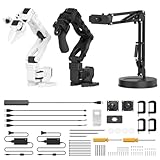
- 【End-to-End Imitation Learning】Hiwonder SO-ARM101 robot arm is an embodied intelligent hardware platform compatible with the Lerobot open-source framework. It provides developers with streamlined access to shared code, templates, and pre-trained models to explore the latest advancements in AI research.
- 【Dual-Camera Vision System】Equipped with both a gripper-mounted camera and an external camera, the system supports both precise manipulation and environmental awareness for accurate imitation learning.
- 【Hiwonder High-Performance Bus Servos】Featuring 12 high-torque bus servo motors with magnetic feedback, the Hiwonder SO-Arm101 robotic arm delivers smooth, stable motion, eliminating issues like power deficiency and jitter.
- 【Professional Control & Debugging】Integrated with the Hiwonder BusLinker V3.0 debugging board, the system supports servo scanning, real-time status monitoring, and trajectory control. The professional PC software simplifies device calibration and debugging, making it accessible for both researchers and hobbyists.
- 【Open-Source Compatibility】The SO-ARM101 robotic arm is designed to be fully compatible with the LeRobot open-source project. We acknowledge the contributions of the open-source community; all trademarks and copyrights belong to their respective owners.
- Systems enter real operating environments.
- Machines collect data on movement, defects, demand, maintenance and human interaction.
- Models and hardware improve using that data.
- Higher reliability and lower cost expand adoption.
- More deployments compound the data and manufacturing advantage.
This loop may matter even if China does not lead every general-purpose benchmark. Industrial data can be difficult to acquire elsewhere, although it is not automatically valuable: it may be siloed, inconsistent, expensive to label or poor at capturing rare failures.
Open models can widen China’s reach
Open-weight models can lower adoption barriers for smaller companies, support Chinese-language and sector-specific adaptation, and reduce dependence on foreign cloud services. They may also help China export software to countries that cannot afford or do not want closed U.S. systems.
Free tools Windows power users keep installed
One-click scans. No signup required.
Open weights do not remove dependence on chips, data, cloud capacity or skilled operators. Chinese models may face censorship, localization and regulatory constraints, while U.S. open-source projects remain important. Adoption is not the same as technical leadership. A 2026 analysis argues that restrictions could unintentionally accelerate China’s investment in open AI ecosystems; that is an analytical claim, not a settled outcome (paper).
What export controls can—and cannot—accomplish
- They can: raise the cost of frontier training, limit access to leading accelerators and slow expansion of high-end capacity.
- They cannot reliably: prevent efficiency gains, domestic-chip development, model distillation, compute sharing, open-source diffusion or all forms of circumvention.
- They may also: encourage Chinese self-reliance and fragment hardware and software ecosystems.
Controls are therefore a constraint, not a complete strategy. They are most effective when paired with domestic research, allied semiconductor capacity, energy investment and policies that preserve technological leadership.
Why a Chinese overall lead is premature
The United States still combines the strongest concentration of frontier-model companies, the largest disclosed private investment, advanced semiconductor access, hyperscale cloud platforms, substantial data-center capacity and a powerful university-to-startup commercialization system. China’s state coordination can mobilize resources rapidly, but it can also produce duplicate projects, inefficient data centers, politically favored investments and weak commercial discipline.
The U.S. model is not frictionless: permitting, power, immigration, labor and fragmented policy can slow buildout. China’s model is not guaranteed to innovate efficiently. Both countries contain competing firms, local interests and uneven projects rather than acting as single companies.
Outdated Drivers Are Slowing You Down
One free scan finds every outdated or missing driver and matches the right update for your exact hardware.Free scan · exact hardware matchWindows Errors? Fix Them Before They Spread
Repair common Windows errors and clear accumulated junk for a smoother, more stable PC - no reinstall needed.Free scan · no reinstallTwo forms of AI leadership
The United States may define leadership by building the most capable general-purpose intelligence and the infrastructure that supports it. China may define leadership by embedding sufficiently capable systems into more factories, vehicles, machines and services at lower cost and greater physical scale.
The likely outcome is not one universal winner. It could be specialization, coexistence or a bifurcated ecosystem in which frontier models, chips, industrial systems and standards are led by different countries. For businesses and investors, the material question is which layer creates durable value—not which national flag appears first on a chatbot leaderboard.
Quick Recap
Product prices and availability are accurate as of the date/time indicated and are subject to change. Any price and availability information displayed on Amazon at the time of purchase will apply.




