Boston Metal commissioned its largest molten-oxide-electrolysis (MOE) reactor in January 2025 and tapped approximately one ton of metal on February 17. The achievement is an important scale-up demonstration for lower-emissions steelmaking—but it is not evidence that the company is already producing commercial quantities of green steel.
The test showed that Boston Metal’s multi-inert-anode cell could operate at industrially relevant temperatures and produce a ton-scale output. It did not yet establish long-term reliability, commercial throughput, competitive costs, or zero lifecycle emissions.
What Boston Metal actually achieved
Boston Metal, an MIT spinout headquartered in Woburn, Massachusetts, commissioned a multi-inert-anode MOE cell at its facility in January 2025. After several weeks of operation, the company tapped roughly one ton of material on February 17, according to MIT Technology Review.
Boston Metal described the result as “tonnage steel,” while the MIT Technology Review account referred to more than a ton of metal. Those terms should not automatically be treated as interchangeable with finished, market-qualified steel. The material produced in the reactor may require downstream refining, alloying, casting, and other processing before it becomes a specified commercial steel grade.
Recommended Free Tools
#1 Best Overall
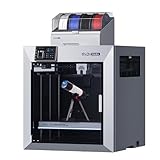
- Ultra-Large Build Volume: QIDI Max4 Combo has a 390×390×340mm printing area, 55% larger than its predecessor MAX3, enables you to print large industrial parts, complex molds and custom prototypes in one go without splitting; full-surface silicone heated bed ensures even temperature distribution and strong first-layer adhesion to avoid warping.
- High Precision & Stability: QIDI Max4 Combo 3D Printer equipped with closed-loop motors on X/Y axes, Achieve a maximum printing speed of 800mm/s and an acceleration of 30,000mm/s²; 2mm lead screw and anti-backlash nut on Z-axis reduce vertical gaps, ensuring smooth and precise printing with excellent surface quality.
- Wide Material Compatibility: 40mm³/s high-flow hotend with hardened steel nozzle supports standard materials (PLA/ABS) and industrial-grade abrasive materials (carbon fiber-reinforced nylon); 65℃ active heated chamber and self-developed Polar Cooler system create ideal printing conditions for high-temperature materials like ABS-CF, PC, PPS-CF.
- Smart Monitoring & User-Friendly Design: Built-in AI camera automatically detects printing abnormalities (e.g., spaghetti-like failures) and pauses printing instantly to save materials and time; large touch screen with optimized interface offers smooth operation, QIDI Max4 Combo suitable for both professionals and enthusiasts.
- Expandable Multi-Color Printing: Seamlessly connect with QIDI BOX to achieve 16-color and multi-material printing and enjoy intelligent filament management (e.g., real-time filament level monitoring, automatic pause when filament runs out); providing you with a worry-free 3D printing experience.
The company announced the commissioning run as a major validation of its technology. More precisely, it demonstrated that a substantially larger reactor could operate and tap accumulated liquid metal. It did not demonstrate a full commercial steel plant.
Why a one-ton run matters
Electrochemical reactions can work in a laboratory cell without proving that they will survive industrial conditions. Commercial equipment must handle extreme temperatures, corrosive materials, high electrical currents, larger electrode surfaces, thermal cycling, maintenance, and repeatable production.
Boston Metal’s cell operates at approximately 1,600°C. A larger reactor also needs multiple anodes rather than the single small anode commonly used in laboratory-scale systems. Successfully operating multiple anodes is therefore an important engineering step: the company had to show that its electrode design could function in a larger, hotter, more demanding environment and that liquid metal could be collected and tapped.
That is best understood as risk reduction. It is evidence that the chemistry and reactor architecture can work at ton scale, not proof that the process is economically scalable. Boston Metal itself describes the run as de-risking and validating scalability; those are company interpretations rather than independent confirmation of commercial performance. Its announcement is available here.
How molten-oxide electrolysis works
In conventional ironmaking, oxygen must be removed from iron ore. Today’s dominant blast-furnace route uses coke as both a fuel and a chemical reductant, producing substantial carbon dioxide. MOE uses electricity to perform the reduction directly in a molten electrolyte.
Rank #2

- One-Click Automatic Printing: Experience hassle-free 3D printing with the Adventurer 5M Series. Enjoy automatic bed leveling for flawless first layers, ensuring consistent adhesion and saving time with no manual adjustments required.
- 12X Ultra Fast Printing: Featuring a CoreXY structure with 600mm/s travel speed and 20000mm/s² acceleration, the AD5M maximizes efficiency, reduces production cycles, and ensures high precision, making it ideal for rapid prototyping and mass production.
- Smart and Efficient Design: Quick 3-second nozzle changes, a high-flow 32mm³/s nozzle, and fast 35-second warm-up to 200°C deliver stable high-speed printing. Its dual-sided PEI platform and versatile options provide easy removal and adaptability for various creative projects.
- Superior Print Quality & Adaptability: Combines a 280°C direct drive extruder with dual-fan cooling and vibration compensation. Includes a standard 0.4mm nozzle and accepts optional sizes from 0.25mm to 0.8mm to fit various printing needs.
- Real-Time App Monitoring: Monitor print progress, adjust settings, and receive instant status alerts remotely with the Flash Studio. Smart mobile control ensures a seamless, effortless printing experience anytime, anywhere.
- Iron ore or another iron-bearing oxide is placed in a molten oxide electrolyte.
- The cell is heated to roughly 1,600°C so the electrolyte remains molten.
- Electricity passes through the electrolyte.
- The current separates oxygen from the iron oxide.
- Liquid iron collects at the bottom of the cell and can be tapped.
- Oxygen is released at the anode if the anode remains electrochemically inert.
Boston Metal says its process can avoid coke production, sintering or pelletizing, blast-furnace reduction, and basic-oxygen-furnace refining, and that it can use all iron-ore grades. Those are stated company capabilities, not blanket independent validation for every ore, product specification, or plant configuration. The company’s technical explanation is at Boston Metal’s MOE overview.
Why the inert anode is the central technology
The anode is where much of the climate and durability case rests. A conventional carbon anode can be consumed during electrolysis and generate carbon dioxide. Boston Metal’s process instead depends on a metallic inert anode intended to withstand the hot, highly corrosive molten-oxide environment without becoming the source of the reaction’s carbon emissions.
“Inert” does not mean indestructible. A commercial system must prove that the anodes remain stable for long periods, maintain consistent electrical performance, can be manufactured at acceptable cost, and can be inspected, replaced, or repaired without excessive downtime. These challenges become more difficult when one cell uses multiple large anodes.
Important unanswered questions include operating hours, degradation rates, replacement intervals, material costs, and performance during repeated starts, stops, taps, and thermal cycles. Boston Metal has also discussed inert anodes in its work on other electrochemical metals applications, including high-volume ferroalloys.
What “green steel” means here
Green steel is not a universal technical label with one agreed emissions boundary. It generally refers to steel made with substantially lower greenhouse-gas emissions than conventional steel.
Rank #3

- 600mm/s Speed & CoreXY Structure — Powered by an all-metal CoreXY frame and 20,000mm/s² acceleration, Adventurer 5M Pro reaches speeds up to 600mm/s. Integrated vibration compensation algorithms eliminate ghosting and ringing for smooth, high-precision surface finishes.
- 3-Second Quick-Swap Nozzle & Auto Leveling — Features a tool-free, quick-release nozzle mechanism for effortless 3-second replacements across multiple sizes (0.25/0.4/0.6/0.8mm). One-click full auto-leveling ensures precise bed calibration and a perfect first layer every time.
- Dual Filtration System & Quiet Enclosure — Built with an integrated dual filtration system and a fully enclosed chamber to ensure a clean printing environment and thermal stability. Powered by low-noise motion control, it operates quietly under 50dB for seamless home, office, or classroom use.
- 280°C High-Temp Extruder & Broad Material Compatibility — With a 280°C max nozzle temperature and a 110°C heated bed, it reliably prints engineering materials like ABS, ASA, and PETG-CF, as well as standard PLA and PETG.
- Smart Camera & Mobile Control — Features a built-in camera for real-time monitoring and time-lapse video creation. Monitor progress, adjust settings, and receive instant status alerts via Flash Studio. Integrated with filament detection, power loss recovery, and a 4.3-inch touchscreen for effortless operation.
Boston Metal says MOE can avoid carbon emissions from the electrochemical reduction reaction when powered by renewable electricity. That claim is narrower than saying the entire product has zero emissions. A full assessment would also include electricity generation, mining, ore preparation, transportation, refining, alloying, casting, reheating, rolling, finishing, and plant construction.
For that reason, the most accurate description at this stage is a potential pathway to lower-emissions steel or potentially near-zero-process-emissions steel. If the electricity comes from a carbon-intensive grid, the process may still have significant indirect emissions even though oxygen rather than carbon dioxide is released at the anode.
Outdated Drivers Are Slowing You Down
One free scan finds every outdated or missing driver and matches the right update for your exact hardware.Free scan · exact hardware matchWindows Errors? Fix Them Before They Spread
Repair common Windows errors and clear accumulated junk for a smoother, more stable PC - no reinstall needed.Free scan · no reinstallHow MOE compares with other steelmaking routes
| Route | Primary input or reductant | Main advantage | Main limitation |
|---|---|---|---|
| Blast furnace plus basic oxygen furnace | Iron ore, coke, and coal | Mature, high-volume infrastructure | Highly carbon-intensive and difficult to decarbonize without major process changes |
| Scrap electric arc furnace | Scrap steel and electricity | Can have relatively low emissions with clean electricity | Depends on scrap supply and quality; does not by itself produce primary iron from ore |
| Hydrogen direct reduction plus EAF | High-grade iron ore, low-carbon hydrogen, and electricity | Uses hydrogen instead of much of the fossil reductant | Requires large hydrogen and clean-power supplies and suitable ore |
| MOE | Iron-bearing oxides and electricity | Direct electrochemical reduction to liquid metal without hydrogen infrastructure or a carbon reductant in the reaction | Very high temperature, unproven commercial anode life, power demand, and no demonstrated full-scale commercial steel plant |
MOE’s proposed advantage is that it could turn ore directly into liquid iron, potentially reducing the number of major process steps. It may also avoid the need to build a hydrogen supply chain. But it still needs dependable low-carbon electricity, downstream steel refining, and equipment for casting and finishing.
In regions with abundant clean scrap, an EAF may remain simpler and cheaper. Hydrogen-based direct reduction also has a head start in some commercial projects. MOE’s eventual position will depend on measured energy use, throughput, ore flexibility, product quality, plant cost, and operating reliability—not merely on whether the electrochemical reaction works.
What the test did not prove
- Commercial production: One ton from a commissioning run is not hundreds of thousands or millions of tons per year.
- Continuous operation: The run does not establish months or years of stable availability.
- Anode durability: It does not reveal long-term degradation or replacement economics.
- Finished-steel quality: “Metal” or “tonnage steel” does not necessarily mean a fully qualified final product.
- Cost competitiveness: No public commissioning result alone establishes cost per ton against blast furnaces, EAFs, or hydrogen DRI.
- Zero lifecycle emissions: The electricity source and all upstream and downstream activities still matter.
- All-ore performance: The company’s claim of broad feedstock flexibility still requires process-specific evidence, because ore chemistry affects energy use, impurities, and refining.
The remaining path to commercialization
A larger demonstration plant is the next major milestone described in public reporting. MIT Technology Review reported a target of coming online in late 2026 and operating in 2027. That should be treated as a reported company target, not a confirmed operating date; Boston Metal’s current public materials describe the plant more generally as arriving “in the coming years.”
Rank #4

- [FIVE-TOOL MULTI-MATERIAL SYSTEM] Print with up to five materials or colors in a single job for advanced functional prototypes and full-color visual models.
- [INDUSTRIAL PROTOTYPING PLATFORM] Designed for professional environments requiring maximum flexibility in material and color combinations. Build volume of14.17 × 14.17 × 14.17 inches.
- [HIGH-END COREXY PERFORMANCE] Maintains speed and precision even with frequent tool changes and complex geometries.
- [OPTIMIZED MATERIAL EFFICIENCY] Smart tool management reduces waste while ensuring smooth transitions between multiple materials.
- [SEGMENTED HEATED BED SYSTEM] Intelligent heating zones improve energy efficiency and reduce warping on large prints for reliable first-layer adhesion across the entire platform.
Before MOE can be judged as a commercial steelmaking route, investors, steelmakers, and customers will need evidence on:
Free tools Windows power users keep installed
One-click scans. No signup required.
- months- or years-long operation rather than a commissioning run;
- stable performance from multiple inert anodes;
- throughput per cell and plant availability;
- measured electricity consumption per ton of finished steel;
- reliable operation across different iron-ore feedstocks;
- reproducible steel quality and commercial-grade qualification;
- integration with refining, casting, and rolling equipment;
- maintenance, refractory, electrolyte, tapping, and anode-replacement procedures;
- capital cost, operating cost, and financing requirements;
- confirmed customers or offtake agreements;
- independent lifecycle-emissions analysis; and
- permitting and successful construction of demonstration and commercial facilities.
Intermittent renewable power could also create an operational challenge. A high-temperature cell may need firm electricity, storage, grid balancing, or a design that can tolerate flexible operation. A process can be electrochemical and low-carbon in theory while delivering a weaker climate result if it relies on carbon-intensive power in practice.
Independent reader supportYour contribution helps us test, update, and keep practical guides available for everyone.Boston Metal’s stated business model
Boston Metal says it does not intend to become a conventional steel producer operating giant steel mills. Its stated model is to license the MOE platform to steelmakers and manufacture and sell the metallic inert anodes used in the process.
The company is also pursuing critical-metals applications, including recovery from mining waste, and has described a commercial MOE critical-metals operation in Brazil. That activity could provide an earlier route to revenue, but it should not be confused with commercial green-steel production. The business model and company history are described on Boston Metal’s company page and in its announcement about its Brazilian subsidiary.
Licensing could let Boston Metal deploy its technology through established steelmakers instead of financing and operating every plant itself. The trade-off is that adoption depends on steel companies’ willingness to build new systems or retrofit facilities, accept a technology with a shorter operating record, and commit to the power and downstream equipment it requires.
Do these 3 things before closing this tab:
1Clear out junk files and repair common Windows errors2Scan for outdated or missing drivers - takes under a minute3Repair Windows errors before they cause bigger problemsBest Value

- Multi Color Printing with All-new CFS: K2 Plus Combo multi-color flagship printing, exciting for you to combine. With four CFS units hooked together, it is possible to deliver 16-color 3D prints, saving the need for painting afterward. CFS is intelligent with automatic filament selection, switch, and relay. Upon loading an RFID filament, it can read the color and type instantly. When a filament is running out, it can relay with a similar one installed
- Larger Size to Meet More Needs: Compared to Creality K2 and K2 Pro, the Creality K2 Plus offers an extraordinary 350*350*350mm large build volume, great for handling larger objects or larger batches, large models don‘t require partitions, and small models are printed in batches more calmly, easily satisfying your ever-expanding 3D printing aspiration
- 600mm/s High Speed Printing: Creality 3D Printer K2 Plus Combo adopting industry-grade FOC step-servo motors for the XYZ axis and extrusion, Step-servo Motor System 30000mm/s² accelaration, 40mm³/s High-flow and quiet. For a large-format machine, 600mm/s is pretty fast, but that's not the whole story. Turbocharged by the step-servo motors, it can accelerate at a staggering 30000mm/s²
- Super Master of Materials: The Creality K2 Plus 3d printer actively maintains a constant temperature of up to 60°C, allowing you to easily print high-end filaments like ASA and PPA. Printed models are warp-resistant and high-strength. High-temp nozzle with hardened steel tip, Supports operating temperatures up to 350°C, easily handling a variety of high-melting-point, wear-resistant engineering filaments
- Dual AI Cameras & Automation: K2 Plus features 18 smart sensors. Everything is automated and closely monitored. It has two AI cameras. One is on the chamber side to watch over spaghetti failure, idling, etc. Another is on the toolhead for flow rate optimization. No more underfeeding and overfeeding. With two Z-axis independently motorized, it can auto-adjust bed tilt before auto leveling
How to evaluate the milestone
The most useful question is not simply whether Boston Metal made a ton of steel. It is whether the company can convert that demonstration into a repeatable industrial process with competitive economics and verified emissions performance.
Watch for four types of evidence: measured kilowatt-hours per ton, long-duration anode performance, sustained throughput and availability, and independently assessed emissions for finished steel. Until those data are available, the milestone supports a more limited conclusion: Boston Metal has crossed a meaningful engineering threshold, while the commercial case remains open.
Bottom line
Boston Metal’s February 2025 tap showed that its molten-oxide-electrolysis chemistry could produce approximately one ton of metal in a larger multi-anode reactor operating at about 1,600°C. That is a significant scale-up result because industrial electrolysis must solve problems that laboratory cells do not.
It is not yet proof of cheap, continuous, market-ready, zero-emissions steel. The decisive tests are still long-term anode life, throughput, electricity use, steel quality, plant economics, and lifecycle emissions. The achievement makes MOE more credible as a potential green-steel pathway; it does not make the technology commercially proven.
Quick wins for a faster PC:
Fix the driver behind crashes, sound loss and screen glitchesFind Drivers →Repair Windows errors before they cause bigger problemsFix Now →Quick Recap
Product prices and availability are accurate as of the date/time indicated and are subject to change. Any price and availability information displayed on Amazon at the time of purchase will apply.




