What’s actually slowing this PC down?
Pick the symptom - the matching free tool is one click away.
Blue Origin, the space company founded by Jeff Bezos, announced TeraWave on January 21, 2026: a planned 5,408-satellite communications network aimed at enterprises, data centers and governments. The proposed system would combine 5,280 low-Earth-orbit satellites with 128 medium-Earth-orbit satellites and deliver up to 6 terabits per second of aggregate capacity. Blue Origin says deployment could begin in the fourth quarter of 2027, but TeraWave is not an operating service yet.
That distinction matters. TeraWave is a future, contact-led business connectivity proposal—not a consumer broadband plan that households can order today, and not evidence that Blue Origin and Amazon are one company.
What Blue Origin announced
Blue Origin calls the network TeraWave. Its stated purpose is space-based connectivity for critical operations and large-scale data movement, particularly where terrestrial fiber is limited, unavailable or vulnerable to outages.
| Announced element | What Blue Origin has said |
|---|---|
| Total satellites | 5,408 |
| Low-Earth orbit satellites | 5,280 |
| Medium-Earth orbit satellites | 128 |
| Aggregate capacity | Up to 6 Tbps, a company claim about total network capacity |
| Maximum customer access | Up to 144 Gbps, attributed to Blue Origin CEO Dave Limp and presented as a planned maximum |
| Intended customers | Enterprises, data centers and government agencies |
| Proposed deployment start | Fourth quarter of 2027 |
The detailed orbital split totals 5,408 satellites, so the precise figure is more useful than rounded descriptions such as “5,400.” Blue Origin’s TeraWave page describes symmetrical upload and download capacity, network redundancy and global connectivity. Those are announced capabilities, not measured results from a functioning commercial network.
Quick wins for a faster PC:
Repair Windows errors before they cause bigger problemsFix Now →Scan for outdated or missing drivers - takes under a minuteDriver Scan →Clear out junk files and repair common Windows errorsFree Scan →#1 Best Overall

- HOBBY MODEL KIT – Unassembled model packed in an envelope with easy to follow instructions. Ideal for ages 14 and up.
- NO GLUE OR SOLDER NEEDED – Parts can be easily clipped from the metal sheets. Tweezers are the recommended tool for bending and twisting the connection tabs.
- VOYAGER – 1.5 Sheet Model with a moderate difficulty level. Assembled Size: 1.38 x 1.77 x 6.70 inches.
- FROM STEEL SHEETS TO 3D – Pop out the pieces and connect using tabs and holes. Includes illustrated instructions.
- HIGHLY DETAILED ETCHED MODEL – Display your 3D model once completed - collect and build them all.
Why this is Bezos’s “other” megaconstellation
Amazon is developing its own satellite broadband system, originally called Project Kuiper and now referred to as Amazon Leo. Amazon Leo is a separate Amazon program intended to provide broadband connectivity with thousands of low-Earth-orbit satellites.
Blue Origin is also a separate company. Both businesses were founded by Bezos, but they do not operate as a single satellite-network company. Their projects could eventually have overlapping enterprise or government customers, and Blue Origin’s launch business could be relevant to Amazon’s plans, but no merger or operational integration has been announced.
Who TeraWave is designed to serve
TeraWave is not initially presented as another household broadband service. Blue Origin is targeting organizations that move substantial amounts of data or need a resilient connection at difficult locations.
Data centers and cloud-connected facilities
Data centers increasingly exchange large datasets with other facilities and cloud platforms. A high-capacity, symmetrical link could be useful for replication, distributed computing, scientific workloads and media operations. Upload capacity matters when an organization is sending data out, not merely downloading files.
Rank #2

- Model Kit
- May Require Paints and Glues to Assemble
- Accurate Scale Model
- Detailed Instructions Provided
- Decals/Transfers Included
Remote industrial and government sites
Mining, energy, maritime, defense and public-sector locations may need connectivity where laying fiber is slow, expensive or impossible. A satellite layer could supplement existing carrier connections rather than replace them.
Continuity and temporary capacity
Organizations could use satellite connectivity as a backup during terrestrial outages, for disaster recovery or while a permanent site is being built. Redundancy in a satellite network does not automatically create a contractual uptime guarantee; that would depend on the eventual service-level agreement.
How the proposed architecture may work
Blue Origin has announced a multi-orbit design using radio-frequency (RF) and optical communications links. The company has not published a complete engineering specification, so the following explains the likely rationale rather than asserting undisclosed design details.
Low-Earth orbit
LEO satellites are closer to Earth than MEO satellites. That generally shortens link distances and can support lower latency, although actual round-trip performance depends on routing, gateways, congestion and the application path.
Windows Errors? Fix Them Before They Spread
Repair common Windows errors and clear accumulated junk for a smoother, more stable PC - no reinstall needed.Free scan · no reinstallOutdated Drivers Are Slowing You Down
One free scan finds every outdated or missing driver and matches the right update for your exact hardware.Free scan · exact hardware matchRank #3

- HOBBY MODEL KIT – Unassembled model packed in an envelope with easy to follow instructions. Ideal for ages 14 and up
- NO GLUE OR SOLDER NEEDED – Parts can be easily clipped from the metal sheets. Tweezers are the recommended tool for bending and twisting the connection tabs
- APOLLO CSM – 3.5 Sheet Model with a challenging difficulty level. Assembled Size: 5.07 L x 2.28 W x 3.45 H inches.
- FROM STEEL SHEETS TO 3D – Pop out the pieces and connect using tabs and holes. Includes illustrated instructions
- HIGHLY DETAILED ETCHED MODEL – Display your 3D model once completed - collect and build them all
Medium-Earth orbit
MEO spacecraft can cover larger footprints and may serve backbone or capacity roles in a mixed network. The trade-off is that longer distances can affect latency and link budgets. How TeraWave assigns traffic between orbits remains undisclosed.
Optical and RF links
Optical intersatellite links can move data between spacecraft without sending every connection through a ground station, potentially improving routing flexibility and capacity. They also require precise pointing and acquisition. RF links have different propagation, equipment and regulatory characteristics and may be used for customer or gateway connections.
What “6 Tbps” and “144 Gbps” actually mean
Six terabits per second is an aggregate network claim. It is not a 6-Tbps plan for each customer. Total constellation capacity must be shared across geographic areas, gateways, terminals and customers.
The advertised maximum of up to 144 Gbps per customer is likewise a planned peak figure, not a demonstrated or guaranteed service rate. A buyer would need to establish:
Rank #4

- HOBBY MODEL KIT – Unassembled model packed in an envelope with easy to follow instructions. Ideal for ages 14 and up.
- NO GLUE OR SOLDER NEEDED – Parts can be easily clipped from the metal sheets. Tweezers are the recommended tool for bending and twisting the connection tabs.
- JAMES WEBB SPACE TELESCOPE - 2.75 Sheet Model with a moderate difficulty level. Assembled Size: 4.13 L x 2.75 W x 2.75 H inches. 1:221 Scale. 62 Pieces
- FROM STEEL SHEETS TO 3D – Pop out the pieces and connect using tabs and holes. Includes illustrated instructions.
- HIGHLY DETAILED ETCHED MODEL – Display your 3D model once completed - collect and build them all.
- How much capacity is committed to a site rather than shared;
- Whether 144 Gbps applies to one terminal, multiple terminals or a particular service tier;
- What throughput is available in each region and during congestion;
- How much backhaul and gateway capacity exists; and
- What end-to-end application performance, latency and availability are covered by contract.
TeraWave compared with Starlink and Amazon Leo
| Feature | TeraWave | Starlink | Amazon Leo |
|---|---|---|---|
| Primary positioning | Enterprise, data-center and government connectivity | Consumer, enterprise, aviation, maritime and other markets | Broadband connectivity through Amazon’s LEO program |
| Orbit plan | 5,280 LEO plus 128 MEO satellites | Primarily LEO | Thousands of LEO satellites are authorized or planned |
| Operational status | Planned; deployment targeted for Q4 2027 | Operating service in many markets | Deployment program, not equivalent to an established global consumer service |
| Connectivity emphasis | Symmetrical, high-capacity and resilient links | Broad broadband plus specialized services | Broadband connectivity |
| Direct-to-cell | Not the announced focus | A major development area | Not established here as TeraWave’s service |
| Public pricing | Not listed on the TeraWave page as of August 18, 2026 | Varies by market and service tier | Not comparable to a published TeraWave plan |
Starlink therefore has the practical advantage: an operating constellation, existing terminals, customers and launch experience. TeraWave could compete for high-value enterprise, government, aviation or data-center work, but its commercial importance cannot be judged fully until Blue Origin publishes pricing, terminals, coverage, latency, contracts and service guarantees.
Why data-center connectivity is an attractive market
Fiber is usually preferable where it is available at an acceptable price: it tends to offer predictable latency and established service commitments. But fiber construction can be slow or uneconomic at remote sites, and a single terrestrial route can be vulnerable to cuts, disasters or local infrastructure failures.
A satellite connection can add geographic diversity, temporary capacity or a path to a site that has no practical fiber route. The economic case depends on the whole deployment: terminals, installation, power, support, redundant links, gateway access and recurring capacity charges—not just the advertised bandwidth.
Independent reader supportYour contribution helps us test, update, and keep practical guides available for everyone.The difficult part is building the network
A 5,408-satellite system requires much more than a spacecraft design. Blue Origin would need to:
Free tools Windows power users keep installed
One-click scans. No signup required.
Best Value
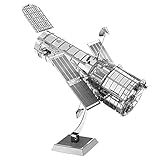
- HOBBY MODEL KIT – Unassembled model packed in an envelope with easy to follow instructions. Ideal for ages 14 and up.
- NO GLUE OR SOLDER NEEDED – Parts can be easily clipped from the metal sheets. Tweezers are the recommended tool for bending and twisting the connection tabs.
- HUBBLE TELESCOPE – 1 Sheet Model with a moderate difficulty level. Assembled Size: 3.00 x 2.00 x 2.50 inches.
- FROM STEEL SHEETS TO 3D – Pop out the pieces and connect using tabs and holes. Includes illustrated instructions.
- HIGHLY DETAILED ETCHED MODEL – Display your 3D model once completed - collect and build them all.
- Mass-produce satellites and replace aging units;
- Secure spectrum, orbital and national operating approvals;
- Build gateways, network-control systems and customer terminals;
- Manufacture and operate optical crosslinks at scale;
- Launch thousands of spacecraft and maintain a high launch cadence;
- Meet debris-mitigation and deorbiting obligations; and
- Coordinate TeraWave with Blue Origin’s other space programs.
Launch capacity is a particular dependency. The plan must fit alongside external customers and Blue Origin’s other missions on New Glenn. Ars Technica reported that Amazon Leo already has multiple launch commitments and that Amazon has used other providers while New Glenn has faced delays. The same report noted the execution challenge created by Blue Origin’s numerous simultaneous programs, including lunar landers, Blue Ring and space-station work.
What prospective customers still need to ask
- What is guaranteed? Require committed throughput per site, not only aggregate constellation capacity.
- What is the latency? Ask for measured round-trip latency by route, orbit and operating condition.
- What is the availability commitment? Clarify uptime, handoffs, weather effects, gateway outages and congestion remedies.
- Where can the service legally operate? A global constellation still needs spectrum, landing rights and gateway permissions in each market.
- What equipment is required? Determine terminal count, power draw, installation, pointing, environmental ratings and redundant-network needs.
- How does it integrate? Check support for private networking, encryption, SD-WAN, cloud interconnection, routing and existing carriers.
- What is the total cost? Include hardware, installation, support, regulatory charges, minimum commitments and replacement capacity.
What could go wrong
TeraWave could launch late or provide only partial coverage. Satellites might be available before terminals, gateways or national approvals are ready. The network’s headline capacity could be divided among more customers than expected, while optical-link, weather or gateway issues could reduce end-to-end performance.
New Glenn cadence may prove insufficient for both TeraWave and external customers. Spectrum coordination, debris rules and manufacturing delays could also change the schedule. Finally, a customer may discover that existing fiber or fixed wireless is cheaper and more predictable at its particular site.
Can businesses buy TeraWave now?
No public checkout, standard plan or price list was shown on Blue Origin’s TeraWave page as of August 18, 2026. The page uses a contact form requesting company and business details, which indicates a negotiated enterprise-sales process rather than a generally available consumer service. Interested organizations can monitor or contact Blue Origin through the official TeraWave page, but should treat it as a future supplier opportunity, not an orderable connection today.
Bottom line: a serious proposal, not a Starlink killer yet
TeraWave is a significant enterprise-connectivity proposal: 5,408 planned satellites, a mixed LEO/MEO design and ambitious claims of up to 6 Tbps overall capacity and 144 Gbps per customer. Its initial target is different from ordinary residential satellite broadband, and symmetrical capacity could appeal to data centers, governments and remote critical facilities.
But Blue Origin has announced a plan, not delivered a commercial network. Until the company discloses approvals, financing and manufacturing progress, launch cadence, terminals, prices, customer contracts, coverage, latency and service-level guarantees, TeraWave is best viewed as a potentially important future competitor whose execution remains unproven.
Quick Recap
Product prices and availability are accurate as of the date/time indicated and are subject to change. Any price and availability information displayed on Amazon at the time of purchase will apply.




