BlackRock did not buy a $40 billion data center with a single check. On July 21, 2026, a consortium comprising BlackRock’s Global Infrastructure Partners (GIP), the AI Infrastructure Partnership (AIP) and Abu Dhabi-based MGX completed its acquisition of Aligned Data Centers at an enterprise value of approximately $40 billion. The consortium also committed $5 billion for growth.
The strategic issue for CIOs is access to future powered capacity. Institutional capital, sovereign investment and AI-industry participants can finance campuses, electricity and expansion at a scale most enterprises cannot. That may mean longer lead times and weaker negotiating leverage for buyers—not an immediate removal of every existing colocation site from the market.
What the consortium actually bought
Aligned Data Centers was sold by private infrastructure funds managed by Macquarie Asset Management and co-investment partners. Aligned says its portfolio covers 51 campuses and more than 6.4 gigawatts (GW) of operational and planned capacity. The 6.4GW figure combines facilities already operating with capacity that is being built or planned; it is not a statement that 6.4GW is available for immediate enterprise contracts.
| Item | What is established |
|---|---|
| Closing date | July 21, 2026 |
| Buyer | A consortium involving AIP, BlackRock GIP and MGX |
| Transaction value | Approximately $40 billion enterprise value, not a stated cash payment by BlackRock alone |
| Growth funding | $5 billion committed at closing |
| Portfolio scale | 51 campuses and more than 6.4GW of operational and planned capacity, according to Aligned |
The public announcement does not provide a complete campus-by-campus breakdown of operating, construction-stage, reserved or generally available capacity. Customer allocation and preferential access for AIP participants should not be assumed without specific contract disclosures.
Quick wins for a faster PC:
Clear out junk files and repair common Windows errorsFree Scan →Scan for outdated or missing drivers - takes under a minuteDriver Scan →#1 Best Overall

- Save valuable floor space: 6U wall mount server cabinet Dimensions: 13.78" H x21.65" W x17.72" D.Maximum mounting depth is 14.2"
- Keep critical network equipment secure: glass door and side panels are lockable to prevent unauthorized access. Front door can be installed on either side of the front of the cabinet to satisfy your door swing orientation preference
- Easy equipment configuration: Fully adjustable mounting rails and numbered U positions, with square holes for easy equipment mounting with top and bottom punch-out panels for easy cable access
- Durability: Made of high quality cold rolled steel holds up to 110lb (50kg) (Easy Assembly Required)
- PCI & HIPPA and EIA/ECA-310-E compliant
Aligned’s closing announcement describes the transaction and portfolio.
Why powered capacity—not buildings—is scarce
A data center is useful only when several constrained pieces arrive together: land and permits, grid interconnection, substations and transformers, high-density electrical design, cooling, fiber, construction capacity and equipment. For an AI deployment, accelerator supply, storage and high-speed networking must also be ready.
The practical scarce asset is increasingly time-to-powered-capacity. A campus announcement or a megawatt reservation does not necessarily mean production-ready racks. CIOs should distinguish among:
- Operating capacity that can be commissioned now.
- Capacity under construction.
- Power secured but not yet converted into usable racks.
- Longer-term development options.
- Capacity already committed to large customers.
As historical context, CIO reported North American data-center vacancy of 1.6% in the first half of 2025 and Northern Virginia vacancy of 0.76%. Those figures illustrate tight markets at that time; they are not current 2026 vacancy rates. See CIO’s analysis.
Rank #2

- Universal 19” Rack Mount Compatibility – Perfect for pro audio, video, IT, and network gear. Compatible with mixers, routers, patch panels, servers, power amps, and more.
- Heavy-Duty Load Capacity – Built to support up to 550 lbs. Ideal for studio gear, DJ setups, server equipment, and AV components that demand serious stability.
- Robust Steel Frame & Design – Made with 1.5mm thick steel and weighs 36 lbs for maximum durability, reduced vibration, and long-term reliability in any setting.
- Mobile & Secure – Preinstalled with 3” industrial-grade caster wheels (lockable), making it easy to move and position your rack exactly where you need it.
- All-In-One Setup Kit Included – Comes with 34 rack screws (5mm & 6mm), a 1U blank spacer, and an assembly tool—ready for fast installation out of the box.
The four layers of the new infrastructure battle
1. Sites and powered land
Developers compete for parcels with transmission access, feasible permitting, network proximity and workable tax and regulatory conditions. A site with attractive real estate but no credible power path is not an AI facility.
2. Electricity and supporting infrastructure
AIP was formed to invest in data centers and supporting power infrastructure, including generation and transmission. Its 2024 launch sought $30 billion of private-equity capital and said total investment could reach up to $100 billion including debt financing. “Up to” describes potential investment, not committed spending. The partnership announcement sets out that model.
3. Compute and networks
AI campuses need accelerator-dense racks, liquid-cooling capability where required, storage throughput and low-latency east-west networking. NVIDIA and xAI joined AIP in 2025, adding technology and customer-side participants; that announcement does not itself guarantee either company capacity at every Aligned campus. AIP’s 2025 announcement records the expansion.
4. Enterprise access
Hyperscalers and AI laboratories can reserve large blocks years ahead, sign take-or-pay commitments or help finance facilities. A bank, retailer or manufacturer usually arrives later through cloud, colocation or managed-GPU contracts. That difference can affect location, delivery date, minimum commitments and price. It does not prove that enterprises are categorically locked out.
PC Slower Than It Used to Be?
A free scan shows the junk files, broken settings and background clutter dragging Windows down - then fixes them in one click.Free scan · Windows 10 & 11Crashes, No Sound, or Screen Glitches?
Random freezes, missing sound and display glitches usually trace back to one bad driver. Find and replace yours safely.Free scan · under a minuteRank #3

- ADJUSTABLE DEPTH: 4- Post 22U 19" server rack enclosure with 4 vertical rails and adjustable mounting depth 5.7" to 33.0" (14,4cm to 83,8cm); IT rack is compatible with various servers / switches / data / video / AV and other IT networking equipment
- EASY SHIPPING AND ASSEMBLY: Enclosed 22U data rack cabinet ships compact flat-packed to avoid damage and facilitate installation; Include wheels & levelling feet to offer more stability; Home server rack cabinet is only 46.6in (118,3cm) in height
- DESIGN AND VENTILATION: Half height server rack cabinet has lockable and removable door and side panels with vented top allowing airflow; 4 Post 19" rack with 1764lb (800kg) weight capacity (stationary); Computer cabinet rack is EIA/ECA-310-E Compliant
- HARDWARE INCLUDED: Rolling home network rack includes rack mounting and equipment mounting hardware, such as 20 M6 cage nuts / screws, PVC cup washers; Front/rear doors and side panels Keys, 2x allen keys; Rack assembly hardware; Casters and leveling feet
- THE IT PRO'S CHOICE: Designed and built for IT Professionals, this 22U IT Server Cabinet is backed for life, including free lifetime 24/5 multi-lingual technical assistance
What changes for CIOs
Capacity and launch dates
A funded AI program can still miss its launch date if GPUs, rack power, cooling, network fabric, data-sovereignty approvals or interconnection bandwidth are unavailable. Treat facility capacity as one dependency in a chain, not as a substitute for compute procurement.
Pricing and contract leverage
Concentrated demand and ownership may improve infrastructure owners’ bargaining position. Possible consequences include higher rates for scarce powered shells, larger deposits, longer terms, utility pass-throughs and separate charges for liquid cooling, cross-connects or high-density power. The Aligned transaction itself does not establish that enterprise prices have already risen.
Capital and risk decisions
Infrastructure commitments now belong on the finance, legal and risk agenda. Management must decide how much capacity to reserve, who bears the cost of idle power, and what happens if a newer accelerator makes a reserved design uneconomic.
Choose a capacity model by workload
| Model | Strengths | Trade-offs |
|---|---|---|
| Public cloud | Fast procurement when capacity exists; broad managed services and flexibility | Availability constraints, usage-price complexity, egress costs and vendor dependence |
| Colocation | Hardware and architecture control; potentially better economics at sustained utilization | You provide hardware, operations and capacity planning; availability varies by market and density |
| Managed GPU infrastructure | Access to specialized accelerators without operating a facility | Review tenancy, data handling, performance guarantees and exit rights carefully |
| Dedicated or build-to-suit | Maximum control and long-term capacity certainty | Longest lead time, largest commitment and exposure to obsolescence or demand error |
| Hybrid portfolio | Baseline reservation plus cloud bursts and controlled environments for sensitive workloads | More integration, governance and provider-management work |
Classify each workload by training or inference, latency, sovereignty, availability, bandwidth, utilization and expected growth over 12, 24 and 36 months. Training may tolerate geographic flexibility; regulated inference close to users may not.
Recommended Free Tools
Rank #4
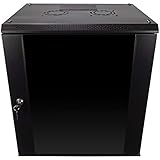
- DURABLE BUILD: Constructed from high-quality Cold Rolled Steel, the NavePoint Consumer Series 12U network cabinet boasts a sturdy, welded frame. Fitting EIA standard 19” networking equipment, this server cabinet confidently supports up to 110 lbs, providing a resilient base for your vital IT gear and equipment
- CONVENIENT DESIGN: This 12U cabinet features a reinforced, heat-treated, tempered glass front door with a security lock. Perfect for applications requiring both security and accessibility, its compact design of 17.72"L x 21.65"W x 24.42"H offers a practical solution for space-constrained settings.
- EASY & CUSTOMIZABLE EQUIPMENT SET UP - The 12U IT cabinet, with removable side panels and security locks, offers customization at its finest. Whether it's for an efficient device or cable management, this data cabinet ensures secure, adaptable configurations that suit your networking server requirements
- ENHANCED VENTILATION & SECURITY - Built-in fans and flow-through ventilation work to prevent overheating, ensuring optimal operation of your equipment. The reinforced, lockable tempered glass front door not only boosts security but also facilitates easy monitoring of installed equipment.
- SAFETY & COMPLIANCE - All NavePoint products are built to industry standards.
Contract questions that prevent unpleasant surprises
- What exactly does “available power” mean, and when is it usable at the rack?
- Are energization, construction completion and production readiness separate milestones?
- What are the ramp schedule, density assumptions and liquid-cooling specifications?
- How are utility costs, curtailment and energy-price changes passed through?
- Are there expansion options, transfer rights, downsizing windows or termination remedies?
- What are the SLA remedies, disaster-recovery duties and network cross-connect charges?
- Who handles hardware installation, removal, data destruction and exit?
- What protections apply if ownership or the operating provider changes?
Reserve the bottleneck without overcommitting
If you reserve too much
Demand may disappoint, staffing may lag, or a new accelerator generation may make the design uneconomic. Use staged reservations, flexible ramps, expansion options, transfer or sublease rights and hardware-neutral designs where possible.
If you reserve too little
You may face a delayed product launch, an inferior geography, higher prices or emergency migration to a cloud service with poor economics. The objective is not to buy the most capacity now; it is to secure the constraint while retaining options elsewhere.
Do not equate megawatts with compute
Useful AI output depends on accelerator type, rack density, cooling, topology, storage, software, utilization and availability design. Headline gigawatts cannot be compared as if they were equivalent amounts of compute.
A practical 90-day CIO response
- Build a 36-month demand forecast by workload, region, accelerator class and utilization.
- Separate facility power, hardware, network, data-governance and software dependencies.
- Identify which dependency has the longest lead time and reserve that one first.
- Obtain campus-level evidence for power, interconnection, delivery milestones and cooling.
- Price cloud, colocation, managed GPU and build-to-suit options using total cost, including labor, networking, power, cooling and egress.
- Negotiate staged commitments, expansion rights and credible exit mechanisms.
- Maintain at least one tested fallback region, cloud or colocation path where business risk justifies it.
- Escalate major reservations to finance, legal, risk and the board rather than treating them as ordinary operating spend.
What remains uncertain
The investment case assumes continuing AI demand, high utilization, durable customer contracts and workable energy economics. Grid queues, transformer shortages, permitting, water constraints, environmental review and changing utility tariffs can delay announced capacity. Conversely, weaker AI demand or rapid hardware productivity gains could leave owners with stranded capacity and encourage repricing.
Microsoft’s roughly $190 billion calendar-year 2026 capital-expenditure outlook, reported in its investor materials, demonstrates the scale gap between a hyperscaler and a typical enterprise; it is Microsoft’s forecast, not an industry-wide number. See Microsoft’s FY2026 third-quarter investor materials.
The acquisition therefore signals a capital-market and supply-chain shift rather than a proven monopoly or guaranteed enterprise shortage. CIOs may still obtain capacity, but waiting to negotiate late and treating infrastructure as a commodity are becoming riskier strategies.
Quick Recap
Product prices and availability are accurate as of the date/time indicated and are subject to change. Any price and availability information displayed on Amazon at the time of purchase will apply.




