Free tools Windows power users keep installed
One-click scans. No signup required.
AWS reports global data-center water-use efficiency (WUE) of 0.12 liters per kilowatt-hour (L/kWh) for 2025. That is lower than the 0.15 L/kWh reported for 2024 and the 0.25 L/kWh reported for 2021. The available evidence does not verify the title’s claim that AWS was the first cloud service provider (CSP) to publish such metrics, so that priority claim should be treated as unconfirmed.
What is AWS’s data-center water-use efficiency?
AWS defines WUE as the volume of water withdrawn per kilowatt-hour of IT load inside a data center. It is an intensity measure: it describes water withdrawals relative to computing energy demand, not the total water AWS withdraws, the scarcity of water at a particular site, or a community’s resulting impact.
The latest figure on Amazon’s AWS Cloud sustainability page is 0.12 L/kWh for 2025. The page was accessed on September 27, 2026. Amazon’s 2024 Sustainability Report provides the earlier series.
How AWS’s reported WUE changed
| Reporting year | Global data-center WUE | What the source establishes |
|---|---|---|
| 2021 | 0.25 L/kWh | Amazon 2024 Sustainability Report |
| 2022 | 0.19 L/kWh | Amazon 2024 Sustainability Report |
| 2023 | 0.18 L/kWh | Amazon 2024 Sustainability Report |
| 2024 | 0.15 L/kWh | Reported by Amazon as a 17% improvement from 2023 and 40% from 2021 |
| 2025 | 0.12 L/kWh | Current AWS Cloud sustainability page |
The figures show a declining withdrawal intensity across the reported period. They do not, by themselves, show that absolute withdrawals fell: total water can rise or fall as the amount of computing capacity, facility mix, climate, and operating conditions change.
#1 Best Overall

- Ventilation Fan: Designed to quietly ASUS GT/RT- AC5300 , cool Xboxs, CPU/ GPU, Playtations, Rokus, TVs, receivers, mondems, routers, DVRs, window fans ,network appliances, DIY aquarium cooling and other audio video electronics
- Variable Speed Control: 110V - 220V Fan power supply with speed control function, turn the knob to adjust the speed, 4V - 12V adjustable fan speed,and can turn off the fan . | Input: 100V - 240V 50/60Hz | Output: DC 3-12V 200-2000ma
- DIY Vertical Window Fan: Can both vertical and horizontal, provide efficient cooling and ventilation. Mining rigs rely on the cooling power of fans for optimal operation.Double Metal Protective, the fan is equipped with double metal protective net
- Easy to Install: Draw out air in refrigerators, provide ventilation in greenhouses, prevent amplifier overheating, and vent hot air from living room consoles like PS4. Y cable connects 2 fans, two fans can be 42cm/16.5 in far away from each other
- Dual Ball Bearing: 240mm x 240mm x 25mm / 9.45in(L) x 4.72in(W) x 1in(H) in in total. | Rated Voltage :12V | Rated Current: 0.93A at full speed | Airflow: (82CFM)x4 at 12V | Speed: 2500 RPMx4
Was AWS really the first CSP to publish WUE metrics?
The title’s “first CSP” wording is not established by the available documentation. The sources confirm AWS’s published figures, but they do not provide a verified first-publication date or a complete historical comparison with every other cloud provider. A precise statement is therefore that AWS publishes data-center WUE metrics; its priority relative to all CSPs remains unverified.
How AWS compares its WUE with an industry figure
AWS’s comparison page lists an industry-average withdrawal WUE of 0.84 L/kWh. This is not presented as a directly measured, universal industry census. AWS says it derives the number from a 0.56 L/kWh consumption-WUE figure attributed to de Vries-Gao (2025), then applies three cycles of concentration based on U.S. Department of Energy best-practice guidance.
Rank #2
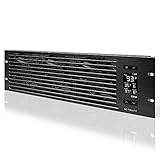
- An intelligent fan system designed for cooling audio video, DJ, server, network, and IT equipment racks.
- Protects rack-mount equipment from overheating, performance issues, and shortened lifespans.
- Programmable thermostat controller with automated speed control, alarm warnings, and backup memory.
- Premium anodized aluminum construction with CNC-machined detailing for a professional appearance.
- Size: 3U Rack Space | Design: Intake | Airflow: 60 to 300 CFM | Noise: 12 to 38 dBA | Bearings: Dual Ball
- AWS’s metric: water withdrawn per kWh of IT load.
- The underlying comparison figure: water consumed per kWh, which is a different numerator.
- Conversion assumption: three cycles of concentration.
Because withdrawal and consumption measure different flows, and because the benchmark is calculated using an assumption, readers should not treat 0.84 L/kWh as a directly observed universal average or use it to create a definitive provider ranking.
What AWS says it changed operationally
Amazon reports that AWS uses water-monitoring technology, real-time leak detection, treatment systems, and other water-conserving measures. Its 2024 report says AWS reduced cooling-water needs in North America by 946 million liters during 2024.
Rank #3

- [Adjustable] Adjustable temperature control helps ensure optimal performance for your rackmount such as network, server, music, and AV cabinets
- [Quiet and powerful] Equipped with three powerful 4” (120mm) noise control ball bearing fans capable of pumping 225 CFM of air, preventing overheating of expensive equipment
- [Optimal Airflow] This three fan cooling system will provide excellent cooling with its high-performance fans, which keep the hot air stream away from your setup with its top exhaust cool air system.
- [Compact Design] Device is standardized to mount to any 19" server rack or cabinet while taking only a single unit (1U) of space and has a wide variety of applications.
- [Programmable] Equipped with a programmable thermostat sensor controller for better temperature monitoring that will trigger fans based on your parameter configuration.
The report also says AWS began integrating liquid-cooling components for AI workloads into new data-center designs. AWS estimates those designs can reduce mechanical-energy use by up to 46% compared with previous designs during peak cooling conditions. That is a company forecast about energy use, not a measured water-saving result.
What “water positive by 2030” means
Amazon says AWS was 53% of the way toward its 2030 water-positive goal in the 2024 report. The goal is defined as returning more water to communities than AWS uses in its direct operations. This percentage is Amazon’s reported progress measure; it is separate from the WUE intensity figures and does not replace disclosure of absolute withdrawals or local water conditions.
Rank #4

- Adjustable temperature control helps ensure optimal performance for rackmount such as network, server, music, and AV cabinets
- Noise controlled fans makes the cooling system useful for a quiet office or business space
- Compact design mounts to any 19" inch cabinet and takes up only 1 unit of space
- Simple and easy to use LCD display allows user to control temperature
- Air pumped through to the top exhaust system of the fan
How AWS customers can see water-withdrawal data
In July 2026, AWS announced that annual water-withdrawal data is available through the Sustainability Console and API by AWS Region, service, and AWS account. The AWS Sustainability Console provides regional, service, and account environmental data with API and SDK access for sustainability planning. The announcement is available at AWS Sustainability service now includes water withdrawals data.
- Open the AWS Sustainability Console.
- Select the water-withdrawals data view.
- Filter the annual results by Region, AWS service, or account.
- Use the API or SDK when you need to export or integrate the data into sustainability reporting.
AWS explains its allocation method this way: “The model allocates total water withdrawals from AWS data center operations to individual customer accounts based on their proportional cloud service usage, to ensure customers receive transparent, attributable water withdrawals data.”
The Tool Desk
Outbyte PC Repair FREERepair Windows errors before they cause bigger problemsFix Now →Outbyte Driver Updater FREEFix the driver behind crashes, sound loss and screen glitchesFind Drivers →Best Value
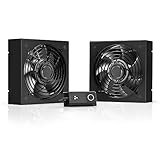
- A quiet fan kit designed for standard 19” racks, to be mounted on the roof or to replace existing fans.
- Features a speed controller utilizing PWM which can control the fan's speed without generating noise.
- Compatible with CLOUDPLATE series rack fans and can be linked to share the same programming.
- Heavy-Duty steel construction with spiral fan guards, mounting hardware, and power adapter.
- Size: Standard 120mm Rack Fans | Fans: 2 | Airflow 200 CFM | Noise: 26 dBA | Bearings: Dual Ball
What is included in a customer’s attributable boundary?
AWS’s documented system boundary includes withdrawals directly supporting cloud-service delivery at data centers AWS owns, leases, or controls. Examples include:
- Data-center cooling
- Domestic uses at operational data centers
- Fire-flow tanks
The boundary excludes warehouses, manufacturing facilities, office buildings, and customer-hosted sites such as Outposts and certain embedded or extension locations. A customer’s allocated number therefore represents the defined AWS operational boundary, not every water use associated with its wider technology footprint.
How to interpret AWS’s numbers responsibly
- Keep the denominator visible: 0.12 L/kWh means liters withdrawn per kWh of IT load, not liters per customer, server, or unit of revenue.
- Separate intensity from totals: a better WUE can coexist with higher total withdrawals if IT demand expands faster than efficiency improves.
- Check geography: the same withdrawal has different significance in a water-abundant region and a water-stressed basin.
- Align definitions before comparing providers: match reporting year, withdrawals versus consumption, data-center boundary, treatment of leased or partner facilities, denominator, and regional detail.
- Use customer data for attribution: the Console and API provide annual allocated withdrawals, while WUE is a fleet-level intensity statistic.
Bottom line for AWS customers and investors
AWS’s reported global data-center WUE improved from 0.25 L/kWh in 2021 to 0.12 L/kWh in 2025, with 0.15 L/kWh in 2024. The trend indicates lower withdrawal intensity, but it does not establish total water use, local water risk, or a complete ranking against other CSPs. For account-level analysis, use the Sustainability Console or API and read the resulting withdrawals within AWS’s stated system boundary.
Quick Recap
Product prices and availability are accurate as of the date/time indicated and are subject to change. Any price and availability information displayed on Amazon at the time of purchase will apply.
Quick wins for a faster PC:
Clear out junk files and repair common Windows errorsFree Scan →Scan for outdated or missing drivers - takes under a minuteDriver Scan →Repair Windows errors before they cause bigger problemsFix Now →



