Outdated Drivers Are Slowing You Down
One free scan finds every outdated or missing driver and matches the right update for your exact hardware.Free scan · exact hardware matchPC Slower Than It Used to Be?
A free scan shows the junk files, broken settings and background clutter dragging Windows down - then fixes them in one click.Free scan · Windows 10 & 11The headline refers to a historical transaction, not a new 2026 funding round. Amonix announced a $129.4 million Series B private financing on April 20, 2010. Led by Kleiner Perkins Caufield & Byers, the round was intended to accelerate deployment of Amonix’s concentrating-photovoltaic (CPV) systems and expand manufacturing. Amonix later transferred its assets, technology and key expertise to Arzon Solar in 2014, so the financing is best understood as a cleantech scale-up case study rather than evidence of a currently independent company.
What happened on April 20, 2010?
Amonix announced $129.4 million in Series B financing, commonly rounded to $129 million in headlines. Kleiner Perkins Caufield & Byers led the round. The named participants were Adams Street Partners, Angeleno Group, PCG Clean Energy & Technology Fund, Vedanta Capital, New Silk Route, The Westly Group and existing investor MissionPoint Capital Partners. The announcement appears in a DOE/NREL presentation of the company’s release (DOE/NREL presentation).


Amonix said the proceeds would fund two linked objectives: deploy more CPV systems and increase manufacturing capacity. That was a substantial private round for a solar-technology company still moving from demonstration and limited production toward utility-scale volume. Contemporary coverage described it as an effort to commercialize a factory-built alternative to conventional flat-plate photovoltaic modules (Renewable Energy World’s 2010 report).
The round was equity financing, not a federal grant. Amonix also benefited from government programs, but those sources of support had different economic meanings.
#1 Best Overall
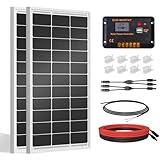
- [Wide Application]: Daily Output 800wh/day under 4 hours full sunshine condition. Perfect for RV, Caravan, Marine, Camper, Electric scooter, Golf Carts, Power wheels, Trolling motor, Tool trailer, Backup power supply for cabin shed home etc.
- [Excellent Performance]: ECO-WORTHY solar panels use high-performance monocrystalline solar cells, which can provide up to 21.5% higher efficiency sufficient light conditions.size:35.2*23.1.37in
- [Durable]: Corrosion-resistant aluminum alloy frame, so that the panel can be used for decades, and can withstand strong wind (2400Pa) and snow load (5400Pa), with a long service life. Ip65 rated junction box provides complete protection.:
- [Complete and Easy]: The back of the pre-drilled and plug-and-play cables allow quick installation, the kit can be connected in series (24V) or parallel (12V) if you need. What you will get: 2 pcs 100W mono solar panel + 2 set of Z mounting brackets + 30A solar controller + 1 pair of 16.4ft 10 awg solar cables + 1 pair of 2-in-1 connectors + 1 pair of 4.92ft tray cable.
- [Support]: 1 year with 24/7 tech support, if any problems or questions about the product,please do not hesitate to let us know through Amazon or call ECO-WORHTY hotline for solution.
How much capital had Amonix received before Series B?
| Source | Amount | What it was |
|---|---|---|
| Series A | $25 million | Earlier private financing reported by contemporaneous coverage |
| DOE Solar America Initiative | $15.6 million | Grant support for technology development, not equity |
| Recovery Act-related Advanced Energy Manufacturing Tax Credit | $9.5 million reported in 2010 coverage | Tax-credit support associated with manufacturing plans, not Series B proceeds |
| Series B | $129.4 million | Private financing announced April 20, 2010 |
The figures should not be added together as though they represented one pool of cash. Venture capital buys an ownership stake; a grant supports specified development work; and a tax credit reduces qualifying project costs or tax liability. The financing and earlier-support figures are reported by Renewable Energy World and the DOE’s Solar America Initiative fact sheet.
What is concentrating photovoltaics?
CPV uses optics and tracking to replace much of the semiconductor area used by a conventional flat-plate panel:
- Large lenses collect incoming sunlight.
- The optics concentrate that light onto a much smaller photovoltaic cell.
- High-efficiency multijunction cells convert the concentrated light into electricity.
- A two-axis tracker continually points the optics at the sun.
Amonix combined Fresnel lenses, multijunction cells and modular “MegaModules” on a hydraulic dual-axis tracking structure. Technical descriptions of the Amonix 7700 report concentration of approximately 500 times incident sunlight (NREL Amonix 7700 fact sheet; NREL-linked CPV project record).
CPV is not concentrated solar power (CSP). CPV makes electricity directly in photovoltaic cells. CSP concentrates sunlight to produce heat, which is then used in a thermal power cycle, often with thermal storage.
Rank #2

- 【Efficient Performance】This Starter Kit can generate an average of 500Wh of electricity per day (varies with sunlight). The solar panel boasts a 22.5% cell efficiency, 1.3% higher than other counterparts. Each panel dispatched from our facility undergoes 100% EL testing, ensuring that your panel is completely free from any hidden cracks.
- 【Market-Leading Service Plan】Enjoy worry-free usage with our market-leading service plan, providing 10 years of coverage for solar panel material and workmanship, along with a 2-year plan for the charge controller. Additionally, benefit from a 25-year service plan for the power output of the panel.
- 【Exceptional Safety】Certified by UL 61730, CSA C22.2#61730, IEC 61730/IEC 61215, our solar panel withstands 2400Pa wind and 5400Pa snow loads. Featuring IP65-rated J-box and IP67-rated solar connectors, rest assured, it can tackle any weather challenge.
- 【Remote Monitoring】The Wanderer PWM Charge Controller features an RS232 Bluetooth port. By adding a Renogy BT-1 Bluetooth Module, you can remotely monitor your solar system on the Renogy DC Home app. Keep track of voltage and current at any time, and receive timely warnings for over-voltage, under-voltage, and over-discharge.
- 【Excellent Compatibility】The solar kit with the Wanderer 30A PWM Charge Controller, supports expansion up to 400W with additional solar panels and is compatible with AGM, Gel, Flooded, and Lithium batteries.
Why did investors find CPV attractive?
- Efficiency potential: multijunction cells can convert a larger share of concentrated sunlight than many conventional silicon modules under suitable conditions.
- Less semiconductor material: a small cell can receive light collected across a much larger optical aperture.
- Utility-scale modularity: factory-assembled modules could, in principle, simplify field installation and reduce labor.
- Land productivity: high output per unit of land was attractive for large projects in sunny regions.
- Manufacturing leverage: the strategy depended on scaling production of optics, receivers and trackers rather than covering every square meter with expensive high-efficiency cells.
Those benefits were location-specific. CPV needs strong direct normal irradiance, not merely a bright or warm climate. Tracking accuracy, optical cleanliness, maintenance access and grid connection all affect the result. A technology can have a high conversion-efficiency figure without delivering the lowest levelized cost of energy.
What product was Amonix commercializing?
The principal utility-scale product in the period’s technical material was the Amonix 7700. The following figures come from the cited NREL product description and are historical specifications, not current Amonix offerings.
| Measure | Reported figure | Qualification |
|---|---|---|
| AC output | Approximately 53 kW | Product-description figure in NREL material |
| DC output | About 67 kW | Figure associated with a Sandia-measured configuration |
| Sunlight-to-electricity efficiency | 28.9% | Historical cited measurement; do not generalize to every system or operating condition |
| Architecture | Fresnel lenses, multijunction cells, MegaModules and dual-axis tracking | System design described in NREL material |
AC and DC ratings are not interchangeable: DC is the electricity produced before inverter conversion, while AC is the grid-facing output. Nor is a module-efficiency result the same as annual plant yield or lifetime project economics.
How public programs supported the scale-up
Amonix’s private financing was part of a broader public-private commercialization model. DOE’s Solar America Initiative supported development, while DOE and national-laboratory work provided testing, reliability and grid-integration evaluation. Manufacturing support also helped establish a North Las Vegas operation.
Rank #3
In a June 23, 2011 announcement, DOE described a 214,000-square-foot North Las Vegas facility producing MegaModules and associated it with more than 300 permanent jobs. The announcement said the facility benefited from a $5.9 million clean-energy manufacturing tax credit (DOE announcement). That $5.9 million facility credit is distinct from the $9.5 million Recovery Act-related figure reported in financing coverage.
The Solar America Initiative’s stated objective was to move technologies such as CPV from low-volume production toward manufacturing at a scale capable of reducing levelized energy costs. Those were program goals, not guarantees that Amonix would achieve them (DOE fact sheet).
What evidence showed that the technology worked?
The public record includes NREL and Sandia testing, pilot and field deployments, technical evaluations, and later reliability and grid-integration research. NREL-linked material describes Amonix systems focusing sunlight roughly 500 times onto small, high-efficiency cells and targeting multi-megawatt projects (project record).
That evidence answers a narrower question—whether the hardware could produce electricity and achieve impressive measured efficiency—than the question investors ultimately faced. A complete commercial assessment would also require:
Quick wins for a faster PC:
Clear out junk files and repair common Windows errorsFree Scan →Fix the driver behind crashes, sound loss and screen glitchesFind Drivers →Repair Windows errors before they cause bigger problemsFix Now →- long-term outdoor energy yield and degradation data;
- tracker, lens and receiver maintenance costs;
- installed, operating and financing costs;
- reliability over a project’s life;
- bankability and utility procurement history; and
- comparison with the rapidly declining cost of conventional PV.
The cited sources do not establish a complete lifetime levelized-cost calculation or investor return for the 2010 round. Claims such as “lowest-cost solar” should therefore be attributed to Amonix or its backers rather than presented as independently proven outcomes.
Independent reader supportYour contribution helps us test, update, and keep practical guides available for everyone.What were CPV’s commercial and engineering risks?
Dependence on direct sunlight
Diffuse light from clouds and haze is less useful to a concentrating optic than direct beam sunlight. That narrowed the suitable project geography compared with flat-plate PV.
Tracking and optical maintenance
Two-axis trackers add moving parts and control requirements. Dust, lens degradation or misalignment can reduce the light reaching the cells, particularly in the dry environments where CPV was most attractive.
Manufacturing and supply-chain complexity
Multijunction cells, precision optics, receivers and large tracking structures require specialized production and logistics. Scaling one component does not automatically solve installation, servicing or grid-integration costs.
Free tools Windows power users keep installed
One-click scans. No signup required.
Best Value

- Portable Generator with 60W Solar Panel Included: with a big battery pack, ZeroKor 300W solar powered generator are powerful enough to charge smartphones,tablets,laptops,headphones or other outdoor small camping supplies(Tips:Using electrical appliances over 300W may damage the portable solar generator, especially some devices that are prone to heat or built-in air compressor such as coffee maker,Hair dryer, water pump etc )
- Multiple Charging outlets for camping gear with SOS Flashlight: with 2* 300W Max wall AC outlets, 1* DC port (9V-12.6V/10A max ), 3* 5V/3A Max USB ports, 1*quick charge USB port (5V/3A 9V/2A Max), Flashlight with reading mode and SOS mode for your outdoor Adventures, our portable solar power station offers a versatile charging solution,allowing you to charge your outdoor smart devices directly from a wall AC outlet
- Multiple Charging Optional, Solar Panel Charger 60W Included: ZeroKor portable power bank generator can be recharged by Home AC outlet, DC5521 13V-23V Solar Panel (Portable Power Station built-in MPPT), 12V Carport. Take the portable solar power bank generator with you on-the-go and never worry about power shortage,the portable AC outlet design makes it more suitable for Tent camping OFF-Grid
- Built in BMS(Battery Management System) : ZeroKor portable power station features short circuit protection, over-current protection, over-voltage protection, overload protection and overheating protection. The built-in cooling fan system will automatically start and stop according to the portable battery pack internal temperature during use. Acting as a portable solar power bank, it accommodates multiple devices simultaneously, making it perfect for indoor and outdoor use
- HIGH CONVERSION EFFICIENCY: ZeroKor solar panels 60W monocrystalline solar cell have a high conversion efficiency of 20.5%, and its performance is better than that of polycrystalline solar panels under the condition of insufficient light
Competitive pressure from conventional PV
CPV had to overcome falling prices and enormous manufacturing scale in conventional PV. Its efficiency advantage mattered only if total installed and operating costs remained competitive.
NREL’s historical CPV overview shows an industry with many developers and developing manufacturing capacity, rather than a settled commercial standard (NREL technology overview).
What happened after the financing?
| Date | Event |
|---|---|
| April 20, 2010 | Amonix announces the $129.4 million Series B round (DOE/NREL presentation). |
| 2010–2011 | Amonix 7700 technical specifications and manufacturing ambitions appear in NREL and DOE material (NREL fact sheet). |
| June 23, 2011 | DOE highlights the North Las Vegas facility, MegaModule production and associated employment (DOE announcement). |
| 2013 | Amonix and Solar Junction announce a co-development agreement focused on CPV performance and cost (announcement). |
| 2014 | Arzon Solar announces the acquisition of Amonix’s assets, technology and key expertise (Arzon Solar announcement). |
The acquisition does not, by itself, prove that CPV technology failed. It does establish that Amonix did not continue as an independent company. Technology and expertise continued under a new owner, while the original corporate growth plan did not produce a durable independent market leader on the evidence cited here.
Did the $129 million bet pay off?
The financing was a major vote of confidence in CPV in the 2010 cleantech market and helped support real manufacturing, testing and deployment activity. It also coincided with public programs designed to push CPV toward higher-volume production.
Do these 3 things before closing this tab:
1Scan for outdated or missing drivers - takes under a minute2Repair Windows errors before they cause bigger problems3Fix the driver behind crashes, sound loss and screen glitchesBut the available record does not support saying that the round delivered a proven investor return, a permanently successful manufacturer or lower lifetime energy costs than conventional PV. The clearest long-term outcome is corporate and technological: Amonix’s assets and expertise moved to Arzon Solar in 2014. That makes the round an instructive example of the difference between technical promise, funded scale-up and durable commercial success.
Why the headline is misleading today
A page published with the same headline in 2026 appears to repackage the 2010 announcement and adds unsupported forward-looking claims (republished page). It should not be cited as evidence of a new Amonix raise, resumed operations or 2026 projections. For historical context, NREL lists Amonix among notable 2010 solar venture transactions, alongside other large cleantech financings (NREL 2010 solar technologies report).
Quick Recap
Product prices and availability are accurate as of the date/time indicated and are subject to change. Any price and availability information displayed on Amazon at the time of purchase will apply.




