Short answer: The announcement is real, but “AWS is spending $50 billion” is misleading shorthand. On November 24, 2025, Amazon said it would invest up to $50 billion through AWS to expand AI and high-performance-computing infrastructure for U.S. government customers. The plan targets nearly 1.3 gigawatts of additional capacity across AWS GovCloud (US), AWS Secret, and AWS Top Secret environments, with projects expected to break ground in 2026. Public information does not show that the full amount has been spent, that the capacity is operational, or that the federal government awarded AWS a single $50 billion contract.
For taxpayers and investors, the key distinction is between Amazon’s planned capital investment and government procurement. Agencies may later buy cloud services from that infrastructure, but the announcement itself is not proof of a $50 billion federal payment or guaranteed revenue stream.



What Amazon actually announced
Amazon’s November 24, 2025 announcement describes a maximum planned investment by Amazon, through AWS, for existing and future U.S. government customers. The company said construction was expected to begin in 2026 and that the build-out would add nearly 1.3 GW of AI and high-performance-computing capacity.
| Item | What is publicly stated |
|---|---|
| Investor | Amazon, through AWS |
| Maximum announced investment | Up to $50 billion; this is a ceiling, not evidence that the amount has been spent |
| Target customers | Existing and future U.S. government customers |
| Planned capacity | Nearly 1.3 GW of AI and HPC capacity; Amazon does not define whether this is IT load, facility power, or another measure |
| Target environments | AWS GovCloud (US), AWS Secret, and AWS Top Secret Regions |
| Timing | Projects were expected to break ground in 2026; completion dates and operational capacity are not disclosed |
AWS’s public-sector description continued to characterize the initiative as “up to $50 billion” during 2026. The available public material does not identify locations, the number of facilities, project-by-project spending, financing, or the amount deployed by August 16, 2026.
The Tool Desk
Outbyte Driver Updater FREEScan for outdated or missing drivers - takes under a minuteDriver Scan →Outbyte PC Repair FREERepair Windows errors before they cause bigger problemsFix Now →Is this a $50 billion government contract or subsidy?
No such arrangement is established by the announcement. It does not identify a $50 billion contract award, congressional appropriation, guaranteed purchase commitment, government ownership stake, or reimbursement schedule.
Four different money flows
- Amazon capital expenditure: AWS funds and builds data-center, power, networking, and computing assets.
- Cloud-service revenue: Agencies pay for consumption or contracted capacity after they have an authorized procurement path.
- Federal procurement: Agencies use contracts, task orders, appropriations, security approvals, and operating budgets to buy services.
- Credits or incentives: AWS may reduce the cost of particular programs, but a credit is not the same as construction funding.
The separate GSA OneGov agreement, announced August 7, 2025, offers federal agencies up to $1 billion in savings through December 31, 2028. It is not identified as the funding source for this infrastructure plan.
What “purpose-built” infrastructure means
Amazon says the systems will combine advanced computing and networking for government AI and HPC workloads. Named technologies include AWS Trainium chips, NVIDIA AI infrastructure, Amazon SageMaker AI, Amazon Bedrock, Amazon Nova models, Anthropic Claude, and open-weight foundation models. The announcement does not provide a complete chip inventory, GPU count, network design, cooling plan, delivery schedule, or facility locations.
“Purpose-built” should not be read as proof of one completely separate national cloud. It means infrastructure and services designed around federal mission, security, compliance, classification, and performance requirements. The exact architecture is not public, particularly for classified environments.
How the three AWS government environments differ
| Environment | High-level role | Important limitation |
|---|---|---|
| AWS GovCloud (US) | Sensitive unclassified government and regulated workloads | Service availability and authorization vary by region and workload |
| AWS Secret | Workloads classified at the Secret level | Requires appropriate contracts, clearances, facilities, and authorizations |
| AWS Top Secret | Workloads classified at the Top Secret level | Not a general self-service commercial region; access is tightly controlled |
A service listed in a commercial AWS Region is not automatically available in GovCloud, Secret, or Top Secret. Model approval, personnel requirements, export controls, data-handling rules, and cross-domain restrictions can all affect deployment.
What agencies could use the capacity for
AWS describes the following as potential applications, not independently demonstrated results from this specific investment:
- Scientific simulations and physics or engineering modeling.
- Autonomous-systems development and weapons testing.
- Energy, nuclear, genomics, and other data-intensive research.
- National-security analysis and processing of large datasets.
- Training, customizing, and deploying AI models.
- Workforce productivity and agentic-AI applications.
AWS says combining simulation data with AI could support autonomous experimental steering and faster feedback loops. Whether those benefits materialize depends on data quality, model performance, authorization, power, staffing, and agency implementation.
What the plan could mean for taxpayers and investors
Potential public benefits
- Agencies may obtain elastic AI and HPC capacity without each building a separate supercomputing cluster.
- Government-specific regions can keep sensitive workloads within specialized U.S.-based environments.
- Trainium and NVIDIA systems give agencies different hardware and software trade-offs.
- Multiple model options through AWS services may reduce dependence on one model vendor.
Costs and risks
- Vendor concentration: Infrastructure, identity, data pipelines, and operations could become more dependent on AWS.
- Portability: Bedrock APIs, SageMaker workflows, Trainium optimizations, and AWS-native controls can make migration expensive.
- Procurement friction: New capacity does not provide an agency access until contracts, funding, authorizations, migration plans, and personnel are in place.
- Energy and construction: A 1.3-GW build-out implies substantial power, cooling, networking, and physical-security needs, but locations, energy sources, water use, and grid arrangements have not been disclosed.
- AI reliability: More compute does not eliminate hallucinations, biased data, cyber risk, weak evaluation, or the need for human oversight.
For Amazon investors, the announcement signals an attempt to expand AWS’s federal infrastructure and future workload pipeline. It does not, by itself, establish $50 billion of booked sales, profit, backlog, or government revenue.
Recommended Free Tools
Best Value
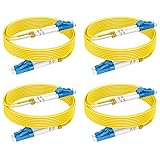
- 【6ft/2m 4pack OS2 Fiber Optic Patch Cable】 As AI continues to advance at an unprecedented pace, having reliable and efficient connectivity is crucial.RamboCables offers a cost-effective solution for your AI infrastructure with the 4-Pack OS2 LC-LC Single Mode Fiber Patch Cables. These high-quality fiber optic patch cords are designed to provide reliable and efficient connectivity for your AI applications.
- 【Wide Application】Whether you're using AI for data processing, machine learning, or other applications, the OS2 LC-LC Single Mode Duplex Fiber Patch Cable is ideal for connecting high-speed transceivers such as 10G SR, 40G BIDI SR, QSFP+, SFP+, and more. It is suitable for 1G/10G/40G/100G/400G Ethernet connections, making it a versatile choice for data centers, cloud storage networks, server farms and any other environments where reliable fiber optic connectivity is essential.
- 【Max Transmission Distance】With the OS2 Single Mode Optic Fiber Cable, you can transmit data for up to 10km at 1310nm or up to 40km at 1550nm. It offers excellent bandwidth at 1310nm-1550nm, with a low attenuation rate of 0.36 dB/km-0.22 dB/km, and can operate in a wide temperature range of -20~70°C, ensuring reliable performance even in harsh environments.
- 【Industry Standard】The OS2 LC-LC Fiber Patch Cords are built to industry standards. With LSZH (Low Smoke Zero Halogen) jacket, LC/UPC to LC/UPC connectors, 9/125μm high-rated fiber cladding, and a 2.0mm cable diameter, feature an LSZH environmentally friendly jacket, Zirconia Ceramic Ferrule, and 15mm minimum bend radius, all in accordance with EIA/TIA 604-2 standards, ensuring optimum insertion loss (IL) and return loss (RL) performance.
- 【Standards & Reliability】With over 15 years of experience manufacturing fiber patch cords, RamboCables are dedicated to supplying high-quality products and services. Our fiber patch cables comply with industry standards to enable efficient network transmission.
How the separate 2026 programs fit in
Two other announcements should not be folded into the infrastructure figure:
- AWS announced up to $100 million in credits over 2026–2028, divided between the Warfighter Capability Accelerator and Genesis Accelerator. Details are in AWS’s public-sector announcement.
- Amazon announced a separate $1 billion Forward Deployed Engineering initiative at AWS Summit Washington, D.C. Details appear in its 2026 public-sector update.
Those programs concern adoption, engineering, or credits. Neither changes the status of the “up to” $50 billion infrastructure commitment.
What is still unknown—and what would verify delivery
As of August 16, 2026, public sources reviewed for this article do not establish exact groundbreaking dates, facility locations, completion dates, dollars spent, operational gigawatts, or whether the 1.3-GW figure refers to usable compute power.
Milestones worth watching
- Named data-center locations, permits, power agreements, and construction announcements.
- Federal procurement notices, contract modifications, and agency budget documents tied to the capacity.
- New region or availability-zone announcements and service authorization details.
- Evidence that specific AI services are available in GovCloud, Secret, or Top Secret environments.
- Agency workload deployments, migration notices, and measurable mission outcomes.
- Independent disclosures of spending, delivered capacity, and operating dates.
How this compares with other government-cloud choices
| Option | Why an agency might consider it | Trade-off |
|---|---|---|
| Microsoft Azure Government | Existing Microsoft identity, productivity, security, or defense ecosystem | Migration and interoperability costs can still be significant |
| Google Cloud for Government | Google AI, data, analytics, and Kubernetes capabilities | May not align with an agency’s existing contracts or tooling |
| Oracle Cloud for Government | Oracle databases, enterprise applications, or specialized government requirements | Fit depends heavily on the agency’s Oracle footprint |
| On-premises or hybrid HPC | Direct control over hardware, locality, and long-term infrastructure | Requires capital, facilities, power, cooling, security engineering, and specialist staff |
Commercial buyers should not assume they can purchase access to the classified capacity. AWS GovCloud, Secret, and Top Secret offerings require eligibility and authorization. For ordinary business workloads, standard AWS, Azure, Google Cloud, or a managed AI API may be more practical.
Quick wins for a faster PC:
Repair Windows errors before they cause bigger problemsFix Now →Fix the driver behind crashes, sound loss and screen glitchesFind Drivers →Clear out junk files and repair common Windows errorsFree Scan →Quick Recap
Product prices and availability are accurate as of the date/time indicated and are subject to change. Any price and availability information displayed on Amazon at the time of purchase will apply.




