Recommended Free Tools
AI infrastructure is tightening the memory market and pushing DRAM prices higher, but this is not a simple shortage of every type of RAM. Artificial-intelligence data centers need large quantities of specialized high-bandwidth memory (HBM) as well as conventional server DRAM. Manufacturers are prioritizing those higher-value products while new capacity takes years to build and qualify.
For households and businesses, the likely effects are higher prices for some memory modules, more expensive PCs and workstations, costlier server upgrades, and potentially higher cloud-computing bills. The market may eventually swing back toward oversupply, but there is no reliable single date for broad price relief.
The short version
- AI accelerators use HBM, a specialized form of DRAM designed for extremely high bandwidth.
- AI servers also require conventional DDR5 server memory for CPUs, orchestration, preprocessing, and inference.
- HBM and premium server products are more strategically important and often more profitable, so suppliers are allocating capacity toward them.
- The effect on ordinary DDR5 and LPDDR is indirect and varies by product, supplier, contract, and region.
- Counterpoint, as reported by IEEE Spectrum, measured an 80%–90% DRAM price increase during the referenced quarter. That figure should not be treated as a universal increase for every consumer memory kit.
- Relief could come from new fabs, better yields, improved packaging, weaker AI spending, or more competition—but each has limitations and timing risk.
What DRAM is—and why AI needs it
Dynamic random-access memory, or DRAM, is the short-term working memory used by PCs, laptops, servers, smartphones, graphics systems, networking equipment, and many embedded and automotive products. It is faster than storage but loses its contents when power is removed, which is why computers constantly move data between processors, DRAM, and SSDs.
AI workloads place unusual demands on memory. Training and running large models requires moving enormous volumes of parameters and intermediate data between processors and memory. If the processor cannot receive data quickly enough, expensive compute resources sit idle.
#1 Best Overall

- Disclaimer: Maximum Speed requires overclocking/PC BIOS adjustments. Maximum speed and performance depend on system components, including motherboard and CPU
- Hand-sorted memory chips ensure high performance with generous overclocking headroom
- VENGEANCE LPX is optimized for wide compatibility with the latest Intel and AMD DDR4 motherboards
- A low-profile height of just 34mm ensures that VENGEANCE LPX even fits in most small-form-factor builds
- A solid aluminum heatspreader efficiently dissipates heat from each module so that they consistently run at high clock speeds
HBM addresses the bandwidth problem. It stacks multiple DRAM dies vertically, connects them with through-silicon vias, and places the stack close to a GPU or other accelerator inside an advanced package. The result is much wider and faster communication than a conventional memory module can provide. HBM is therefore not a completely separate raw material from DRAM; it is a technically demanding DRAM product.
AI servers need more than HBM. They also use conventional server memory—often DDR5 registered DIMMs—for CPUs, operating-system tasks, data preparation, coordination between accelerators, and inference services. As AI systems expand, Micron says infrastructure is spreading beyond accelerator racks into CPU racks and storage racks that hold growing context stores.
The memory products affected are not interchangeable
| Product | Typical use | Connection to AI demand |
|---|---|---|
| HBM | GPUs and AI accelerators | Directly critical to AI systems and a high-priority product |
| DDR5 RDIMM | Servers and data centers | Rising capacity requirements in AI and conventional servers |
| DDR5 UDIMM/SODIMM | Desktops, laptops, and workstations | Indirectly affected by allocation, pricing, and supplier mix |
| LPDDR | Phones, tablets, and thin devices | Shares manufacturing resources but follows different demand cycles |
| NAND flash | SSDs and other storage | Also used heavily in data centers, but it is not DRAM |
This distinction matters financially. A shortage of HBM can coexist with available consumer DDR5, while manufacturers’ decisions to emphasize HBM and server memory can still make consumer products more expensive or harder to obtain.
How HBM tightness spreads to ordinary DRAM
The claim that “HBM takes memory away from consumers” needs careful explanation. It does not mean that every HBM bit physically replaces one DDR5 bit. The impact depends on the manufacturing process, die size, yields, product mix, packaging capacity, and supplier decisions.
What’s actually slowing this PC down?
Pick the symptom - the matching free tool is one click away.
There are several channels:
- Shared wafer resources: HBM is made from DRAM dies, so suppliers must allocate wafer output among HBM, server DRAM, PC memory, and mobile memory.
- Portfolio allocation: HBM and premium server products can generate more revenue and strategic value than commodity products. When demand is strong, manufacturers have an incentive to prioritize them.
- Packaging constraints: HBM requires stacking, testing, advanced packaging, thermal management, and qualification alongside a specific accelerator platform. More front-end wafer capacity alone does not instantly create more finished HBM.
- Long-term commitments: Hyperscalers, accelerator companies, and server manufacturers may secure output through agreements, leaving spot-market buyers with less flexibility.
The commercial shift is visible in the data cited by IEEE Spectrum: Micron’s HBM and other cloud-related memory rose from 17% of DRAM revenue in 2023 to nearly 50% in 2025. That is evidence of changing product economics, not proof that an identical quantity of consumer DRAM disappeared.
Thermal management is another constraint. Faster and denser stacks generate more heat, and SK hynix has described cooling and packaging as critical challenges for future HBM generations.
The earlier memory downturn made the squeeze worse
AI demand arrived after a normal but severe memory cycle. During the pandemic, supply concerns encouraged hyperscalers and other customers to build inventories. When supply normalized and demand weakened, those inventories contributed to a sharp downturn. DRAM prices fell substantially in 2022 and 2023.
Manufacturers responded by cutting production. They were cautious about adding expensive capacity during 2024 and much of 2025 because another oversupply could destroy margins. AI infrastructure spending then accelerated before sufficient new capacity had been built.
Rank #2
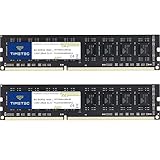
- [Color] PCB color may vary (black or green) depending on production batch. Quality and performance remain consistent across all Timetec products.
- DDR3L / DDR3 1600MHz PC3L-12800 / PC3-12800 240-Pin Unbuffered Non-ECC 1.35V / 1.5V CL11 Dual Rank 2Rx8 based 512x8
- Module Size: 16GB KIT(2x8GB Modules) Package: 2x8GB ; JEDEC standard 1.35V, this is a dual voltage piece and can operate at 1.35V or 1.5V
- For DDR3 Desktop Compatible with Intel and AMD CPU, Not for Laptop
- Guaranteed Lifetime warranty from Purchase Date and Free technical support based on United States
This is why the current price surge cannot fairly be attributed to AI alone. It reflects an AI demand shock layered onto production cuts, delayed investment, product transitions, supplier concentration, and the memory industry’s familiar boom-and-bust economics.
How much have DRAM prices increased?
The most prominent figure in the available evidence is an 80%–90% increase during one recent quarter, based on Counterpoint data reported by IEEE Spectrum. The number is significant, but its meaning depends on what was measured.
Memory prices can refer to several different things:
- Contract prices negotiated by large OEMs and cloud providers.
- Spot prices paid by distributors and smaller buyers.
- Retail prices for finished desktop or laptop modules.
- Average selling prices by category, such as server DRAM or HBM.
- Blended revenue or cost per bit across a manufacturer’s portfolio.
A manufacturer’s average selling price can rise because its product mix shifts toward expensive HBM and high-capacity server products, even if every individual DRAM chip does not rise by the same percentage. Retail prices can also include distributor replacement costs, scarcity premiums, currency movements, and retailer margins.
The available evidence does not independently establish a single consumer-retail price index for August 2026. Therefore, it would be misleading to say that every desktop DIMM, laptop module, or smartphone memory component doubled in price.
Micron has also pointed to higher cost per bit as the industry moves toward more complex DRAM, newer DDR generations, and newer HBM products. That represents a structural cost and product-mix issue as well as a temporary supply shortage.
Who controls most DRAM supply?
Global DRAM production is highly concentrated. Samsung Electronics, SK hynix, and Micron Technology are the dominant suppliers, according to IEEE Spectrum. Their investment and allocation decisions therefore have an unusually large effect on prices and availability.
China’s CXMT could become a stronger source of conventional DRAM competition. A 2026 report described CXMT expanding capacity for products including DDR5 and LPDDR5X while the established suppliers focused heavily on HBM and server memory. That may eventually add pressure to conventional-memory pricing, but it should not be treated as evidence that CXMT is already an equivalent substitute for the leading suppliers in HBM.
Rank #3

- Requires overclocking/BIOS adjustments. Maximum speed and performance depends on system components, including motherboard and CPU.
- G.SKILL RipjawsV Series DDR4 U-DIMM Memory Kit, Model: F4-3200C16D-16GVKB
- Non-ECC, DDR4 U-DIMM, 288-pin, for Desktop PC & Gaming
- Includes JEDEC default profile, and Intel XMP memory overclock profile
- Do not mix memory kits. Memory kits are sold in matched kits that are designed to run together as a set. Mixing memory kits will result in stability issues or system failure.
What the major suppliers are saying
Samsung
In its second-quarter 2026 results, Samsung said server demand was strong, price increases were continuing, and the industry was expected to remain undersupplied in the second half of 2026 despite production increases.
Samsung also announced HBM4 mass production in February 2026 and said it expected HBM sales to more than triple in 2026 compared with 2025. It later announced shipment of HBM4E samples. These announcements show how aggressively suppliers are developing next-generation products, but sampling is not the same as broad commercial availability.
SK hynix
SK hynix said favorable pricing conditions for DRAM and NAND would continue, citing demand growth as AI develops from large-model training toward agentic AI and real-time inference.
In June 2026, the company announced samples of 12-layer HBM4E for major customers, reporting speeds of up to 16 gigabits per second per pin and a 17% reduction in heat resistance from its packaging process. Those are supplier-reported development figures, not a guarantee that finished systems will be available at scale.
Free tools Windows power users keep installed
One-click scans. No signup required.
Micron
Micron reported HBM4 high-volume shipments for a lead customer’s platform, qualification samples of 256GB DDR5 RDIMMs, and strong AI-related data-center demand. Its fiscal third-quarter 2026 materials said HBM4E volume production was expected in calendar 2027 and gave a fourth-quarter revenue outlook of approximately $50 billion, plus or minus $1 billion.
Micron also said calendar-2026 data-center DRAM and NAND bit shipments were expected to be more than double their level two years earlier, with server-unit growth in the high-teens percentage range. These are company outlooks and should be read alongside independent market data rather than treated as neutral forecasts.
Who pays for the shortage?
Hyperscalers and cloud providers
Large cloud companies may be better positioned to secure supply through contracts, but memory is still part of the capital cost of AI servers. Those costs can appear indirectly in GPU-instance pricing, reservation requirements, quotas, and longer procurement cycles.
Server manufacturers and enterprises
Server OEMs, system integrators, and companies expanding their own data centers may face allocation, higher bill-of-material costs, and longer lead times. A cheaper module is not necessarily a practical substitute: registered and unbuffered memory are different, and compatibility depends on the CPU, motherboard, BIOS, memory topology, capacity, and qualification list.
Crashes, No Sound, or Screen Glitches?
Random freezes, missing sound and display glitches usually trace back to one bad driver. Find and replace yours safely.Free scan · under a minutePC Slower Than It Used to Be?
A free scan shows the junk files, broken settings and background clutter dragging Windows down - then fixes them in one click.Free scan · Windows 10 & 11Rank #4

- Boosts System Performance: 32GB DDR5 RAM laptop memory kit (2x16GB) that operates at 5600MHz, 5200MHz, or 4800MHz to improve multitasking and system responsiveness for smoother performance
- Accelerated gaming performance: Every millisecond gained in fast-paced gameplay counts—power through heavy workloads and benefit from versatile downclocking and higher frame rates
- Optimized DDR5 compatibility: Best for 12th Gen Intel Core and AMD Ryzen 7000 Series processors — Intel XMP 3.0 and AMD EXPO also supported on the same RAM module
- Trusted Micron Quality: Backed by 42 years of memory expertise, this DDR5 RAM is rigorously tested at both component and module levels, ensuring top performance and reliability
- ECC Type = Non-ECC, Form Factor = SODIMM, Pin Count = 262-Pin, PC Speed = PC5-44800, Voltage = 1.1V, Rank And Configuration = 1Rx8
PC, workstation, and device buyers
Consumers are more likely to feel the shortage through the price of a complete laptop, desktop, workstation, phone, or repair rather than through direct HBM purchases. Possible effects include higher system prices, fewer memory upgrades at a given price, delayed availability, and more expensive replacement parts.
Independent reader supportYour contribution helps us test, update, and keep practical guides available for everyone.When will prices fall?
No single forecast is reliable because memory prices depend on both supply and rapidly changing AI investment decisions. Three scenarios are plausible:
Base case: tight conditions continue
Existing fabs increase output gradually, advanced-node yields improve, and packaging capacity expands. AI demand remains strong enough that the market stays tight, even as some mobile and PC demand moderates. This is consistent with Samsung’s stated expectation of undersupply in the second half of 2026.
Relief case: demand cools before supply does
AI capital spending moderates, conventional PC and smartphone demand remains weak, and new capacity begins contributing. Conventional DDR5 and LPDDR could ease before HBM does because they have different demand and production constraints.
Quick wins for a faster PC:
Repair Windows errors before they cause bigger problemsFix Now →Scan for outdated or missing drivers - takes under a minuteDriver Scan →Bust case: expansion meets an AI slowdown
DRAM’s historic cycle can reverse sharply. If suppliers add capacity and qualify new products just as AI spending weakens, oversupply could push prices down quickly. This is a risk scenario, not a prediction that an AI downturn is imminent.
New fabs will not provide instant relief. A facility must be built, equipped, qualified, and ramped to acceptable yields. IEEE Spectrum cites an 18-month-or-more build-and-ramp timeline for new capacity, while large greenfield projects can take longer.
What could worsen or ease the shortage?
Conditions that could worsen it include:
- Continued hyperscaler capital spending.
- Larger models and more inference at scale.
- Higher memory capacity per accelerator.
- HBM4 and HBM4E stacks containing more dies.
- Supply commitments that lock in output.
- Yield problems during advanced-node or packaging transitions.
Potential sources of relief include:
- Higher output from existing fabs.
- Better yields on advanced DRAM processes.
- Improved HBM stacking, testing, and packaging yields.
- More effective cooling and thermal-management technologies.
- New fabs and retooled facilities.
- Smaller models or inference optimizations that reduce memory requirements.
- Alternative accelerator designs requiring less HBM per unit.
- Additional conventional DRAM supply from new competitors.
What buyers should do
For businesses and IT departments
- Forecast memory needs earlier instead of relying on last-minute spot purchases.
- Separate HBM, DDR5 RDIMM, UDIMM, SODIMM, LPDDR, and NAND requirements in procurement plans.
- Qualify multiple module suppliers where the platform permits it.
- Check vendor-qualified part numbers, firmware requirements, capacity limits, and memory-channel rules before substituting modules.
- Compare the cost of a larger initial configuration with the risk and labor cost of a later upgrade.
- Consider longer-term supply agreements for predictable server deployments, while avoiding commitments that exceed realistic demand.
For PC and workstation buyers
- Buy for the workload you actually have rather than paying an AI premium without a defined use case.
- Compare the total price of a prebuilt system with the cost and availability of upgrading memory separately.
- Prefer systems with supported, upgradeable memory when future capacity matters.
- Do not mix incompatible modules merely to reduce the purchase price.
- Check the exact capacity, speed, form factor, and error-correction support; “AI-ready” labels are not memory specifications.
For cloud customers
If physical accelerator hardware is unavailable, cloud infrastructure may provide access without requiring an upfront server purchase. Compare GPU memory capacity, hourly or reserved pricing, egress fees, storage charges, region availability, quota limits, minimum commitments, and data-governance requirements. Cloud access transfers the hardware constraint into a service-cost and availability decision; it does not eliminate the underlying demand pressure.
The personal-finance takeaway
For most households, this is not a reason to panic-buy RAM. Memory prices vary substantially by capacity, speed, form factor, location, and retailer, and the evidence does not show that every consumer product has risen by the headline 80%–90% figure.
For a planned PC or workstation purchase, compare complete-system prices, upgradeability, and the cost of delaying the purchase. For a business, the bigger risk is often not the price of one module but the combined effect of allocation, downtime, incompatible substitutions, and delayed deployment.
The central truth is narrower—and more useful—than “AI is consuming all the world’s memory.” AI has changed the economics and allocation priorities of a concentrated, cyclical DRAM industry. That is enough to raise costs across parts of the market, even though HBM, server DRAM, consumer DDR5, mobile LPDDR, and NAND remain distinct products.
Quick Recap
Product prices and availability are accurate as of the date/time indicated and are subject to change. Any price and availability information displayed on Amazon at the time of purchase will apply.




