Quick wins for a faster PC:
Repair Windows errors before they cause bigger problemsFix Now →Fix the driver behind crashes, sound loss and screen glitchesFind Drivers →Clear out junk files and repair common Windows errorsFree Scan →Animated marketing video production is a controlled pipeline, not a matter of opening an animation app and moving objects. Define the business outcome, approve the script and timing before detailed animation, then design, animate, finish, distribute and measure the result. Planning protects both quality and budget because changes to a brief, script or animatic are normally less expensive than changes after final artwork and animation.
What counts as an animated marketing video?
Animation can explain, demonstrate or persuade without filming actors and locations. Common formats include:
- 2D motion graphics: Animated text, icons, diagrams, illustrations and product screens.
- Character animation: Characters speaking, gesturing or interacting with a product.
- Whiteboard animation: Draw-on illustrations that explain a sequence.
- Kinetic typography: Animated words carry most of the message.
- Product or UI animation: Software screens, app flows and dashboards.
- 3D animation: Product models, environments, camera moves and simulations.
- Mixed media: Animation combined with screen recordings, photography, live footage or user-generated content.
- AI-assisted production: AI helps with scripts, images, voices, avatars, scenes, captions or rough edits; people still direct, verify and approve the result.
The planning sequence is broadly similar across these formats, but illustration, rigging, modeling, rendering and revision requirements can differ substantially.
Choose the format and scope before production
| Need | Suitable format | Main advantage | Main risk |
|---|---|---|---|
| Explain a complicated process | 2D explainer or motion graphics | Makes abstractions visible | Can become generic |
| Demonstrate software | UI animation or screen-led video | Shows the actual product | Interfaces change quickly |
| Show a physical product | 3D or mixed media | Demonstrates construction and use | Modeling and rendering can be expensive |
| Build emotional brand recognition | Character or illustrated animation | Creates a distinctive visual identity | Needs strong art direction |
| Produce many social variants | Template-based motion graphics | Fast and reusable | May look repetitive |
| Teach a sequence | Whiteboard or diagram animation | Clear progression | Can feel dated if poorly designed |
| Make a low-cost first version | Template or AI-assisted tool | Accessible and quick | Less originality and control |
Use the simplest format that communicates the idea. More animation is not automatically better marketing. Decide early whether you need one master or landscape, square and vertical versions, and whether product screens, translated text or future edits must be modular.
PC Slower Than It Used to Be?
A free scan shows the junk files, broken settings and background clutter dragging Windows down - then fixes them in one click.Free scan · Windows 10 & 11Outdated Drivers Are Slowing You Down
One free scan finds every outdated or missing driver and matches the right update for your exact hardware.Free scan · exact hardware match#1 Best Overall

- 【Video Camera as Webcam】: The video camera is useful to take the beautiful photos and share it in your Youtube. It can be used as webcam when the camera connect the computer. Please operate the camera button to choose the “PC CAM” mode.When the “AMCAP ” window is opened,from which shooting object through the camera will be showed on this window. You can have a video call with your families or friends. Please download the software “AMCAP ” before use the webcam function.
- 【Multifunction Camcorder】: 1080P(15fps) Video Resolution, 24M(6000x4500) Image Resolution, image format (JPEG), video format(AVI), 16X digital zoom, camcorder with fill light, 3.0 inch LCD and supports 270°rotation, Anti-shake, Face Capture, Beauty Function, Self-timer and Webcam function, Pause function, USB 2.0, TV Output, Setting Date and Time.
- 【Pause Function】: This video camera supports Pause function,so you can pause the recording when you need,then continue recording again without starting a new one, which makes it easier for you to edit and upload the videos. This video camera included a USB cable,you can connect it directly to the computer to upload videos. This video camera included a AV cable,you can connect it directly to the TV to playback the videos.
- 【Recording While Charging】: The camcorder come with two NP-FV5 batteries. It allows you to keep recording around 60 to 90 minutes when it's fully charged. For the first time use need to charge more than 8 hours. The camcorder support the recording while charging,good to record long videos anytime.
- 【Small and Compact Camcorder】: The camcorder supports SD/SDHC card up to 128GB (not included), just remember to format the SD card before use the camcorder first time. The camcorder support the tripod(not included) connection and the hole is standard size.
Set the business objective, audience and CTA
Start with a measurable behavioral outcome rather than “make people understand our brand.” Possible objectives include generating leads, increasing trials, supporting sales, launching a feature, improving onboarding, building awareness or reducing support questions.
- Classify the audience as problem-unaware, problem-aware, solution-aware, product-aware or an existing customer.
- Choose one primary action: start a trial, book a demo, visit a page, download a guide, share the video or continue onboarding.
- Choose a success metric such as completed views, click-through rate, landing-page conversion, demo requests, trial activations, assisted conversions or reduced support volume.
Use customer language from sales notes, support tickets, interviews, search queries, reviews, objections and product analytics. Focus on one problem and one transformation; a short video rarely explains every feature well.
Step 1: Write a production brief
Record the product, audience, problem, desired reaction, promise, proof, tone, visual direction, mandatory brand elements, claims and disclaimers, CTA, channels, aspect ratios, duration, budget, deadline, stakeholders, approval process and deliverables. Include caption files, transcripts and editable project assets in the deliverables list.
A useful brief sentence is: “For [audience] who struggle with [problem], [product] helps them achieve [outcome] by [mechanism], so they should [call to action].”
Brief approval gate
Do not commission detailed artwork until the owner approves the audience, objective, core message, CTA, destination and success metric.
Step 2: Choose a production model
In-house
In-house production suits teams with motion skills, frequent variations and a need to keep source files editable. It saves external fees but consumes internal labor and can create a continuity risk if only one person understands the files.
Freelancer
A freelancer fits a small or medium project with a clear brief and one decision-maker. Confirm relevant portfolio work, revision limits, source-file delivery, ownership, future-edit rights and licenses for voices, music, stock and fonts.
Agency or studio
An agency is useful when writing, illustration, animation, sound and multiple deliverables are needed. It costs more and may make post-approval changes slower, so provide timely consolidated feedback.
Recommended Free Tools
Template or AI-assisted production
Templates and AI tools are practical for instructional content, frequent resizing, localization or a low-cost test. Check commercial rights, export limits, AI credits, voice permissions, continuity, brand consistency and whether files can be migrated if the service or plan changes. Human review remains necessary for claims, pronunciation, accessibility and final editorial judgment.
Step 3: Write the script and AV plan
A dependable explainer structure is hook, problem, solution, mechanism, proof, payoff and CTA. Specify the voice-over, on-screen text, visual action, music or sound cue, scene duration and legal language in a two- or three-column AV script.
| Time | Audio / voice-over | Visuals / text |
|---|---|---|
| 0:00–0:05 | Hook | Visual problem and short headline |
| 0:05–0:15 | Why the current situation is costly or frustrating | Problem illustration |
| 0:15–0:30 | Product and mechanism | Product, UI or diagram |
| 0:30–0:45 | Proof or differentiator | Result, evidence or demonstration |
| 0:45–0:60 | Payoff and CTA | Outcome, logo and action |
Use approximately 130–160 spoken words per minute as a planning estimate, then adjust after recording. This is a production heuristic, not a universal standard. Wistia recommends a script or visual framework and establishing the point quickly in business videos: Wistia’s production guidance.
Rank #2

- 4K & 64MP Video Camera Camcorder: Capture life in breathtaking detail with 4K Ultra HD recording and vibrant 64MP photos, powered by an advanced high-sensitivity CMOS sensor. Equipped for exploring the beautiful world, this video camera is your perfect companion! Ideal for video recording, travel vlogs, family activities, interviews, studying, and cherishing precious moments
- 18X Digital Zoom & Infrared Night Vision: This 4K camcorder powerful 18x digital zoom brings distant action right to you. Capture clear details of people and landscapes. With the push of “OK” button, activate the IR cut filter. This night vision camcorder delivers high-contrast black & white video in total darkness, providing a clearer image than standard low-light color mode
- 3.0 Inches Touchscreen with 270° Rotation: This camcorder features a brilliant 3-inch touchscreen that puts complete control in your hands. The screen rotates a full 270 degrees, making it a game-changer for vloggers. Easily frame yourself for solo shots, capture high-angle overhead videos, or get creative low-angle perspectives
- Webcam & Remote Control: Instantly transform your camcorder into webcam with a single USB cable. No complex drivers needed. Just connect and ready to go. Elevate your live streams and professional presentations with stunning 4K clarity. This video camera comes with a handy wireless remote to start/stop recording, and take photos without ever touching the device—ideal for solo creators, vloggers, and group shots
- Multifunctional Camcorder: This 4K camcorder is loaded with pro features. Like face detection, video pause, slow motion, continuous shooting, time-lapse, self-timer, recording while charging, date stamp. Resulting in consistently smooth, sharp, and stunning footage in every scene. The two high-capacity batteries and 32GB micro SD card ensure that you won't miss a single beautiful moment in life
- Avoid company history before the viewer’s problem.
- Translate features into customer benefits.
- Write for the ear, not the page; remove jargon and unnatural prose.
- Use one primary CTA.
- Do not describe visuals that are impossible or unaffordable to animate.
- Do not record final narration before the script is approved.
Step 4: Create the visual treatment
Define the art style, palette, characters, typography, illustration approach, camera language, transitions, motion behavior, product-UI use, music and sound direction. State what the work should and should not resemble; references should communicate characteristics, not copy another company’s work.
Decide whether the visual world is realistic, abstract, playful, technical, editorial or premium; whether objects move individually or as complete scenes; and whether diagrams communicate faster than characters. Test the existing brand system in motion, including contrast and readability without audio.
Step 5: Storyboard every scene
Each frame should show the scene number, approximate duration, voice-over, main visual, camera move, on-screen text, transition, asset requirements and open questions. Check visual hierarchy, continuity, text density, CTA time and whether the sequence makes sense without animation. A visual must add information beyond narration, not merely decorate it.
Storyboard approval gate
Approve the story and production feasibility before detailed illustration and animation. This is the safer point to remove scenes, change the message or simplify a visual claim.
Step 6: Build an animatic
An animatic is a timed storyboard with temporary or final voice-over, rough transitions and temporary music or sound. It tests duration, scene order, pacing, voice length, comprehension, monotony and CTA timing. It is the final major checkpoint for story and timing.
What’s actually slowing this PC down?
Pick the symptom - the matching free tool is one click away.
- Hear the script aloud rather than approving untimed frames.
- Record narration at a pace the scenes can support.
- Do not add scenes just because the draft feels short; first remove dead time or clarify the message.
- Do not use music to disguise weak pacing.
Step 7: Record voice-over and plan audio
Record after script and animatic approval but before final animation. Control pronunciation of brand and product names, pace, tone, pauses, emphasis and legal wording. Request alternate takes of difficult lines and retain clean room tone for in-house recordings.
For synthetic or AI-generated voices, verify commercial-use rights, pronunciation, emotional fit and any consent requirement for voice cloning. Do not imply that a real person endorsed the message unless that is true. Keep the approved script and voice record. The final voice track becomes the timing reference for animation, captions, editing and localization.
Step 8: Design, license and organize assets
Prepare characters and rigs, poses, environments, props, icons, charts, diagrams, screenshots, UI states, logos, text treatments, transitions and sound placeholders. Replace customer data in product screens with fictional data unless permission has been obtained.
Organize by scene, asset type, version, status, license and owner. A consistent naming pattern might be:
The Tool Desk
Outbyte Driver Updater FREEScan for outdated or missing drivers - takes under a minuteDriver Scan →Outbyte PC Repair FREEClear out junk files and repair common Windows errorsFree Scan →ProjectName_S03_Dashboard_Approved_v03ProjectName_S03_VO_Final_48kHzProjectName_S03_Caption_EN_v01
Check font, stock, music, voice and AI-output licenses for commercial advertising and future reuse. Wistia recommends standardized names, tidy folders and backups in at least two locations: Wistia’s production guidance.
Step 9: Animate the approved scenes
- Create the project and compositions at the intended frame size, frame rate and duration.
- Import and organize assets.
- Place assets into scene compositions.
- Time actions against the approved voice-over.
- Animate position, scale, rotation, opacity, masks, shape paths and other properties.
- Add purposeful camera moves and transitions.
- Preview repeatedly and render short test regions.
- Correct timing, readability, continuity and technical errors before a full render.
Adobe describes the general motion-graphics loop as importing and organizing, arranging and compositing layers, animating properties, adding effects, previewing, then rendering and exporting; the loop can repeat: Adobe After Effects workflow. Properties can be animated with keyframes, expressions or both, with the stopwatch control indicating whether a property is animated: Adobe animation basics.
Rank #3
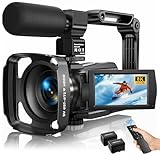
- Latest 8K Video Camera with Remote Control : This Video camera features 8K video resolution at 15FPS, with additional options for 6K at 30FPS, 5K at 30FPS, 4K at 30FPS, 1080P at 60FPS/30FPS, 720P at 60FPS/30FPS. With an impressive 88MP image resolution and 18X digital zoom, this camcorder delivers exceptional visuals. The included remote control allows for effortless self-recording and photography from any angle, making it an ideal 8K vlogging camera for bloggers and content creators.
- Experience Smooth and Stable Footage with Our 8K Camcorder : Featuring advanced 6-Axis anti-shake technology for high-precision stabilization. The 3-inch, 270-degree rotatable touch screen allows for effortless self-recording and framing, making it perfect for vlogging and self-blogging. Additionally, the digital video camera's intuitive interface and user-friendly navigation ensure easy operation, so you can focus on capturing stunning 8K video and photos.
- Infrared Night Vision Video Camera with WiFi : Stay connected and share your moments instantly with our 8K Camera's built-in Wi-Fi and companion app "iSmart DV2". Download the app on your Android/iOS device to easily transfer photos/videos, and share them directly to social media platforms like Facebook and YouTube. Additionally, this camera features infrared night vision, allowing you to capture footage in low-light environments, producing clear black and white images even in complete darkness.
- Dual-Functionality and Enhanced Audio : This 8K video camera for YouTube doubles as a high-quality webcam, simply connect via USB and switch to "Webcam" mode for seamless video calling, live streaming, vlogging, and online teaching. The included external X-Y stereo microphone reduces ambient noise and captures clear, stable audio, ensuring professional-grade sound quality for your recordings.
- Versatile camcorders video camera 8k for Every Adventure: This multifunctional camera features a range of creative modes, including continuous shooting, time-lapse, slow motion, and recording while charging. Perfect for capturing life's adventures, whether you're traveling, camping, hiking, or enjoying your favorite sports. Plus, our dedicated team is available to provide technical support, troubleshooting, and answers to any questions you may have after your purchase.
Motion checks
- Timing and spacing: Use readable durations and natural acceleration.
- Anticipation and follow-through: Prepare and complete actions so movement does not feel abrupt.
- Hierarchy: Give the key visual the viewer’s attention.
- Hold time: Keep essential text and diagrams visible long enough to read.
- Consistency: Use a repeatable motion language for similar actions.
Common failures include animating every object equally, excessive transitions, unreadable text, voice and visuals disagreeing, distracting characters and camera movement without a storytelling purpose.
Independent reader supportYour contribution helps us test, update, and keep practical guides available for everyone.Step 10: Edit, composite, mix and caption
Assemble scenes to the final voice track, tighten pauses, synchronize music changes, add sound effects, balance dialogue, music and effects, add logos and end cards, check safe margins, and create platform variants. Adobe positions Premiere for editorial post-production and After Effects for animation and visual effects; using both can separate scene creation from final assembly: Adobe’s Premiere and After Effects comparison. Wistia’s editing guidance covers organized files, selecting strong takes and trimming dead space: Wistia’s editing guidance.
Plan captions before export. Supply an accurate SRT or WebVTT file where supported, identify speakers and meaningful sound, maintain contrast and mobile-readable text, provide visual alternatives for essential information, avoid flashing effects, and make key claims understandable without audio. Platform and jurisdiction requirements vary; a caption feature does not guarantee accurate captions. Vyond lists caption export in SRT, VTT or MP4 and translation features on its plans page: Vyond plans.
Step 11: Use formal review gates
| Gate | Approve |
|---|---|
| Strategy | Audience, objective, message, CTA and claims |
| Script | Accuracy, tone, spoken clarity, legal language |
| Storyboard or animatic | Story order, timing, visual logic and feasibility |
| Design | Brand, typography, color, characters and product accuracy |
| Rough animation | Motion, pacing, continuity and readability |
| Final master | Audio, captions, spelling, logo, end card, links and export settings |
Collect consolidated comments through one decision-maker. Separate reviews prevent stakeholders from changing strategy while they are supposed to be checking spelling or audio.
Step 12: Export and package deliverables
- High-quality master and web-ready MP4.
- Landscape, square and vertical versions where required.
- Short cutdowns, captions, transcript and thumbnail.
- Clean version without text and, if useful, version without music for localization.
- Project files, linked assets and license documentation.
Before delivery, verify the destination’s current aspect ratio, frame rate, codec and size requirements rather than relying on a universal preset. Check for missing fonts or offline media, unintended transparency, clipped audio, black frames, corrupted captions, unreadable mobile text, draft watermarks, outdated UI and the correct CTA URL.
Step 13: Publish, distribute and measure
Place the video where its objective occurs: a homepage, product or pricing page, landing page, help center, sales follow-up, email, YouTube, Vimeo, organic social, paid advertising or an event presentation. Wistia discusses websites, help pages, e-commerce listings, paid ads and organic social as common business-video destinations: Wistia’s distribution guidance.
| Question | Useful measures |
|---|---|
| Did people notice? | Impression-to-play rate and first-seconds retention |
| Did they watch? | Average watch time, completion and rewatches |
| Did they act? | Clicks, CTA rate, forms, demos and trial activations |
| Did the business benefit? | Assisted conversions, sales usage, revenue influence and support deflection |
| What should change? | Drop-off by scene, caption use, device and aspect-ratio performance |
Judge performance against the original objective. A high view count alone does not establish qualified demand or revenue impact.
Tool choices by production need
| Tool or route | Best fit | Dated U.S. pricing signal | Limitation to check |
|---|---|---|---|
| Adobe Premiere and After Effects | Professional editors, motion designers, agencies and custom work | Premiere individual displayed at US$22.99/month, annual billed monthly; team price US$37.99/license/month; Creative Cloud Pro regular display US$69.99/month. Observed August 2026. | Steeper learning curve and separate animation/editorial applications |
| Vyond | Character explainers, training and sales enablement at volume | Starter US$58/month and Professional US$100/month on annual billing; Enterprise displayed at US$137/user/month. Observed August 2026. | Template style may limit distinctiveness and advanced control |
| Animaker | Browser-based character, whiteboard and explainer videos | Pro displayed at US$43/month, billed annually at US$516. Observed August 2026. | Less suitable for advanced compositing or bespoke motion systems |
| Powtoon | Templates, presentations, training and quick social content | Annual-billing displays were approximately US$28/month Pro, US$68/month Pro+ and US$117/month Agency. Verify checkout because presentation is dynamic. | Limited custom rigs and deep timing control |
| Wistia | Hosting, embeds, captions, thumbnails and marketing analytics | Pricing not stated here | Publishing and analytics platform, not a replacement for animation software |
Check current prices, taxes, geography, billing cadence, export branding, commercial rights, AI credits, source-file access and cancellation terms before purchase. The Vyond Essential plan was no longer offered to new users from May 7, 2025, according to its pricing FAQ: Vyond pricing FAQ. Tool capability never replaces concept development, design, animation, sound and review expertise.
Budget and timeline drivers
- Script and concept development.
- Illustration, character design and rigging.
- 3D modeling, texturing, lighting and rendering.
- Animation complexity and number of scenes.
- Voice-over, music and sound design.
- Number of aspect ratios, cutdowns and localized versions.
- Revision rounds, rush work and source-file handoff.
Animation is not automatically cheaper than live action: it may avoid locations, cameras and actors while adding design, asset preparation, rigging and rendering labor.
Troubleshooting checklist
- The message is unclear: Return to one audience, one problem, one transformation and one CTA.
- Late revisions are expensive: Revisit the brief, script or animatic before changing animated scenes.
- The video feels slow: Remove repeated explanation and test the voice track and scene holds in the animatic.
- Text is unreadable: Increase size and hold time, simplify copy and test on a phone.
- Product UI changed: Use modular screen compositions so replacements do not require rebuilding every scene.
- Global rollout is planned: Leave room for translated text and avoid embedding language-specific artwork.
- Silent autoplay is expected: Design core meaning through visuals, captions and on-screen text.
- Budget is very small: Reduce locations, characters, scenes and versions before sacrificing message clarity.
- Many stakeholders disagree: Appoint one review owner and gather one consolidated response per gate.
- Rights are uncertain: Confirm licenses for music, stock, fonts, voices, templates and AI outputs before publication.
Keep the project reusable
Archive the final master, editable project files, linked assets, fonts, licenses, caption files, transcript, voice takes, music stems, version notes and approval records. Modular scenes, fictionalized data and separated text layers make future product updates, localization and new aspect ratios less expensive.
Free tools Windows power users keep installed
One-click scans. No signup required.
Quick Recap
Product prices and availability are accurate as of the date/time indicated and are subject to change. Any price and availability information displayed on Amazon at the time of purchase will apply.




